

The 36th Medical AI Class III Certificate Issued: How Close Are Unicorns to Realizing the Vision of AI-Powered Healthcare?

Infervision
Artificial Intelligence Product Developer
AI-assisted diagnostic software for single diseases is often questioned due to its limited clinical application scope. However, with the in-depth development of the industry, some leading medical AI companies have long surpassed the so-called diagnostic limitations of single anatomical sites and single diseases, achieving multi-disease recognition from a single image.
Recently, Infervision Medical Technology Co., Ltd. (hereinafter referred to as “Infervision”), a medical AI company, announced that its CT imaging-based triage assistance software for fractures has received approval from the National Medical Products Administration (NMPA), further enhancing Infervision’s comprehensive AI-assisted diagnostic capabilities in thoracic and pulmonary care.
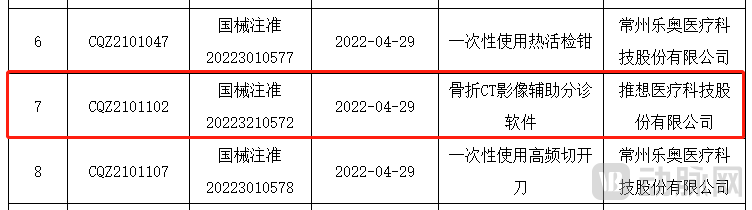
According to VCBeat, the significance of this certification lies not only in its status as the NMPA’s first Class III AI certificate for multiple types of thoracic fractures, but also as Infervision’s third NMPA Class III certificate approved in the thoracic domain. With this approval, Infervision has secured NMPA Class III certifications across all major thoracic and pulmonary conditions—pulmonary nodules, pneumonia, and thoracic fractures—integrating these three products into a comprehensive solution known as the “Thoracic-Pulmonary Trio.” This enables the detection of the vast majority of thoracic and pulmonary diseases from a single CT scan, achieving multi-condition screening through one examination.
Infervision Has Taken Another Major Step Toward the Ideal of AI-Empowered Healthcare.
AI for Multiple Types of Thoracic Fractures is a unique product. Clinically, thoracic fractures differ from conditions such as tumors and pneumonia, which are commonly addressed by medical AI. These fractures often occur suddenly in association with accidental injuries, entailing a heavy workload and strict requirements for timeliness.
Contrary to common intuition, the medical images that physicians review often do not show obvious, severe fractures but rather subtle misalignments or minute cracks. Although patients may experience physical symptoms, these abnormalities are difficult for clinicians to detect, necessitating meticulous review of extensive CT image datasets. Furthermore, due to the thin structure of the ribs and poor contrast of fine fracture lines, combined with suboptimal continuity of rib visualization on axial CT slices and volume averaging effects, incomplete fractures and subtle fractures without significant displacement are highly prone to being overlooked during interpretation, leading to missed diagnoses.
The Importance of Diagnosing Thoracic Fractures in High-Volume SettingsThoracic fracture patients often present to the emergency department following accidental injuries. The quality of diagnosis and the efficiency of emergency care are critical to patient survival; even minor errors can easily lead to medical malpractice incidents and subsequent disputes.
Under the combined influence of multiple factors, interpreting radiographs for fractures has long been a challenging headache for radiologists. Infervision’s AI solution for multi-type thoracic fractures addresses precisely this need.
According to data released by Infervision, its multi-type thoracic fracture AI demonstrates high robustness and strong generalization capabilities, with high sensitivity in lesion detection. It can detect, localize, and characterize fractures across multiple anatomical sites—including the ribs, scapulae, clavicles, and sternum—on chest CT images, enabling precise, second-level triage of thoracic fractures involving these structures.
Furthermore, this AI product features automated bone reconstruction, intelligently generating reconstructed images such as Volume Rendering (VR), Multi-Planar Reconstruction (MPR), and Curved Planar Reconstruction (CPR) of the ribs. It supports rotation at any angle, facilitating lesion observation by physicians, accurate diagnosis, and effective doctor-patient communication.
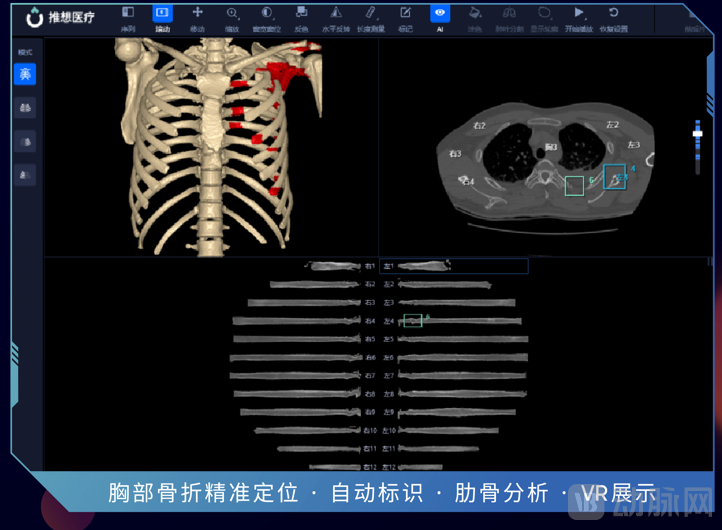
Based on the above description, this AI product can significantly reduce physicians’ repetitive workload and improve image interpretation efficiency. It can also be deployed in primary care hospitals to lower the risk of missed diagnoses. For patients, AI integration can shorten waiting times, enable earlier access to precise and standardized diagnoses, and reduce additional medical expenses arising from missed or misdiagnoses.
Considering AI for multiple types of thoracic fractures alone, the imaginable implementation scenarios include routine outpatient and emergency imaging departments, trauma centers, and injury assessment. However, by integrating this fracture AI with Infervision’s previously certified AI solutions for pneumonia and pulmonary nodules, the new combined solution will expand AI into a broader and more ideal range of application scenarios.
Among the common conditions treated in hospitals, thoracic diseases often represent one of the highest-volume and most frequently diagnosed scenarios, and they are also prone to triggering various medical disputes. For example, when a radiologist examines a chest CT scan of a patient with pulmonary nodules, they analyze all potential lesions visible in the images. However, their attention is often drawn primarily to the patient’s chief complaint, which may lead to oversight of subtle fractures.
In this context, Infervision’s comprehensive AI solution, “Full Category III Chest and Lung,” can help address this issue to some extent. By leveraging a multi-AI combination, it enables standardized, one-stop, precise diagnosis of various thoracic diseases from a single CT scan, largely achieving a diagnostic workflow comparable to that of physicians.
Further Discussion on the Economic Value of Chest AI Solutions. The currently piloted DRG-based cost-control system emphasizes cost containment. Infervision’s chest AI solution reduces physicians’ workload and shortens the time required per diagnosis, enabling screening for a broader range of diseases without increasing medical expenses. This enhances the efficiency and output of examinations, supports more precise and comprehensive diagnoses by physicians, and does not increase patients’ radiation exposure risk.
Similar to the advantages of AI in fracture detection, chest AI solutions can also help patients identify potential diseases and initiate treatment at an early stage. It is well known that the cost of early-stage treatment is significantly lower than that of late-stage treatment; therefore, the integration of AI will indirectly alleviate the financial burden on both patients and the health insurance system.
For a long time, both doctors and patients have hoped to obtain as much physical information as possible through as few examinations as possible. Infervision’s AI solutions for chest imaging have largely achieved this goal in chest diagnosis.
From AI for pulmonary nodules, pneumonia, and fractures to the “trifecta” of comprehensive chest AI solutions, Infervision’s R&D demonstrates the company’s continuous horizontal deepening around high-frequency thoracic and pulmonary scenarios. Its AI can now identify the vast majority of lesions from a single chest CT scan. Based on Infervision’s current product portfolio, this AI enterprise is extending this approach to other fields, including neurology, cardiology, orthopedics, and trauma care.
Most of these areas are high-throughput domains. Judging from the current distribution of medical AI products, few companies have achieved multi-disease recognition from a single imaging modality, leaving substantial room for expansion. Therefore, if Infervision can replicate its chest AI solutions in the aforementioned scenarios, it will be able to unlock the market for its medical AI business.
Systematic, full-cycle management targeting specific diseases represents a high-dimensional strategic path pioneered by Infervision following its achievement of multi-site assisted diagnosis. By expanding vertically within specific disease categories, Infervision enables comprehensive, full-cycle management of major diseases, encompassing screening, diagnosis, treatment, follow-up, and research. Specifically, this end-to-end workflow is divided into five segments—Digital Screening, Digital Diagnosis, Digital Treatment, Digital Management, and Digital Research—significantly broadening the scope of its capabilities.
Digital Screening: AI enables early screening for major diseases and rapid, precise identification of subtle lesions, significantly improving the efficiency of early disease detection and helping primary healthcare institutions enhance their disease screening capabilities.
Digital Diagnosis: AI-based target reconstruction enables precise early diagnosis of major diseases, improving early detection rates and long-term survival through intelligent multi-dimensional analysis and benign-malignant risk prediction.
Digital Therapy: AI 4D Reconstruction Surgical Navigation for Precise Early Treatment of Major Diseases, Reducing Costs and Improving Five-Year Survival Rates.
Digital Steward: AI-driven patient health management that integrates examination, treatment, and follow-up data to enable full-lifecycle tracking and management of major diseases.
Digital Research: An AI Scholar Research Platform for Building Specialized Disease Databases and Accelerating the Development of Smart Hospitals.
With the simultaneous implementation of its two major product strategies—horizontal and vertical—Infervision’s product matrix has begun to demonstrate stickiness, developing in close alignment with policies governing public hospitals. Taking its AI solution for chest imaging as an example, this approach enables systematic management of common thoracic conditions. By integrating with physicians’ diagnostic pathways and workflows, it delivers an efficient and precise solution that effectively enhances diagnostic and treatment efficiency while reducing missed diagnoses.
Through this model, Infervision enables early detection of major diseases, follow-up assessment of chronic diseases, and effective reduction of doctor-patient disputes; enhances hospitals’ emergency response capabilities for public health incidents; establishes a rapid AI-based diagnostic system for thoracic conditions; and supports the smart transformation of hospitals.
Beyond the horizontal and vertical axes, Infervision’s third strategic line in its medical layout originates from overseas.
As one of the first Chinese medical AI companies to explore overseas markets, Infervision has consistently led its peers in market access.
In July 2020, Infervision’s AI-assisted lung detection software became the only application developed by a Chinese company and approved by the U.S. FDA that utilizes deep learning algorithms. One year and one month later, its stroke product portfolio also received FDA approval, making Infervision one of the few AI healthcare companies in the industry to hold two FDA certifications simultaneously.
To date, Infervision has established a significant leading advantage, securing regulatory approvals from the four major global markets: the U.S. FDA, the EU CE, Japan’s PMDA, and China’s NMPA. While most domestic medical enterprises are still striving for import substitution, Infervision has been able to export multiple cutting-edge AI products overseas, reflecting the company’s strength to a certain extent.
It is reported that in recent years, Infervision has achieved diversified success in its overseas commercialization. Its AI solutions for COVID-19 have been consecutively included in centralized procurement programs in the European Union and Japan. Additionally, InferRead DR Chest, its chest digital radiography (DR) product, has been listed on the medical device procurement list of the United Nations Global Drug Facility (GDF), marking the first time the UN has included AI technology in its procurement listings. Meanwhile, Infervision is actively participating in the formulation of international standards, with its CT chest product selected for the WHO and ITU “Standards Development Group for Medical AI Products.”
Overall, Infervision, established six years ago, has provided integrated smart healthcare solutions to more than 450 medical institutions across nearly 20 countries worldwide. Under its product pipeline strategy characterized by a “horizontal and vertical” layout and internationalization, Infervision is poised to become the first company to achieve a breakthrough in the commercialization of medical artificial intelligence.
Although Infervision has delivered a strong performance in the field of medical artificial intelligence, is its core competitiveness truly reliable? We must revisit two fundamental elements of medical AI: “products” and “implementation pathways.”
When the first AI-assisted diagnostic software for medical applications received regulatory approval, the entire industry celebrated this milestone breakthrough. To date, more than 40 medical AI software products have obtained approval. So, as regulatory review and approval become commonplace, can we still assess the value of medical artificial intelligence enterprises based on this factor? The answer is yes.
Reviewing Infervision’s strategic layout, when this medical AI company targeted chest CT imaging, it successively obtained three Class III medical device registrations for its AI solutions for pulmonary nodules, pneumonia, and fractures. Under the current regulatory approval framework, medical AI companies are inevitably required to split their comprehensive solutions into multiple independent AI products.
In this context, to maximize the value of the entire solution suite, AI solutions acquired by hospitals must comprise sufficient components to enable the detection of a wide range of diseases. Therefore, over the next few years, NMPA and FDA certifications will remain core benchmarks for evaluating the value of medical AI enterprises. The number and scope of these certifications will directly influence the market reach of AI companies.
As regulatory approval becomes routine, the next stage of market access—pricing and reimbursement—has grown increasingly critical. According to incomplete statistics, more than one-third of China’s provinces are currently attempting to add new pricing items related to artificial intelligence products. This breakthrough in policy implementation will inevitably drive the in-depth development of AI-based medical products.
The implementation pathway determines the profitability of future medical AI enterprises. Generally, medical AI companies target tertiary hospitals as their primary deployment scenario, while some are shifting away from tertiary hospitals to seek commercialization opportunities in primary care.
From Infervision’s strategic layout, both tertiary hospitals and primary care institutions are integral to its deployment. As its vertical integration deepens, Infervision will establish screening and triage capabilities in primary care settings, therapeutic support capabilities in tertiary hospitals, and follow-up management (i.e., full-cycle disease management) along with clinical research translation capabilities within hospital environments. While it will take time to fully realize this pathway, it also promises greater additional value.