

Tmall Collaborates with Industry to Launch China's First Premium Standard for Oral Care Devices, Driving Standardization and Brand Development
In recent years, with the continuous improvement of economic standards, public awareness of oral care has been increasingly awakened, leading to a growing demand for oral hygiene products. The oral care sector has seen rising momentum, with new products, categories, and brands continuously emerging to meet consumers’ increasingly diverse needs for oral care.
However, as the industry is still in its early stages and lacks established standards, consumers are uncertain about what constitutes a good product or how to select high-quality options. This ambiguity has created opportunities for unscrupulous merchants to produce substandard goods, thereby discouraging consumers and hindering the sound and healthy development of the entire industry.
“Consumers who have purchased low-end, inferior products may develop concerns about this category, which can negatively affect their experience and lead to misconceptions about the product, thereby ‘closing the door’ to new approaches for dental health in the future.”Lian Minxiu, General Manager of the Oral Healthcare Business Unit under the Personal Health Division of Philips Greater China’s Lifestyle Business Group, stated that for the industry to develop in a healthy manner, clearer industry standards are needed to assist consumers in making informed decisions.
Against this backdrop, to enhance consumers’ awareness of oral care and facilitate better purchasing decisions, Tmall recently collaborated with the industry to release premium product standards for electric toothbrushes and water flossers, specifying requirements for their materials, performance, and safety.
How is the oral care sector developing?
From the perspective of capital market performance, Saky’s parent company recently announced plans to list in Hong Kong, while USMILE and Soocas have both initiated their IPO processes. In the primary market, according to incomplete statistics from VCBeat, there were 12 financing events in China’s oral care sector by October 2021, with total funding amounting to approximately RMB 1 billion. Invested companies included well-known emerging oral care brands such as Canban, BOP, and Qingzhi Research.
In terms of market size, Euromonitor estimates that China's oral care market reached RMB 49.1 billion in 2020, with a compound annual growth rate (CAGR) of 9.6% from 2015 to 2020. Meanwhile, the global market size was estimated at USD 47.4 billion in 2020, with a CAGR of 2.5% from 2015 to 2020. It is evident that the growth rate of China's oral care market significantly outpaces that of the global market. Frost & Sullivan also projects that the retail sales value of China's oral care market is expected to reach RMB 152.2 billion by 2025.
Amid the industry’s rapid development, subtle changes are quietly taking place.
In terms of distribution channels, according to Guosheng Securities’ research report on oral care, China’s retail sales via e-commerce channels for oral care products reached RMB 34 billion in 2020, with the market size expected to reach RMB 68 billion in the future, accounting for 46% of the total channel share.
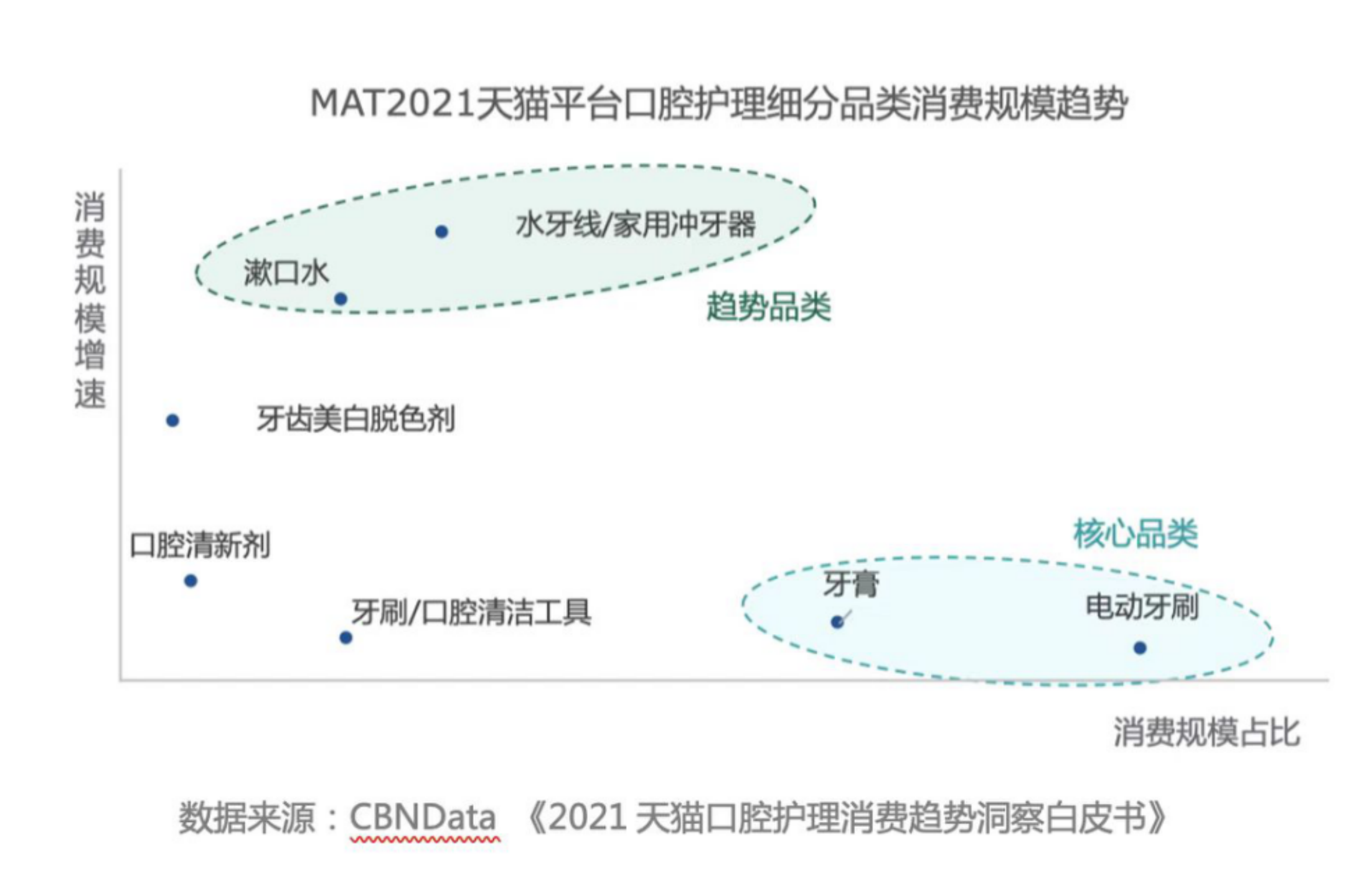
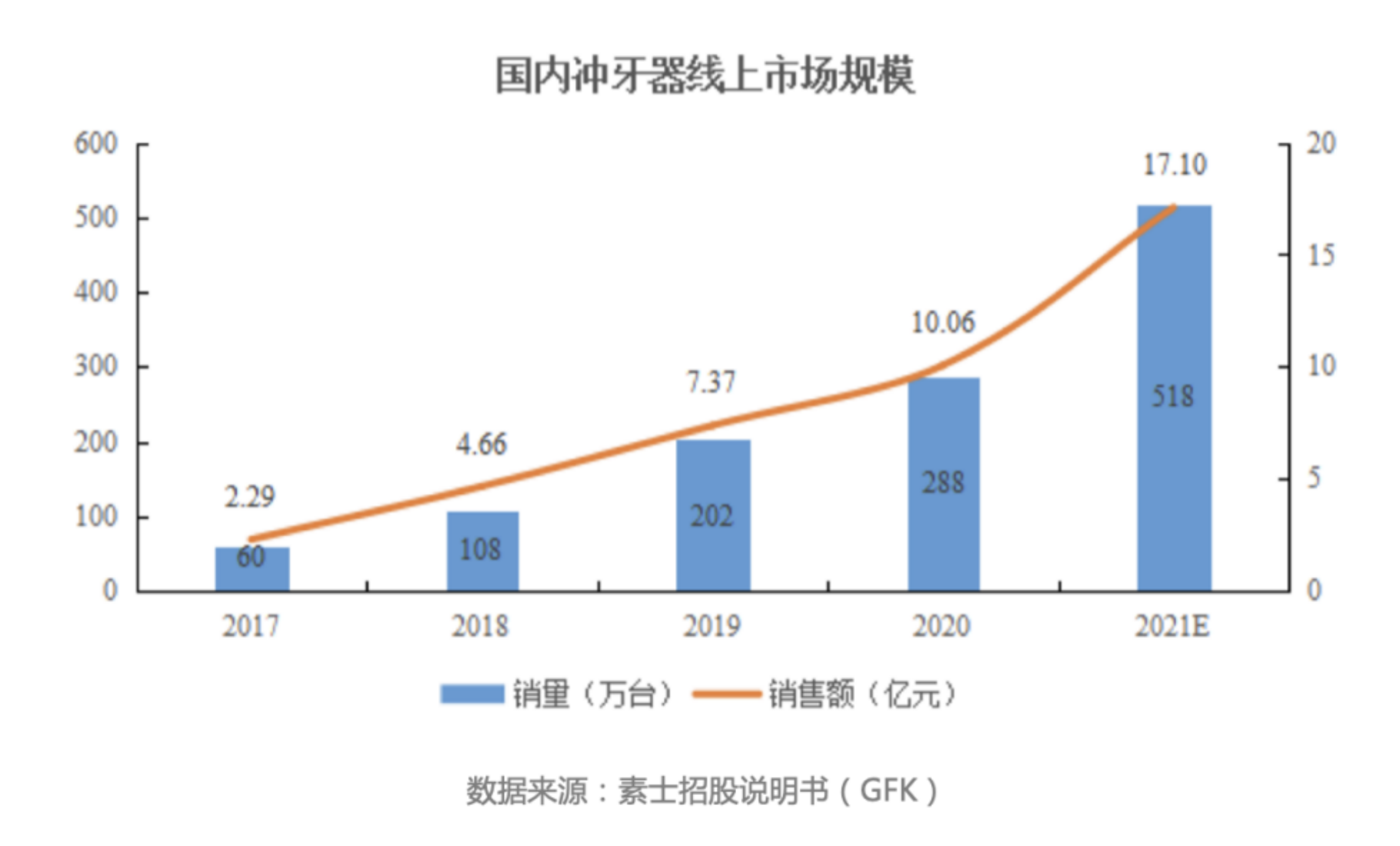
In terms of products, according to the “2021 Tmall Oral Care Consumption Trends Insight White Paper,” new products are continuously emerging in the oral care sector. In addition to well-established oral care products such as electric toothbrushes and mouthwashes, new product forms including water flossers, dental scalers, whitening pens, oral sprays, and teeth whitening strips are also gaining popularity. Among them,Water flossers have emerged as a dark horse, tripling their GMV contribution in the oral care segment within two years.
Meanwhile, the consumer base for traditional oral care products continues to expand. Taking electric toothbrushes as an example, the number of child and elderly consumers is steadily increasing.
However, despite the continuous growth in the number of segmented consumer groups, the penetration rate of electric toothbrushes in China remains low. “We have witnessed the development of the electric toothbrush industry from its inception. Currently, the penetration rate of electric toothbrushes in China is only about 15%, which leaves substantial room for future growth compared to the 30%–50% penetration rates seen in developed countries and regions such as Europe and the United States,” said Lian Minxiu.
However, as the trend of using electric toothbrushes and water flossers for oral care has gained popularity, a large number of low-priced, inferior products have flooded the market.Faced with electric toothbrushes priced at 9.9 yuan, 99 yuan, and 999 yuan, consumers often find themselves confused: How should I choose? What are the criteria for judging a good electric toothbrush?
It is undeniable that when consumers purchase low-quality electric toothbrushes, their perception of the entire industry will inevitably be affected, thereby influencing their repurchase behavior.
“Some products currently on the market are hastily labeled as electric toothbrushes simply by adding a motor and bristles. The circulation of such products in the market not only results in a poor user experience and dampens repurchase intent, but also inadvertently deprives other brands of opportunities to recommend their products,” said Jia Qi, head of Soocas’ Tmall flagship store.“The lack of standards has been a long-standing pain point.”
Therefore,Some industry observers believe that the growth driver for the oral care industry in 2019 stemmed from the diversity of product offerings; in 2020, it was driven by upgrades in products and functionalities; and the next catalyst for the oral care industry may lie in the standardization and brand-oriented development of the sector.
Against this backdrop, the first premium product standard for oral care devices on domestic e-commerce platforms was introduced.
It is reported that,Tmall’s newly released premium standards for oral care devices primarily target two product categories: electric toothbrushes and water flossers.
For electric toothbrush products, this standard specifies requirements across multiple dimensions, including performance, noise, test methods, labeling instructions, and packaging. Regarding the core performance requirements, the standard sets forth specifications for the motor performance, bristle safety, discharge performance, antibacterial properties, and cleaning efficacy of electric toothbrushes.
Furthermore, distinct standards have been established for adult and children’s electric toothbrushes with regard to rotational frequency, bristles, noise levels, and other parameters.
For example,Regarding motor performance, the standard stipulates that the reciprocating frequency of the brush head for adult rechargeable reciprocating electric toothbrushes shall be at least 20,000 strokes per minute, and for children’s rechargeable reciprocating electric toothbrushes, at least 10,000 strokes per minute; the rotational frequency of the brush head for adult rechargeable rotating electric toothbrushes shall be at least 7,000 rotations per minute, and for children’s rechargeable rotating electric toothbrushes, at least 5,000 rotations per minute.
Regarding surface matting, the standard specifies that the sharp edges of the monofilament tips must be removed through matting, and no burrs should be present. In terms of cleaning efficacy, the cleaning efficiency must be no less than 50% when tested according to the test methods established by the standard.
andFor electric water flosser products, the standards recently released by Tmall also cover dimensions such as safety and performance, with specific requirements for pulse frequency, water jet impact force, antimicrobial properties, noise level, water tank capacity, and cleaning efficacy.
For example, the time required for the water tank to operate from full to empty shall be no less than 30 seconds; the impact force of the water jet shall be no less than 9 g; for electric oral irrigators claiming antibacterial functions, the antibacterial rate of relevant components shall meet the evaluation requirements of GB 21551.2; the sound power level noise shall not exceed 76 dB(A); and the plaque staining area shall show a significant reduction compared to that before use.
“This is a very positive signal. It not only reduces consumers’ decision-making costs and provides them with a better product experience, helping users find the most suitable products in the shortest time, but also helps brands lower the cost of consumer education, making scientifically sound oral care practices and high-quality products more widely known,” said Jiaxin.
andOral-B, a well-known Chinese brand of electric toothbrushesIt is also believed that “although people are paying increasing attention to oral health, most still have knowledge gaps in oral care, ranging from how to choose an electric toothbrush to how to maintain optimal oral health. This calls for continued efforts by the entire industry to popularize oral health education. The standards recently released by Tmall represent a positive step forward.”
Huang Kaijie, Secretary-General of the Subcommittee on Beauty and Other Appliances under the National Technical Committee for Standardization of Household Electrical Appliances, also stated:“The oral care industry is currently experiencing rapid growth, creating an urgent need for comprehensive performance evaluation standards. The oral care device standards recently released by Tmall are closely aligned with consumers’ actual usage patterns and teeth-cleaning efficacy, providing consumers with more intuitive and professional insights. This initiative not only assists consumers in product selection and enhances their user experience but also encourages merchants to optimize product quality, thereby driving the industry toward positive development.”
Additionally, VCBeat has learned that, in addition to the newly released premium standards for oral care devices, Tmall recently collaborated with BAI Capital to conduct a thematic study on the oral care sector.
Research findings indicate that e-commerce has become the primary sales channel in China's oral care market, driving the transformation of oral care products from "household daily necessities" to "fashionable fast-moving consumer goods."
In terms of product categories, the study indicates that penetration rates for electric toothbrushes, mouthwashes, oral sprays, teeth whitening strips, and water flossers remain low in China, presenting substantial room for growth. Furthermore, as young consumers place greater emphasis on their personal image, demand for oral care is bound to evolve from basic maintenance to a diverse range of specialized benefits, thereby further stimulating market demand for refined and innovative oral care products.
Cong Jia, Vice President of Investment at BAI Capital, stated, “Oral care products represent a high-frequency, essential need. The current market is not yet fully competitive, features relatively high gross margins, and is rife with emerging trends and opportunities, creating a high probability for blockbuster products to emerge as new players break through the status quo. As one of China’s largest e-commerce platforms, Tmall boasts a more precisely targeted consumer base. Therefore, Tmall plays a crucial role in market education, advancing China’s oral care sector, guiding merchants in functional upgrades, iteration, and segmentation of their products, and enhancing both product quality and brand strength.”
It is reported that Tmall will subsequently award specific “Premium Product” labels to items meeting established standards, such as deep cleaning, gum care, long-lasting performance, and antibacterial properties, enabling consumers to quickly identify high-quality products that meet their needs. Additionally, Tmall will collaborate with industry associations to jointly promote the standardization and digital transformation of the industry.