

Innovation Works and Dr. Kai-Fu Lee: Medical Investment Enters Rational Adjustment Phase Amid 'MedTech+X' Boom

Sinovation Ventures
Technology-Focused Venture Capital Firm
Cooling healthcare investment has become a consensus in the primary market for healthcare investments. Although the healthcare sector remained one of the top three fundraising sectors in Q1 2022, attracting RMB 31.296 billion in financing across 427 deals, the total investment amount in the healthcare field declined compared to the RMB 45.355 billion raised in Q1 2021. On the exit front, stock prices of Hong Kong-listed biotech companies have continued to fall for six months, with a wave of IPOs breaking their issue prices.
An investor told VCBeat (WeChat ID: vcbeat): “A clear sentiment in 2022 is that valuations have declined. When starting a new funding round, the increase compared to the previous round was not significant, whereas a year ago, companies saw very substantial valuation increases in their new rounds.”
Market sentiment toward the healthcare industry has undergone a significant shift. In this cooling market environment, investors unable to predict how long the “winter” will last have chosen to adopt a passive stance, while those continuing to seek investment opportunities are exercising greater caution. Against the backdrop of a cooling market, confidence is more valuable than gold.
The Medical Technology Sector, Catalyzed by the COVID-19 Pandemic: From Frenzy to Calm, Gradually Entering a Phase of Bubble-Bursting. Amidst This Shift, Which Hotspots Will Subside, and Which Trends Will Endure Across Cycles?
On May 11, at the Medical Innovation Trends Sharing Session hosted by Sinovation Ventures, Dr. Kai-Fu Lee, Chairman and CEO of Sinovation Ventures, stated that the traditional healthcare and wellness sector is reaching an innovation inflection point driven by two platform technologies—AI and automation—ushering in an era of widespread implementation of “Healthcare + X.” The life sciences industry is accelerating its upgrade toward digitalization and automation.
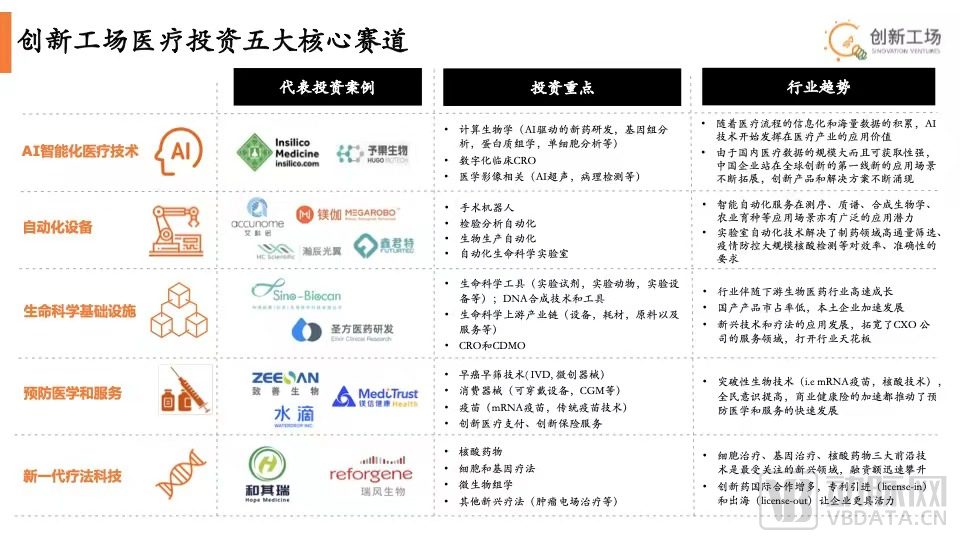
Since 2019, Innovation Works has been strategically positioning itself in medical technology investments. Initially, it leveraged its core expertise in artificial intelligence to make a discreet entry into the healthcare investment sector. Today, Innovation Works’ investment footprint in healthcare spans multiple domains, including gene editing, innovative drugs, healthcare payment solutions, molecular diagnostics, orthopedic surgical robots, pathogen sequencing, and the CRO (Contract Research Organization) sector.
Having witnessed the cycle of the healthcare investment sector from its peak to its subsequent decline, Sinovation Ventures’ healthcare team has not adopted a passive stance; instead, they have become even more active during this period. As a new player in healthcare investment with an interdisciplinary perspective, how does Sinovation Ventures view healthcare investing in an era of bubble deflation?
In early 2021, Innovation Works also held a sharing session on trends in healthcare investment. At that time, although Beijing was bitterly cold, the topic of discussion was whether the surge in financing amounts and deal activity, driven by the pandemic-fueled boom in the healthcare sector, would lead to overheating.
One year later, in early summer, the fervor surrounding discussions on the healthcare investment landscape has cooled significantly. The focus has shifted to bursting bubbles, and market sentiment has turned pessimistic.
Regarding the changes over the past year, Wu Kai, a partner at Innovation Works, stated that driven by the catalytic effect of the COVID-19 pandemic, healthcare investment has become extremely heated over the past two years. During this period, a large number of healthcare technology companies went public in the secondary market, while substantial primary market capital also flowed into this sector. In addition to traditional healthcare funds, many emerging 2.0 and 3.0-generation funds, as well as numerous traditional TMT (Technology, Media, and Telecom) funds, have entered the healthcare investment arena.
However, the overall situation has entered an adjustment phase since February last year. The P/E ratio of A-shares has dropped below 12x, basically reaching a historical low. In addition to the transmission from the secondary market, the superposition of factors such as geopolitical games and the COVID-19 pandemic has made primary market investments highly volatile.
The long investment cycles in healthcare and the volatility of the primary market have driven away allocation-oriented “hot money” from this long-cycle sector, but professional healthcare funds exhibit greater patience toward cyclical fluctuations.
Wu Kai stated, “Although there is widespread discussion about the cooling of the primary market, with many investors choosing to remain passive and many entrepreneurs feeling pessimistic, we can still see points of hope. First, capital in the primary market remains abundant; a significant amount of funds has been successfully raised in China’s healthcare investment market, and liquidity in the primary market is expected to remain ample over the next three to four years. In terms of exits, more than 20 healthcare companies went public in Q1 2022, representing the highest number of successful IPOs across all industries. Therefore, we believe that despite the current unfavorable conditions, there is still hope.”
Innovation Works’ enthusiasm and confidence in the healthcare industry stem primarily from the overall advancement of technology. Over the past few decades, medical technology has gone through three distinct eras.
The first era, prior to 1990, saw the emergence of small molecules, recombinant peptides, insulin, growth hormones, and antibodies. In terms of medical devices, CT, MRI, dental implants, intraocular lenses, and cardiac pacemakers were all introduced before 1990.
From 1990 to 2010, drug development transitioned from monoclonal antibodies to antibody-drug conjugates (ADCs), gene therapy, and then bispecific antibodies; in the medical device sector, surgical robots began to emerge.
Wu Kai stated, “Many of today’s highly popular technological products, such as those in neurointervention, are actually the fruits of technological innovation from that period. Therapeutics developed during this phase continue to advance; the golden age for gene therapy, bispecific antibodies, and antibody-drug conjugates (ADCs) has yet to arrive. Although ADCs have shone brightly over the past one to two years, many leading products may still require another one to two years to achieve sustained volume growth.”
Since 2010, rapid advancements in medical technologies—including oncolytic viruses, mRNA therapeutics, cell therapy, gene editing, third-generation sequencing, brain-computer interfaces, single-cell sequencing, and artificial intelligence—have fostered cross-disciplinary iteration, propelling the healthcare sector into the “Healthcare + X” era.
Wu Kai added, “Over the past few decades, technology has advanced rapidly, giving rise to a number of great companies. These include firms such as Moderna, 10x Genomics, and Exact Sciences, as well as some outstanding biotech enterprises in China. The rapid development of medical technology fills us with hope for the future.”
Domestic professional investors are cautious about the term “winter,” viewing the current situation more as a cyclical correction following a market surge. Simply labeling cyclical fluctuations as a “winter” fails to reflect the divergent trajectories of different enterprises. Moreover, such a pessimistic mindset can cause investors to miss the “true gold” that remains after the market’s shakeout; genuine opportunities are often hidden within downturns.
However, it is undeniable that under the new circumstances, domestic medical investment institutions have become more cautious about biotech investments. Against this downward backdrop, what are the trends in healthcare investment?
First, domestic life sciences investment is increasingly shifting its focus toward early-stage ventures.Compared with mid-to-late-stage investments, investing at earlier stages can reduce risks and better capture valuations. Medical investment institutions in China have increasingly shifted their focus to earlier-stage opportunities, with some opting for lower-risk strategies such as assembling teams to incubate startups.
Innovation Works has long been deeply engaged in early-stage investment and will continue to focus on early-stage investments in the future.
Meanwhile, as a new entrant in healthcare investment, Innovation Works has chosen to break through by focusing on cross-disciplinary innovation investment in “Healthcare + X.”
Wu Kai stated that cross-disciplinary integration and convergent innovation represent the major direction for the current development of the healthcare industry. Over the past decade, with the rapid advancement of interdisciplinary fields such as artificial intelligence, quantum computing, new materials, semiconductor technologies (including integrated circuits), sensor technology, biochemistry, and optoelectronics, a large number of cross-disciplinary talents have entered the burgeoning healthcare sector, swiftly driving the development of “Healthcare + X” convergent innovation.
Kai-Fu Lee cited a case study: “In the era of ‘Healthcare + X,’ scientists can be liberated from the repetitive and arduous task of waking up in the middle of the night to check experimental results. My brother is a biochemist who used to get up at 4 a.m. every day to rush to the laboratory to review results before continuing his experiments. Thus, we can envision that future biological, chemical, and pharmaceutical scientists will work more like ‘AI scientists.’ They can use software to write code that controls robots. You can instruct the system to test one drug after another—trying up to 100 candidates sequentially—and finally report which one performs best. This allows scientists to devote all their time to brainstorming new ideas and innovation, while robots handle repetitive tasks, thereby accelerating drug development.”
Interdisciplinary fields have achieved significant technological breakthroughs across numerous areas, with some already commercialized. Examples include computational biology (AI-driven drug discovery), the application of synthetic biology in healthcare and other sectors (such as chemicals and daily-use products), surgical robots, medical-grade wearable devices, and aesthetic medicine materials.
Particularly, synthetic biology has been a hot topic this year. “We saw the emergence of an early cohort of Chinese companies in synthetic biology three to four years ago, such as Bota Biosciences and Bluepha Microbiology. However, the sector truly gained momentum last year. I believe synthetic biology is undoubtedly ‘Healthcare + X’”’“This is a critically important direction. Essentially, against the broader backdrop of carbon neutrality, replacing petroleum-based chemicals with bio-based alternatives is undoubtedly a major trend,” said Wu Kai. “The current challenge in synthetic biology is that the field is overheated. We aim to identify teams that can truly integrate research with industrialization, and we also seek to empower domestically based teams with strong scientific research capabilities through industrial applications.”
The advent of the “Healthcare + X” era is reflected in the fact that an increasing number of founding teams behind cross-disciplinary innovation projects possess highly composite management backgrounds. Investors need to accelerate their learning capabilities and broaden their professional expertise and industry experience to rapidly assess the potential of “Healthcare + X” ventures and provide more comprehensive post-investment value-added support.
The ecosystem synergy of hard technologies and teams composed of top-tier interdisciplinary talents constitute the advantages of Innovation Works as a new entrant in medical investment. Although Innovation Works has been laying out its medical sector for only over three years, the Deep Tech VC DNA has brought it a unique interdisciplinary perspective.
“We have recently met with many entrepreneurs, and in fact, most of them remain highly motivated. If entrepreneurs are so driven, we as investors must be even more proactive and persistent; this is, in essence, a sense of mission,” summarized Wu Kai. He stated that Innovation Works will fully leverage its Deep Tech VC DNA and the resource advantages of its interdisciplinary team to actively seek out and empower technology-driven healthcare innovation projects, aiming to “identify investment opportunities capable of delivering 100x returns over the next decade.”
At the Sinovation Ventures Medical Trends Sharing Session, Sinovation Ventures also announced the establishment of its inaugural Life Sciences Expert Advisory Committee. Dr. Chen Bo, Chairman and CEO of Keymed Biosciences; Dr. Zhao Yining, Chairman of Transcenta Holding; and Dr. Bi Honggang, Senior Vice President of LabCorp and Head of Asia Pacific, have been appointed as standing members of Sinovation Ventures’ inaugural Life Sciences Expert Advisory Committee. These seasoned industry experts will assist Sinovation Ventures in further broadening the scope and reach of its healthcare investment activities.
Several industry veterans also offered recommendations on corporate strategic development during the downturn.
Zhao Yining, Chairman of Transcenta Holding, stated: “Looking back at the decade from 2005 to 2015, or even earlier, the overall innovation climate in China was relatively weak, and the general atmosphere was quite conservative.”The current situation cannot be described as a downturn; it is merely a period of consolidation. This phase serves as an opportunity for natural selection, allowing us to observe which enterprises can survive and endure, recalibrate their strategies, and embark on a new journey.。”
“Survive and stay afloat” is the advice most investors in the industry give to entrepreneurs. When fundraising is not going smoothly, Chinese founders should make strategic trade-offs regarding their product pipelines, place greater emphasis on their business development (BD) capabilities, realize their core value, and extend their runway for survival.
As a senior executive who has witnessed the ups and downs of China’s pharmaceutical industry for many years, Dr. Bi Honggang also pointed out: “The overarching direction and trends in new drug development, as well as the trend toward internationalization, will remain unchanged; this broad market will continue to move forward. The first priority is to ensure your vessel stays afloat. What follows depends on how companies conduct their operations. I believe two key points will emerge: corporate choices and strategic directions will become more rigorous, as we are no longer in an era where throwing money around guarantees substantial returns.”
Regarding the global expansion strategy for innovative drugs, Chinese innovators have encountered setbacks over the past year. In response to the consecutive failures in overseas markets, Dr. Bi Honggang believes that there are no shortcuts in new drug development. In many cases, slow is fast; without proper planning, acceleration becomes impossible at later stages, given that drug development is inherently a protracted process.
Dr. Zhao Yining shared experiences and lessons learned from the global expansion of innovative drugs: “The first lesson is that if you aim to establish a foothold for your product in the U.S. market, you must position your product and clinical strategy according to U.S. standards; you cannot simply repurpose domestic products for export. China’s strengths lie in efficiency, speed, and the network effects achieved through large-scale market promotion, whereas the U.S. market is characterized by innovation, quality, and precision.”
“If your product is intended for clinical trials in the United States, your positioning must be U.S.-centric, shaping your corporate culture and operational model around American teams and cultural norms. The U.S. market prioritizes not speed, but the quality of data and the precision of innovation. I am genuinely confident in China’s innovative capabilities; I believe China has already joined the first tier, on par with Europe and Japan. However, we may need to adjust our approaches to better adapt to international competition.”
As winter passes, the surviving enterprises will emerge stronger. The crisis has provided a clearer view of the industry’s weaknesses, compelling entrepreneurs to focus on core value, strengthen internal capabilities to navigate the cycle, and prepare for the next round of expansion.