

Nanovision Selected for China's Key Core Technologies and Components List in CT Equipment with Static CT Breakthrough
Nanovision
X-ray Detector and Static CT Product R&D Provider
In recent years, China’s medical device industry has experienced rapid development, with continuous improvements in R&D and manufacturing technologies, accelerating the pace of import substitution. While domestic replacement was previously concentrated in the mid-to-low-end segments, localization of high-end medical devices has been progressively advancing in recent years, accompanied by a surge in innovative medical device products.
The development level of high-end medical equipment is closely related to the overall level of industrial and technological advancement in a country. As a strategic emerging industry, the medical device sector will continue to develop, and efforts are needed to address the shortcomings in high-end medical devices.
The domestic substitution and industrialization of key core technologies and critical components for high-end medical devices have become a focal point for the development of China’s medical device enterprises,Chinese enterprises are gradually overcoming critical bottlenecks in high-end medical devices such as MRI and CT scanners, driving the supply chain toward self-reliance and controllability.。
In October 2021, the research project titled “Survey on the Current Status of Key Core Technologies and Critical Components in China’s Medical Industry,” organized by the Chinese Association for Drug Supervision and Science, was approved. This resulted in the *Research Report on the Current Status of Key Core Technologies and Critical Components of Medical Devices in China*, which was subsequently submitted to the National Development and Reform Commission, the Ministry of Industry and Information Technology, the Ministry of Science and Technology, the National Health Commission, and the National Healthcare Security Administration.
This research project focuses on a comprehensive, systematic, product-line-specific investigation of “key core technologies and critical components,” integrating clinical, engineering, and R&D perspectives, with experts strictly grouped by specialty, and subject to continuous improvement.
By establishing an “Expert Pool for Key Core Technologies of Medical Devices,” and leveraging the system built over 15 years by Chinese Medical Equipment Magazine, which covers more than 8,000 hospitals and includes 17,000 “China Medical Equipment Industry Data Researchers,” along with 12 consecutive years of industry data survey experience and the magazine’s “five-tier” structural framework, we have achieved continuous, stable, high-coverage (3,665 hospitals), professionally aligned, and industry-collaborative data surveys.
This study surveyed seven key component suppliers in China’s CT equipment market, comprising three domestic manufacturers, three importers, and one joint venture. According to data from the China National Intellectual Property Administration, these surveyed companies filed a total of 517 CT-related patents between 2019 and 2021.
This survey covered a total of 28 key components, among which 22 were recommended as “Key Components for China’s Medical Industry,” and 12 items held patent certificates.
Among these, 15 key components were independently developed in China, 11 were independently manufactured in China, 8 filled domestic technological gaps, 8 achieved import substitution with Chinese-made alternatives, 5 underwent technological upgrades, 12 demonstrated technological innovation, 1 involved the development of new materials, and 1 is set to lead the future direction of next-generation CT technology.
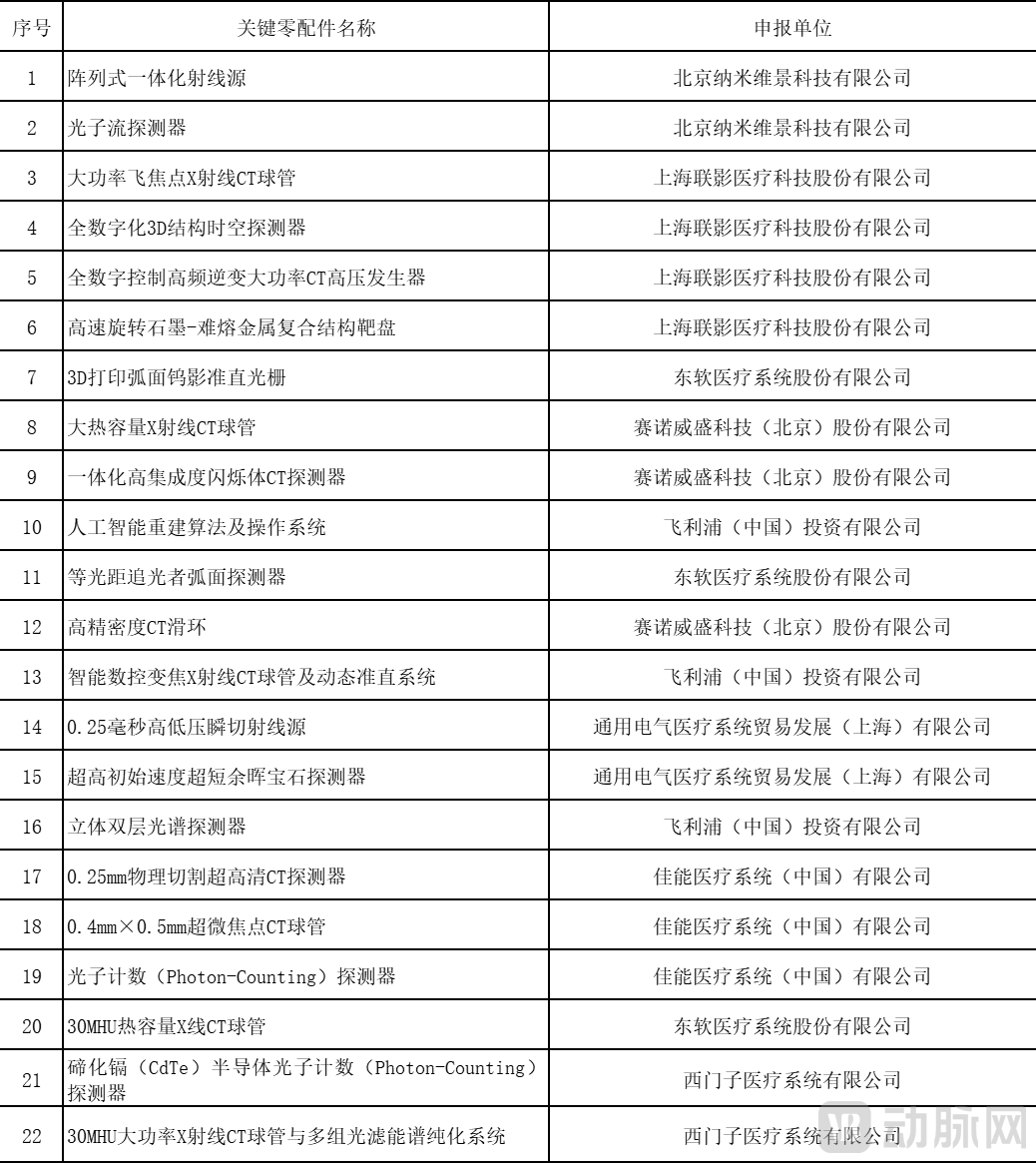
List of Selected Key Components for CT Equipment in China’s Medical Industry Source: Blue Book of Medical Devices (2022)
Among these, Nanovision’s “24/36-Source Static CT Platform Technology” was included in the list of key core technologies for CT equipment in China’s medical industry, while its “Array Integrated X-ray Source” and “Photon Flux Detector” were included in the list of key components for CT equipment in China’s medical industry.
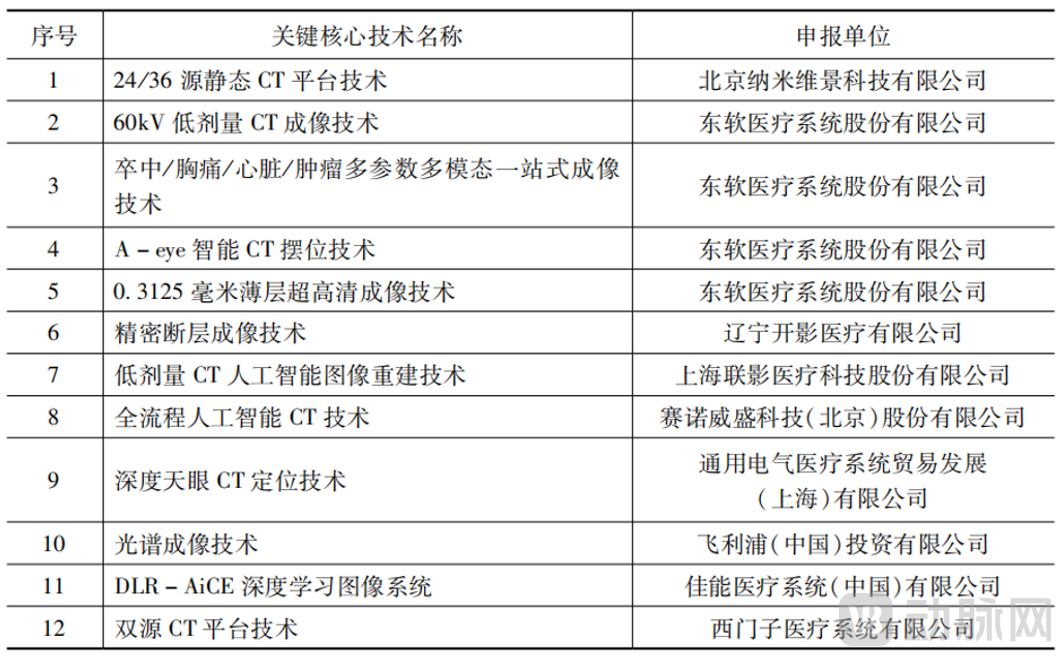
List of Selected CT Equipment with Key Core Technologies in China’s Medical Industry Source: Blue Book of Medical Devices (2022)
Based on data research findings, by focusing on “key core technologies and critical components” as a breakthrough point, and led by six national ministries and commissions through joint efforts involving “clinical practice + engineering + enterprises + universities,” rapid product commercialization and translation will be achieved.
Founded in 2014, Nanovision is dedicated to the research, development, and commercialization of the world’s first whole-body medical static CT scanner. As an industry leader, it is the only company globally to have successfully brought a product to market in the more than ten years since the concept of static CT was introduced.
Compared with traditional CT, the whole-body medical static CT technology independently developed by Nanovision has significantly improved time resolution and spatial resolution, and can achieve multi-spectral imaging. Meanwhile, to realize the independent research and production of static CT, Nanovision has successively overcome core components such as array integrated X-ray sources and photon flow detectors.
Reference: Blue Book of Medical Devices: China Medical Device Industry Data Report (2022) — Social Sciences Academic Press