

Apogenomics Files IPO Prospectus: Synthetic Biology-Based Non-Invasive Molecular Diagnostics Platform Poised to Disrupt a $100B Market
“If liquid biopsy is likened to the crown of the IVD field, then undoubtedly, the largest and brightest gem on it is cell-free nucleic acid testing.”
Liquid biopsy, also known as non-invasive molecular diagnostics, is a non-invasive testing method that primarily analyzes liquid samples from the human body, such as blood, urine, and saliva. Compared with traditional biopsy methods, liquid biopsy offers advantages including minimal invasiveness, operational simplicity, and the ability for repeated sampling. It addresses clinical sampling challenges and meets the need for high-frequency patient monitoring.
Biomarkers for liquid biopsy primarily include circulating tumor cells (CTCs), cell-free DNA (cfDNA), exosomes, and microRNAs (miRNAs). Among these, cfDNA, also known as plasma cell-free DNA, is the most accessible and extensively studied type of liquid biopsy sample. According to clinical trials registered for liquid biopsy technologies, cfDNA accounted for 56% of the 170 clinical studies conducted in the United States as of the first quarter of 2022.
As the final product of cellular degradation, cfDNA exhibits high stability. Consequently, cfDNA is the optimal molecular diagnostic agent for non-invasive acquisition, offering significant advantages in clinical applications such as differential diagnosis of etiology, early disease detection, assessment of therapeutic efficacy, and disease monitoring, corresponding to a market size worth hundreds of billions.
Shanghai Yiming Biotechnology Co., Ltd. (hereinafter referred to as “Yiming Biotech”) isA company focused on the development of foundational technologies and core reagent raw materials for cell-free nucleic acid testing, a company dedicated to providing customers with high-quality, high-performance non-invasive molecular diagnostic testing products and services.
Yiming Bio has successfully established a comprehensive target detection technology platform for cell-free nucleic acids, with more than 50 intellectual property applications filed, including over 20 granted patents. Leveraging this technological platform, Yiming Bio is developing products across three key areas: scientific research services, clinical diagnostics, and health management. To date, the company has launched products for scientific research services and clinical diagnostics, while an additional 3–5 products are currently undergoing clinical validation.
The concept of cfDNA was proposed approximately 70 years ago, yet the number of globally approved products remains extremely limited. Yang Guohua, founder of Yiming Biotech, explained to us: “Apart from NIPT, there are very few regulatory-approved products based on cell-free nucleic acids in the global market, and their market application potential has not been fully realized.” As a technology capable of significantly expanding the application scenarios of current molecular diagnostics, why has product development progressed so slowly over the years?
According to the introduction,Cell-free nucleic acid testing requires high sensitivity and specificity, utilizing multiplex detection technologies suitable for short fragments.. First, because target molecules are rare, ctDNA (DNA fragments derived from the tumor genome present in the human blood system) is extremely scarce, necessitating highly sensitive detection technologies. Second, target molecules are heavily fragmented; that is, compared to normal molecules, target molecules in blood samples are shorter, thus requiring technologies capable of efficiently detecting short nucleic acid fragments. Third, cell-free nucleic acid testing also faces extremely complex background noise. In addition to target molecules, samples contain a large amount of normal nucleic acid molecules. Base damage occurring during preservation, extraction, and capture processes, as well as errors generated during library amplification and sequencing on instruments, are all sources of background noise.
Existing technologies struggle to simultaneously address the above three key issues. Yang Guohua stated that the underlying technologies currently used in molecular diagnostics, such as PCR and hybrid capture, were initially developed to meet research needs in molecular biology laboratories and are primarily applied to the detection of intact genomic samples from tissues and cells. However, significant technical bottlenecks remain when dealing with fragmented nucleic acid molecules found in common clinical specimens such as blood and urine.
In 2019, the National Institutes for Food and Drug Control (NIFDC), under the National Medical Products Administration (NMPA), released national reference materials for the detection of plasma ctDNA mutations in KRAS, NRAS, EGFR, BRAF, and MET genes. For IVD product registration testing, it is required that the lower limit of detection (LoD) for ctDNA mutations be no higher than 0.3% (~30 ng input).
According to a 2021 report in *Nature Biotechnology*, a global quality study of ctDNA detection technologies led by the FDA indicated that current techniques (including hybrid capture and multiplex PCR) have a limit of detection (LOD) of only 0.5% for ctDNA mutations. The reliability of detecting ctDNA samples with variant allele frequencies below 0.5% is low, and most loci fail to meet regulatory registration requirements.
Yang Guohua stated, “To truly overcome the detection bottleneck of cell-free nucleic acids, we must abandon our habitual approach to technology development and familiar existing foundational technologies, and instead establish entirely new foundational technologies based on the molecular characteristics of cell-free nucleic acids.”
Since its inception, Yiming Bio has been committed to the research and development and industrialization of novel foundational technologies for cell-free nucleic acid testing. The development of these new foundational technologies entails not merely the optimization of one or two key factors, but rather a comprehensive optimization spanning nearly the entire workflow and all influencing factors.
The development of foundational technologies entails high costs and protracted timelines. While difficulties and challenges are objective realities, breakthroughs must ultimately be achieved.The Yiming Biotech team selected a quantitative assay development approach based on mathematical modeling and guided by synthetic biology,Transforming traditionally qualitative descriptions of biological processes into quantifiable engineering problems。
Specifically, the Yiming Bio team employed mathematical modeling to design a theoretically optimal pathway for the detection of cell-free nucleic acid molecules. They then applied the model to determine the influence coefficients of key variables, ultimately identifying the underlying core biological components that required redevelopment. Furthermore, by leveraging synthetic biology approaches, they screened novel compounds and tool enzymes to achieve the entirely new biological functions required for this innovative pathway.
Notably, Yiming Bio’s team has extensively employed small-molecule chemical screening technologies in its technology development, a strength attributable to the unique characteristics of its team.
Yang Guohua has over 15 years of experience in R&D, management, and entrepreneurship in the fields of new drug development, liquid biopsy, molecular diagnostics, and synthetic biology. He was a co-founder and technical lead at a leading domestic liquid biopsy company, where he spearheaded the regulatory approval and market launch of China’s first circulating tumor cell (CTC) detection kit within five years. This product was awarded the Second Prize of the National Science and Technology Progress Award in 2019.
Yiming Bio’s core team possesses over a decade of development experience in molecular diagnostics, including several members with extensive backgrounds in small-molecule new drug R&D. Leveraging this expertise, Yiming Bio has extended the principles of new drug development to the field of molecular diagnostics, constructing its foundational technology platform based on synthetic biology. In terms of key performance metrics, Yiming Bio’s cell-free nucleic acid pan-target OPERA® platform, built upon this novel underlying technology, demonstrates superior performance.
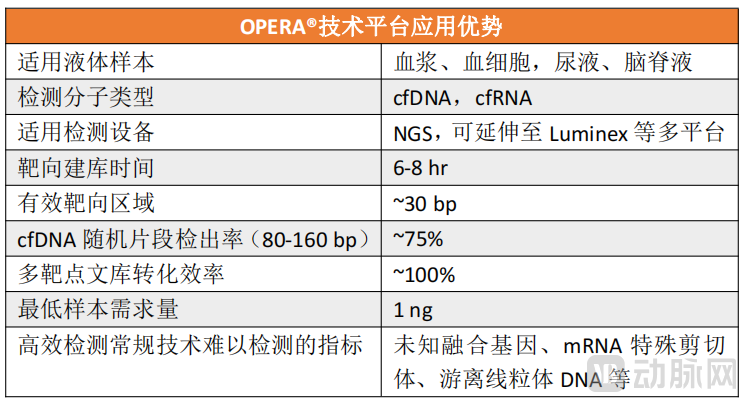
Source: Yiming Biotech
Yiming Biotech has established three specialized platforms—OPERA Jupiter®, OPERA Mars®, and OPERA Saturn™—targeting three distinct types of cell-free nucleic acid biomarkers: DNA, bisDNA (DNA methylation biomarkers), and RNA. Furthermore, to mitigate potential limitations in the detection process, Yiming Biotech has developed a comprehensive end-to-end product portfolio. This integrated suite encompasses cell-free nucleic acid extraction, nucleic acid quality control, OPERA universal library preparation reagents and single-primer panels, as well as bioinformatics analysis software.
The molecular diagnostics industry is experiencing rapid growth. According to reports, excluding COVID-19 nucleic acid testing, the compound annual growth rate (CAGR) of China’s molecular diagnostics market reached 29% from 2016 to 2020. Yang Guohua stated, “If molecular diagnostics can overcome sampling limitations by advancing from current tissue and cytology testing to blood and urine testing, it could expand the market size by more than tenfold.”
Promising growth prospects must first focus on addressing industry pain points. Currently, due to inherent limitations in underlying technologies, non-invasive molecular diagnostic products require R&D companies to commit exceptionally high budgets and endure prolonged development cycles. Furthermore, high testing costs lead to elevated product pricing, making clinical adoption and market penetration challenging within China.
Yiming Bio's Non-Invasive Molecular Diagnostic ProductsLeveraging its cutting-edge technology platform, it reduces development complexity, effectively shortens product development cycles, and thereby controls R&D costs.. Moreover, its 5- to 10-fold improvement in detection performance reduces the requirement for the number of targets in clinical studies of the product, thereby accelerating the progress of clinical research.
Meanwhile, Yiming Biotechnology synthesizes and prepares the vast majority of its core raw materials in-house, thereby enabling effective control over product manufacturing and sequencing costs., thereby safeguarding product pricing and significantly enhancing market accessibility.
From a business model perspective, Yiming Bio adopts a dual-pronged strategy.On one hand, it develops standardized products in-house to address market pain points; on the other hand, it provides customized products and testing services tailored to the personalized needs of clients such as IVD companies, hospitals, and research institutions.From a market perspective, Yiming Biotech has established a multi-pronged growth model, providing targeted products and services for three key markets: scientific research services, clinical diagnostics, and health management.
Among them, Yiming Biology launched a multi-gene companion diagnostic (CDx) product for lung cancer in 2021, a companion diagnostic product targeting cell-free nucleic acid detection in blood samples. It is reported that the testing region of this product covers all currently common loci in lung cancer and can stably detect gene mutations at a frequency of 0.1%. It is almost the only NGS solution that meets the latest national reference standards for ctDNA issued in 2019, and it has reached an agreement with key customers for the collaborative development of IVD products.
Most currently approved CDx products are tissue-based, with only one liquid biopsy CDx product from Amoy Diagnostics approved in China. Tissue sampling is challenging for cancer patients undergoing multiple lines of therapy, and current liquid biopsy mutation detection capabilities remain insufficient. OPERA® achieves an overall concordance rate of 98% between plasma and tissue samples for several common companion diagnostic mutation types, effectively addressing the persistent discrepancy between cell-free nucleic acid and tissue testing results. This fills the application gap for liquid biopsy CDx in multi-line treatment settings and unlocks significant market potential.
Furthermore, Zenisight®, a minimal residual disease (MRD) detection product for solid tumors designed to meet the needs of tens of millions of cancer patients, will be a key focus for Yiming Biotech. Tumor MRD represents the most promising application scenario in the current liquid biopsy market; unlike companion diagnostics, it typically requires repeated testing for patients. Although the clinical value of MRD has become an industry consensus, there is an urgent need to address the critical issue of excessively high costs and pricing in the current MRD market.
Zenisight® is a solid tumor MRD product based on the OPERA® technology platform and a Tumor-informed strategy. In addition, Zenisight® incorporates two proprietary core technologies exclusive to Yiming: a biomarker selection mathematical model and MicroMax® technology with full-channel noise reduction capabilities. These innovations enable a simple and efficient customization process, ensuring sensitivity (0.01% limit of detection, 100% detection rate) under controlled quality and cost conditions. The price is also effectively managed, meeting the practical needs of clinical implementation.
In addition to the aforementioned products, given the extensive clinical application value of cell-free nucleic acids in early disease diagnosis and screening, pathogenic microorganism detection, organ transplant rejection monitoring, and cell therapy development, YiMing Bio will sequentially launch its commercial products based on OPERA®.
Yiming Biotechnology has long been dedicated to the research and development of its novel foundational technology platform, as well as the translational development of subsequent commercial products. Following tens of thousands of comprehensive tests and nearly 10 translational medicine studies conducted in collaboration with multiple hospitals and academic research institutions, the OPERA® technology platform will now be formally rolled out on a full scale.
Furthermore, Yiming Bio’s production base in Lingang, Shanghai, is nearing completion, while its new R&D center in Suzhou is expected to commence operations within the year. In the near term, Yiming Bio aims to promptly demonstrate the value and potential of its technology platform, striving to become a leading supplier of cell-free nucleic acid testing products within two to three years.
Finally, when discussing the future prospects of cell-free nucleic acid molecule detection, Yang Guohua drew an analogy to the development of mobile internet technology: from 2G to 3G and 4G, and then to 5G, the proportion of users has increased from less than 10% in the 2G era to 99% today. Once there is a breakthrough in the underlying technology of cell-free nucleic acid molecules, it will significantly transform the landscape of the molecular diagnostics industry and, consequently, change our daily lives.