

Data-Driven Digital Transformation: Revolutionizing Clinical Trial Efficiency and Quality
Currently, traditional clinical trials face a series of challenges. Due to their labor-intensive nature, efficiency and quality have become urgent issues to be addressed in pharmaceutical R&D. Decentralized Clinical Trials (DCT) have been a hot topic in recent years. Given the real-world conditions, regulatory framework, and ethical requirements in China, can DCTs resolve the issues of low efficiency and quality in the clinical trial process? Furthermore, can digital models reverse the efficiency problems associated with traditional CROs while simultaneously enhancing research quality?
On May 13, focusing on the theme of cost reduction and efficiency enhancement, Walnut joined forces with CMAC to invite top industry experts for an in-depth discussion. The session provided a thorough analysis of the current inefficiencies in clinical trial processes and their underlying causes, aiming to offer recommendations for improving scientific research service capabilities and proposing solutions to collectively enhance the efficiency of pharmaceutical R&D.
Dr. Lu Mingying, Director of the Office of the Clinical Pharmacology Institution at the First Affiliated Hospital of Xi’an Jiaotong UniversityShe stated that in July 2018, with the implementation of the implied permission system, the approval times for both Investigational New Drug (IND) applications and New Drug Applications (NDA) were significantly reduced by more than 400 days. However, there was no significant change in the speed of clinical trials. The reason lies with the various stakeholders involved; thus, this outcome is attributable to multiple factors. She believes that to improve the efficiency of clinical trial projects while ensuring high quality, efforts should begin with study protocol design. Prioritizing the rights and interests of subjects and guided by clinical value, it is essential to continuously optimize clinical trial management processes, build efficient and user-friendly information systems, strengthen the full-process application and management of Clinical Trial Management Systems (CTMS), and ensure the standardized operation of quality control systems. Education and training for personnel involved are also indispensable.
Dr. Wang Meixia, Director of the Office of Clinical Trial Institution Management and Director of the Phase I Clinical Trial Research Unit at Beijing Jishuitan HospitalClinical research is proposed as a distinct activity within clinical medical practice, one that should align with the new perspective of the “patient-centered” medical model along clinical care pathways. She pointed out that prioritizing participants’ rights and subjective experiences, while integrating personalized precision medicine and multidisciplinary comprehensive care, can enhance participant engagement throughout the research process and comprehensively improve service quality. Meanwhile, strengthening the application of digital smart healthcare systems in clinical research can help physicians precisely identify eligible patients and accelerate recruitment processes. Furthermore, enhanced management focused on patient follow-up can reduce loss-to-follow-up rates and enable timely detection and resolution of adverse events, thereby achieving mutual benefits for both parties.
During the roundtable discussion, participants fromDr. Li Jie, Director of the Department of Gastrointestinal Medical Oncology at Peking University Cancer Hospital; Dr. Hu Zhiqiang, CEO of the Clinical Business Division at Andu Bio; Zhang Ying, Deputy General Manager of the Clinical Research Center at the Research Institute of Jimin Kexin Group; Li Gaoyang, Head of Remote Intelligent Clinical Trials at Happy Life Technology; and Ren Wei, Chairman of Beijing Walnut Computer Technology Co., Ltd., engaged in a discussion.Various opinions were expressed regarding the trend toward decentralized clinical trials (DCTs). There was a consensus that, regardless of whether DCTs currently constitute a dominant trend, the digitalization of clinical trials is imperative. This shift will fundamentally address the challenges related to data quality and efficiency improvement in the research process.
Dr. Wang Yongsheng, Director of Walnut Technology Medical CenterIt is proposed that data-driven digital management and services covering the entire process and all elements of clinical trials can comprehensively enhance trial efficiency. Compared with traditional clinical trials, the digital model will significantly improve process quality and cost control.
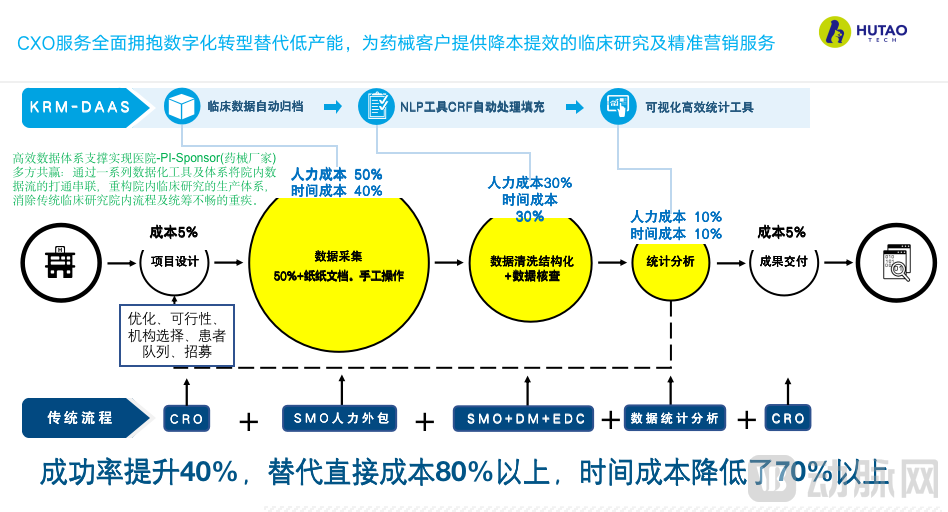
Data Source: Walnut Technology
Digital clinical trials fundamentally transform the traditional model, which relies on experience-based protocol design, suffers from unstandardized resource coordination and evidence quantification during the research phase, and faces challenges in data traceability. By employing a white-box data funnel design, automatically matching inclusion and exclusion criteria, enabling real-time data chain integration, and providing real-time alerts to investigators, digital clinical trials ensure data quality, standardized processes, and high efficiency throughout the study.
Walnut Tech leverages data from hundreds of specialized hospitals as a strategic entry point, employing digital methods for data cleaning and governance to create high-quality, usable datasets. The company has established collaborative models with leading disciplines in infectious diseases, liver diseases, and pulmonary diseases. Meanwhile, Walnut Tech is progressively strengthening its role as a research partner to hospitals, forging deep collaborations to provide end-to-end, high-quality services for clinical trials, patient follow-up management, and post-market services.