

DXY Marketing Center (dmc) Releases Insights from Survey of Over 1,000 Researchers Amid IPO Filing
Amid the impact of the pandemic, the life sciences sector has increasingly demonstrated its importance and ushered in a period of rapid development.
According to VCBeat data, global healthcare financing reached a record high of $127.1 billion (approximately RMB 819.4 billion) in 2021, representing a year-on-year increase of 70%; the number of financing deals also rose by 3,052, a year-on-year increase of approximately 63%. Notably, there were as many as 360 financing transactions exceeding $100 million in 2021, accounting for 10% of the total.
While the life sciences sector garners significant attention, the vast number of researchers who form its core are often overlooked. The characteristics of life science research—namely, its diverse subdisciplines, niche communities, and high degree of specialization—have inadvertently raised the barriers to providing services tailored to researchers.
Against this backdrop, DXY Marketing Center (DMC), the marketing arm of the DXY Group, conducted quantitative research and released the 2022 “Insights into Researchers: Analysis of Online Research Behaviors” report. This initiative aims to help the industry gain deeper insights into researchers’ online learning and procurement behaviors, thereby driving further industry development.
Online Learning and Procurement by Researchers: Unmet Needs
It is reported that a total of 1,162 researchers participated in this survey, which primarily covered ten major scientific research fields. The insight report highlights two key characteristics: the digitalization of learning behaviors and online procurement decision-making within the research community.
“The Online Migration of Learning” Gives Rise to Content Demands
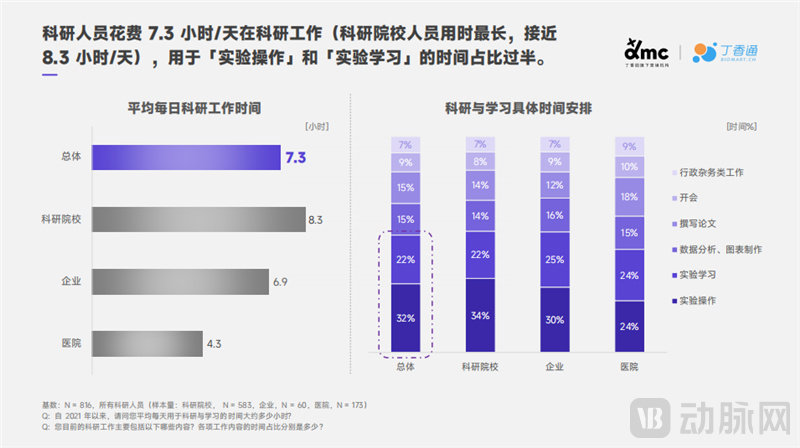
Consistent with the common public perception that researchers spend their days conducting experiments in laboratories, a survey by DMC of researchers from academic and research institutions, hospitals, and corporate research institutes revealed that researchers currently spend an average of 7.3 hours per day on scientific research activities (with personnel at academic and research institutions spending the most time, nearing 8.3 hours per day). Of this time, more than half is devoted to “experimental operations” and “experimental learning.”
However, contrary to the common public perception, researchers are no longer working solely in offline laboratories; online work has already accounted for a significant proportion of scientific research activities. The survey found that researchers spend an average of 3.4 hours per day on online tasks, accounting for 47% of their total working time (researchers in hospitals have the highest proportion of online time, reaching 71%). Although mobile devices have occupied a certain share of online scientific research activities, PC computers remain the primary platform for such online research behaviors.
Online, researchers devote more time and energy to studying “literature” and “experimental methods.” In terms of content preferences, researchers favor video-based learning materials over chart- or text-based ones. Regarding video content, researchers place greater emphasis on the appeal of the content and the authority of the presenter; additionally, video duration is often a factor considered in their overall evaluation.
Although existing video content partially meets user needs, there is still room for improvement. Significant opportunities remain to enhance the highlighting of key points, practicality, focus, and interactivity of the content.
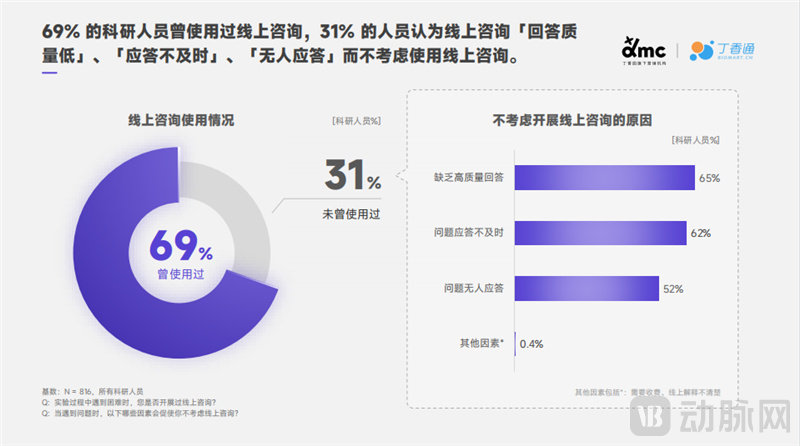
In fact, the most troubling issue for researchers during their learning process is that “experimental results do not meet expectations, and there is no way to understand the reasons.” This pain point has further spurred the development of online consultation—according to statistics, 69% of researchers have used online consultation. At the same time, issues such as “low quality of answers,” “untimely responses,” and “no response” in online consultation have led some researchers to rule out using these services.
Regarding Q&A services, more than two-thirds of respondents are open to “providing online answer services,” with researchers from academic institutions and enterprises showing high willingness to participate. Fifty-six percent of researchers are willing to dedicate 1–1.5 hours per week to providing online answer services, and 55% are willing to answer at least six questions per week. The primary motivation for researchers to provide online answer services is “knowledge expansion,” while some personnel from academic institutions hope to “increase income,” and physician-researchers value “building influence.”
“Online Procurement”: Over 40% of Researchers Learn About Purchased Products Online
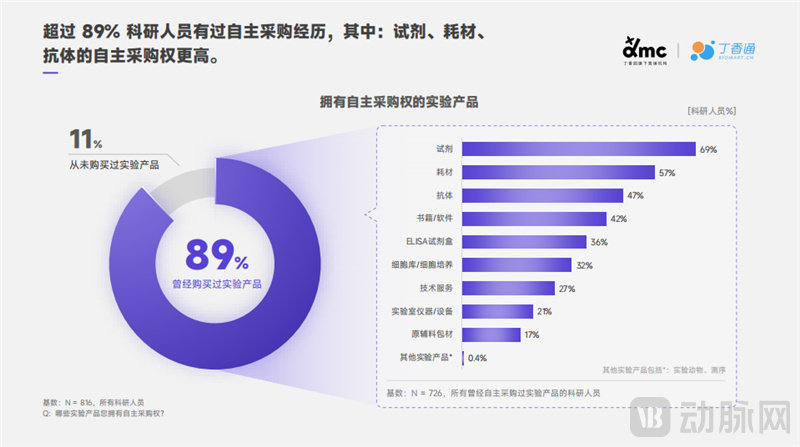
According to the survey report, over 89% of researchers have engaged in independent procurement, particularly enjoying greater autonomy in purchasing reagents, consumables, and antibodies.
In terms of procurement frequency, researchers purchase experimental products on average once every 3.5 months, with over two-thirds of users requiring such purchases at least once every 2–3 months. The key factors influencing researchers’ procurement decisions are product “quality,” “price,” and “brand,” followed closely by “user experience” and “after-sales service.”
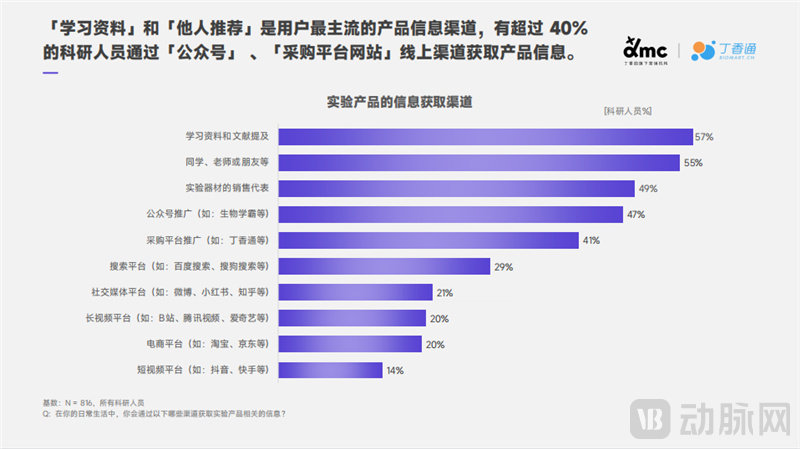
Moreover, the report shows that although “study materials” and “peer recommendations” are currently the most mainstream channels for obtaining product information, more than 40% of researchers also access product information through online channels such as “WeChat official accounts” and “procurement platform websites.” Online channels for product information are becoming increasingly important.
As channels for obtaining product information become increasingly diversified, procurement channels are also exhibiting a trend toward diversification: the report indicates that most researchers currently acquire experimental products primarily through “contacting offline sales representatives,” “online procurement platforms,” and “institutional centralized procurement.” Procurement channels are becoming increasingly diverse and are no longer confined solely to offline methods.
Gaining Insight into the Industry's Real Pain Points, Linking the Ecosystem to Empower Enterprises
Behind the insights into researchers’ behavior lies DMC’s continuous exploration of the core pain points in scientific research and its upstream and downstream industries. By analyzing behavioral data from researchers to uncover their true needs, DMC uses these insights as a foundation to provide targeted, ongoing support for decision-making at research-oriented enterprises, thereby achieving a closed-loop ecosystem that spans “identifying bottlenecks–analyzing needs–supporting decisions–resolving pain points.”
For upstream and downstream enterprises, particularly those in the scientific research sector, a common misconception in business decision-making is to assume that users (i.e., researchers) are as knowledgeable about and attentive to their products as the companies themselves. However, this is not the case. Users have extremely limited attention spans and focus only on content that is directly relevant or highly interesting to them. Consequently, many companies fail to discern users’ true needs and lack effective support—such as data analysis and user behavior analysis—to inform their business decisions, making it difficult to genuinely influence researchers who hold decision-making authority.
Under the aforementioned circumstances, how to ensure that the needs of researchers are presented to relevant enterprises in a complete, authentic, and effective manner, and how to enable the products and services of research-oriented enterprises to truly provide effective support to researchers, is a direction that requires deep reflection and exploration by various platforms, including DMC.
"Eliminating 'information asymmetry' is the first step in building a complete, closed-loop ecosystem for the industry, under the theme of 'effectively connecting users and enterprises to drive industry development.'"
Taking DMC as an example, through channels such as "Biology Master," a WeChat official account under DXY focused on the life sciences sector; "Dingxiang Tong," a procurement platform for research products; and "DXY Lab," an interactive exchange platform, DMC meets and sustains the needs and engagement of researchers via content sharing and knowledge bases. Simultaneously, research enterprises can leverage DMC’s scientific research services to better understand the genuine needs and pain points of researchers. By tapping into DMC’s professional databases, expertise, and team of specialists, companies can upgrade their existing models using various digital tools and present customized solutions to deeply reach and influence researchers who hold purchasing authority and other decision-making power. Furthermore, based on long-term analysis of the behavioral characteristics of research professionals, DMC’s scientific research services can provide upstream and downstream research-related enterprises with marketing decision-making references tailored to the actual needs of the target audience.
On the other hand, within the broad-demand segment, in addition to precisely reaching the scientific research community, DMC leverages Dingxiang Live Streaming, industry academic conferences, and a matrix of vertical new media platforms under the Dingxiang Garden umbrella to engage industry professionals. It also influences enterprise users through tools such as the Insight Database and the Medical Data Open Platform. The aggregation of diverse user groups within DMC’s ecosystem enables it to offer customized solutions tailored to the varied needs of research-oriented enterprises. These capabilities not only meet corporate marketing objectives but also address further demands, such as enhancing R&D capabilities.
In reality, by thoroughly exploring the pain points of researchers, DMC does not simply stop at the pursuit of commercial value. Instead, it anchors its efforts in broader humanistic care—focusing on niche, high-barrier groups such as researchers, and reflecting on and practicing how to concretely visualize their behavior choices and pain-point needs, which are often difficult for the general public to understand, thereby serving as a bridge for “connection and interoperability.”
By addressing the pain points of researchers, DMC is building a virtuous commercial ecosystem that will further help research professionals overcome various challenges in learning, procurement, and other areas, enabling them to realize their true value to a greater extent. Ultimately, through deeper insights into researchers, DMC will enhance research-oriented enterprises’ understanding of researchers’ needs and strengthen industry insights, thereby fostering the development of both researchers and enterprises and driving rapid progress across the industry.
As DMC showcased at the beginning of its Insight Report—“This report aims to reflect the online learning and purchasing behaviors of the scientific research community, providing references for enterprises and professionals serving the life sciences sector. The goal is to jointly help researchers address their practical needs by delivering more targeted products and services, thereby elevating the overall standard of the industry.”
For the full report, please contact via email: dengyinglin@dxy.cn