

L'Oréal and Shiseido Enter VC Arena, Heavily Betting on Biotech in Beauty and Health
Recently, beauty giants have begun pouring money into the medical and health sector.
In May, L'Oréal and Shiseido, two giants in the beauty industry, successively established investment funds in China.
On May 8, L'Oréal China and Oriental Beauty Valley signed an agreement to announce the establishment of its first investment company in the Chinese market—Shanghai Meicifang Investment Co., Ltd.—which is dedicated to investing in innovative beauty technology. On May 10, Xiamen Ziyue Equity Investment Partnership (Limited Partnership), the entity behind Shiseido’s first China-based investment fund, the “Ziyue Fund,” was officially registered with a registered capital of RMB 501 million.
In addition to the two high-profile giants, a cohort of emerging domestic brands—including Bloomage Biotech, Botanee, and Proya—had previously contributed capital to establish a fund.
Within the investment portfolios of these funds, biotechnology related to general health has unexpectedly become a heavily weighted sector. According to public information, global beauty companies have all established varying degrees of presence in the general health sector, with a particular focus on technologies related to dermatological science. The investment portfolios of L'Oréal, Shiseido, and Proya encompass sectors such as synthetic biology, microbial technology, green chemistry, and health management. The Shiseido China Fund has also explicitly stated its focus on emerging brands in the frontier health market and their upstream and downstream industrial chains.
Although L’Oréal has only disclosed its intention to invest in beauty tech, its previously held Startup Challenge in the field of beauty tech in China sent a clear signal that it focuses on frontier and fundamental disciplines, including exposomics, skin microbiome, regenerative beauty technology, and life sciences. Building on these disciplines, the company further prioritizes applied technologies, such as innovative raw materials, novel manufacturing processes, and advanced formulation technologies.
Why Are Cosmetic Giants’ Venture Capital Arms Increasingly Targeting the Life Sciences Sector? What Resources Can Beauty Conglomerates, with Their Vast Industrial Assets, Provide to Biotech Companies? What Cross-Industry Synergies Will Emerge from the Convergence of Biotechnology and Consumer Beauty?
Furthermore, it is not uncommon for pharmaceutical companies to operate in the beauty sector globally. As a cohort of beauty industry giants begins to invest in Chinese biotech enterprises, does this signal that China will soon produce its own conglomerates spanning personal care and pharmaceutical R&D and manufacturing, akin to Johnson & Johnson or Sanofi?
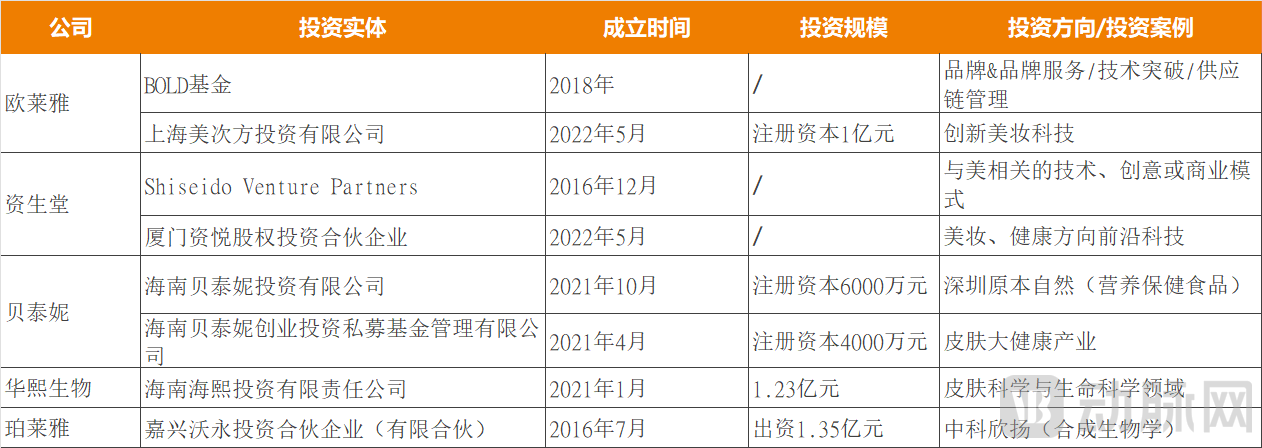
Biotech-Related Investments by Beauty Companies | Source: Jiemian News
L’Oréal and Shiseido’s optimism about China’s bioscience sector aligns with their global investment preferences.
The newly established Meicifang Investment Company is backed by BOLD (Business Opportunities for L’Oréal Development), the strategic innovation venture capital fund of the L’Oréal Group. Established in 2018, BOLD is a corporate venture capital fund launched by L’Oréal to provide financial support to startups and facilitate their integration into L’Oréal’s global ecosystem.
BOLD Fund has announced three major investment directions on its official website: branding and brand services, technological breakthroughs, and supply chain improvement.These technological breakthroughs include novel active substances, ingredients, materials, smart devices, biotechnology solutions, and green chemistry. Most of these technologies pertain to the life sciences sector.
Among the seven portfolio companies of the BOLD Fund, two are biotech firms: the French enzyme engineering company CARBIOS and the French global bioenergy company Global Bioenergies.
Founded in 2011 by the French venture capital firm Truffle Capital, Carbios is led by Chief Technology Officer Alain Marty, who earned an engineering degree and a Ph.D. in Biochemical Engineering from the National Institute of Applied Sciences (INSA) in France and became a professor in 2007. Carbios leverages enzyme engineering to enable plastic circularity, achieving recycling through processes that include depolymerization, purification, and repolymerization. In addition to L'Oréal, Carbios has established partnerships with Nestlé, PepsiCo, and Suntory. In 2021, the company successfully produced the world’s first food-grade PET plastic bottle made from recycled plastic waste.
Global Bioenergies leverages its proprietary innovative technology to convert plant-based resources (sugars and starch residues, agricultural and forestry waste) into isobutene, one of the major petroleum derivatives, which is then converted into isododecane. Isododecane is a key ingredient in the cosmetics market, serving as an emollient and solvent in many skincare and haircare products. It is also a primary component in long-wear cosmetic products such as waterproof mascaras and long-lasting liquid lipsticks.
In China, prior to establishing an investment fund, L’Oréal had already partnered with two domestic biotechnology companies through its Beauty Tech startup challenge.
The heated primary marketBluepha, and also the winning company in the “Foreseeing New Product R&D” track of the first L’Oréal BIG BANG Beauty Tech Creation Camp in 2020.
Bluepha, founded in 2016, has established a presence in the healthcare, agriculture, and chemical industries. In the beauty sector, L’Oréal has entered into a comprehensive partnership with Bluepha, covering ingredient-based and material-based products, among other areas. Currently, three products have completed the validation phase, and discussions on the next stage of collaboration are imminent.
L'Oréal has also partnered with leading microbiome platform technology companiesMoonBiologicsExpand collaboration to jointly conduct research on the skin microbiome.
MoonBiome is a leading microbiome platform technology company. Leveraging microbes to develop live biotherapeutic products, MoonBiome focuses on biological control and soil health in agriculture. In the field of skin microbiome research, the company has collected and preserved over 5,000 high-value strains for its “Skin Microbiome” project. Among these, multiple candidate strains have demonstrated excellent efficacy in combating skin inflammation and acne, as well as providing antioxidant and anti-aging benefits. MoonBiome will collaborate with L'Oréal to conduct a proof-of-concept (POC) pilot study on skin microbiome applications.
L’Oréal’s BIG BANG Beauty Tech Creation Camp can be regarded as a barometer of L’Oréal’s investment trends. This year, Xu Jintao, Senior Manager of Open Innovation at the L’Oréal China Research and Innovation Center, stated in an interview: “In addition to biotechnologies such as synthetic biology and RNA technology, we are particularly eager to see advancements in green chemistry, new process technologies, innovative materials, and digital-driven R&D technologies for ingredients and formulations. We hope to identify globally leading innovative enterprises and projects in these areas.”
Just like L'Oréal, Shiseido established a global venture capital fund, Shiseido Venture Partners, before setting up its investment fund in China.
Shiseido’s global investment strategy shows a clear preference for health technology. To date, Shiseido has invested in only two companies worldwide: FiNC, a health management platform, and Dricos, a dietary supplement provider.
FiNC, established in 2012, leverages AI to deliver preventive healthcare services to both enterprises and individuals. For corporate clients, FiNC analyzes employee health data to promote healthy habits. For individual users, FiNC offers a health management app that provides tailored health management services and products to those who place a high priority on beauty and wellness.
Dricos, founded in 2012, has as its core product a customized nutritional beverage dispensing device. One of its underlying principles is to personalize the nutrients required by the human body by analyzing identified biological data, which may be sourced from wearable devices or obtained through contact with specific medical monitoring equipment.
Which health tech sectors will the foundation under Shiseido invest in within China? Zhou Taosheng, Senior Vice President of Shiseido Group’s China Business Innovation Investment Office, stated in a previous interview that the fund would primarily focus on rapidly growing segments in the Chinese market, such as medical aesthetics and certain oral care products. “In the future, we aim to build a ‘holistic beauty’ concept that integrates both external and internal beauty. Companies engaged in innovative technologies, those facilitating rapid product growth, those with a strong social media presence, and brand-focused enterprises all fall within the fund’s investment scope. Our investment areas are not narrowly defined.”
For Chinese domestic beauty brands, Proya’s subsidiary fund, Jiaxing Woyong, has invested in the synthetic biology company Zhongke Xinyang.Founded in 2015, SynBio Tech is an innovative intelligent manufacturing enterprise in synthetic biology, co-founded by a doctoral team from the Institute of Microbiology, Chinese Academy of Sciences. In terms of product applications, the company is anchored in raw materials for cosmetic skincare products and has been gradually expanding into the food, health supplement, and pharmaceutical industries. Its current main products include high-stability, heat-resistant deep-sea superoxide dismutase (SOD), arbutin, and other raw material ingredients.
Botanee and Bloomage Biotech have also established investment funds, respectively, to focus on fundamental science related to dermatology.
As living standards rise and consumer mindsets mature, buyers are no longer solely brand-driven; instead, they prioritize product specificity and professionalism, with growing attention to ingredient profiles. It is a future trend for beauty giants to focus more on underlying scientific technologies, and it is foreseeable that more of them will invest in biotech companies within the broader health sector.
In the global investment strategies of beauty companies, it is evident that synthetic biology has become the most closely watched sector. Major beauty corporations are actively expanding their presence in synthetic biology and the cosmetics ingredients supply chain.
There are four major production technology pathways for raw materials in the beauty industry, including plant extraction, chemical synthesis, bio-fermentation, and synthetic biology. Natural plant extraction and bio-fermentation technologies are currently the mainstream in the industry.
Synthetic biology technologies are regarded as the direction of development for the production of cosmetic ingredients.
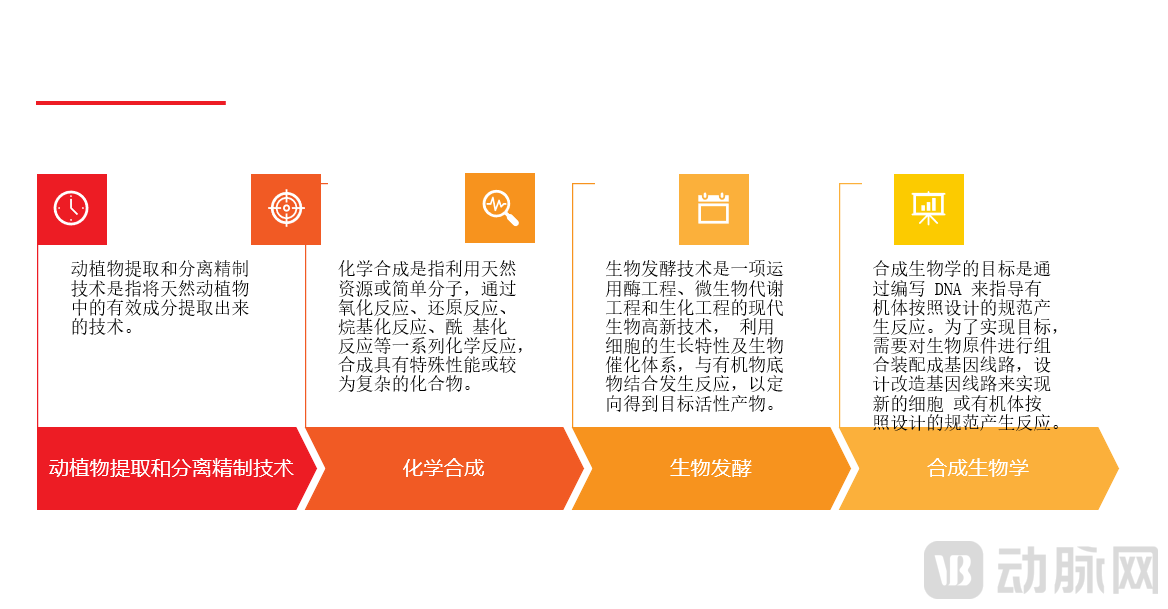
Source: CITIC Securities, “In-Depth Special Report on the Beauty and Cosmetic Ingredients Industry: The Ingredients Arena—Who Will Prevail?”
Synthetic biology technologies can not only enhance the safety, stability, and bioactivity of ingredients and raw materials,These substances can also be customized according to specific requirements (such as different skin types, skin concerns, dietary habits, and environmental conditions), thereby achieving precise functionality. Compared with certain traditional methods (i.e., extraction from petrochemical products, animal-derived sources, and plant-derived sources), synthetic biology has the potential to produce ingredients for beauty and health products in a more sustainable manner, at a larger scale, and with greater stability.
Furthermore, compared with traditional production methods for cosmetic ingredients, synthetic biology enables companies to produce these ingredients at a lower cost.
As a groundbreaking technology for the next generation of beauty products, synthetic biology has become an unavoidable sector for cosmetics companies. Even without external investment, Bloomage Biotech, China’s leading hyaluronic acid producer, is advancing into synthetic biology by building its own technical platform.
In addition to synthetic biology, data-driven personalized skincare is another key area of focus for beauty giants.Skin is the largest organ of the human body, and skin conditions are common ailments. Analyzing skin images using AI to assess conditions such as acne, hyperpigmentation, and wrinkles, while providing skincare and lifestyle guidance, has become a key R&D focus for numerous startups. This sector is also a strategic priority for international beauty giants.
In January this year, L'Oréal partnered with Verily, the life sciences subsidiary of Alphabet, to develop new digital technologies and diagnostic products for skincare. The two companies stated that the new products may include AI algorithms or sensors.
The third major area favored by beauty giants is research on the exposome.. Simply put, it refers to the cumulative impact of the environment on an individual from fertilization to death, including effects on the body, skin, and emotions.
Taking the skin microecosystem as an example, it is an ecosystem composed of various microorganisms, tissue cells on the skin surface, diverse secretions, and the local microenvironment. These components collectively maintain the balance of the skin microbiome, forming the primary biological barrier on the skin surface and playing a crucial physiological role. Alterations in the skin microecosystem are closely associated with the onset and progression of various inflammatory and infectious skin diseases.
How Will Beauty Brands’ CVC Investments in Biotech Projects Change the Market?
As leading domestic beauty CVC giants favor the application of biotechnology in the beauty and skincare sector, these industry leaders not only provide financial investment but also empower the sector with industrial resources, insights into market trends, and the ability to connect upstream and downstream segments of the supply chain, thereby driving rapid advancement across the entire industry.
For biotechnology, this means that cross-disciplinary intersection and integrated innovation are beginning to emerge as new trends in the development of the healthcare and wellness industry. The commercialization of biotechnology in other sectors has become a new growth driver.
As more beauty consumption giants begin to favor biotechnology applications, domestic medical giants are also starting to tap into the large market of beauty consumption.
Previously, the sectors most favored by Chinese pharmaceutical companies for cross-industry expansion were daily chemicals and cosmetics. Companies such as Yunnan Baiyao, Dong-E-E-Jiao, Guangzhou Pharmaceutical Holdings, Tongrentang, and Pien Tze Huang have all developed personal care products, including body washes, acne treatments, and facial masks.
Beyond pharmaceutical companies, medical device manufacturers are also crossing industry boundaries to deeply engage in the cosmetics market. MicroPort, a leading domestic medical device company, has incubated the skincare platform Yuefuda, which offers a diverse portfolio of skincare product categories.Yuefuda’s core technology platform is based on polymeric microneedle technology. In addition, Hybio Pharmaceutical and Yuefuda have jointly invested in establishing a pharmaceutical-device joint venture to fully leverage their respective leading advantages and resources in transdermal drug delivery systems, new drug development, and pharmaceutical research, thereby achieving complementary strengths and conducting in-depth, comprehensive collaboration in the field of peptide-based microneedle transdermal drug delivery.
As domestic beauty companies with biotechnology ties, such as Botanee, Bloomage Biotech, and Giant Biogene, have successively completed their initial public offerings (IPOs), beauty brands incubated by life sciences enterprises may also have the potential to list independently in the future.
Looking at the development history of global pharmaceutical companies, there is no shortage of drugmakers that have successfully operated skincare brands. Pharmaceutical giant Johnson & Johnson owns multiple skincare and consumer brands, including Neutrogena, AVEENO, and Dr. Ci:Labo. Sanofi boasts two widely recognized overseas brands in hair care and body care: Selsun and Gold Bond.
Amid the beauty consumption boom, corporate venture capital (CVC) arms of beauty giants are circling biotech firms, while pharmaceutical companies are gradually penetrating the cosmetics market. How will these two major players compete?
In the beauty market, which exceeds RMB 150 billion, pharmaceutical companies and beauty giants each possess distinct advantages. Pharmaceutical enterprises entering the consumer skincare sector benefit from rigorous multi-layered testing of safety and efficacy, extensive experience in developing functional products tailored to specific needs, and a strong track record of leveraging clinical trial data. Their product R&D expertise and mature systems confer a competitive edge in a market that prioritizes professionalism and efficacy. In terms of marketing, pharmaceutical companies are backed by abundant resources of medical experts.
In terms of R&D barriers, the development of cosmetic products involves interdisciplinary research and application across life sciences, fine chemicals, dermatology, botany, and other fields, requiring support from a robust technical R&D team. High R&D investment is an advantage for pharmaceutical companies.
However, the beauty and cosmetics industry features exceptionally high brand barriers. Companies can only gradually establish their brands and gain consumer recognition and trust through sustained, long-term efforts across multiple dimensions, including product quality control, corporate culture, marketing networks, and professional services. For new entrants, the cost of building a brand is several times higher than the cost for incumbent companies to maintain and strengthen their existing brands, and the required timeframe may be even longer. Therefore, branding constitutes a significant barrier in the cosmetics industry, which differs markedly from the pharmaceutical market.
Currently, investment in the healthcare sector is in a downturn. The entry of corporate venture capital (CVC) firms from the beauty industry may inject greater vitality into this market, allowing us to see more possibilities for the biotechnology sector.
References:
Achieving Infinite Plastic Recycling: French Enzyme Engineering Firm Carbios Boldly Claims New PET Production Will Be Unnecessary in the Future – Shenghui
Giant Biogene Prospectus
Botanee Prospectus
CITIC Securities: “In-Depth Special Report on the Beauty and Cosmetic Ingredients Industry: The Ingredients Arena—Who Will Prevail?”
Reshaping the Beauty Industry Landscape: 15 Major Companies Pool Billions in Investment Capital — Future Trace