

Meinian Onehealth Reports 16.66% Revenue Growth in 2021; Insurance Business Expansion Emerges as New Growth Driver
health 100
Medical Examination Service Provider
On the evening of April 29, 2022, Meinian Onehealth (stock code: SZ.002044), known as the “first listed private physical examination company,” released its first-quarter report for 2022. The data showed that in Q1 2022, Meinian Onehealth achieved operating revenue of RMB 1.352 billion, a year-on-year increase of 1.12%. Furthermore, the 2021 annual report recently disclosed by Meinian Onehealth indicated that the company’s operating revenue for 2021 reached RMB 9.156 billion, representing a year-on-year growth of 16.66%. The net profit attributable to shareholders of the listed company after deducting non-recurring gains and losses amounted to RMB 72.7206 million, marking a year-on-year increase of 112.11%.
Not only did revenue grow, but Meinian Onehealth also performed well in terms of the scale of customers served and average service price. According to financial report data, from January to February 2022, the number of individuals undergoing health check-ups increased by 5% year-on-year, while the average revenue per customer rose by 12% year-on-year. The net profit attributable to shareholders of the listed company was RMB -431.1041 million, basically flat compared with the same period last year.
In addition to revenue performance, Meinian Onehealth disclosed a series of strategic initiatives for innovative businesses in its financial report. Building on the continuous refinement of its health examination services and the concurrent growth in both volume and price, the company has been actively introducing and launching innovative projects. By leveraging digital tools, it has rapidly initiated multi-channel revenue generation from remote services. Furthermore, through the acquisition of a nationwide insurance brokerage firm, Meinian Onehealth has implemented a closed-loop service model integrating “professional health examinations, intelligent diagnostics, specialized clinical care, and insurance payment,” thereby addressing customer needs for deeper integration of health examinations, health management, specific disease management, and insurance payment solutions.
As a leading enterprise in the health checkup industry, Meinian Onehealth has been committed to providing professional health checkup services to the general public since its establishment in 2004. It has gradually formed a service system centered on health checkups, integrating health consultation, health assessment, and health intervention. Leveraging health big data, the company focuses on professional prevention, health protection, and concierge-style medical services, delivering higher-quality health management solutions to both corporate and individual clients.
Large-Scale Health Checkups + Digital Operations Drive Revenue Growth
From a macro perspective, driven by rising public health awareness and consumption upgrades, the preventive healthcare philosophy has gained increasing recognition. Consequently, demand for health checkup services has surged significantly, propelling the rapid development of the health checkup industry.
According to data from the China Health and Family Planning Statistical Yearbook (2021), the number of health checkups conducted nationwide in 2020 reached 431 million, with a penetration rate of approximately 31% for the national health examination industry. In terms of total volume, the number of health checkups increased from 230 million in 2009 to 431 million in 2020, representing a compound annual growth rate (CAGR) of 5.37%.
As the “Healthy China 2030” Planning Outline is steadily advanced, health check-ups are playing an increasingly prominent role in the healthcare system, ushering the industry into an era of explosive demand growth. Against this backdrop, many preventive medicine companies, including Meinian Onehealth, have seen substantial business expansion. We believe that Meinian Onehealth’s emergence as a leader in this field is primarily driven by the following two factors.
External: Offline large-scale support for core business operations
As a company that has been deeply involved in the health checkup industry for many years, Meinian Onehealth’s operating revenue is now primarily derived from health checkup services. According to the annual reports of Meinian Onehealth for 2020 and 2021, revenue generated from health checkup services accounted for 95.51% and 96.74% of its total revenue, respectively.
Historically, the delivery of health checkup services has relied heavily on offline settings. Therefore, for health checkup enterprises to achieve large-scale service deployment, sufficient offline infrastructure is indispensable. From this perspective, it is understandable that Meinian Onehealth, a company whose core business revolves around health checkup services, prioritizes the establishment and expansion of its physical offline institutions.
According to Meinian Onehealth's financial report for the first quarter of 2022, as of March 31, 2022, the company operated a total of 613 health examination centers. Among these, 274 were majority-owned centers, an increase of 8 compared to the same period in the previous year, while 339 were minority-invested centers, a figure consistent with that at the end of 2021.
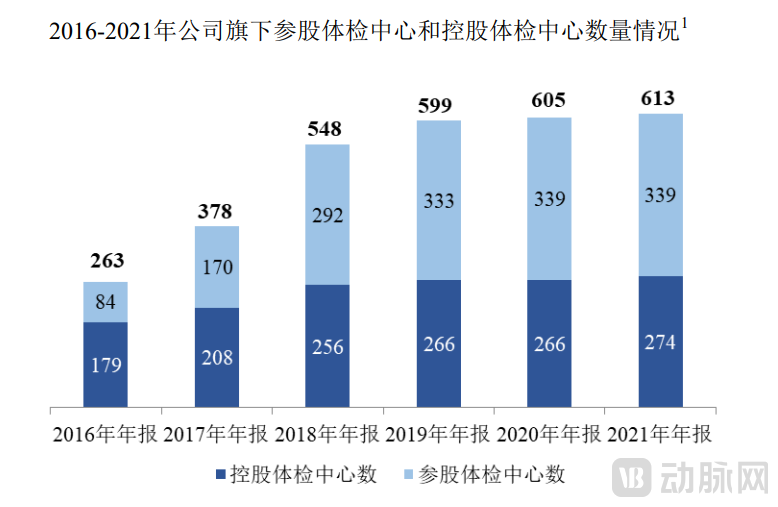
Image source: Meinian Onehealth 2021 Annual Report
Secondly, at the user coverage level, the comprehensive user network established by Meinian Onehealth has also served as a significant driver of revenue growth.
Specifically, in the mass health checkup market, Meinian Onehealth has launched two major brands, “Health 100” and “Ciming,” targeting the mid-to-high-end corporate health checkup, comprehensive medical services, and premium individual health checkup markets. Meanwhile, Meinian Onehealth delivers its services through the “Aoya” and “Meizhao” brands, respectively.
Among these four major brands, "Health 100" remains the core brand of Meinian Onehealth, accounting for 76.7% of its revenue in 2021. An analysis of the financial reports from the past two years reveals that the revenue-generating capacity of Meinian Onehealth’s other brands is strengthening, with their share of total revenue rising accordingly; however, the overall change has been relatively modest.
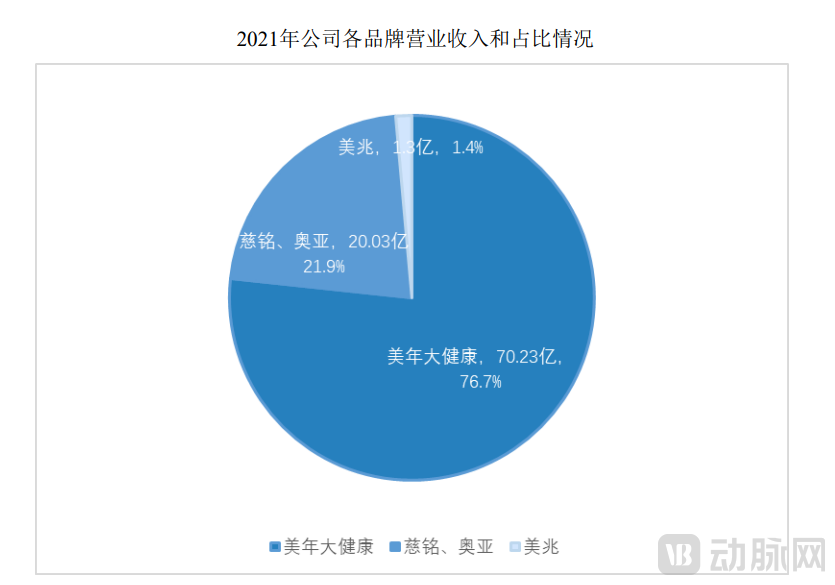
Image source: Meinian Onehealth 2021 Annual Report
Overall, the sufficient number of offline scenarios and the broad user coverage have laid the foundation for the continuous revenue growth of Meinian Onehealth. However, to truly achieve significant business expansion on this basis, it is essential to exert strict control over service quality and operational management.
Internal: Digital Transformation, Refined Operations
With over 600 health checkup centers and an annual reception volume exceeding 30 million visits, this is the current scale of development for Meinian Onehealth.
However, the massive service volume also means that enterprises are highly prone to problems in operational and management efficiency. Therefore, for Meinian Onehealth, given its current scale, digital transformation and refined operations are clearly indispensable approaches.
Moreover, as the global trend toward digital healthcare becomes increasingly pronounced, Meinian Onehealth believes that the future of the health checkup and preventive medicine industry will shift from a purely operational model to one focused on discipline development, from standalone health checkups to comprehensive health management, and from simple disease detection to an integrated model of screening, diagnosis, and treatment. The core capability driving this transformation lies in the mastery of digitalization, intelligence, and standardization.
From this perspective, whether driven by the need to upgrade its own services or to align with broader market trends, digital transformation is an imperative path for Meinian Onehealth.
In fact, Meinian Onehealth had long laid the groundwork for its digital transformation. For instance, in 2019, the company introduced Alibaba Group, Ant Financial, and Yunfeng Capital as key strategic shareholders and partners to facilitate its digital transformation in terms of organizational structure and internal development.
Based on the current business layout of Meinian Onehealth, it is evident that its digital transformation is primarily reflected in the following two aspects.
First, at the product and service level, leveraging digital technologies to enhance the accuracy, efficiency, and quality of health examination services is key to delivering a positive user experience.
Second, at the management level. Specifically, in terms of medical quality management, Meinian Onehealth has not only comprehensively promoted the cloud-based upgrade of service systems such as Picture Archiving and Communication Systems (PACS) and Laboratory Information Systems (LIS) to enhance work efficiency and data storage quality, but also advanced the implementation of the LIS system for laboratory quality control and the new generation SaaS-based health examination software, Bianque 2.0. To date, the LIS system for laboratory quality control has been launched in over 300 health examination centers.
In terms of customer management, Meinian Onehealth is continuously advancing the implementation of its existing “Xingchen” customer management system and promoting the rollout and upgrade of products such as SOA and mini-programs across more regions in China, thereby enhancing the customer service experience.
The current capital investment also offers a glimpse into Meinian Onehealth’s determination to pursue digital transformation. According to the company’s 2021 annual report, Meinian Onehealth invested RMB 138 million in research and development (R&D) in 2021, representing a year-on-year increase of 196.74% compared with RMB 46.5152 million in 2020. The primary R&D initiatives were the Terminal Information Security Upgrade Project and the Management System Upgrade Project.
Over the next three years, continuing to advance the company’s overall digital transformation and gradually achieving informatization upgrades across various business sectors will also be a key strategic priority for Meinian Onehealth.
Insurance + Health Checkups: Can It Become Meinian’s New Growth Curve?
Over the past year, Meinian Onehealth delivered satisfactory performance in terms of revenue, average transaction value per customer, and the number of new clinics opened. However, a notable phenomenon cannot be overlooked: although Meinian Onehealth has been consistently building an integrated service system centered on health checkups and encompassing health consultation, health assessment, and health intervention, more than 95% of its revenue still comes from its core health checkup business.
For Meinian Onehealth at the current stage, although the overall health checkup market is showing a positive development trend and there is still ample room for growth in the company’s checkup business in the future, exploring new channels for business growth will clearly bring greater development opportunities.
It is understood that Meinian Onehealth is currently planning to launch its insurance business by acquiring a nationwide insurance brokerage firm. Leveraging its existing preventive medicine system and the vast amount of health examination data it has accumulated, the company aims to implement a closed-loop service model of “professional health examinations + intelligent diagnosis + specialized treatment + insurance payment.” This approach addresses customer needs for further integrating health examinations, health management, specific specialized diseases, and insurance payment, while also providing a pathway for the realization of a Chinese-style HMO (Health Maintenance Organization) model.
It is referred to as a new HMO model because the HMO framework planned by Meinian Onehealth differs significantly from both traditional HMO models and the China-specific HMO models being explored by other domestic enterprises.
In the global health management industry, the HMO (Health Maintenance Organization) model of “insurance + healthcare,” long implemented by leading U.S. companies such as UnitedHealth and Kaiser Permanente, has consistently served as a benchmark for numerous health management enterprises. This model advocates “prevention first, with integration of prevention and treatment,” aiming to avoid excessive medical care and control costs by coordinating all medical resource allocation and complementing it with health management services to improve the health status of insured individuals. Throughout the HMO model, commercial insurance has always been one of the primary payers of health expenditures and constitutes the foundation of the HMO model.
In China, the HMO models explored by some enterprises include a “comprehensive finance + medical health” service model centered on “family doctors,” as well as a “specialty-disease HMO” model focused on chronic disease management that adopts “diagnosis-related group (DRG) and capitation-based bundled payments.” Overall, localized HMO models vary across companies, reflecting differences in their existing business lines and core resource priorities.
Distinct from the aforementioned models, Meinian Onehealth has established an HMO model centered on “Preventive Medicine + Insurance Innovation,” enabling the precise design and sale of insurance products built upon its existing health examination services. In simple terms, at the product design level, Meinian Onehealth leverages billions of health examination data points accumulated over years of operation to support insurance product development; at the sales level, its customer base of tens of millions provides a solid foundation for marketing these insurance products.
In fact, for many years, Meinian Onehealth has been actively exploring and laying out its insurance business. For instance, in 2018, Meinian Onehealth jointly launched the "Meinian Good Doctor" product with Ping An Insurance and PICC, which combines health checkups with insurance to create an innovative service model of "checkup, storage, management, medical care, and insurance."
Unlike previous efforts to explore the integration of insurance and health checkups through external partnerships, Meinian Onehealth’s acquisition of an insurance brokerage firm is actually based on strengthening its own service chain in preventive medicine. By directly operating the insurance brokerage, the company aims to further expand the integration of preventive health screenings with health insurance.
However, although Meinian Onehealth has accumulated certain experience in exploring the integration of insurance and health examination services, and this acquisition of a national insurance brokerage firm will play an important role in promoting the future implementation of its insurance business, it is clearly difficult to build the HMO model solely on its own.
Therefore, in recent years, Meinian Onehealth has been actively collaborating with public hospitals across various regions to establish medical consortiums, partnering with authoritative medical and academic institutions such as the National Clinical Research Center for Respiratory Diseases, the Respiratory Center of China-Japan Friendship Hospital, Peking University Health Science Center, Nanjing Medical University, and the Zhongshan Ophthalmic Center of Sun Yat-sen University, thereby providing channel support for post-examination medical services for its clients.
Meanwhile, in terms of business layout, Meinian has entered key sectors such as specialized diagnosis and treatment, chronic disease management, genetic testing, internet hospitals, vaccine and cell storage, traditional Chinese medicine industry, and health big data development. This essentially covers the upstream and downstream industrial chain of the physical examination business, thereby supporting the construction of the service loop of “professional physical examination + intelligent diagnosis + specialized diagnosis and treatment + insurance payment.”
Amid the challenges and opportunities constantly facing the broader health industry, and driven by the in-depth implementation of the Healthy China strategy, the market size and scale of the preventive medicine sector are undoubtedly significant. Seizing this opportunity, Meinian Onehealth will continue to refine its services and innovate its strategic layout, aiming to provide a “Meinian” model for the development of the health services industry.