

Tsinghua University Team Leverages 20-Year Research to Innovate 'Forgetting Suppression' Mechanism, Paving the Way for Broad-Spectrum Alzheimer’s Therapeutics

Professor Zhong Yi graduated from the Department of Biological Sciences and Biotechnology at Tsinghua University and earned his Ph.D. in Biological Sciences from the University of Idaho, USA. He formerly served as a professor at Cold Spring Harbor Laboratory in the United States and is currently a professor at the School of Life Sciences, Tsinghua University, as well as the founder of Zhuokai Biology. Leveraging the research advantages of model organisms such as Drosophila and mice, Professor Zhong has long investigated the biological mechanisms underlying learning, memory, and forgetting. Building on this foundation, he is dedicated to advancing research into the pathological mechanisms of human memory-related disorders and developing potential therapeutic drugs, while also striving to deepen our understanding of biology.
Alzheimer’s Disease: Known as the “Longest Goodbye”
This is a progressive neurodegenerative disease with an insidious onset. Patients gradually experience memory blurring and failure to recognize familiar individuals, presenting with memory impairment, aphasia, apraxia, agnosia, visuospatial deficits, executive dysfunction, as well as changes in personality and behavior.
According to World Health Organization (WHO) data, more than 55 million people worldwide were living with dementia in 2021, a figure projected to reach 78 million by 2030. Alzheimer’s Disease International (ADI) estimates that three-quarters of people with dementia globally have not been diagnosed, with this proportion reaching as high as 90% in some low- and middle-income countries.
Over the past two decades, drug development for Alzheimer’s disease has been plagued by repeated failures. Since 1993, the U.S. Food and Drug Administration (FDA) has approved only six drugs for the treatment of Alzheimer’s disease, nearly all of which are symptomatic therapies. The sole disease-modifying therapy, Aduhelm, has remained highly controversial since its market launch. Consequently, Alzheimer’s disease has become known as a “battleground” for drug development, where industry giants such as Novartis, Johnson & Johnson, Biogen, Eli Lilly, Pfizer, Roche, and Merck have suffered significant setbacks.
Despite repeated setbacks, countless individuals continue to strive in the hope of averting this farewell, or at least making it more dignified. The scientific and industrial communities have made numerous attempts to identify therapeutic targets for Alzheimer’s disease, ranging from reducing amyloid-beta (Aβ) deposition and tau protein aggregation to ameliorating neuroinflammation, mitigating microvascular dysfunction, and enhancing neuronal function. Research mechanisms targeting Alzheimer’s disease are thus flourishing in diverse directions.
Approximately 20 years ago, Nobel laureate Professor Tonegawa proposed the engram cell theory, which posits that memory encoding in the brain can be stored in different states. Memories formed through normal learning are stored in a latent state that can be retrieved via natural recall, whereas memory encoding resulting from artificial intervention or pathological conditions may be stored in a silent state that is not retrievable.
At that time, Professor Zhong Yi, founder of Zhuokai Biotech, was leading an independent laboratory in neurobiology at Cold Spring Harbor Laboratory in the United States.
Professor Zhong Yi was exceptionally appointed to the faculty of the Department of Neurobiology at Cold Spring Harbor Laboratory in the United States upon completing his Ph.D., where he leads an independent laboratory. Building on the theory proposed by Professor Tonegawa, he further investigated and discovered the physiological significance of multiple memory storage states and the mechanisms underlying transitions between encoding states. Specifically, negative emotions activate the Rac1-mediated active forgetting mechanism, which silences normal memories and renders them inaccessible for retrieval; conversely, positive emotions inhibit Rac1, thereby converting silenced memories into a latent state and facilitating memory recall.
This discovery has opened up entirely new avenues for restoring lost memories in Alzheimer’s patients and laid the foundation for the subsequent establishment of Zhuokai Biotechnology.
Simply put, the engram cell theory posits that memory encoding in the brain can be stored in different states: memories formed through normal learning are stored in a latent state retrievable via natural recall, whereas memory encoding resulting from artificial intervention or pathological conditions (such as in patients with Alzheimer’s disease) may be stored in an inaccessible silent state.
“Everyone is aware of memory impairment, but few pay attention to its underlying nature,” Professor Zhong Yi told Chengguo Ju. In 2001, after several rounds of discussions with former Tsinghua University classmates, Professor Zhong established Zhuokai Bio with RMB 2 million in seed funding they had jointly raised, aiming to develop therapeutic drugs for Alzheimer’s disease from the perspective of “inhibiting forgetting.”
The decade from 1993 to 2003 was a highly productive period for Alzheimer’s disease therapeutics. Following the establishment of disease models, the scientific community largely believed that the challenges posed by this condition had been resolved, leading the FDA to approve a total of ten inhibitors during those ten years. In contrast, China’s research and development in Alzheimer’s drugs remained entirely blank during this period.
“From a technical standpoint, if others can do it, so can we. But why is there such a stark difference in R&D precision? It ultimately comes down to the gap between applied research and industrialization,” said Professor Zhong Yi, discussing the original motivation for founding the company.
At its inception, the company’s greatest challenge was not R&D but team building. Professor Jian Wang, a co-founder of the company, was primarily responsible for drug research, while Professor Yi Zhong, still teaching at Cold Spring Harbor Laboratory, found it difficult to balance his academic duties with the company’s operational needs. He persuaded Professor Zuoping Xie from Tsinghua University to temporarily oversee team management. It was only after the arrival of new-generation leaders, including CEO Weiwei Ma, that the company completed the construction of its overall team.
“Previously, we were all technicians. His arrival helped perfect our management team, which has been crucial for our subsequent development,” recalled Professor Zhong Yi. After graduating from Tsinghua University in 2007, Ma Weiwei had always hoped to join a Chinese pharmaceutical company with independent R&D capabilities. However, drug development in China at that time was still dominated by generic drugs. In an industry where imitation was the prevailing trend, Zhuokai Bio stood out for its unique approach to both R&D direction and mechanisms of action, attracting a group of like-minded individuals who shared the same ideals.
According to the theory proposed by Professor Tonegawa, memories exist in two forms: a latent state (retrievable) and a silent state (not readily retrievable). Studies using animal models of Alzheimer’s disease have revealed that the engrams for these memories are preserved, indicating that a portion of these memories is actually in a silent state. If the engram-bearing neurons are labeled and then stimulated using optogenetic tools to induce re-expression of the associated genes, could these memories potentially be restored?
Following the proposal of the theory, researchers suggested loading optogenetic tools into memory cells to stimulate memory recall. However, this approach is difficult to implement in practical applications. “The challenge lies in the need to open the patient’s skull and use viruses to deliver optogenetic components,” stated Professor Zhong Yi.
Through further research, the Zhuokai Biologics team discovered that, in addition to memory processing, the brain actually possesses an active forgetting mechanism. During the formation of memories, another set of signaling pathways is simultaneously activated, leading to forgetting.
“These memories are not truly forgotten, but rather silenced,” he explained. Since the memory engrams remain intact, could inhibiting the forgetting mechanism and converting memories from a silent state to a latent state enable their retrieval? This theory was subsequently confirmed in multiple mouse experiments. By enhancing stimuli that promote forgetting and inhibiting the associated mechanisms, they induced switching of memory engrams between these two states. Meanwhile, a study conducted by Peking Union Medical College Hospital on post-mortem brain samples donated by individuals who had died from Alzheimer’s disease surprisingly revealed elevated expression of forgetting mechanisms in the brains of these patients.
“These findings suggest that we could develop drugs capable of silencing memories by targeting this mechanism,” he continued. He proposed a two-pronged approach: inhibiting the silencing of new memories and reactivating already silenced old memories.
Following the identification of targets and mechanisms, the next step involves compound screening and optimization. This process requires the use of drug screening tools.
Animal models are essential tools in disease and drug research. Due to considerations of cost, availability, experimental accessibility, and genetic similarity, Drosophila (fruit flies) and mice are the most commonly used animal models. By encoding disease-associated gene fragments into the animals’ genomes, researchers can induce symptoms and pathological phenomena similar to those observed in humans. Administering drugs or compounds to these animals allows for the observation of their therapeutic effects on the disease.
Although high-throughput and AI-driven drug screening platforms have already played a significant role in improving the efficiency of drug discovery for diseases such as cancer, he remains more inclined to use animal models for drug development targeting neurological disorders. While AI and high-throughput screening platforms can screen millions of compounds simultaneously, thereby substantially enhancing screening efficiency, both high-throughput screening and AI-based drug discovery platforms require precise identification of the specific protein or gene responsible for the disease etiology.
“There has been extensive research on cancer, but our understanding of the brain remains limited,” he explained.
In 2004, the team established the world’s first Drosophila model of Alzheimer’s disease. Leveraging this Drosophila animal model alongside a diverse panel of transgenic mice of varying ages, Zhuokai Bio has further refined its drug screening platform.
Since 2008, Zhuokai Biotechnology has screened and stored multiple compounds using a “Drosophila-mouse” animal model. In 2014, after the R&D team first demonstrated the link between forgetting mechanisms and Alzheimer’s disease, the team further screened these compounds.
“At that time, three out of the five compounds demonstrated inhibitory effects,” recalled Professor Zhong Yi.
Building on these three compounds, the team conducted further drug evaluation and compound optimization. Wang Jian, another co-founder of the company and a professor at the School of Pharmaceutical Sciences, Tsinghua University, leveraged his expertise and advantages in medicinal chemistry to optimize more than 200 compounds. After iterative screening and in-depth validation, the company’s current product pipeline was established. Among these candidates, compound 50561 exhibits the most favorable structural fit and is the most advanced in development.
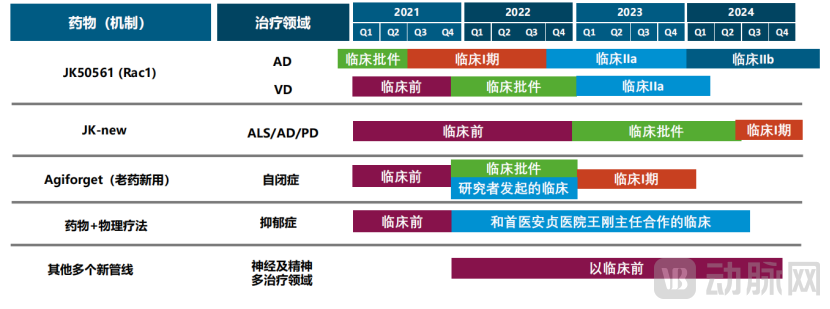 Zhuokai Biotech's Product Pipeline and R&D Plan
Current research suggests that Alzheimer’s disease may be caused by one or several etiologies, with memory loss being a common feature. Therefore, Professor Zhong Yi believes that drugs developed to target the mechanisms of memory loss will have broad-spectrum efficacy. “Regardless of which mechanism underlies the memory impairment in dementia, this drug should theoretically lead to improvement,” he explained.
However, the forgetting mechanism does not fundamentally prevent neuronal death. Neuronal death is a common feature of all neurodegenerative diseases; in addition to Alzheimer’s disease, it is closely associated with Parkinson’s disease, amyotrophic lateral sclerosis (ALS), and other conditions. Therefore, the research team at Zhuokai Biotechnology has been continuously exploring mechanisms of neuronal protection, aiming not only to help patients preserve their memory but also to halt neuronal death. In animal studies involving one of their candidate compounds, the research team has seen promising results.
According to reports, in animal experiments, significant improvements were still observed in mice one month after discontinuation of the compound. Professor Zhong Yi stated that while neuronal death is difficult to reverse, current experimental results indicate that this compound can help repair synaptic damage and promote neurogenesis.
Furthermore, in drug evaluation experiments, researchers observed a reduction in inflammatory factors in the brains of mice following treatment. It is important to note that the academic community recognizes an association between inflammation induced by beta-amyloid in the brain and the pathogenesis of Alzheimer’s disease. However, Professor Zhong Yi stated that further research is required to determine whether this compound can fundamentally ameliorate beta-amyloid-induced inflammation.
Based on existing research findings, this compound is being developed for the treatment of diseases such as amyotrophic lateral sclerosis (ALS). Professor Zhong Yi hopes that this compound can be combined with drugs that inhibit memory loss, thereby not only achieving a true cure for Alzheimer’s disease but also bringing hope to patients with Parkinson’s disease, ALS, Huntington’s disease, and other conditions.
It has been revealed that the compound is currently undergoing modification.
Furthermore, the company has also established a presence in multiple neurological disorders, including autism spectrum disorder (ASD) and depression. It is reported that Zhuokai Biotech’s candidate drug for ASD primarily targets pediatric patients. Currently, there are no approved medications for ASD specifically indicated for children. Professor Zhong Yi revealed that research based on memory extinction mechanisms has already yielded some preliminary findings and breakthroughs in this area.
At its inception, the company secured nearly RMB 10 million in support from individual investors. After completing its first round of financing in 2016, led by Zhongshan Beisen Capital, the company successively closed its Series B and Series B+ funding rounds in 2021. The Series B round was led by Hetang Fund, with participation from Daoyuan Capital, MSA Capital, and Dongpingheng, among other institutions. The Series B+ round was exclusively invested in by Legend Capital.
To date, Zhuokai Biotech has secured cumulative financing of nearly RMB 100 million. It is reported that the company’s next round of financing is imminent, with the proceeds earmarked for preclinical and clinical studies of multiple candidate products, including 50561.