

Soaring Monkey Prices: Who's Entering the Market?
WuXi AppTec
New Drug R&D and Production Service Provider
A Monkey Is Hard to Come By.
Since last year, this has almost become a consensus when people discuss the current state of the innovative drug industry. But how many monkeys is China’s innovative drug sector actually short of? Or is there really a shortage of monkeys? No one can provide a definitive answer.
In this article, we attempt to piece together fragmented data to outline the current state of China’s laboratory monkey market. What is driving the persistently high prices of laboratory monkeys? How will these elevated prices impact the industry? Read on to find out.
First, let's examine supply and demand.
Currently, the use of experimental monkeys in new drug development is limited to only a few essential stages. Specifically, each new drug requires 40–60 experimental monkeys for preclinical pharmacological and toxicological studies. An investor calculated for VCBeat that, based on the normal pace of new drug development, the annual demand for experimental monkeys in China is approximately 30,000. However, according to publicly disclosed biological asset figures from companies such as WuXi AppTec and Joinn Laboratories, the inventory of experimental monkeys controlled by leading domestic CROs alone exceeds 40,000, indicating that supply is not as tight as commonly perceived.
“Frankly speaking, if we carefully calculate the current demand, the inventory and normal output of laboratory monkeys at various breeding facilities, and the existing stock held by CROs from an absolute supply perspective, we will find that the supply-demand ratio is far less deteriorated than commonly perceived.” He pointed out.
This means that behind the soaring prices of experimental monkeys, there are actually more complex structural mismatch factors.
First, for a long time, the domestic market for laboratory non-human primates (NHPs) has been characterized by random and fragmented supply, with very low levels of standardization. In other words, there has never been a sufficient supply of monkeys to fully meet research demands. Even before the widely recognized “monkey shortage” crisis erupted, few breeding facilities were able to rapidly and comprehensively provide the experimental NHPs required for research. More often than not, large animal models used in new drug development studies require coordinated efforts among multiple breeding facilities, contract research organizations (CROs), and scientific research institutions. While breeding facilities play a critical role, their position remains largely passive.
The underlying reasons are twofold. On one hand, China’s laboratory non-human primate (NHP) industry has a very weak foundation, remaining in a nearly primitive stage of development. Prior to 2015, only a handful of teams in China were engaged in new drug R&D, resulting in minimal demand for laboratory NHPs. At that time, NHP breeding operated discreetly, resembling traditional agricultural projects, with practitioners mostly being ordinary laborers possessing limited knowledge of agronomy and animal husbandry. The absence of professional researchers has long constrained the development of the laboratory NHP industry. “Large animal models differ from small animal models such as mice; they require long-term breeding in remote areas far from human habitation. This makes it difficult to keep pace with cutting-edge technological advances, rendering them a relatively niche research field within universities,” noted an investor. “Scientific achievements are already scarce, and their translational applications are even rarer.”
On the other hand, for a long period, experimental monkeys were priced low and the overall market scale was small, leaving operators with little incentive to upgrade production capacity through technological innovation. “In the early years, most experimental monkey breeding enterprises were even operating at a loss,” an investor told VCBeat. The turning point came with reforms in pharmaceutical regulation. Coupled with accelerated drug review processes, the return of high-end talent in new drug development, and the vigorous growth of professional venture capital, these factors triggered a surge in preclinical research. The subsequent surge in demand for experimental monkeys overwhelmed breeding facilities, exacerbating short-term shortages and fueling panic among pharmaceutical companies and CROs. Eager to secure supplies quickly, these buyers were willing to pay higher prices, thereby driving up the transaction prices of experimental monkeys to some extent.
Second, the liquidity in China’s experimental monkey market is very low. Due to the limited number of buyers and sellers and infrequent transactions, occasional high transaction prices are used as the fair market value for experimental monkeys.
In China, the number of qualified monkey breeding facilities is limited and their distribution is highly concentrated. A search of the Laboratory Animal License Management System by VCBeat revealed that there are currently 57 operating monkey breeding facilities nationwide holding licenses for the production of laboratory animals. These facilities are primarily located in Yunnan (22%), Guangxi (17%), Guangdong (14%), and Sichuan (12%), supplying various types of non-human primates for research, including cynomolgus monkeys, rhesus monkeys, and marmosets. Among these, cynomolgus monkeys are the most widely used species in preclinical studies. According to incomplete statistics, cynomolgus monkeys account for over 70% of the total volume of experimental non-human primates. Their smaller body size (males weighing 5–7 kg and females 3–4 kg) makes them easier to handle.
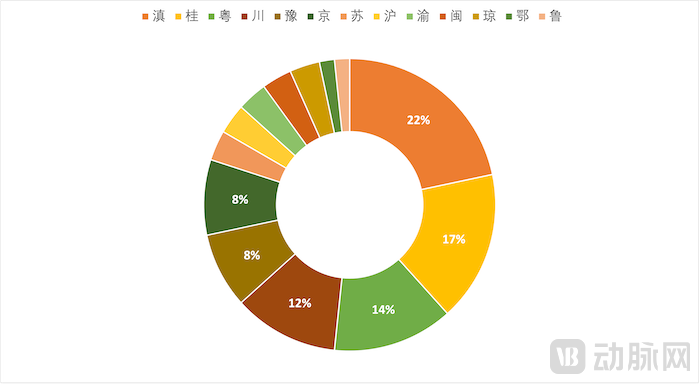
Distribution of Monkey Farms in China
Cynomolgus monkeys are primarily found in Southeast Asian countries such as Thailand, Laos, Vietnam, Malaysia, and Indonesia. They prefer habitats in tropical regions, including tropical rainforests, mangrove swamps, and areas along tidal rivers. This ecological preference explains why domestic monkey breeding facilities in China are mainly distributed along the southeastern coast, which features a warmer climate. Such distribution patterns also corroborate that China’s experimental monkey industry remains in a predominantly agricultural breeding state, heavily reliant on accommodating the natural behaviors of the animals, with a very low level of intensification.
It is worth noting that the domestic market for experimental non-human primates (NHPs) exhibits characteristics of an oligopoly. Among the fewer than 60 NHP breeding facilities in China, very few are of a relatively substantial scale, defined as having an inventory of more than 100 animals. Over the past three to four years, large-scale breeding facilities have been progressively acquired or taken equity stakes in by Contract Research Organizations (CROs). As a result, most facilities maintaining a certain inventory of suitable adult NHPs do not sell directly to external parties; instead, their supply is primarily consumed internally.
For instance, Chunsheng Biotech and Zhaoqing Chuangyao, two large primate breeding facilities located in Guangdong—a major hub for macaque farming—each maintain an inventory of over 10,000 experimental monkeys. The former was acquired by WuXi AppTec in 2019, while the latter was acquired by Pharmaron in 2021 for RMB 110 million. In the same year, Pharmaron also spent RMB 206 million to acquire Kangruitai, another large primate breeding facility in Guangdong. Furthermore, in April 2022, Joinn Laboratories acquired Yingmao Biotechnology, the leading primate breeder in Yunnan, and the leading primate breeder in Guangxi, for a cumulative price of nearly RMB 1.9 billion.
“Domestically, pharmaceutical companies place advance orders, effectively borrowing against future supplies of monkeys, which further exacerbates the supply-demand imbalance and drives up monkey prices even more,” an investor told VCBeat. “Especially during the COVID-19 pandemic, demand for laboratory monkeys surged rapidly, leading to increased stockpiling practices that have made current high prices somewhat unreasonable.”
Over the past two years, the unit price of laboratory monkeys has skyrocketed from around RMB 10,000 to nearly RMB 200,000. Such dramatic price fluctuations have placed significant pressure on users of these animals, while generating substantial profits for owners of this biological asset. According to annual financial reports, in 2021, WuXi AppTec held animal assets valued at RMB 1.489 billion, with an appreciation of up to RMB 568 million within one year; Joinn Laboratories’ animal asset value nearly doubled. This has made monkey breeding appear to be a risk-free, highly profitable business.
Interestingly, two investors revealed to VCBeat that they had indeed planned to organize a consortium to fund monkey breeding, but ultimately neither initiative came to fruition.
The first hurdle that investors cannot overcome is the excessively long breeding cycle and high risks associated with laboratory monkeys.
“When it comes to investment, you must conduct on-site visits and cannot rely solely on second-hand information for decision-making,” an investor told VCBeat. The context behind this remark was that, before the outbreak of the pandemic, he learned from his contacts in the CRO industry that companies were frequently raising their bids to secure suitable monkeys for experiments, with initial offers often marked up by 30%. At that time, the unit price for adult cynomolgus monkeys used in preclinical studies did not exceed RMB 12,000, a level that had remained relatively stable for nearly a decade without significant increases. This sudden price surge triggered the market sensitivity he had developed over many years as an investor.
He immediately began searching for investment targets across China. However, high-quality targets were surprisingly scarce. “The current market for laboratory monkeys is very similar to the market for laboratory mice from about 20 years ago,” remarked another investor after visiting several large-scale monkey breeding facilities in China. The implication is that these facilities are still in the early stages of development in terms of technical capabilities and operational management.
The obvious market demand and the strained supply capacity indeed make it tempting for one to jump in and go all out. “When the pandemic first broke out, we had identified monkey-breeding experts, communicated with local governments, and reached out to downstream clients; all that was missing was the courage to retreat into the remote mountains to raise monkeys,” he said. He noted that it takes at least three to five years for laboratory-bred monkeys to reach marketable size, and he remained uncertain whether the experimental monkey market, with its unprecedented price surge, could withstand the risks associated with such a long cycle.
“More importantly, although the domestic experimental monkey industry theoretically has good development opportunities in the future, it is not easy to execute,” he added. “This is because regulatory requirements for breeding experimental monkeys are far stricter than those for other laboratory animals. The entire domestic industry chain is relatively weak in this regard; for instance, there are no ready-made solutions for ethical issues such as animal welfare, which inevitably arise, necessitating further exploration.” Ultimately, he abandoned the idea of establishing a facility to breed experimental monkeys.
Later, the wave of CRO acquisitions of non-human primate (NHP) breeding facilities grew increasingly intense, driving up their valuations in tandem with rising prices for laboratory NHPs. But that is a story for another time.
Another investor took an interest in a lake island, but abandoned the idea because the monkey farm’s diseconomies of scale failed to meet basic investment logic.
“Drawing on the experience of breeding laboratory monkeys in countries like Indonesia and Brazil, we believe that small islands offer an ideal environment.” Regarding the breeding of laboratory monkeys, he analyzed the challenges as strict regulations, difficulties in introducing breeding stock, and limited growth potential. At that time, together with another top-tier domestic institution, he was invited to assess investment opportunities in a coastal province, where the topic of breeding laboratory monkeys arose. “The isolated environment of small islands and their relatively stable ecological structure are conducive to maintaining the quality of monkey colonies.” This breeding plan advanced to the stage of communicating with overseas monkey farms for the introduction of breeding stock, but it was ultimately shelved. “Establishing a monkey farm requires the large-scale introduction of breeding monkeys, and continuous replenishment is needed during operations to maintain the quality and reproductive capacity of the colony. This process involves a series of issues related to animal health indicators and import/export regulations,” he explained. “At least at this stage, starting laboratory monkey breeding from scratch is not very realistic.”
Even when fully operational, independently run macaque breeding facilities face a relatively low growth ceiling. “Purebred experimental macaque farming suffers from poor economies of scale,” he explained. The inherent biological differences among animals mean that macaques are unlike mice; ample breeding space and long reproductive cycles are both indispensable. Even with experimental macaques commanding sky-high prices in the current market, a facility raising 1,000 monkeys generates an annual output value of only around RMB 200 million. However, reaching a scale of 1,000 experimental macaques is difficult for most breeding farms to achieve. Unlike laboratory mice, whose housing can be vertically stacked to save space and rapidly expand breeding capacity, macaques cannot be accommodated in such a manner. Moreover, the extensive space required leads to prohibitively high management costs, severely limiting the growth potential of independently operated macaque breeding facilities.
Perhaps, building a monkey farm from scratch is not as logically self-consistent as it appears.
So, how can the predicament of a severe shortage of monkeys be resolved? CROs may hold the key.
First, monkey breeding facilities are ill-equipped to take on a leading role. Due to cognitive gaps and talent shortages, very few such facilities have extended their operations downstream. “To use an imperfect analogy, it is far more difficult for a vegetable farm to open a restaurant than for a restaurant, after scaling up, to strengthen its supply chain management and acquire controlling stakes in farms,” explained one investor. “The team DNA and resource endowments of both parties make it easier for downstream players to move upstream.” For monkey breeding facilities, whether building an in-house team to provide pharmaceutical services or recruiting a professional pharmaceutical team to integrate into their existing management structure, the challenges are substantial.
Monkey farm operators, well-versed in the intricacies of the trade, mostly choose to sell their equity stakes to CROs at high valuations, thereby achieving financial freedom ahead of schedule. This explains why venture capital and private equity firms are rarely seen in the experimental monkey breeding sector.
Secondly, from a logical perspective, the strong intervention of Contract Research Organizations (CROs) can, to some extent, optimize the allocation of resources in China’s experimental non-human primate (NHP) industry. On one hand, integrating NHP breeding facilities into the CRO business workflow transforms the operational nature of NHP husbandry from diseconomies of scale to economies of scale. As part of the CRO’s intensive service model, breeding facilities can focus exclusively on NHP rearing, while CROs integrate the upstream and downstream segments of the industrial chain to enhance overall efficiency. On the other hand, CROs possess more extensive experience in the production and use of laboratory animals. They can apply over 20 years of technological accumulation—originally developed for species such as laboratory mice—to areas such as genetic modification and phenotypic regulation required for constructing disease models in large animals. This capability provides essential empowerment for the nascent field of large-animal disease model development.
Finally, CROs themselves are also eager to make their mark in the experimental non-human primate arena. Beyond the aforementioned appreciation of animal assets, there is an inherent logic behind CROs acquiring and operating monkey breeding facilities.
On one hand, for large contract research organizations (CROs), effectively integrating acquired cynomolgus macaque breeding facilities is not particularly challenging. This is because the unique complexities associated with experimental monkeys are primarily concentrated in the breeding phase, which is led by the breeding facilities, whereas the utilization phase, overseen by CROs, involves skills that differ little from those used for small animals. In other words, the internal learning cost for CROs when utilizing non-human primates as a biological resource is low. For instance, if the difficulty ratio of breeding experimental mice versus experimental monkeys is 1:100, the difficulty ratio of using them might be only 1:10, or even 1:5. For large CRO enterprises, the strategic significance of acquiring monkey breeding facilities lies in truly enabling clients to complete the “last mile” of preclinical new drug development and delivering one-stop services, which will undoubtedly enhance their market competitiveness.
On the other hand, smaller CROs that have acquired non-human primate (NHP) breeding facilities now possess the opportunity to compete with top-tier CROs. “This is equivalent to filling a critical resource gap,” explained an investor. “If we simplify the CRO process, some CROs may not have strong service capabilities in other areas. However, their ample supply of experimental monkeys compels clients to accept their weaknesses in other segments, allowing these CROs to continuously learn and improve through order accumulation.” In a sense, the CRO sector does not have particularly high technical barriers; growth is driven by securing orders. Market reputation is built by delivering satisfactory results across all aspects and providing standardized operations and documentation. Such soft power continues to be refined as the client base and order volume grow.
The process by which CROs absorb monkey farms and achieve self-reinforcement may also be the process by which experimental monkey prices return to normal levels.