

The Biggest Threat to Endoscopy: Johnson & Johnson's $3.4B Surgical Robot Monarch Enters the Arena
For over a decade, the da Vinci Surgical System has dominated the surgical robotics market, with no single competing product worldwide able to rival it.
Recently, Monarch, the flexible surgical robot under Auris, a subsidiary of Johnson & Johnson, received FDA approval for new indications, drawing renewed attention to Monarch following Johnson & Johnson’s $3.4 billion acquisition. Leveraging two high-volume indications—lung biopsy and urinary stone surgery—the Monarch surgical robot is poised to rival the da Vinci Surgical System and become the second most widely used multi-specialty surgical robot globally.
However, the Monarch and da Vinci surgical robots differ in flexibility versus rigidity and serve distinct application scenarios, so they do not yet compete directly. The greater concern lies with endoscopy companies, as the approval of new indications for flexible surgical robots has delivered a direct impact to the endoscopy market.
As early as 2018, the then Chief Strategy Officer of Auris Health made a bold statement: “There are certain issues with endoscopy today. Current endoscopes differ little from those of the 1960s, and they demand a high level of expertise from operators. Therefore, we decided to enter this field.”
Previously, the competitive impact of Auris Health’s Monarch surgical robot was primarily confined to the field of lung biopsy. With the approval of its indication for urological stone removal, the Monarch system now poses a greater threat to the endoscopy market.
The global endoscopy market exceeds $20 billion. Long considered to be in a “technological silence period,” how will the entry of flexible surgical robots reshape the market landscape? Within the complex, curved, and narrow natural lumens of the human body, endoscopes and surgical robots have gradually begun to compete.
On one side are surgical robotics companies such as Johnson & Johnson, Intuitive, Lanhua Medical, MicroPort MedBot, and Edge Medical; on the other are endoscopy giants like Olympus, Pentax, and Fujifilm. How will flexible surgical robots reshape the market landscape? VCBeat interviewed industry insiders to provide an analysis.
The renewed global attention on flexible surgical robots is inseparable from the latest advancements in Monarch, a platform under Johnson & Johnson. In April 2022, Johnson & Johnson announced that its Monarch surgical robot had received FDA approval for a new indication, allowing its use in kidney stone removal.
Compared with percutaneous nephrolithotomy (PCNL), Monarch reduces the complexity of the percutaneous renal access and removes fragmented kidney stones and other debris with higher precision. The system can also be used in ureteroscopic procedures to remove smaller stones.
Initially, the first approved indication for both Johnson & Johnson’s Monarch and Intuitive’s Ion flexible surgical robotic systems was lung nodule biopsy. Previously, flexible surgical robots were synonymous with bronchoscopic surgical robots.
However, the approval of Monarch’s new indications has sparked imagination regarding the market potential for flexible surgical robots.Bronchoscopic surgical robotics is just one of its indications; flexible surgical robots are expected to enable multi-departmental applications, replacing flexible endoscopes in procedures involving the respiratory tract, gastrointestinal tract, vagina, and urinary system.
This also means that the application scenarios for flexible surgical robots are not limited to the respiratory tract. In the past, endoscopic procedures of the respiratory tract, gastrointestinal tract, and urinary tract were dominated by flexible endoscopes.
The endoscopy market can be divided into three major segments: flexible endoscopes, rigid endoscopes, and ancillary diagnostic and therapeutic devices.According to Frost & Sullivan data, the market size of medical endoscopes in China will increase from RMB 23.1 billion in 2020 to RMB 62.4 billion in 2030.
Flexible endoscopes can be freely bent, whereas rigid endoscopes cannot. Unlike flexible endoscopes, rigid endoscopes do not require consideration of shaft flexibility or maneuverability. Flexible endoscopes are primarily used for diagnostic examinations via natural body orifices and can be employed in surgical procedures such as polypectomy. They facilitate examination, diagnosis, and treatment through the human digestive, respiratory, and urinary tracts. Major products include gastroscopes, colonoscopes, and bronchoscopes.
The flexible endoscope market is dominated by three major Japanese companies—Olympus, Pentax, and Fujifilm—and is relatively mature in clinical applications.
How Can Flexible Surgical Robots Challenge Established Flexible Endoscope Products?
The primary advantage of flexible surgical robots lies in their flexibility and control capabilities.
Dr. Ma Jiajun, founder of Langhe Medical, stated, “Flexible endoscopes have already achieved widespread adoption. As they rely on mechanical control, their range of motion is limited. In larger luminal spaces such as the gastrointestinal tract, flexible endoscopes can move in four directions; however, in narrower airways like the bronchi, they are restricted to only two degrees of freedom (up and down). This limitation constrains physicians’ operational capabilities and increases the difficulty of controlling the endoscope. Flexible surgical robots upgrade traditional mechanical manipulation to precise electronic control, granting surgical instruments within body cavities greater multi-dimensional maneuverability and enabling more precise surgical procedures.”
In the respiratory tract, existing bronchoscopy is widely used in procedures such as lung nodule biopsy. However, limited by the control precision and flexibility of bronchoscopes and lacking navigation technology, current bronchoscopes can cover less than 50% of the lung regions, resulting in a low positive biopsy rate.
By integrating navigation technology with master-slave control, the bronchoscopy surgical robot enables preoperative 3D reconstruction of the bronchial tree and path planning. During the procedure, it combines virtual imaging with real-time image guidance, allowing physicians to remotely control the tip of the flexible bronchoscope in real time via a joystick. This system can reach peripheral lung regions beyond the sixth generation of bronchi, facilitating precise real-time biopsies or ablation procedures, thereby significantly improving the positive detection rate of pulmonary nodules and the efficacy of early-stage treatment.
This is akin to the difference between manually driven cars and intelligently driven ones. The distinct design philosophy and architecture of intelligent driving enable the integration of more digital-based smart features, which cannot be achieved by simply adding functions to manually driven cars.
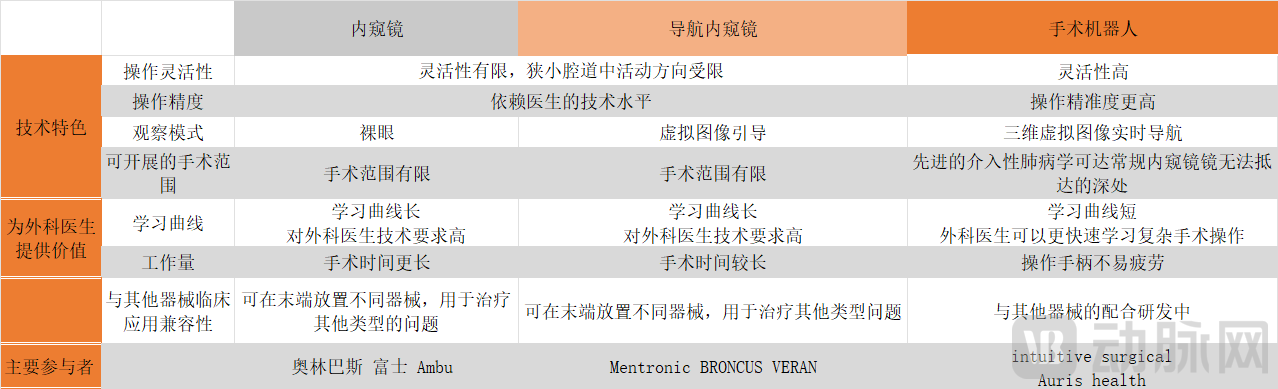
Differences Between Flexible Surgical Robots and Endoscopes and Electromagnetic Navigation Endoscopes
The second major advantage is that flexible surgical robots lower the operational threshold for physicians. Although flexible endoscopes are used in a wide variety of procedures, they demand high levels of operator skill. Training a proficient endoscopist requires years of specialized clinical practice. Flexible surgical robots convert mechanical control into electronic control, allowing physicians to perform procedures intuitively by simply manipulating the control handle. This significantly reduces operational difficulty and markedly shortens the learning curve.
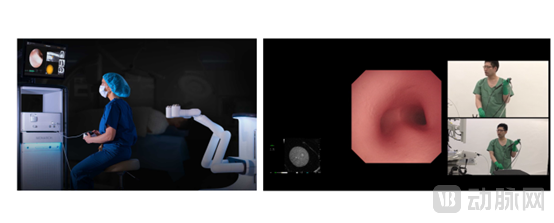
Surgeon operating a flexible surgical robot (left) and an endoscope (right)
The lever-based mechanical design of traditional endoscopes dictates that the direction of the physician’s manipulation is opposite to the direction of the instrument’s movement, requiring extensive practice for physicians to achieve hand-eye coordination.
For surgical procedures such as Endoscopic Submucosal Dissection (ESD), physicians may require years of practice to achieve proficiency. The difficulty of existing ESD procedures stems from the limited flexibility of current surgical instruments, which typically consist only of an electrosurgical knife, forceps, and an endoscope. Given the multitude of maneuvers required within the intestinal tract, substantial clinical experience is necessary for physicians to perform these procedures skillfully. On average, performing an ESD procedure takes between forty minutes and one hour.
Hong Kong-based Choketech Medical Robotics has developed a fully flexible, natural-orifice surgical robotic arm for endoscopic submucosal dissection (ESD) procedures, which can be used in conjunction with existing flexible endoscopes. Professor Guo Jiawei, founder of Choketech Medical Robotics and a professor at the University of Hong Kong, stated, “The motivation behind developing a gastrointestinal surgical robot was the recognition that there is still considerable room to enhance existing tools through mechanization, thereby improving surgical outcomes and reducing physicians’ training time.”
A similar dilemma exists in urological surgery. When flexible ureteroscopes are available, the need for urologists to acquire new skills becomes apparent, particularly for those unfamiliar with flexible cystoscopy. Controlling the deflection of the flexible scope is a technically challenging skill, especially in anatomical regions with sharp angulations and complex curves. Consequently, flexible ureteroscopy has been adopted by only a subset of urologists. In contrast, during robotic surgery, physicians operate surgical instruments using controls akin to a gamepad.
In terms of surgical outcomes, the force feedback mechanism and flexible angles of surgical robots can help doctors perform surgeries more precisely and reduce the occurrence of complications.
Whether bronchoscopy, endoscopic submucosal dissection (ESD), or percutaneous nephrolithotomy, these are all commonly performed clinical procedures. Existing instruments are not yet optimal; flexible surgical robots can carve out a niche by offering a lower learning curve and more precise operative control.
Although both are surgical robots, the core technical barriers involved in natural orifice surgical robots differ significantly from those of laparoscopic surgical robots. Laparoscopic surgical robots have a development history spanning over 30 years, whereas flexible surgical robots emerged at a later stage.
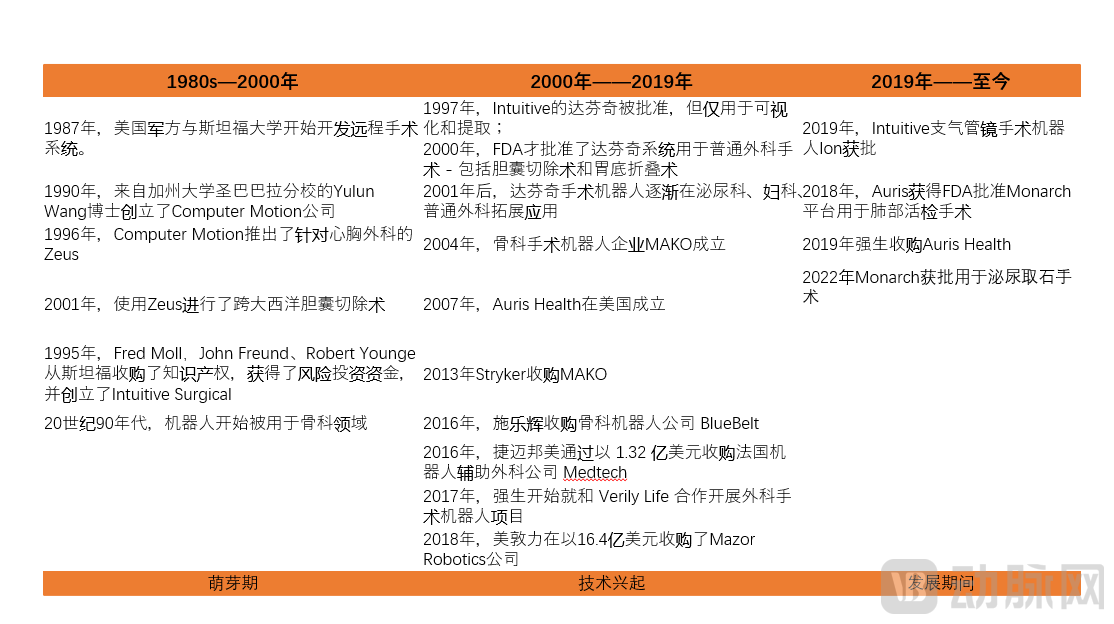
The History of Surgical Robot Development
Compared with rigid surgical robots, the difficulty of natural orifice surgical robots can be described in one sentence as “performing a grand ritual inside a snail’s shell.”
Whether in the digestive tract or the respiratory tract, human natural lumens are highly tortuous. Rigid surgical robots are not designed for operation in such environments, necessitating that natural-orifice surgical robots be flexible enough to adapt to the anatomical contours of these lumens. Safety is also a critical requirement for robots operating within natural orifices; they must not cause damage to the linal walls during navigation. In narrow passages such as the respiratory tract, where the diameter progressively decreases, surgical robots must not only be sufficiently compliant and bendable but also slim enough to traverse these confined spaces.
Professor Guo Jiawei from Qiaojie Li Medical Robotics told VCBeat, “The challenge with natural orifice surgical robots lies in controlling the overall diameter of the components that pass through the human body and performing more maneuvers within limited space. Our company’s design philosophy is to use fully flexible robotic arms for endoscopic operations, with the main difficulty being the design of the robotic arms.”
Another key technology for flexible surgical robots lies in how to achieve flexibility while simultaneously enabling dexterous control and force transmission for the operation of surgical instruments, allowing diagnostic and therapeutic procedures such as biopsy and resection to be performed at the distal end. Achieving a balance between force and dexterity within narrow passages has always been a critical technical challenge constraining the development of natural orifice surgical robots.
Ma Jiajun, CEO of Langhe Medical, stated: “For flexible surgical robots operating through natural orifices, it is necessary to overcome the motion limitations inherent in da Vinci-style laparoscopic surgical robots, which stem from joint rigidity and material stiffness. Constrained by the narrow operative space within natural orifices, flexible surgical robots impose exceptionally high requirements on the user-friendliness and ease of use of human-robot interaction.”
In addition to control technologies for surgical robots, intraoperative navigation technologies for natural orifice surgical robots also present high barriers to entry. This is particularly true for bronchoscopic surgical robots. Due to the extensive branching of the bronchi within the lungs, although physicians have historically been able to obtain endoluminal images of the airways via endoscopy, they were unable to determine the real-time position of the endoscope within the pulmonary bronchial tree. Operating the endoscope was akin to navigating a maze, requiring physicians to possess extensive familiarity with anatomical structures and spatial orientation. Navigation technologies assist physicians by providing accurate, real-time positional information.
An industry insider stated: “Johnson & Johnson’s Auris surgical robot excels in navigation technology, demonstrating robust capabilities in real-time intraoperative navigation.“The MONARCH Platform combines three distinct navigation technologies—electromagnetics, optical pattern recognition, and robotic kinematics data—to provide real-time measurement and localization of the bronchoscope’s position during procedures, thereby delivering accurate positional information to physicians performing bronchoscopy.”
The R&D of flexible surgical robots, along with control technology, navigation technology, and human-computer interaction technology, collectively constitute the primary R&D barriers for natural orifice surgical robots. In terms of these technological barriers, global participants each possess distinct characteristics and advantages.
As a sector where Johnson & Johnson, Intuitive Surgical, Longhe Medical, and other players in minimally invasive surgical robotics have all established their presence, the commercial potential of natural orifice surgical robots is gradually being realized.
Currently, four natural orifice surgical robots have received U.S. FDA approval or obtained European CE marking worldwide. These include Intuitive Surgical’s Ion endoscopic system for peripheral lung tissue examination, Johnson & Johnson’s Monarch robotic platform for pulmonary biopsy, Memic’s Hominis robot for vaginal robotic surgery, and MedRobotics’ Flex robotic system for visualization and surgical access in the anus, rectum, and distal colon. Among these, the first two products are bronchoscopic surgical robots.
In China, although no natural orifice surgical robots have been approved to date, multiple surgical robotics companies are actively developing related products. These include Longhe Medical, MicroPort Surgical Robot, Edge Medical, Broncus Medical, Langkai Medical, Puli Medical, and Qiaojie Li Surgical Robotics, with the majority of these enterprises focusing on the development of bronchoscopic surgical robots.
In terms of commercial performance, data from Intuitive Surgical indicate that the Ion system received FDA approval in 2019, with approximately 40 units installed in 2020; in 2021, the Ion surgical robot facilitated 2,950 procedures, and 129 units were installed. Data from Auris Health, a subsidiary of Johnson & Johnson, show that the Monarch platform has been used in over 10,000 procedures.
In terms of commercialization speed, bronchoscopy surgical robots have achieved rapid global installation. According to a report by Frost & Sullivan, the global market size for natural orifice surgical robots has experienced sustained and rapid growth in recent years, increasing from RMB 21.4 million in 2016 to RMB 520 million in 2020, with a compound annual growth rate (CAGR) of 122.2%. The market is projected to further expand to RMB 25.74 billion by 2030, at a CAGR of 47.7%.
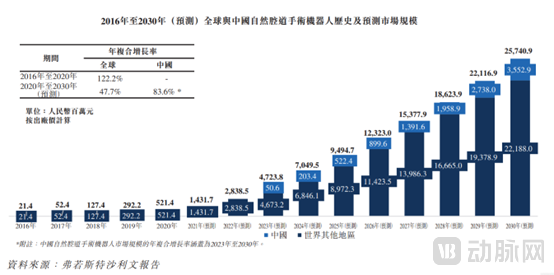
The rapid volume growth of natural orifice surgical robots is attributed to their applicability in diagnostic examinations. Globally, a massive number of flexible endoscopic procedures are performed each year. According to Frost & Sullivan, there were 7.1 million bronchoscopies performed worldwide in 2020, including 3.84 million in China. According to announcements from Nanwei Medical, approximately 300,000 endoscopic submucosal dissection (ESD) procedures were conducted in China in 2018, with a compound annual growth rate exceeding 20% over the preceding three years.
As flexible surgical robots gradually expand their indications, the market potential for flexible surgical robots will be substantial.
China’s surgical robot market is predominantly concentrated in laparoscopic, vascular interventional, and orthopedic surgical robots, while natural orifice surgical robots remain relatively scarce. In the endoscopy market, domestic substitution of flexible endoscopes has been challenging, as the Japanese companies Olympus, Pentax, and Fujifilm dominate the domestic flexible endoscope market. According to data from Guoyuan Securities, the market share of domestic brands in China’s flexible endoscope market is less than 5%, indicating substantial room for substitution. Flexible surgical robots, capable of replacing certain functions of flexible endoscopes, are poised to become an opportunity for Chinese manufacturers to achieve leapfrog development.
Exploration of natural orifice surgical robots is still in its early stages. The development trajectories of earlier-established laparoscopic and orthopedic surgical robots demonstrate that the ultimate value of surgical robots lies in mass production, emphasis on performance growth, and commercialization. Whether natural orifice surgical robots can replace the market space occupied by flexible endoscopes remains to be verified over time.