

2022 Pharmaceutical R&D Trends Annual Analysis: COVID-19 Drug Development Cools Down as Hengrui and Fosun Enter Global Top 25
In the third year of the protracted battle against COVID-19, the virus has left its mark on every aspect of our lives, creating the perception that everything revolves around the pandemic, particularly in the pharmaceutical and healthcare sectors.
However, the world beneath the data often contradicts our subjective perceptions, much like our understanding of R&D for COVID-19 therapeutics.
In May 2022, the global pharmaceutical intelligence platform Informa Pharma Intelligence released online the white paper “Annual Analysis of Pharmaceutical R&D Trends 2022,” which stated that 6,343 new investigational drug candidates were added to the Pharmaprojects database in 2021.
Among the newly added drugs, over 38.8% were anticancer agents. Neurological drugs ranked second at 14.7%, while anti-infective drugs—primarily those related to COVID-19—ranked third with only a 12.0% share, significantly lower than the 17.5% accounted for by new drugs indicated for one or more rare diseases.
What is even more striking is the significance of the figure 6,343 itself. Compared with the 5,544 candidate drugs added in 2020 and the 4,730 added in 2019, this seems to indicate that global enthusiasm for pharmaceutical R&D, after briefly converging during the COVID-19 pandemic, has once again begun to diversify.
Of course, making judgments based solely on single-dimensional data may be too arbitrary. In the “2022 Annual Analysis of Pharmaceutical R&D Trends,” Informa Pharma Intelligence found sufficient evidence to support the development trends for the new year—in 2022, the winds of recovery had already begun to blow.
Analyzing Trends: The Total Size of the Pipeline Is a Simple Yet Clear Macro Indicator.
At the start of 2022, the number of drugs in the global R&D pipeline surpassed the 20,000 mark, reaching a total of 20,109, an 8.22% increase from 2021—nearly double the previous year’s growth rate of 4.76%. Among these, antineoplastic agents accounted for the largest share of the increase, followed by drugs in other therapeutic areas, including those for neurological disorders and anti-infectives.
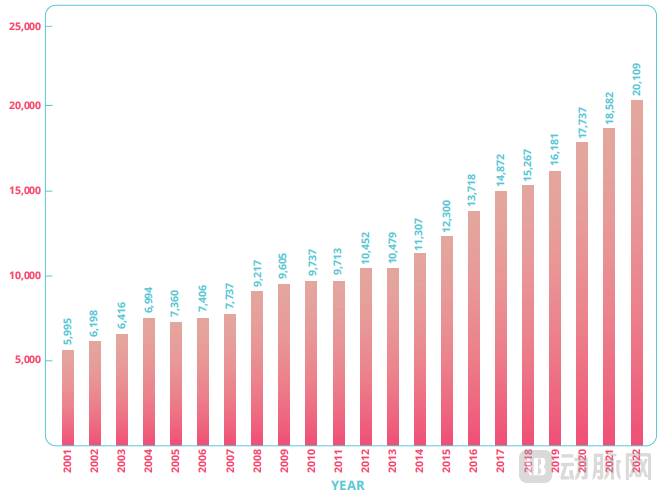
Overall Scale of the R&D Pipeline by Year, 2001–2022 (Data Source: Pharmaprojects)
Compared with drugs in the oncology and neurology fields, COVID-19-related drugs have experienced growth, but at a slower pace than a year ago. The white paper predicts that as COVID-19 vaccines and related therapeutics continue to gain approval, the growth rate of COVID-19-related R&D will decelerate; furthermore, as the impact of the pandemic on the pharmaceutical industry gradually diminishes in the post-pandemic era, the global R&D sector will slowly return to normalcy.
Further Breakdown of the R&D Pipeline. The growth in pipeline scale is primarily concentrated in preclinical-stage drugs, with a growth rate as high as 11.0%. A total of 1,128 new drugs entered the preclinical development stage, representing a significant increase compared to the 6.0% growth rate for preclinical-stage drugs in 2020, and outperforming the incremental trends observed in clinical trials in recent years.
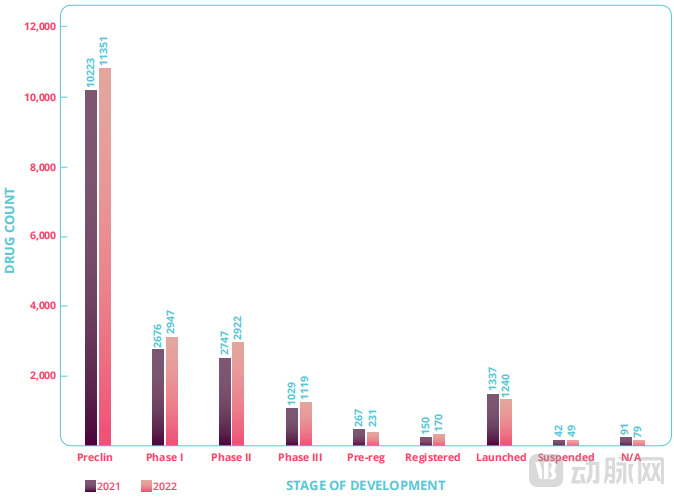
Comparison of R&D Pipelines Across Development Stages in 2022 vs. 2021 (Data Source: Pharmaprojects)
The number of drugs in Phase I clinical trials has also increased. Currently, there are 2,947 drugs in Phase I clinical trials in the pharmaceutical industry, indicating a clear phase of rapid development. The growth rate reached 10.1%, surpassing not only the overall growth rate of the pipeline but also last year’s growth rate of 6.4%. Last year, the growth rates for drugs in Phase II and Phase III clinical trials were merely 2.0% and 0.9%, respectively; however, this year, the pharmaceutical industry has achieved explosive growth of 6.4% and 8.7%, respectively.
It is important to note that the number of drugs in Phase II clinical trials is roughly similar to that in Phase I. This does not imply that all drugs undergoing Phase I clinical trials can smoothly advance to Phase II. In fact, a considerable number of drug candidates are discontinued between Phase I and Phase II clinical trials. However, since Phase II development typically requires a longer duration, a “bottleneck” or accumulation of drugs tends to occur at this stage.
Phase III clinical trials serve as a more significant barometer for the pharmaceutical industry. In recent years, the number of Phase III clinical trials has remained at an “idle” level, but this year appears to have seen a “hot start,” with the number of trials in this stage rising from 1,029 to 1,119, ending a five-year period of stagnation.
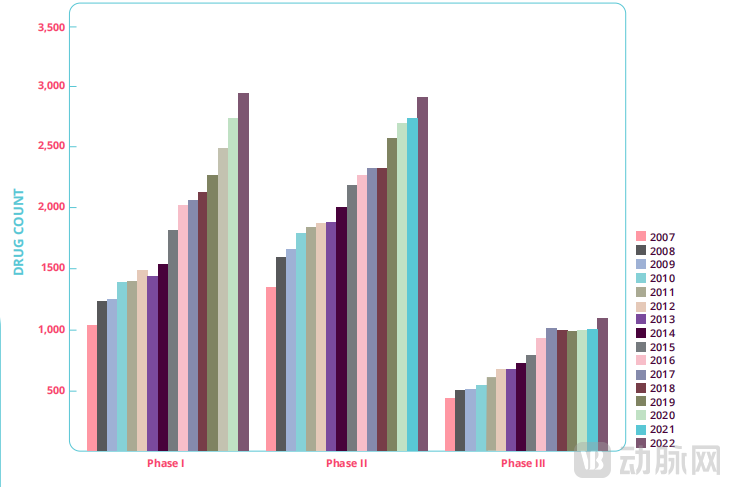
Trends in Clinical Trial Phases, 2007–2022 (Data Source: Pharmaprojects)
Overall, nearly all clinical trial phases in the pharmaceutical industry have entered a period of rapid growth. As clearly illustrated by the chart “Trends in Clinical Trial Phases, 2007–2022,” the momentum of clinical trials has surged again after several years of sluggishness.
Regarding this phenomenon, Andy Benson, Senior Director at Trialtrove, another research institution under Informa, explained, “The recovery in trial activity was to be expected, as many sponsors have now begun to adopt more innovative approaches to clinical trial recruitment and conduct, and the scale and nature of COVID-19-related restrictions have changed significantly across regions over time.” He continued, “The number of confirmed trial initiations in 2021 is expected to be higher, because delays in the release of certain trial activity reports (particularly Phase I clinical trials in some regions) have affected the statistical analysis of trial data; therefore, the final figures may be several percentage points above 2%.”
Although new drugs and clinical trials demonstrate the rare vitality in the field of pharmaceutical R&D, this driving force seems to have little to do with the top-tier pharmaceutical companies.
No new entrants appeared among the top 15 pharmaceutical companies ranked by R&D pipeline size, and even the ranking order saw little change.
Novartis, which ranked first, saw a slight reduction in the number of drugs in its pipeline (from 232 to 213), while Roche, in second place, decreased from 227 to 200. Additionally, Takeda (third), Bristol-Myers Squibb (fourth), and Pfizer (fifth) all experienced marginal declines in their pipeline sizes.
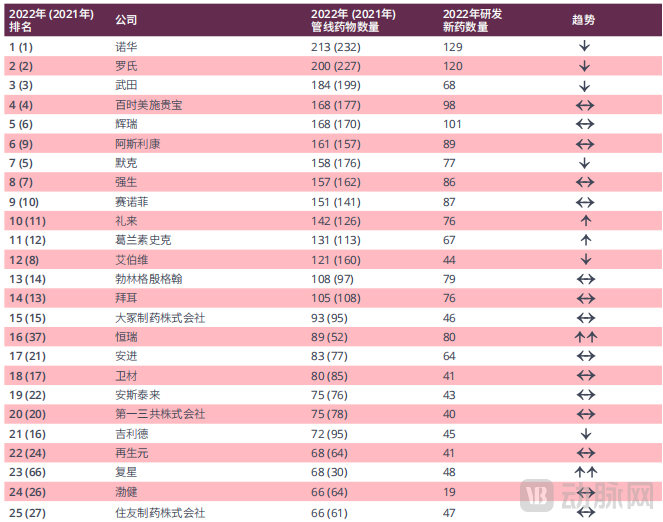
Top 25 Pharmaceutical Companies Ranked by R&D Pipeline Size (Data Source: Pharmaprojects)
According to the white paper, the overall pipelines of the Top 10 companies have stagnated or declined slightly, which can be partly attributed to the notably low M&A activity among major players this year.
Novartis acquired Cadent Therapeutics for $770 million early last year, Pfizer secured Trillium Therapeutics for $2.3 billion, and Eli Lilly spent $1 billion to bring Protomer Technologies into its fold, while Roche, Takeda, Bristol Myers Squibb, and Johnson & Johnson remained on the sidelines, staying completely out of the M&A game.
In stark contrast to top pharmaceutical companies are those in the Asia-Pacific region. While more than half of the world’s leading pharmaceutical firms face shrinking R&D pipelines, some Chinese pharmaceutical companies have stood out, surging into the first tier of the global pharmaceutical landscape.
White paper data shows that in the 2022 ranking of the top 25 global R&D pipelines, two companies headquartered in China—Jiangsu Hengrui and Shanghai Fosun Pharma—appeared for the first time. Over the past year, these two pharmaceutical giants surged in the rankings, securing the 16th and 23rd positions, respectively. Notably, another Chinese pharmaceutical company, BeiGene, ranked 26th, just one spot away from breaking into the top 25.
Moreover, the proportion of Chinese pharmaceutical R&D companies in the global total surged from 9% to 12%, with the number of companies skyrocketing from 522 to 792, representing a remarkable increase of 43.3%. In terms of the volume of drug development, China accounted for 20.8% of the global share, ranking second only to the United States.
Regarding this shift, the white paper describes it as a milestone in the history of pharmaceutical R&D in China: “We often say (albeit inaccurately) that the Great Wall of China is the only man-made structure visible from outer space. What is certain, however, is that after years of rapid development, Chinese pharmaceutical R&D companies have finally made their mark on the global pharmaceutical landscape.”
Over the past year, despite ongoing restrictions on researchers due to the COVID-19 pandemic, the level of innovation in pharmaceutical research and development reached a historic high.
White paper data shows that the total number of targets addressed by drugs currently in development has grown to 1,952, an increase of nearly 100 compared to last year. In addition to mainstream chemically synthesized drugs, the proportion of monoclonal antibodies and biotech drugs under investigation is continuing to rise.
Furthermore, as the overall scale of therapeutic drugs continues to expand, emerging and rare diseases are providing new directions and areas of exploration for the pharmaceutical industry. Data from the white paper indicates that R&D of drugs for rare diseases has shown an upward trend over the past year, with at least one drug in development for each of the 677 rare diseases identified. In the past year alone, 39 drugs received emergency authorization, and the number of orphan drugs and emergency-authorized drugs exceeded the levels seen in 2020.
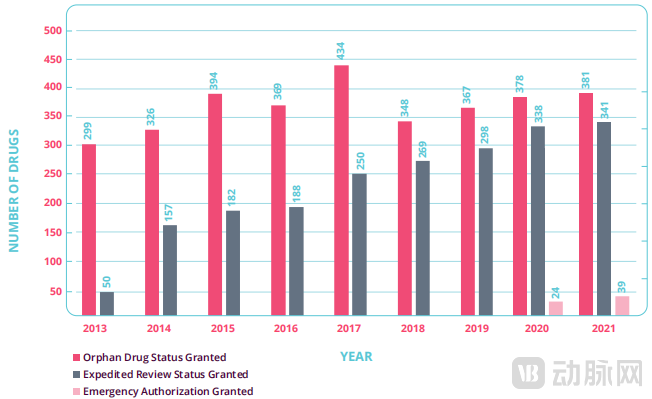
Number of Drugs Granted Orphan Drug Designation, Accelerated Review Eligibility, and Emergency Use Authorization, 2013–2021 (Data Source: Pharmaprojects)
Given this diversified and innovative trend, the white paper predicts that a major turning point in biotechnology may arrive by the mid-21st century. However, to reach this destination, the world must first return to normalcy.
Ian Lloyd, the author of the white paper, wrote at the end: “The pharmaceutical industry has traversed an extraordinary path over the past two years and is now regrouping for the journey ahead. Although the road ahead will be fraught with challenges, occasional roadblocks, and moments of disorientation, once it leaves the pandemic behind, it will navigate more smoothly and accelerate to full speed.”