

Is Pharmaceutical Cold Chain Logistics a Promising Investment Sector Amid Five-Year Market Doubling?

Jointown Pharmaceutical Group
Integrated Service Provider for the Full-Chain Pharmaceutical Industry
MPCi
Venture Capital Institutions in High-Tech Startup Fields
As of May 21, 2022, a total of 3.37 billion doses of COVID-19 vaccine had been administered nationwide in China.
Amid the sweeping wave of new Omicron variants, China has introduced a new response measure: establishing “15-minute nucleic acid testing sampling circles” in major cities.
As COVID-19 vaccines and nucleic acid testing kits reach each and every one of us, an unavoidable challenge is how to transport them. Little known is the fact that inactivated vaccines must be transported at 2–8°C, while conventional nucleic acid test reagents require cold-chain storage and transportation at (-20±5)°C—this constitutes a massive undertaking demanding highly specialized, stringent pharmaceutical cold-chain logistics.
"If the COVID-19 pandemic brought vaccines and nucleic acid testing into the spotlight, then pharmaceutical cold-chain logistics, as a downstream segment of the industry chain, can be said to have seized the opportunity to enter an acceleration phase."
This article attempts to analyze: How has the pharmaceutical cold-chain logistics sector developed in recent years? And how much room for growth remains in this somewhat “cold” niche?
Rapid Strategic Expansion
With annual revenue of RMB 128 billion and net profit of RMB 95.6 billion, Sinovac Biotech, a developer and manufacturer of COVID-19 vaccines, has briefly found itself at the center of public scrutiny.
Behind this success, Jointown Pharmaceutical Group (Jointown)—the only private enterprise among China’s four major pharmaceutical distribution companies and the supplier responsible for distributing COVID-19 vaccines nationwide—also achieved a breakthrough in revenue from pharmaceutical cold-chain logistics transportation: in 2021, Jointown’s third-party logistics business generated RMB 580 million in revenue, a year-on-year increase of 74.31%. Jointown explained to VCBeat that the majority of this revenue and growth came from Sinovac vaccine distribution service orders starting in January 2021.
As a long-established pharmaceutical distribution enterprise, Jointown Pharmaceutical Group began its layout in pharmaceutical cold chain logistics more than 20 years ago. Yi Junchen, General Manager of the Cold Chain Business Division of Jointown Logistics Headquarters, told VCBeat, “When China’s pharmaceutical cold chain industry was just taking off in 2012, Jointown had already stepped up investment in research on cold chain packaging technologies and mastered the core technologies for cold chain distribution.”
Subsequently, Jointown Pharmaceutical Group established a dedicated cold chain business division in 2014. According to the cold storage area data disclosed in its annual reports since 2016, the company’s cold storage capacity grew from 15,704 square meters in 2016 to 44,000 square meters in 2020, representing a compound annual growth rate (CAGR) of over 29%. Yi Junchen attributed this rapid growth to Jointown’s initial strategic plan for its cold chain logistics business, noting that the period from 2016 to 2020 focused primarily on constructing regional logistics centers, as the cold chain infrastructure of certain regional subsidiaries was still incomplete.
2016—An Inescapable Year for Pharmaceutical Cold Chain Transportation
That year witnessed the nationally shocking “Shandong Vaccine Scandal.” In March, Shandong police cracked a case involving the illegal distribution of vaccines valued at 570 million yuan. Approximately 2 million doses of vaccines, which had not been stored or transported under strict cold-chain conditions, were found to have been sold across 24 provinces and municipalities nationwide, accounting for about 2‰ of the total volume of vaccines marketed during the period in question. The implicated vaccines included 25 types of Category II vaccines for both children and adults, affecting 24 provinces such as Anhui, Beijing, Fujian, Gansu, and Guangdong, with more than 300 individuals involved in the case.
Although these vaccines involved in the case were produced by legitimate manufacturers, failure to adhere to required cold-chain storage and transportation protocols, coupled with the fact that some were near their expiration dates, posed risks of expiration and deterioration during distribution.
Looking back,2016 was a pivotal policy year for the pharmaceutical cold chain transportation industry.——
The exposure of the Shandong vaccine scandal revealed numerous issues, including an imperfect cold-chain logistics regulatory system, inconsistent regulations and standards for pharmaceutical cold-chain logistics, lagging infrastructure development, and inadequate informatization. It also prompted relevant authorities to attach great importance to vaccines and pharmaceutical cold-chain logistics. The state has subsequently issued multiple documents to regulate the distribution of cold-chain pharmaceutical products, including the newly revised Regulations on the Administration of Vaccine Circulation and Vaccination.
Subsequently, large national distribution enterprises successively established dedicated cold chain divisions. Following the State Council’s elimination of administrative approval requirements for pharmaceutical logistics qualifications, third-party logistics providers also began actively positioning themselves to enter the pharmaceutical cold chain logistics market.
It was not until 2020, when the COVID-19 pandemic erupted, that Jointown Pharmaceutical Group first stated in its annual report that it regarded pharmaceutical cold-chain logistics as “the most promising business segment in drug distribution.” Soon afterward, Jointown undertook the national distribution project for Sinovac’s vaccines, investing RMB 70 million over two years to purchase 135 refrigerated trucks dedicated to vaccine transport.
Currently, Jointown Pharmaceutical Group has established a large-scale layout comprising 31 provincial-level logistics distribution centers, 110 prefecture-level logistics distribution centers, 519 cold storage facilities with a coverage rate exceeding 98%, over 430 refrigerated trucks, more than 5,000 insulated containers, and five cold-chain trunk line networks.
The pandemic served as both a high-pressure test and an opportunity for technological iteration in the cold-chain transportation of pharmaceuticals.Yi Junchen introduced that the greatest challenge in the distribution process is maintaining temperature control throughout the entire journey. “Due to the vast distances and wide coverage of vaccine distribution areas, it is difficult to maintain cold-chain temperature control throughout the process. This is particularly challenging given the significant temperature differences across China from east to west and north to south during the same season, which imposes stringent requirements for temperature control under extremely cold or hot weather conditions. Furthermore, maintaining stable temperatures is difficult during transshipment between large and small vehicles at trunk and branch logistics nodes.”
Jointown Pharmaceutical Group’s response measures include: first, retrofitting vaccine transport vehicles with insulation materials; second, independently developing a cargo transfer docking chamber equipped with adjustable door seals to accommodate vehicles of various sizes, thereby maintaining temperature consistency during the transition from receiving docks to warehouse interiors; and third, establishing a temperature-control management platform capable of simultaneously monitoring in-transit information for 120 delivery vehicles.
Regarding Jointown’s future development plans, Yi Junchen appeared confident and ambitious. “The target for the average annual growth rate of operating revenue for Jointown Pharmaceutical Cold Chain over the next four years (2023–2026) is to exceed 20%. By 2026, the revenue from third-party cold chain services is targeted to reach RMB 470 million, positioning Jointown among the top ten enterprises in China’s third-party pharmaceutical cold chain logistics industry by revenue. Jointown will also reduce operational costs for its internal businesses through business resource integration and technological and equipment innovation, with a plan to decrease the expense ratio by 3% annually,” said Yi Junchen.
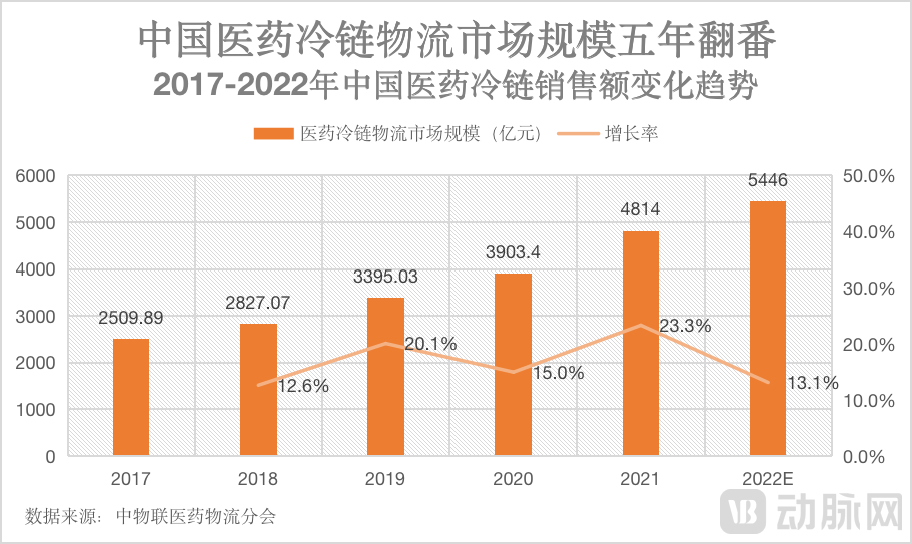
The development of Jointown Pharmaceutical Group is a microcosm of China’s pharmaceutical cold chain logistics industry. Against the backdrop of an expanding range of temperature-controlled drugs, the large-scale centralized launch of COVID-19 vaccines, and intensified R&D efforts in biologics, the market size of the pharmaceutical cold chain has continued to grow substantially.According to statistics from the Pharmaceutical Logistics Branch of the China Federation of Logistics & Purchasing, the total sales volume of China’s pharmaceutical cold chain logistics reached RMB 250.9 billion in 2017 and rose to RMB 481.4 billion by 2021.Nearly doubled over five years.The Pharmaceutical Logistics Branch of the China Federation of Logistics & Purchasing (CFLP) predicts that the market size of China's pharmaceutical cold chain will reach RMB 544.6 billion in 2022.
The Boom in Biopharmaceuticals Drives the Prosperity of the Pharmaceutical Cold Chain Market
The COVID-19 pandemic added fuel to the fire of the pharmaceutical cold chain, but in reality, this fire was already burning brightly before then.The previous wave of momentum came from the biopharmaceutical sector. Against the backdrop of a new round of healthcare reforms, the medical insurance system’s “making room for new initiatives” strategy has driven innovation and upgrading in the pharmaceutical industry. Following the rise of biopharmaceuticals, demand has subsequently emerged for logistics services related to biological sample transport, clinical trial logistics, biopharmaceuticals and diagnostic reagents, biological sample storage, and logistics for biomedical materials.
This is corroborated by statistics from the Pharmaceutical Logistics Branch of the China Federation of Logistics & Purchasing, which show that biological products account for the largest share of cold-chain transported goods, at 40.77%. Based on product categories, pharmaceutical cold-chain transportation products in China include vaccines, blood products, biological products, in vitro diagnostics (IVD), and medical devices (excluding IVD). Apart from biological products, the shares of the other categories are as follows: vaccines account for 10%, blood products for 13.86%, IVD for 24.9%, and medical devices (excluding IVD) for 10.5%.
Yang Yanjun, the founder of Zhongjian Yunkang, identified this opportunity and entered the market to launch his venture in 2018.
As a veteran with 15 years of experience in client-side logistics and supply chain management, Yang Yanjun served as the Logistics Director at KingMed Diagnostics, a third-party medical testing institution, prior to launching his own venture.
When Yang Yanjun decided to start his own business, his baby was just one month old. He sold an apartment to raise the initial capital, describing it as “a startup venture undertaken with no way back.”
Although the path ahead is a “no-retreat” adventure, Yang Yanjun is clearly full of confidence in the future—based on his professional observations, the pharmaceutical cold chain’sMarket supply falls far short of demand, making it a rare blue ocean market.。
At that time, as the client responsible for selecting pharmaceutical cold-chain logistics providers for his company, he often found himself frustrated. The number of reputable pharmaceutical cold-chain suppliers on the market was few—“perhaps only five or six”—while their prices were relatively high, and neither their service professionalism nor the geographic coverage of their service networks was satisfactory.
On the other side of scarce supply is rapidly growing demand.“As the river warms in spring, the ducks are the first to know.” Yang Yanjun quickly observed that the business volume and revenue of KingMed Diagnostics’ new drug clinical department were rising sharply. He was convinced that the new round of healthcare reform policies was taking effect, and that innovative drugs in China were indeed experiencing “explosive growth.” His opportunity was also on the horizon—after benchmarking and studying markets in Europe, the United States, and Japan, Yang Yanjun was certain that China’s cold-chain pharmaceutical logistics market still had substantial room for growth.
The subsequent story is that Zhongjian Yunkang entered the market through its familiar territory of cold-chain logistics for third-party medical testing, gradually expanding into the fields of IVD, CRO, and biopharmaceuticals, thereby seizing opportunities in industry development.
For Zhongjian Yunkang, undertaking BGI Genomics’ non-invasive prenatal testing (NIPT) project for pregnant women in Hebei Province in 2019 marked a critical turning point.
In July 2019, BGI Genomics won the bid for Hebei Province’s non-invasive prenatal genetic testing service project. This public welfare initiative in Hebei Province provides one free prenatal genetic screening (or serum screening for Down syndrome) to pregnant women within its jurisdiction during pregnancy. The total number of genetic screenings conducted that year was approximately 350,000, with a total project budget of RMB 140 million.
To successfully implement such a public welfare project, the cold-chain logistics must meet two key requirements: first, in terms of coverage, it must encompass all county-level cities in Hebei Province, serving more than 200 hospitals; second, regarding timing, it must ensure that samples collected from each hospital on the same day are delivered to BGI’s laboratory in Shijiazhuang, Hebei Province, either on the same day or by the next day.
“But the logistics and transportation of biological samples are by no means a simple matter of moving and delivering them from point A to point B.” Yang Yanjun believes that the key to winning the bid at that time lay in the fact that Zhongjian Yunkang’s solution was not based on a pure logistics mindset, but rather on an actionable plan that truly understood the transportation needs of third-party medical testing. “Many factors need to be considered throughout this process, including how to train logistics personnel, how the entire system operates, and how to develop the information technology systems. Moreover, numerous procedural details must be incorporated into every stage of transportation, such as uploading photos to the backend system, identifying sample test items, and conducting on-site handovers.” These aspects precisely reflect the expertise Yang Yanjun had accumulated over the previous decade.
In Yang Yanjun’s words, the predicament BGI Genomics encountered when seeking logistics providers was identical to the one he faced during his tenure on the client side.
Shortly after the Hebei project, BGI Genomics extended an olive branch to Zhongjian Yunkang by providing angel-round investment and increasing its capital contribution by RMB 5.5 million the following year. Subsequently, the company completed its Series A financing and a Series A+ round amounting to tens of millions of RMB, with Matrix Partners China (MPCi) and Sinopharm Capital as the respective investors.
Logistics is a business with significant scale effects. As demand increases, the upstream sector—particularly the cold-chain storage required for the transshipment and distribution of temperature-sensitive biological materials, including aviation-controlled temperature containers—has gained rare development opportunities.
“The packaging box is the core of the cold chain.”A freight forwarder with extensive experience in international cold-chain logistics told VCBeat that, previously, due to limited demand for cold-chain services and a scarce variety of domestically produced packaging options, international pharmaceutical cold-chain shipments predominantly relied on packaging boxes from international brands. A common issue was the lack of customized fit between the packaging boxes and the products, resulting in “wasted space”—meaning the internal volume of the packaging boxes was not fully utilized.
A notable change over the past two years is that, with the growing demand for pharmaceutical cold-chain logistics, domestic brands have entered the market for air cargo containers. “With more specifications available, there is greater choice, and costs have consequently decreased.”
Haier Biomedical is a pioneer among domestic entrants in the field of aviation temperature-controlled containers.
Established in 2005, Haier Biomedical is a provider of integrated innovative solutions for life sciences and healthcare, which originated in low-temperature storage and has transformed based on an IoT platform. Its core business encompasses equipment and supporting IoT solutions for biobanking, pharmaceutical and reagent safety, vaccine safety, blood safety, and life science laboratories.
Haier Biomedical’s “Cloud Core” ultra-low temperature freezers, leveraging advantages such as bidirectional intelligent interaction among personnel, equipment, and samples, as well as one-click access for sample management, successfully won the bid for a centralized procurement project of 400 IoT-enabled ultra-low temperature units for all public hospitals in the Capital Region of Denmark, thereby becoming China’s leading brand in the export of medical ultra-low temperature freezers.
Its latest high-profile strategic move was the establishment in December 2021 of a new subsidiary, Qingdao Honghu Aviation Technology Co., Ltd. (hereinafter referred to as “Honghu Aviation Technology”), with a registered capital of RMB 27 million, primarily engaged in international freight forwarding services and related activities.
Last month, Meng Zhigang, General Manager of Honghu Aviation Technology, publicly announced, “Our aviation temperature-controlled containers have successfully completed their inaugural flight, breaking the long-standing monopoly held by foreign brands in the field of active temperature-controlled containers.”
Meng Zhigang stated to the media that the future growth of the air temperature-controlled logistics industry primarily depends on the growth rate of the biopharmaceutical sector. “The reason Haier Biomedical entered the air temperature-controlled logistics business is that we have a user base of more than 3,400 biopharmaceutical clients. Currently, we mainly provide storage-scenario solutions for these users. It is relatively easy for us to extend from storage scenarios to transportation scenarios, as Haier Biomedical has a global user base and operational system that can effectively support the growth of this new air temperature-controlled logistics business.”
Treating Logistics as Infrastructure: Greater Potential for Pharmaceutical Cold Chain
As scale effects are amplified, how much room for growth remains in the pharmaceutical cold chain?
“One possibility is to treat logistics as infrastructure and leverage internet-based strategies to offer more value-added products and services”—this was the answer provided by Zhongjian Yunkang during the interview.
In Zhongjian Yunkang’s strategic layout, the company’s first phase focused on providing one-stop supply chain and SaaS solutions by entering the familiar ICL (independent clinical laboratory) sector. The second phase, which is the current stage, involves optimizing the ICL logistics network, gradually expanding into the IVD, CRO, and biopharmaceutical sectors, while also establishing a presence in overseas markets. In the third phase, the company will increase its market share in logistics services while enhancing its healthcare service platform to create an integrated medical service platform that combines testing, medication delivery, healthcare resources, and health management.
In its discussions with Zhongjian Yunkang, VCBeat observed that the core of this strategy lies in the fact that Zhongjian Yunkang does not view cold-chain logistics merely as a logistics business, but rather focuses on how to deliver superior services to customers. From this perspective, subsequent developments become easier to understand: this approach aligns more closely with internet thinking—treating logistics as infrastructure, and upon reaching customers, seeking opportunities for secondary conversion and value-added services to boost revenue and reduce marginal costs.The value-added services here also includeOperationsCostOptimization, and how to help clients provide more professional services。
Currently, Zhongjian Yunkang’s exploration of innovative businesses includes facilitating overseas logistics and transportation for domestic enterprises. In the future, it will leverage the resources of tens of thousands of registered nurses on its platform to provide home-based health management services to consumer-end users, such as at-home testing, medication delivery, home nursing care, and in-home physical examinations.
It can be said that beyond storage and transportation, companies involved in pharmaceutical cold-chain logistics will have even greater room for growth and innovation.