

Huida Gene Breaks CRISPR Patent Monopoly with Homegrown Innovations, Igniting the $30B Global Gene Therapy Market
The booming gene therapy industry has sparked a new wave of transformation in the biopharmaceutical sector.
The global gene therapy market remains highly active. Data from VCBeat shows that there have been over 300 primary market investment and financing transactions in the global gene therapy sector, with cumulative funding exceeding $15.512 billion. According to Frost & Sullivan, the global gene therapy market size was $2.08 billion in 2020 and is projected to reach $30.54 billion by 2025.
After navigating a series of ups and downs, China’s gene therapy industry has entered its golden age, with particularly rapid growth driven by the rise of gene-editing technologies.According to data from VCBeat, cumulative financing in China’s gene therapy sector had exceeded $3.3 billion by mid-April 2022. In May 2022, Hui-Gene Therapeutics announced the completion of its Series C financing round, amounting to hundreds of millions of yuan. As the first company in China to independently develop gene-editing tools, Hui-Gene Therapeutics has garnered favor from numerous professional investment institutions worldwide, leveraging its core technological advantages and integrated drug development capabilities.
As China’s gene therapy industry enters a new development phase characterized by the parallel advancement of conventional gene therapy and gene-editing-based therapies, independent innovation in foundational technologies—such as gene-editing tools and vector delivery platforms—has garnered significant attention. In response to these industrialization barriers, well-prepared companies have already taken action.
From 2015 to 2020, approximately 250 cell and gene therapy clinical trials were conducted in China, placing the country at the forefront of pipeline development worldwide, with the number of clinical trials second only to that of the United States. However,Basic research and underlying technological innovation in gene-editing tools, however, remain relatively lagging.
In vivo gene therapy products predominantly use adeno-associated virus (AAV) as the drug delivery vector. AAV stands out among viral vectors due to its high safety profile and the tissue tropism exhibited by different serotypes. However, AAV has its own limitations; the limited cargo capacity of the vector itself severely restricts the size of the DNA that can be packaged.
To date, CRISPR-Cas9 remains the cornerstone of gene-editing tools. However, the DNA sequence encoding the Cas9 protein is relatively long compared to the packaging capacity of adeno-associated virus (AAV) vectors, posing significant challenges for delivery. The development of smaller, more easily deliverable gene-editing tools would not only enhance therapeutic efficacy in existing clinical applications but also further expand the scope of gene therapy.
Furthermore, the patent rights for CRISPR-Cas9 are held overseas, posing risks of uncertainty associated with patent licensing.。Only by developing gene-editing tools with independent intellectual property rights in China can product commercialization be ensured to remain free from patent restrictions.
Hui-Gene Therapeutics has pioneered the path for independent innovation in gene-editing tools in China.In January 2022, the foundational patents for the CRISPR-Cas13 RNA editor systems—Cas13X (also known as Cas13e) and Cas13Y (also known as Cas13f)—developed by Hui-Gene Therapeutics were granted by the United States Patent and Trademark Office.
This isChina’s First Independently Developed CRISPR-Cas13 Gene-Editing Tool to Receive U.S. Patent Approval, breaking through the patent blockade imposed by Europe and the United States. Gene editing tools with independent intellectual property rights provide more options for domestic gene editing enterprises, ensuring the smooth commercialization of China’s gene editing therapy products.
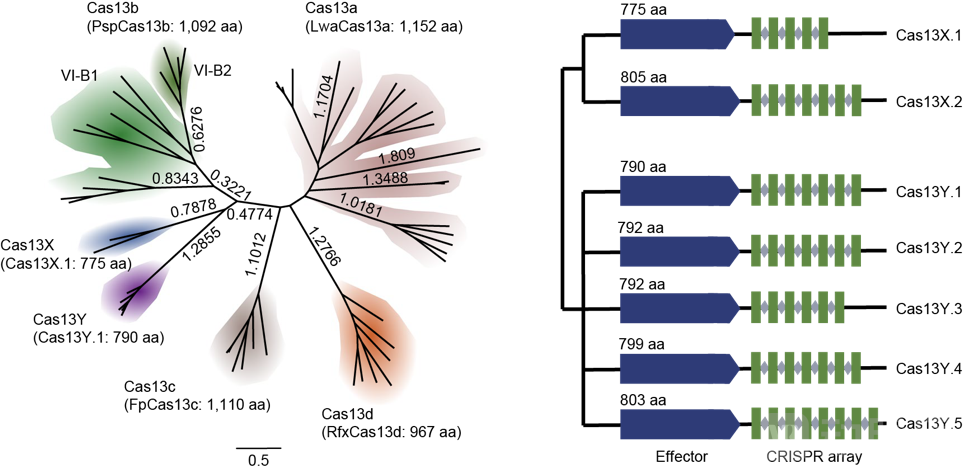
Cas13X/Y Structural Diagram
In this patent, Hui-Gene Therapeutics employed bioinformatics and protein structural biology to conduct sequence evolution of Cas13X/Cas13Y, thereby enhancing targeted editing efficiency (approximately 100% in vitro and ~95% in vivo) and editing specificity. The efficacy and safety have been validated in various cell models, mouse models, and non-human primate models.
Furthermore, Hui-Gene Group has independently developed a novel DNA editor, Cas12Max. With its compact size (~1000 aa), Cas12Max demonstrates significant improvements over the commonly used CRISPR-Cas9 in terms of targeted editing efficiency, editing specificity, and PAM recognition, thereby facilitating the expansion of gene-editing therapies into broader disease areas such as neurological, muscular, and ophthalmic disorders.
With the rapid development of the gene editing field,Establishing capabilities in gene editing tools, vector delivery platforms, animal model platforms, and process development platforms will become a necessary choice for companies to compete internationally.Possessing integrated comprehensive R&D capabilities will become a key competitive advantage for enterprises to stand out.
In terms of integrated capability deployment, Hui-Gene Therapeutics has advanced rapidly, completing the establishment of four platforms in its early stages and already achieving substantial outputs.

Hui-Gene Therapeutics Office Building
Among them,Vector Delivery PlatformComposed of teams from MIT, Yale, and Fudan University, dedicated to developing AAV vectors with high safety, low immunogenicity, and high tissue specificity; multiple AAV vectors have been successfully developed;Animal Model PlatformPossesses leading capabilities in constructing transgenic mouse models, enabling the efficient and rapid generation of murine disease models using CRISPR technology; has successfully established and induced animal models for a variety of conditions, including retinal diseases, neurological disorders, and muscular diseases.Process Development PlatformProcess development for plasmid and adeno-associated virus (AAV) has initially achieved high-yield, high-quality drug production, facilitating process development and method transfer, thereby laying a solid foundation for subsequent non-clinical studies, Investigational New Drug (IND) applications, and clinical trials.
Leveraging its innovative technology platform, Hui-Gene Therapeutics has successfully established comprehensive capabilities across the entire drug development lifecycle, spanning from drug target screening, lead optimization, and efficient animal model construction to preclinical research (including efficacy and toxicology studies), as well as process development, manufacturing, regulatory submission, and clinical trials.
In the field of gene therapy, homogenization of pipeline portfolios is particularly evident in rare diseases.
Rare diseases are predominantly monogenic disorders, representing the most suitable clinical application scenarios for gene therapy. This fundamental mechanistic alignment has prompted widespread strategic positioning by companies. In September 2021, Piper Sandler released a report identifying 21 gene therapy programs targeting hemophilia A, 19 gene therapies for Duchenne muscular dystrophy, and 18 gene therapies for sickle cell disease.
Excessive pipeline overlap will inevitably lead to more intense homogeneous competition. In this context, adopting a flexible strategic approach and pursuing external growth may be a better option.
Beyond rare diseases, common diseases with greater R&D challenges represent a vastly larger potential market.Synchronously laying out rare diseases and common diseases is a more reasonable pipeline layout strategy.
Among common diseases, conditions such as cancer, cardiovascular diseases, and neurological disorders affect large patient populations. Traditional therapies often only control or delay symptoms, making cures elusive. Gene therapy offers new hope for curing these prevalent conditions. Currently, relatively few companies are focusing on gene therapies for common diseases, leaving substantial market potential untapped.
Hui-Gene Therapeutics has implemented a differentiated pipeline strategy based on four innovative technology platforms. Leveraging in vivo gene editing technology, the company covers therapeutic areas including neurology, ophthalmology, musculoskeletal disorders, and hearing, with indications such as Angelman syndrome, MECP2 duplication syndrome, amyotrophic lateral sclerosis (ALS), Leber congenital amaurosis, neovascular (wet) age-related macular degeneration, Duchenne muscular dystrophy, and hearing loss disorders, thereby expanding its pipeline from rare diseases to common conditions.The company plans to submit an Investigational New Drug (IND) application in 2022 to initiate clinical trials.
Regarding the market potential for gene therapy in China, relevant research institutions generally hold an optimistic outlook. LeadLeo Research Institute believes that the market size for gene therapy will reach RMB 120.8 billion in 2025.
Gene therapy represents a novel therapeutic paradigm with the potential to achieve curative outcomes for certain diseases, marking a significant leap forward in the biopharmaceutical industry. In the future, the global gene therapy market is expected to undergo gradual marginal expansion, evolving from single-gene to multi-gene approaches and extending its scope from rare diseases to common conditions.
With its large patient population and strong policy support, China is one of the most promising gene therapy markets globally. At present, the continuous surge in financing and major collaborations within the industry, coupled with an expanding pipeline of indicated conditions, underscores the vast potential of China’s gene therapy market.
It is foreseeable that there will be moreCapital continues to flow into China’s gene therapy industry, with an increasing number of companies entering the field. At the same time, the overall industry structure is becoming more rational.Companies must not only accelerate pipeline progress but also strengthen their foundational technology platforms and strategic pipeline planning, driving innovation in gene-editing tools and vector delivery systems to build the capability for sustained long-term growth.