

Amid Shortage of Smoking Cessation Medications, Hangzhou Yisu Launches Digital Therapy Targeting 50 Million Users
How to Quit Smoking? Many smokers have been pondering this question since lighting their first cigarette. According to 2018 data from the Chinese Center for Disease Control and Prevention, approximately 300 million people in China smoke, accounting for about one-quarter of the national population. Among them, 16.2% of smokers intend to quit within the next year, indicating a demand for smoking cessation services among nearly 50 million individuals.
Quitting smoking for a day is not difficult, but quitting for six months is “harder than reaching the sky” for many long-term smokers.
Relapse After Quitting Smoking? This Has Become a Cliché Problem for Those Trying to Quit. The success rate of quitting smoking on one’s own is very low, with fewer than one in ten succeeding. Most smokers view quitting as a solitary endeavor—“no one can help me but myself”—and thus attempt to quit behind closed doors, relying solely on willpower. However, tobacco dependence is a chronic addictive disease, and since it is a disease, medical assistance can and should be sought.
Many hospitals have established smoking cessation clinics, most of which are housed within their departments of respiratory medicine. However, for the majority of smokers, such clinics are virtually unheard of, and visiting a tertiary Grade A hospital specifically for smoking cessation may seem like using a sledgehammer to crack a nut. According to data from the Chinese Center for Disease Control and Prevention, in 2020, smoking cessation clinics across all provinces in China conducted initial interventions for a total of 24,534 patients, accounting for less than one ten-thousandth of the total smoking population.
In stark contrast to the dismal business conditions of offline smoking cessation clinics, online smoking cessation services are flourishing. In recent years, digital therapeutics for smoking cessation abroad have repeatedly attracted investment. The year 2021 was hailed as the inaugural year of digital therapeutics in China, marking a new form of convergence between healthcare and the internet beyond internet hospitals.
Top Academic Team and Frontline Addiction Experts Collaborate to Launch “Yisu Home” Smoking Cessation Mini Program
Hangzhou Yisu Technology Co., Ltd. is a medical technology company specializing in digital cardiac health management, and it officially launched the Yisu Home Smoking Cessation mini-program earlier this year.
In 2020, China’s cardiac rehabilitation industry was experiencing rapid growth, with the number of hospitals offering cardiac rehabilitation services increasing from over 30 in 2012 to more than 700 in 2020. Cardiac rehabilitation is guided by five core prescriptions: medication, exercise, psychological support, nutrition, and smoking cessation. The Yisu team began to explore which areas within this framework held development potential, remained underserved, and aligned with their own capabilities.
They targeted smoking cessation because, while physicians can clearly outline plans for the first four types of prescriptions, many cardiologists remain uncertain about how to effectively prescribe smoking cessation. Previously, the Cardiovascular Professional Committee of the Chinese Association of Rehabilitation Medicine drafted the “Chinese Expert Consensus on Smoking Cessation Prescriptions for Cardiovascular Patients,” based on relevant domestic and international guidelines. The consensus emphasized that smoking cessation requires long-term pharmacological intervention, psychological support, and behavioral assistance. However, in actual offline clinical consultations, constrained by time and other factors, physicians often issue only a general recommendation to “quit smoking.”
Last year, as digital therapeutics gained momentum in China, the Yisu team recognized that an opportunity had arisen.
In 2021, VCBeat summarized that diseases suitable for digital therapeutics should exhibit the following five characteristics: long management cycles, multiple intervention measures, low patient adherence and self-management capabilities, a primary focus on internal medicine with surgery as a supplementary approach, and the availability of clear clinical guidelines.
From these five perspectives, smoking cessation is inherently well-suited to the domain of digital therapeutics.
In the early 21st century, before the rise of the internet and the emergence of the concept of digital therapeutics, efforts were already underway to explore the use of mobile phones to help smokers quit. Early approaches primarily included quitlines, SMS text messaging, and WeChat-based interventions. The smoking cessation digital therapeutic developed by Yisu is an evidence-based medical software solution specifically designed for smoking cessation, distinguishing itself from traditional calendar- or calculator-style apps that merely track smoking behavior through check-ins.
To develop a medical-grade smoking cessation app, the first step is to collaborate with professionals.
Dr. Hu Yang and Dr. Liao Yanhui were the first individuals recruited by the Yisu team. Dr. Hu is a pulmonologist at Shanghai Pulmonary Hospital, while Dr. Liao is an addiction medicine specialist at Sir Run Run Shaw Hospital, Zhejiang University School of Medicine, and the principal investigator for China’s earliest SMS- and WeChat-based smoking cessation programs. When the Yisu team approached them to discuss their concept of digital therapeutics for smoking cessation, the three parties immediately reached a consensus.
Abroad, digital therapeutics for smoking cessation is not a new topic. However, in China, Tong Qingxia, founder of Yisu, noted that there are few platforms that can truly be classified as digital therapeutics for smoking cessation. “Everyone is figuring it out as they go,” she said. Yisu is among the first batch of companies to enter this field. “While ensuring that treatment adheres to clinical standards is certainly a significant advantage for a digital therapeutic platform for smoking cessation, it is only by integrating therapy with algorithms that one can establish a competitive barrier.”
Digital healthcare, built on the internet, has the inherent advantage of collecting user data continuously to provide personalized services. From the moment a patient first logs in, Yisu Jiayuan begins to observe and learn their smoking behavior patterns. Through long-term tracking, it summarizes patients’ usage habits—such as determining which type of training is most suitable (mindfulness therapy or distraction techniques) based on their browsing, clicking, and interaction history, and identifying the time periods when patients experience the strongest cravings for smoking. Under the leadership of Technical Director Liao Jiafeng, Yisu’s smoking cessation intervention algorithm has now been updated to its fourth generation.
CBT Therapy + Personalized Algorithms: A Dual Approach Combining Self-Help Smoking Cessation and Paid Service Packages
Nicotine addiction, as an addictive disorder, is currently primarily treated with cognitive behavioral therapy (CBT), which comprises three mutually reinforcing components: thoughts, feelings, and actions. Yisu Home integrates cognitive behavioral therapy into the entire smoking cessation process, divided into three steps: pre-cessation preparation, management of withdrawal symptoms after quitting, and relapse prevention.
First, establish the motivation to quit smoking and eliminate misconceptions.
Yisu Home has designed a questionnaire based on the internationally recognized Fagerström Test for Nicotine Dependence (FTND), which users complete upon registration. The questions include: How many cigarettes do you smoke per day? How long after waking up do you smoke your first cigarette? How many years have you been smoking? Patients can independently choose their treatment method based on their level of dependence. Patients with low dependence may attempt self-guided smoking cessation, while those with moderate to severe dependence may consider purchasing service packages to aid in quitting.
“Smoking Cessation Knowledge” section is a form of cognitive therapy, covering topics such as education on withdrawal symptoms, the harms of smoking, and methods for quitting. By establishing correct perceptions about smoking, it aims to reduce cravings.
However, many smokers say, “I understand the rationale, but I just can’t resist the temptation when others offer me cigarettes.” To address this issue, the Yisu Jiayuan mini-program leverages its integration with the WeChat platform to engage users’ social circles. After patients sign a smoking cessation commitment letter and a smoking cessation notification card, they can share these documents to their WeChat Moments with a single click. This not only informs their friends that “I have quit smoking,” but also serves as a form of social accountability.
Step 2 is withdrawal symptoms after quitting smoking.
Making the firm decision to quit smoking is difficult, but the withdrawal phase after quitting is even more challenging. Withdrawal symptoms typically emerge on the first day after cessation, manifesting as irritability, restlessness, and insomnia. These symptoms are generally most intense during the first two weeks, begin to subside after approximately one month, and may persist for up to six months.
To alleviate patients' withdrawal symptoms, Yisu Home has introduced an "Urge to Smoke" button. When patients click the button, the system provides coping and intervention recommendations, such as "practice diaphragmatic breathing," a form of relaxation therapy, or "play a game," which serves as a distraction technique.
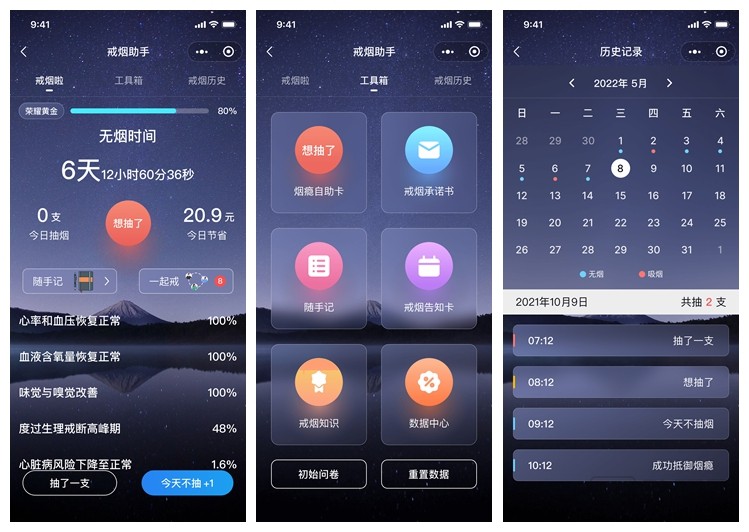
Yisu Home Mini Program Interface | Image Provided by the Company
The final step is to prevent relapse.
The mini-program features a “Quit Together” module, providing patients with a mutual support and communication platform. This module also includes a smoking cessation leaderboard to encourage patients to maintain their quit attempts. Additionally, the mini-program integrates a traditional tracking module that records patients’ duration of abstinence, withdrawal experiences, health benefits, and cumulative financial savings.
All of the above are free self-help smoking cessation services. Recently, Yisu Home has launched a paid smoking cessation service package, offering 30 days of professional guidance. The guiding physicians include Dr. Liao Yanhui and Dr. Tang Jinsong from Sir Run Run Shaw Hospital, Zhejiang University School of Medicine, as well as Dr. Hu Yang from Shanghai Pulmonary Hospital, as previously mentioned.
The smoking cessation protocol within the service package mirrors offline interventions. It begins with patient assessment, selection of a quit date, correction of misconceptions, and development of behavioral strategies, followed by daily guidance and continuous monitoring of the patient’s progress in quitting smoking.
The core of the service package is to help patients prepare for smoking cessation and learn how to manage withdrawal symptoms and cigarette cravings. Related services include more than 70 cognitive behavioral training modules, over 60 educational and popular science illustrated videos, and weekly live sessions with physicians. The cognitive behavioral training comprises 12 types of breathing relaxation exercises and four types of mindfulness relaxation exercises. The specific intervention method delivered depends on the information provided by the patient and the algorithm’s learning and prediction of the user’s smoking behavior.
Currently serving individual users, while exploring the B2B market
For smoking cessation in offline outpatient clinics, physicians typically prescribe pharmacotherapy to patients in need. However, the availability of approved smoking cessation medications is limited, and they are not covered by medical insurance, with a course of treatment costing approximately RMB 1,500. The Yisu Home Standardized Smoking Cessation Service Package is priced at RMB 399.
Currently, the Yisu Home mini-program targets individual users while exploring the B2B market. Abroad, many mature digital therapeutics companies have chosen insurance providers as their initial B2B clients. As is well known, premium amounts are determined based on the insured’s overall health profile; smokers face greater health risks and may pay higher premiums, while insurers may incur higher claim costs. Since smoking cessation benefits both parties, it is logical for digital therapeutics for smoking cessation to target insurance institutions first.
Recently, Hangzhou Yisu Technology Co., Ltd. reached an agreement with its partner, Aixuan Technology, to provide digital smoking cessation services in interactive insurance products soon to be launched by insurance companies. This marks another innovative integration of China’s insurance industry and digital therapeutics.
The Yisu Home mini-program, launched less than six months ago, offers free self-help smoking cessation services and paid service packages, with the aim of expanding its market share. As the services mature in the future, Yisu Home may transition to a pricing model based on the number of interventions or duration of service.
In addition to the standardized smoking cessation service package, Yisu Jiayuan is also planning smoking cessation service packages tailored for cardiovascular and respiratory patients. “Smoking cessation treatment used to be a niche field, but with the rise of digital therapeutics, it may no longer remain so. Both Yisu Jiayuan and the field of smoking cessation digital therapeutics are still in their early stages, but the path forward will become increasingly clear,” said Tong Qingxia.