

Pulibiocon Files IPO Prospectus: Building Photosynthetic Autotrophic Cell Factories for Aging Intervention and Sustainable Biomaterials
Unlike most synthetic biology companies that use microorganisms as chassis organisms, PolyBoKang selected photosynthetic autotrophic cell factories as a key research direction at its inception. Plant bioreactors not only facilitate the synthesis of complex proteins and the production of high-value-added products but also align with PolyBoKang’s long-term strategic considerations for development in the field of synthetic biology.
“From the perspective of the industrial chain, a major bottleneck in the development of synthetic biology is the supply of upstream raw materials.”Wu Songshan, Founder of Pulibokang, ExplainsHe stated, “The upstream fermentation raw materials of the entire industry are heavily dependent on staple crops such as corn. In the long run, this creates issues of ‘competing with humans for food’ and ‘competing with food crops for arable land,’ which is particularly evident in China. China still imports large quantities of corn, and corn used for synthetic biology fermentation ranks lower in priority than corn for human consumption and animal feed. As the number of synthetic biology enterprises increases and their business scales expand, meeting corporate growth demands could potentially jeopardize national food security. Encouragingly, during our research on using aquatic plants as chassis cells, we identified certain species that are suitable for synthetic biology engineering, do not occupy arable land or compete with staple crops, and exhibit high-level expression of starch and proteins. These species hold promise as breakthrough solutions to the ‘raw material bottleneck’ in synthetic biology.”
In synthetic biology, microorganisms used as chassis cells typically rely on organic carbon sources derived from staple crops. In contrast, plants, when employed as bioreactors, possess natural photoautotrophic capabilities that can, to some extent, circumvent limitations associated with upstream raw material supply. This is one of the reasons why Pulibokang has chosen plants as its bioreactor platform.
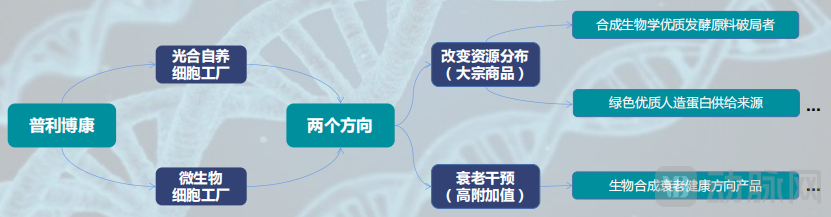
Pulibokang, established in 2021, is a biotechnology company driven by synthetic biology as its core technology. On one hand, the company is dedicated to building efficient, low-cost, low-carbon, and even carbon-negative photoautotrophic cell factories to produce high-value-added proteins and premium bulk commodities. On the other hand, it focuses on aging intervention as its industrial direction, leveraging synthetic biology as its product manufacturing model to meet human health needs.
Selecting plants as synthetic bioreactors will bring numerous advantages to the subsequent business development of Pulikang. Breaking free from the constraints of upstream raw material supply in synthetic biology is just one of these benefits. Wu Songshan, founder of Pulikang, also highlighted several key differences between plant-based and microbial bioreactors in an interview with VCBeat:
First, plants can grow simply through light exposure; using them for synthetic biology engineering to produce target products results in a process that is more low-carbon and environmentally friendly, better aligning with the national advocacy for carbon neutrality.
Second, the choice of chassis organism often determines product selection. Plants can accommodate more gene inserts, making them better suited for producing high-value-added complex proteins; their low-carbon and low-cost characteristics should give them a unique position in the production of commodity goods.
Third, plant cell factories do not involve fermentation processes. On one hand, this ensures greater certainty in scaling up production; on the other hand, it eliminates the need for handling fermentation strains, thereby avoiding additional environmental protection costs.
While plant-based bioreactors offer distinct advantages, they also present greater technical challenges. This explains why there are few synthetic biology companies in China that use plants as chassis cells. Compared to microorganisms, plants possess more complex internal characteristics and exhibit stronger resistance to the insertion of foreign genes, making their genetic engineering more difficult. On the other hand, the genetic systems of mainstream microbial chassis have already been well characterized and optimized; therefore, modifying them is considerably easier than working with plant-based chassis, which require the de novo development of genetic systems.
“Compared with our peers, we have a richer reserve of biological chassis, allowing for more flexible and diverse choices of host organisms when producing target products. From a commercial perspective, we tend to select products by seeking market opportunities and excess profits in segments that are not yet fully mature,” introduced Wu Songshan. The company’s ability to maintain a cross-category chassis reserve and rapidly advance in the high-barrier field of plant-based bioreactors is largely attributable to the leadership of its founding scientist, Dr. Huang Fei.
According to Wu Songshan, founder of Pulibokang, Dr. Huang Fei is a true genius. Despite being only one year younger than Wu, Dr. Huang has already achieved significant accomplishments in the field of genetic engineering and is a scientist with both strong academic and industrial backgrounds. Dr. Huang holds a Ph.D. from Sichuan University/University of Chinese Academy of Sciences, serves as the principal investigator for a major national special project, and brings over ten years of enterprise R&D management experience in the field of synthetic biology.
Wu Songshan and Dr. Huang Fei co-founded Puli Bokang, and the company’s focus on plant cells as chassis cells is closely tied to Dr. Huang’s multidisciplinary research background and professional experience.
“The true value of synthetic biology, I believe, lies in reshaping the spatiotemporal distribution of resources. This value will become increasingly evident, particularly as the current international landscape trends toward deglobalization,” Wu Songshan, founder of Pribiocon, stated repeatedly during an interview.
“From the perspective of the industrial chain, companies that are closest to the upstream end and those closest to the consumer (C) end tend to perform better and are relatively less affected by cyclical fluctuations,” said Wu Songshan. “We will pursue a dual-pronged strategy, implemented in two phases. The first phase focuses on product R&D and technological accumulation in the healthy aging industry, entering the market through To-B and B2B2C models. The second phase starts from optimizing resource distribution through strategic product selection, centering on food security by leveraging plants to produce bulk commodities—particularly aquatic plant proteins and synthetic biology fermentation feedstocks. This approach has significant potential to address China’s challenges of insufficient arable land and reliance on imports. Of course, this strategy not only explores the possibilities of synthetic biology development but also reflects our internal consideration of asset allocation to smooth out business cycles.”
With this in mind, what reflections and actions will Pribocare undertake in its initial focus area of aging?
Founder Wu Songshan responded, “From a business perspective, aging represents the last major market in the broad consumer sector that has yet to produce a true dominant leader. Furthermore, while the aging industry should inherently involve the highest user switching costs, it currently exhibits a pattern of frequent consumer trial and error. This constitutes a significant paradox between market potential and current reality, primarily due to the absence of a suitable rating system for aging. Therefore, on one hand, we are establishing a macroscopic yet precise evaluation system better suited for assessing aging, centered on cellular metabolic data. Based on this framework, we aim to identify indications and corresponding therapeutic interventions, with the ultimate ambition of integrating aging into the precision medicine framework of modern medical practice. This will establish aging as an independent sector and accelerate the industry toward its endgame. On the other hand, we are leveraging synthetic biology as a foundational technology to develop a pipeline of aging intervention strategies, building consumer trust through products that are genuinely safe and effective.”
In the field of aging, Pribiocon’s lead product is Pyrroloquinoline Quinone (PQQ), a crucial substance for cellular energy metabolism. PQQ is the third prosthetic group discovered in membrane-bound bacterial dehydrogenases, following flavin nucleotides (FMN/FAD) and nicotinamide nucleotides (NAD/NADP). It demonstrates significant efficacy in anti-aging, antioxidant activity, immune enhancement, and alleviating certain age-related degenerative diseases, making it an ideal mitochondria-targeted anti-aging product. Furthermore, theoretical research conducted by the company’s team indicates that PQQ also has a broad-spectrum effect in enhancing the body’s ability to counteract the competitive growth of tumor tissues. Currently, the screening of PQQ-producing strains and testing of production processes have been completed, enabling large-scale mass production, and substantial potential distribution channels have been secured. Additionally, the company has finalized the extraction process design for aquatic plant proteins. These novel food-source products offer a approach to improving metabolic issues in humans resulting from evolutionary mismatches, while also providing a strategy to mitigate China’s heavy reliance on imports of high-quality plant proteins, such as soybeans.
Currently, Puboikang has recently launched its angel round financing plan. The funds raised will be primarily used for the production and sales of PQQ series products, as well as the advancement of other pipeline candidates under development.