

Who Are the Disruptors in the Painful Transition of Healthcare IT?
Three years ago, as the State Council’s policy documents on electronic medical record (EMR) system development began to take effect, orders for healthcare informatics projects worth tens of millions of yuan saw an unprecedented surge.
At that time, listed companies such as Winning Health and Ewell Technology reaped the first wave of dividends, with their revenues and profits generally achieving double-digit growth. B-Soft, a leader in public health informatics, even recorded a 105% profit increase within six months, helping the long-dormant healthcare IT sector break through its stagnation and regain momentum.
However, as times have changed, compounding factors such as the pandemic, technological iterations, and intensifying competition have erased the once-thriving landscape of healthcare informatization. Amid this divergence, a few companies continue to press forward, while the majority have scaled back operations, focusing on internal reforms and awaiting a turning point.
At its core, the contradiction between rapidly evolving technological demands and entrenched product models has left listed companies constrained in their response to policy changes. A large number of hospitals that have previously implemented IT systems continue to rely on isolated, department-centric information systems, which generate substantial maintenance and operations revenue for vendors. This makes it difficult for publicly traded companies to go “all in” on next-generation healthcare IT systems.
The growing pains of transformation have created entry opportunities for a new generation of healthcare IT enterprises. Although it is extremely difficult for a company in the healthcare IT sector to reach an IPO-level scale, in this highly competitive arena with over ten thousand players, there are always a few companies that can break through the pack and attempt to reshape the competitive landscape of healthcare IT.
Compared with listed companies that have been in operation for over a decade, most domestic healthcare IT startups emerged during the era of clinical informatics. They face distinct regulatory policies, patient care-seeking behaviors, physicians’ diagnostic and treatment practices, and varying levels of healthcare informatization. By this time, the majority of hospitals had already implemented and were using basic information systems such as Hospital Information Systems (HIS), Picture Archiving and Communication Systems (PACS), and Radiology Information Systems (RIS). However, issues such as data silos, incompatible standards, and inefficient system performance had also become apparent.
Therefore, listed companies and startups have followed distinctly different paths from the outset: the former aim to address whether hospitals have health information systems in place, while the latter focus on enhancing system fluency and better serving clinical practice.
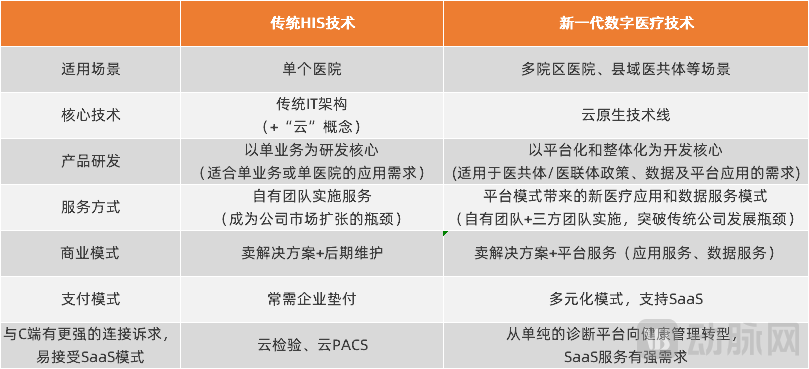 Technological Disparities Across Different Eras
Many enterprises established during this period bear the distinct characteristics of their era. For instance, XinNiu Medical & Future Tech, a healthcare IT company backed by Alibaba, aims to leverage data-driven and business middle-platform methodologies to build next-generation digital solutions and ecosystems for healthcare. Its core objective is to address the pervasive problem of information silos in hospitals through innovative approaches.
Take Huazhuo Technology, for example. Committed to becoming the “Epic” of China, it provides integrated solutions for “new healthcare infrastructure” based on a cloud-native technical architecture. Leveraging cloud computing, microservices, artificial intelligence, and big data technologies, while fostering an open ecosystem for collaboration, the company strives to create a new generation of cloud-native, hospital-wide informatization solutions that break through the limitations of traditional IT architectures.
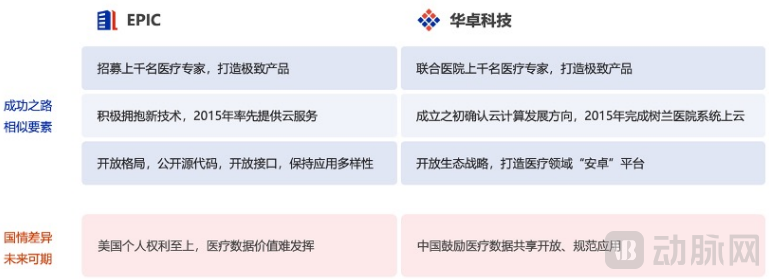 Huazhuo Technology's Various Advantages
It is evident that startups in the healthcare informatics sector always emerge with ambitions to break the status quo. However, as disruptors, which companies can stand out from regional markets to expand nationwide, and which can leverage capital to seize market share first, remains to be seen. We must assess whether their core technologies truly possess disruptive power and whether they are addressing genuine needs or merely pseudo-needs.
There are many explorers pursuing disruptive innovation in healthcare informatization. This article focuses on the most fundamental and representative next-generation Hospital Management Information System (HMIS). After all, the transformation of HMIS involves changes to a hospital’s IT architecture, where a single adjustment can impact the entire system, requiring hospital administrators to demonstrate boldness in driving change.
There has been extensive discussion surrounding next-generation hospital management information systems. Some enterprises focus on technological transformations driven by AI and big data; others center on “middle-platform thinking”; still others prioritize microservices architecture. While each architectural approach addresses specific categories of problems, Hangzhou Huazhuo Information Technology Co., Ltd. believes that next-generation systems should not merely cater to a single type of demand. Instead, they should integrate the aforementioned diverse philosophies, which can be summarized into three key elements: cloud architecture, containerization, and standardized open platforms.
First, the architecture must be a cloud-based architecture.
The emergence of cloud architecture aims to address the bottlenecks encountered in the development of hospital informatization. Due to regulatory compliance requirements, evolving service scenarios, and the widespread adoption of emerging technologies, traditional IT architectures have reached their productivity limits, struggling to accommodate massive clinical applications and failing to achieve hospital-wide data management. Therefore, migrating hospital systems to the cloud is imperative. Currently, regulatory compliance demands, changes in service scenarios, and the proliferation of new technologies are all driving the continuous upgrading of hospital informatization.
Especially for hospitals with complex in-house operations, diverse clinical demands, or those comprising multiple centers/campuses, relying on traditional models for infrastructure deployment is no longer a question of cost, but of feasibility. To achieve cross-regional hospital management, it is essential to leverage Cloud HIS and Cloud PACS to revolutionize traditional architectures. Li Tanwei, CEO of Huazhuo Technology, once offered a vivid analogy: “Warcraft III, a game many played in the past, is a classic single-player title. If a few friends connect via a local area network to play together, does it become an online game? No. World of Warcraft, which supports thousands of players logging in anytime, anywhere, to interact on the same platform, is a true online game. While the monster-slaying and player-versus-player (PvP) scenarios may appear similar, the underlying computational business logic is entirely different. Similarly, the entire computational foundation of our healthcare informatics industry must undergo corresponding changes.”
It is worth noting that cloud-based hospital software services are no longer one-time software projects; instead, they will evolve into continuous SaaS-based software and cloud resource services, with software applications on the cloud undergoing rolling upgrades and continuous evolution. This means that hospitals will have the right to choose whether to continue or terminate these services, thereby avoiding vendor lock-in by software providers.
Next is containerization.
Containerization technology has been successfully applied in other fields, offering significant performance advantages over virtual machines. However, applying it to the traditional healthcare informatics industry is not as straightforward as following a formula.
To explain the concept of containerization in more accessible terms, Li Tanwei compares “containers” to “shipping containers.” In the past, software components existed as separate, independent parts; now, they are encapsulated within a single shipping container. This approach eliminates the need for hospitals to navigate complex interfaces when deploying or accessing software, while also simplifying the integration and scaling of the containers themselves.
In other words, containerization breaks down the originally large monolithic application into multiple lightweight microservices. Different microservice modules can be freely combined and reconfigured like a Rubik’s Cube to form the required process-oriented applications. Compared with the original large monolithic application, the decomposed microservices are more flexible, enabling instant online scaling up or down based on actual traffic demands, thus achieving elastic scalability.
“Containerized decomposition is not simply about breaking the legacy system into pieces,” Li Tanwei told VCBeat. “There are nuances involved; it requires a thorough overhaul of healthcare business systems from the IaaS layer to the PaaS layer and then to the SaaS layer, enabling these systems to adapt to and fully leverage the powerful capabilities of containers. Ultimately, this allows new cloud technologies to truly empower the healthcare industry, while also meeting long-term development needs such as cross-hospital collaboration, rolling upgrades, elastic scaling, and infinite scalability for hospital systems and resources.”
Finally, there is the standardized open platform.One of the causes of data silos is the lack of unified industry data standards, resulting in interoperability issues between various systems and applications.
Therefore, the healthcare informatics industry urgently needs an “Android-like” operating system for the medical field—an open platform that integrates development, management, and marketplace functions to support medical software and capabilities. This platform would allow developers to build and list medical applications or software capabilities (microservices) on the Huazhuo Cloud Platform. It must provide software development kits (SDKs) and platform services, open its app marketplace to customers, foster the emergence of more diverse business systems, integrate into the healthcare industry ecosystem, and better meet the needs of hospital clients. In other words, a standardized, open platform will be a key determinant of the long-term success of next-generation hospital information management systems.
Furthermore, in recent years, policies such as the county-level medical consortiums and the “Thousand Counties Plan” have further promoted regional healthcare development. Adopting cloud-based Hospital Information Systems (HIS) and cloud-based Picture Archiving and Communication Systems (PACS) to break down regional barriers has become an imperative for hospital administrators. Hangzhou Huazhuo Information Technology Co., Ltd. identified this need several years ago and proposed the “One Cloud for Regional Healthcare” solution. This approach helps hospitals avoid the costs of duplicating infrastructure by enabling all entities within the regional healthcare network to share a single cloud data center. It ensures standardized and unified management of information data across various medical institutions, ultimately achieving interoperability of internal information systems and allowing patients to access diverse medical services across different campuses.
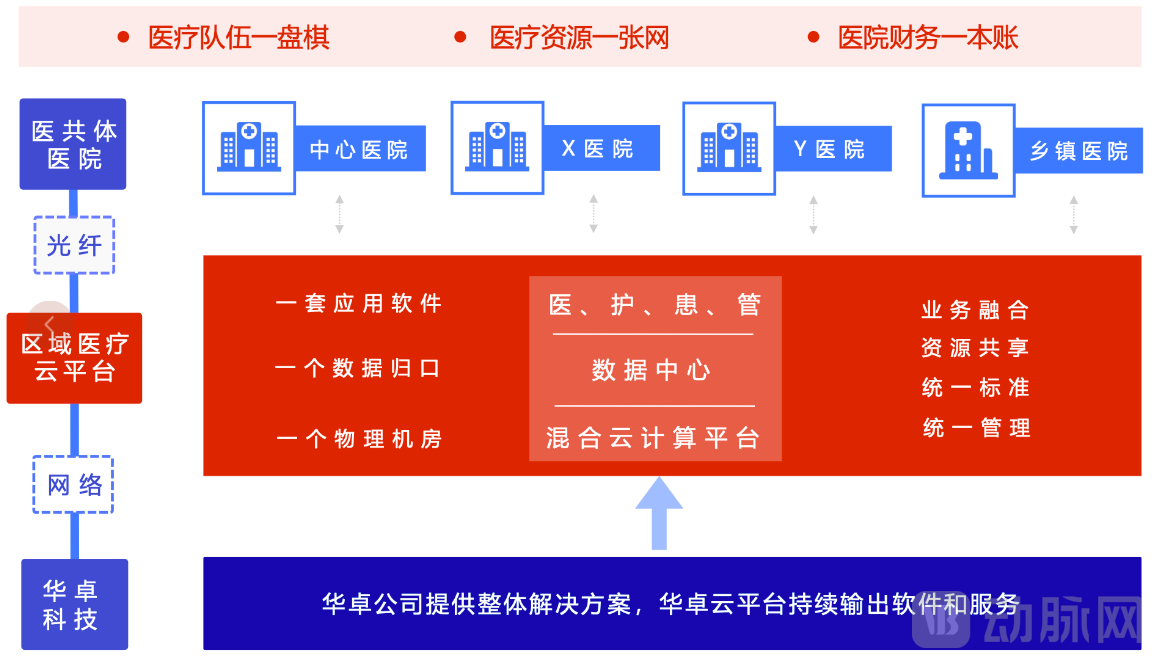 Huazhuo Medical Consortium Solution: “One Cloud for Regional Healthcare”
From the current perspective, concepts such as cloud architecture and containerization have become a consensus within the industry, with numerous hospitals actively implementing them. However, in the field of healthcare informatization, which is heavily influenced by policy changes, Huazhuo Technology has already gained a first-mover advantage and achieved widespread market presence. As the market size enters a growth phase, if Huazhuo Technology can seize this opportunity and accelerate hospital deployments while ensuring quality, the company is poised to reshape the competitive landscape of the healthcare informatization sector.
Huazhuo Technology is not the only disruptor in the field of medical informatics. In fact, both the “new infrastructure” initiatives within medical informatics and various “small yet elegant” clinical digital applications have surged in response to the introduction of supportive policies.
At this juncture, listed companies in the healthcare IT sector must make a decisive choice: either fully embrace digital healthcare IT or cling to traditional business models with only gradual transformation—a decision that will determine their survival.
In contrast, startups have no retreat.
Perhaps it was precisely the resolve forged under pressure that drove them to wholeheartedly lead their hospitals through digital transformation. The market share gained from this transformation ultimately became the driving force behind their reshaping of the industry landscape.