

Alibaba Health's Financial Report Reveals Key Breakthroughs, Unlocking New Possibilities for Internet Healthcare

AliHealth
Medical and Health Services Network Service Provider
On the evening of May 25, AliHealth released its latest financial report.
Data shows that for the 12 months ended March 31, 2022, AliHealth achieved revenue of RMB 20.58 billion, a year-on-year increase of 32.6%, with a gross profit of RMB 4.11 billion. These steadily growing financial figures indicate that AliHealth, eight years after its establishment, has found its own rhythm.
Particularly noteworthy is that, while consolidating its dominant position in pharmaceutical e-commerce, AliHealth has achieved multiple performance breakthroughs in its actively explored internet healthcare services.Online consultations, follow-up visits, traditional Chinese medicine (TCM), chronic disease management, vaccinations, health check-ups, appointment registration... After years of steadfast investment, AliHealth’s healthcare services business has entered a period of multi-sector growth.
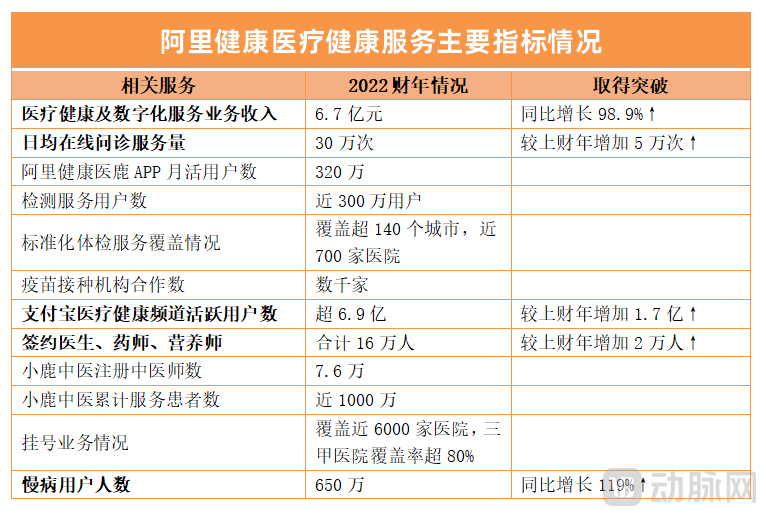
In fiscal year 2022 (April 2021–March 2022), the annual active users of the Alipay Medical and Health Channel operated by AliHealth exceeded 690 million, an increase of 170 million from the previous fiscal year. The total number of licensed physicians, licensed pharmacists, and nutritionists contracted with AliHealth to provide online health consultation services reached nearly 160,000, an increase of more than 20,000 from six months earlier. The average daily volume of online consultations has reached 300,000, an increase of 50,000 from six months earlier.
AliHealth’s Yilu app has surpassed 3.2 million monthly active users. According to the 2022 Spring Report on China’s Mobile Internet recently released by QuestMobile, Yilu app ranked first in the medical services industry in terms of monthly active users.
During the fiscal year, AliHealth completed a deep integration with Xiaolu TCM, establishing integrated online-to-offline medical and healthcare service capabilities that combine traditional Chinese medicine (TCM) and Western medicine. This earnings announcement also disclosed data on Xiaolu TCM for the first time: the platform has registered 76,000 TCM physicians and has cumulatively served nearly 10 million patients.
Notably, amid multi-pronged business breakthroughs and rapid development, AliHealth’s revenue from its healthcare and digital services segment surged by 98.9% year-on-year during the reporting period.
How internet healthcare can deliver more diversified value has long been an expectation of the industry. Judging from the latest financial results, AliHealth, which has been deeply engaged in the medical services sector, has gradually charted a viable path.
Shao Lin is an obstetrician and gynecologist in Shanghai. Since the outbreak of the epidemic in Shanghai this March, he has provided online consultations to more than 300 pregnant women within a month on AliHealth’s internet healthcare platform.
A woman whose husband tested positive for COVID-19 via nucleic acid testing and was isolated for treatment felt deeply anxious, as she had no one to accompany her and was experiencing persistent light bleeding. After a thorough consultation, Shao Lin comforted her and recommended some symptomatic medications. A few days later, the woman left a message: “The bleeding has stopped, and my isolation period is nearly over.”。
With insufficient on-call rooms, male colleagues slept in the office. This space often served as Shao Lin’s “mobile clinic.” After finishing a day of offline work, he would open his phone, log into the backend of AliHealth’s “Yi Die Gu” platform, and respond to questions from online patients. “I hope that by spending more time online, I can provide them with a greater sense of security,” Shao Lin said.
As COVID-19 outbreaks resurge in various regions, ensuring equitable and accessible medical services has become a focal point of public concern. The role played by internet healthcare during this wave of the pandemic has become increasingly prominent: from launching online free clinics to safeguarding medication supplies, the initiatives undertaken by internet healthcare companies have alleviated pressure on offline medical resources. On the other hand, during the pandemic, people’s willingness to seek online diagnosis and treatment has risen rapidly, particularly among patients with chronic diseases, who increasingly rely on the internet for services such as medical consultations, diagnoses, follow-up visits, medication purchases, and rehabilitation support.
In this process, the AliHealth platform serves as a connector between doctors and patients while enhancing the efficiency of medical resource utilization: physicians from tertiary hospitals in first- and second-tier cities provide online consultations and follow-up services through internet hospitals, enabling chronic disease patients in remote areas to address the “last mile” challenge of chronic disease management without leaving their homes.
It is evident that the Internet transcends temporal and spatial constraints, continuously expanding the service radius of physicians and enabling an increasing number of patients in primary care settings to access more advanced medical resources.
It is not difficult to see that, through the stress test of this round of the epidemic, internet healthcare companies have also been able to further understand the question of where to go in the future from the process of responding to the crisis.
As reflected in its performance, AliHealth’s medical services segment has achieved rapid growth, driven by clear strategic direction and steadfast execution.
According to data from third-party analytics firm QuestMobile, the healthcare channel operated by AliHealth ranks first in terms of user base among Alipay mini-programs, while the monthly active users (MAU) of AliHealth’s Yilu app also lead all apps in the medical services sector.
At AliHealth, there are many “hidden gem” doctors.
Xu Xian, 89, is the former director of the Dermatology and Venereology Department at Guang’anmen Hospital of the China Academy of Chinese Medical Sciences, and a renowned master of traditional Chinese medicine in Beijing. Many patients from other provinces travel long distances to seek his medical care. Certain skin conditions require prolonged management to achieve therapeutic efficacy. However, for patients residing outside Beijing, attending follow-up visits every two weeks has become a significant burden.
To minimize the need for patients to travel, Dr. Xu has been conducting online follow-up consultations via AliHealth’s Xiaolu TCM platform since 2016. The number of young people seeking his diagnosis and treatment has also increased; they place a high premium on skin health and trust renowned, experienced experts like Dr. Xu. “Over the past six years, more than 1,700 patient consultations have been conducted with me online, which reportedly saved them over one million kilometers in travel distance.”89-year-oldElder XuNowAdhere to One Week of Online Consultations3 times。
From the perspective of industry development, internet healthcare companies are increasingly prioritizing their “medical” services. Industry practitioners have come to realize thatInnovation and future growth drivers across the entire internet healthcare value chain are increasingly concentrated in the “medical care” segment.
However, the industry as a whole is still in an exploratory phase and has yet to achieve economies of scale, with each internet healthcare company seeking new solutions.AliHealth’s strategy is to continuously integrate resources and capabilities, leveraging the synergies of the Alibaba ecosystem.Leveraging multiple platforms and prioritizing user value, we provide multi-tiered, diverse, professional, and convenient healthcare services.
In fact, AliHealth possesses unique foundational advantages within the industry and has carved out a distinct path different from that of other explorers.
First, by leveraging the Alibaba ecosystem to operate across multiple platforms, AliHealth has achieved steady growth in its user base. According to the performance announcement, AliHealth continues to provide professional and convenient healthcare services to users from various terminals, including Taobao, Tmall, Alipay, the Yilu App, Amap, DingTalk, and Quark Search, achieving breakthroughs on multiple fronts. Notably, the annual active users of the Alipay Healthcare Channel operated by AliHealth exceeded 690 million, a rapid increase of 170 million compared to the previous fiscal year.
As Alibaba Group’s flagship platform in the big health sector, AliHealth has inherited Alibaba’s DNA while leveraging the Group’s ecosystem advantages. This has enabled AliHealth to establish the most comprehensive entry-point matrix in the industry, facilitating multi-channel user engagement.
The research report released by Western Securities at the beginning of the year also pointed out that,Alibaba’s strategic layout in the pharmaceutical and healthcare industry is led and driven by AliHealth, leveraging the collective strengths of its ecosystem partners, including Alipay, Taobao, Alibaba Cloud, and DingTalk.
Taking the current epidemic response as an example, since March, AliHealth has launched free online consultation services for epidemic-related care. More than 3,000 physicians have voluntarily joined the initiative, providing follow-up consultations and health advice to patients in need during this special period. Patients can easily access these free consultation services through the Yilu app under AliHealth and the Healthcare channel on Alipay.
In addition, AliHealth collaborated with Cainiao to deliver medications and epidemic prevention supplies to consumers across various regions. During the pandemic, it joined forces with partners to transport urgently needed materials to families of children with rare diseases, covering a distance of 1,300 kilometers from Beijing to Shanghai in a short period of time.
As can be seen, the strength of the Alibaba ecosystem continues to unfold. Previously, in September 2021, AliHealth announced full integration with Taote, launching its self-operated pharmacy on the platform to provide pharmaceutical and healthcare services. Consumers in lower-tier markets now benefit from home delivery of medications while also enjoying free 24/7 consultations with pharmacists.
Leveraging its advantages in digital technology and digital operations, AliHealth is also strengthening its proprietary platforms and capabilities.
The performance announcement indicates that, leveraging its high-quality and extensive physician resources, AliHealth utilizes the AliHealth Internet Hospital as a platform to deliver online consultations, prescription renewals for follow-up visits, discounted quality medications, chronic disease management, medication adherence follow-ups, and patient education. By capitalizing on its technological, channel, and operational advantages, AliHealth provides inclusive and accessible comprehensive medical services for chronic diseases. As of the end of the reporting period, the number of chronic disease patients served by AliHealth reached 6.5 million, representing a year-on-year increase of 119%.

(In 2016, Xu Mian, a renowned national master of traditional Chinese medicine, began seeing patients on Xiaolu Zhongyi; to date, he has consulted with over 1,700 patients.)
During the fiscal year, AliHealth completed a deep integration with Xiaolu TCM, establishing an integrated online-to-offline healthcare service capability that combines traditional Chinese medicine (TCM) and Western medicine. This earnings announcement also disclosed Xiaolu TCM’s service data for the first time: as of the end of the reporting period, Xiaolu TCM had 76,000 registered TCM practitioners and had cumulatively served nearly 10 million patients.
In addition to strengthening the development of its internet hospital and key departments integrating traditional Chinese and Western medicine, AliHealth provides users with an integrated online-to-offline medical and health service system that includes physical examinations, nucleic acid testing, appointment registration, vaccinations, dental care, psychological counseling, optometry, and nursing services. AliHealth has delivered consumer-grade and professional/medical-grade testing services to nearly 3 million users. Meanwhile, in collaboration with experts in the physical examination industry, AliHealth offers standardized check-up services tailored to seven major customer segments, including young and middle-aged adults, older adults, and women, covering nearly 700 hospitals in over 140 cities.
In addition, the monthly active users of AliHealth’s Yilu app have exceeded 3.2 million.
Beyond its independent infrastructure, AliHealth is also continuously penetrating deeper into the industry through ecosystem partnerships.
During the current fiscal year, in the field of cancer screening, AliHealth partnered with Landin Medical to launch a new model for clinical oncology diagnostic services, gradually leveraging artificial intelligence technology to cover early screening and rapid diagnosis of various high-incidence tumors. Leveraging its accumulated high-quality resources, channels, and capabilities, AliHealth also explored and piloted initiatives in health protection products related to cancer screening.
In summary, AliHealth has not only achieved ecosystem synergy but also continuously deepened its presence in the medical services sector, establishing a self-sustaining revenue model and thereby carving out a differentiated path.
Mr. Wu, a 70-year-old patient with hepatitis B, lives in the mountainous region of Hunan Province, more than 100 kilometers away from the county seat. The journey takes over four hours, requiring multiple bus transfers.
Mr. Wu, finding medical visits troublesome, delayed seeking treatment until he developed liver cirrhosis with ascites. Later, due to infrequent follow-up visits and poor medication adherence, he developed resistance to his original medications. Left with no other option, he had to switch to expensive imported drugs. His daughter had no choice but to quit her job in Guangdong and return home to care for her father, traveling to the provincial capital once a month to help obtain his prescriptions.
Thankfully, internet-based healthcare has made a difference. Lao Wu’s daughter taught him how to have follow-up consultations via the AliHealth Internet Hospital. Last year, a generic version of the medication was approved, making it more affordable. With online follow-up visits and e-prescriptions, the medicine can be ordered online and delivered directly to their village.
As internet healthcare continues to deepen its engagement in medical services, innovation will remain its fundamental hallmark.
Zhu Shunyan, Chairman and CEO of AliHealth, stated, “Leveraging our leading capabilities in digital technology and digital operations, AliHealth is committed to providing inclusive, convenient, efficient, and safe healthcare services to hundreds of millions of families, with ‘cloud infrastructure’ as the foundation, ‘cloud pharmacy’ as the core, and ‘cloud hospital’ as the engine.”
In its fiscal year 2022 earnings announcement, AliHealth provided a clear outline of its future business strategic direction. It is anticipated that the “Three Clouds” architecture of AliHealth’s business will actively explore innovative service models in internet healthcare, while consolidating and strengthening its established advantages in pharmaceutical e-commerce.
“Cloud Pharmacy” enables residents in remote areas to conveniently purchase medications and home medical devices online. By leveraging technologies such as AI for safe medication use, traceability codes, and smart logistics, it ensures that the public can “buy the right medications” and “buy high-quality medications,” including appropriate drugs unavailable in local county towns. It serves as a core mechanism for enhancing the accessibility of healthcare services.
“Cloud Hospital” leverages top-tier physician resources, primary care networks, and patient engagement capabilities to deliver comprehensive health and protection services spanning the entire lifecycle—from prevention and diagnosis/treatment to rehabilitation.
Huatai Research Report points out,AliHealth is poised to reshape the online healthcare services industry by leveraging its deep industry expertise and extensive offline partnerships to deliver comprehensive medical solutions, including internet hospitals, chronic disease management, medical service clouds, and health insurance coverage.
As internet-based healthcare gradually matures, who will be the first to benefit? The answer is patients with chronic diseases and those seeking care at primary healthcare facilities.
Zhu Shunyan once stated that the three most prominent pain points in healthcare access for residents at the county level and below are a large population base, uneven distribution of medical resources, and insufficient digital infrastructure.The introduction of internet technology can break through geographical barriers, improve the current imbalance in medical resource distribution, enhance the efficiency of primary healthcare services, and alleviate the practical pressures faced by grassroots physicians, thereby further addressing the difficulties and high costs associated with accessing medical care for residents at the county, township, and village levels.
This aligns with AliHealth’s original mission to make healthcare universally accessible and affordable. By leveraging the power of the internet and digital technologies, medical resources—including physicians, treatment protocols, and pharmaceuticals—can transcend geographical barriers to reach patients wherever they are, thereby making primary care settings the most human-centric application scenarios for technology.
On the evening of May 13, the working meeting of the BRICS Women’s Business Alliance Joint Working Group on Health and Medical Care was held online. A representative from AliHealth shared China’s practices in internet healthcare, drawing widespread attention from all parties.
On May 20, the “14th Five-Year Plan for National Health” issued by the General Office of the State Council also made multiple references to internet healthcare and digital health, including explicitly promoting the application of the internet in areas such as chronic disease management and medical services.
It is believed that as more and more internet healthcare companies continue to innovate and break through, a brand-new ecosystem will inevitably be accelerated in its construction.