

How Singapore Leverages Innovation to Generate Nearly $16 Billion Annually in the Biopharmaceutical Industry
In 2021, Singapore's GDP hit a record high, reaching$396.8 billion, equivalent to approximately RMB 2.6 trillion, representing a year-on-year real growth of7.6%. Per capita GDP rose toUSD 72,800, achieving a historic breakthrough of $70,000.
This is inseparable from the support of the biomedical industry. According to statistical data, in 2021, the total output value of Singapore's biomedical industry was approximately$16 billion, year-on-year growth11.1%. In addition to its rapid growth, the biopharmaceutical industry is also substantial in scale, with its output value accounting for a high proportion of Singapore’s gross domestic product (GDP) in 2021, reaching4%, is the most “lucrative” industry in Singapore besides the electronics sector.
Such an achievement can truly be called a miracle, especially given that the country’s land area is only719.1 square kilometersof the city-state of Singapore. In fact, Singapore has only a short history in the biopharmaceutical industry40 Years, and at the very beginning, Singapore started from a completely blank slate, with virtually no industrial foundation in the field of biomedicine.
So, why was Singapore able to “start from scratch”? The fundamental reason is that Singapore seized"Innovation"This serves as the critical lever driving rapid industrial development.
“White Paper” Turns “Colored Paper”: Singapore’s Healthcare Gaps Gradually Take Shape
Choice is more important than effort.
In the 1980s, Singapore, having completed its first wave of economic takeoff, beganPlacing the Economic Egg in the Biopharmaceutical Basket. However, this was no easy task, as Singapore at the time was essentially a “blank slate” in the biopharmaceutical sector. There were no representative local companies, relevant policies were underdeveloped, and there was no mature educational system to cultivate related talent; indeed, one could hardly find any information associated with the industry.
At this juncture, the challenge facing Singapore became clear: it needed to find a “guide,” and that “guide” was the founder of molecular biology and Nobel Laureate in Physiology or Medicine.Sidney Brenner. Subsequently, Singapore leveraged its “foreign talent policy” to recruit a cohort of star scholars in the life sciences from around the world.
With talent in place, the next consideration is how to provide robust support for these “external resources,” a matter that primarily hinges on policy. To drive industry growth, Singapore has introduced incentive policies such as the Biomedical Sciences (BMS) initiative, RIE2020, and the Pharmaceutical Innovation Program, while fostering the integration of diverse resources to create an ideal business and export environment. The aim is to spare no effort in meeting the development needs of biopharmaceutical companies and related professionals within Singapore.
After enterprises and talent have been established locally, the next consideration is how to “retain” them. In this regard, Singapore got one thing right: it seized"Innovation"This key variable.
It is reported that Singapore invests approximatelyS$1.5 billion(equivalent to approximately RMB 7 billion), primarily directed toward core research in frontier technology fields, with an additional allocation of approximatelyS$3.7 billion(equivalent to approximately RMB 17.4 billion), to be used for the development of R&D infrastructure, primarily including the establishment of laboratories and incubators.
In addition, Singapore has established multiple multi-stakeholder collaboration platforms designed to facilitate efficient communication among key participants in the innovation ecosystem—including multinational corporations, local enterprises, research and academic institutions, and government agencies—with a focus on addressing their targeted needs in core areas such as technology R&D, research team formation, financial support, and business cooperation.
In terms of scientific research talent, Singapore has launched the “Life Sciences Manpower Development Plan,” which primarily focuses on three horizontal dimensions:1. Continue the "external support policy"”, recruiting top-tier talent in the life sciences sector on a global scale; second, leveraging local premier universities such as the National University of Singapore and Nanyang Technological University to specially cultivate R&D talent in the medical field; and third, collaborating with enterprises to directionally train a cohort of emerging forces in the R&D domain, guided by corporate R&D needs.
This series of “precision services” has made medical innovation, which was originally challenging, significantly easier.
On the one hand, in fostering innovation, Singapore not only provides funding for research teams but also assists them in building talent pools and providing laboratories; on the other hand, in unleashing innovative potential, Singapore has established fast-track approval channels and leverages its favorable business environment and export policies to enable innovative achievements to rapidly enter the market while quickly receiving market feedback.
These substantial “incentives” are difficult for medical giants to refuse. According to statistics, by 2020, more than 11 of the world’s top pharmaceutical and biotechnology companies—including GlaxoSmithKline, Merck & Co., AbbVie, Novartis, Pfizer, Roche, Sanofi, and Amgen—had invested in building over 25 large-scale innovation research hubs in Singapore. Their research focuses on cutting-edge fields such as clinical science, genomics, bioengineering, cell biology, pharmaceutical biology, bioimaging, and immunology, generating annual translational revenue exceeding30 billionUSD.
Innovation is not just about brute force; it is about being methodical and effective.
Singapore’s “Founding Father”Li GuangyaoOnce said: “Our principle of survival is simple, with only one:Singapore must be more resilient and courageous, as well as more organized and efficient, than other countries in the region (Southeast Asia).”
This development philosophy has been vividly demonstrated in the advancement of the biopharmaceutical industry. Singapore has not only invested heavily in innovation within the biopharmaceutical sector, but has done so strategically and effectively. As a result, it has emerged as a leader not only in Southeast Asia, but across the entire Asian continent in the biopharmaceutical industry.
So, how exactly did Singapore do it?
First, at the policy level, there is both awareness and specialized services.
In 2016, Singapore introduced“Research, Innovation and Enterprise 2020 Plan”(abbreviated as RIE2020), with funding allocated over a five-year periodS$19 billion, to promote research, innovation, and corporate activities, with key areas of support including advanced manufacturing technologies,Biopharmaceuticals, services, the digital economy, and urban solutions.
It is precisely on this basis that, with the continuous advancement of technology and the growing demand for high-quality healthcare, the innovative business models are increasingly integrated with appropriate technologies, enabling Singapore, which has always been at the forefront of technological innovation, to witness the emergence of numerous“Health Tech”startup.
Secondly, in terms of building the scientific research ecosystem, it brings together academia, government, and the private sector.
Agency for Science, Technology and Research (A*STAR)At the core of this ecosystem, the Agency for Science, Technology and Research (A*STAR), as a science and technology organization, bridges the gap between academia and industry. By fostering collaboration between these two sectors, A*STAR enables the successful translation of research outcomes into products, processes, and services that benefit Singapore’s development, thereby ensuring the biomedical industry remains competitive and continuously identifies new growth opportunities.
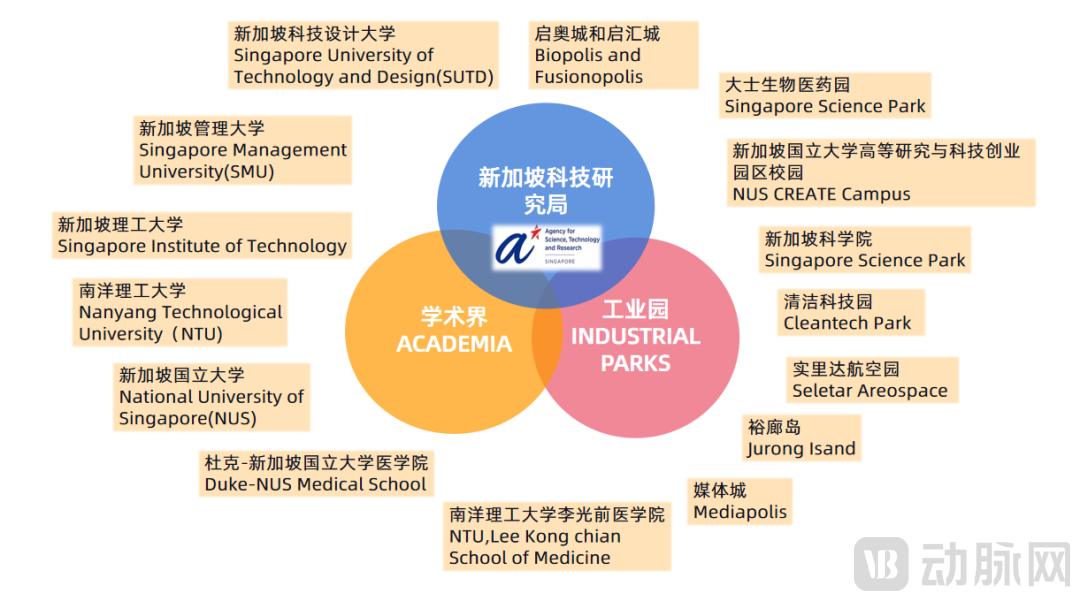
Singapore's Research and Development System
In recent years, Singapore has increasingly faced challenges such as rising healthcare costs, a growing burden of chronic diseases, and shortages of medical personnel.Innovative Medical Technologiesregarded as a crucial approach to addressing challenges. Therefore,Singapore Innovation AgencyandSingapore Health Services Groupsigned a three-year termMemorandum of Understanding on Cooperation, plans to further advanceArtificial Intelligence. Novel applications of emerging technologies in the biopharmaceutical field.
In 2019, Singapore launched its National Artificial Intelligence Strategy, proposing to accelerate the development of AI in five key sectors, including healthcare. Under this framework, measures such as promoting investment in AI research, cultivating talent, and establishing supporting digital infrastructure were implemented to expedite AI innovation and adoption. These efforts aim to enhance the efficiency of disease detection while strengthening capabilities in the analysis, prediction, and intervention of chronic diseases.
Meanwhile, the government is also actively encouraging cross-sectoral and interdisciplinary collaboration on artificial intelligence projects, while strengthening financial support for innovation-driven entities such as public healthcare institutions and higher education institutions.
Of course, in addition to the support from technology,High-quality enterprises and a comprehensive service chain are also driving continuous innovation across the pharmaceutical industry.Singapore’s diverse healthcare institutions, including public hospitals, private hospitals, and specialty centers, offer a comprehensive suite of medical services. These services range from basic health screenings and dental procedures to highly specialized quaternary care, supported by a wide array of high-quality healthcare service providers.
It is worth mentioning that Singapore is developing for healthcare providers"Future Hospital"and ""Future Home Care"platforms. These platforms enable healthcare providers toEnterprises in other industries(e.g., IT, medical devices, pharmaceuticals, nutrition, and fashionable lifestyle consumer industries) to jointly develop and test new products and business models.
Leveraging these advantages, Singapore has addressed several critical pain points in biopharmaceutical innovation: First, it offers robust clinical resources, which not only enable the continuous identification of emerging needs but also serve as a vital window for validating innovations. Second, it boasts strong research institutions equipped with top-tier talent and state-of-the-art laboratory facilities, supported by a comprehensive and efficient research ecosystem. Third, it features active industry participation, with enterprises and industrial parks deeply engaged in the innovation process.
What Can We Learn from Singapore?
Currently, China’s biomedical innovation sector is in its nascent stage, requiring continuous refinement across many areas. Strengthening internal capabilities is undoubtedly essential. At the same time, it is crucial to adopt a global perspective to examine, from multiple dimensions, the challenges faced at this current stage, while continuously drawing on experience to address and improve existing shortcomings.
So, what lessons can we learn from Singapore?
The first priority is to recruit a cohort of top-tier talent.The development of any industry is inseparable from people. This is because individuals not only bring cutting-edge technologies and advanced concepts, but also, more critically, the resources behind them.
withSidney BrennerTake him as an example: he not only came in person but also brought his philosophy, helping Singapore establish a comprehensive pharmaceutical R&D system. In addition, he leveraged his resources to found the Graduate School of the Agency for Science, Technology and Research (A*STAR) and invited many of his friends to serve as mentors at the school.
It is precisely on this basis that the Graduate School of the Agency for Science, Technology and Research (A*STAR) in Singapore has cultivated a large cohort of high-caliber professionals in the biomedical field for the country, laying a solid foundation for Singapore’s subsequent emergence as a pharmaceutical R&D hub in Asia.
Secondly, we strive to provide innovative services to the best of our ability.As previously stated, once individuals arrive, the key to ensuring their willing retention lies in enabling them to genuinely perceive the “sincerity” and “effectiveness” of this region.
First, let’s address “sincerity,” which primarily refers to the implementation of policies that genuinely resolve issues, the provision of funding to support the development of innovative projects, and the establishment of laboratory platforms that advance innovative research.
Next, let us discuss “effectiveness,” which primarily refers to the valuable translation of scientific research achievements within this context. In the process of translation, the primary consideration is naturally the success rate—namely, whether the research outcome can transition from the laboratory to the marketplace. Once this issue is resolved, the subsequent focus shifts to how to “shine brightly” in the market, capture a larger market share, and generate greater revenue.
Finally, the goal is to build a comprehensive, end-to-end scientific research ecosystem.The translation of scientific and technological achievements in the biopharmaceutical field is never a one-dimensional issue but inherently complex; therefore, the processes and elements involved are diverse. The key challenge lies in engaging these various elements and fostering their collaboration.
Based on this, Singapore leverages"Policy Guidance + Market Selection"By adopting this approach, we have gradually cultivated a number of research institutions with distinct specializations, high industrial clustering, and significant scale effects, thereby creating an integrated innovation ecosystem for the biopharmaceutical industry that coordinates the “industrial chain, innovation chain, talent chain, capital chain, and policy chain.”
The Winds of Biopharmaceutical Innovation in Asia Are Accelerating from Singapore to China
It is undeniable that Singapore currently leads China in the field of biomedical innovation. However, the momentum of biomedical innovation in Asia is, in fact, shifting from Singapore to China.
This is not boasting, but supported by case evidence. In July 2018,SanofiSanofi’s Central and Western China Operations and Innovation Center and its Global R&D Operations Center were officially established in the Chengdu High-Tech Zone; in June 2019,Johnson & JohnsonThe JLABS innovation incubation base was officially launched in Shanghai; in October 2019, an investment of RMB 863 million was madeRocheThe Shanghai Innovation Center was inaugurated at the Roche Park in Zhangjiang Hi-Tech, Shanghai; October 2021,AstraZenecaUpgrade the Shanghai R&D Center to the Global R&D China Center.
This is merely the “tip of the iceberg.” According to statistics, in Shanghai alone,Of the top 20 pharmaceutical companies worldwide, 18 have established their China regional headquarters or R&D headquarters in China.
So, why are these global pharmaceutical companies accelerating their pace in China’s nascent innovation market? There are certainly reasons for this.
First, on the innovation production side, an increasing number of research institutions and enterprises are engaging in medical innovation; second, on the innovation output side,Laboratories, Incubators, and Translation Centersas the “hardware” for scientific research gradually matures and becomes increasingly diversified.
Third, on the implementation front of innovation, “buyers” such as investment institutions, enterprises, and the government are showing growing enthusiasm for early-stage medical projects. Taking investment institutions as an example, a total of in China’s healthcare sector in 202159 Early-Stage Investment and Financing Events,Total financing reached RMB 2.5 billion, in addition, it is particularly worth emphasizing that a total of 107 investment institutions participated in early-stage investments, among which there were manyMatrix Partners China, Legend Capital, Bohe Angel Fund, Sinovation Ventures, Venshares Capital, Kaifeng Venture Capitaland other well-known investment institutions.
Next is the vast market space for medical innovation.In recent years, with the intensifying aging population and continuous upgrading of consumption levels, China’s pharmaceutical sector has consistently grown at a rate exceeding that of the global pharmaceutical market. From 2014 to 2018, the sector recorded a growth rate of 8.1%, with its market size expanding from RMB 1.1 trillion to RMB 1.5 trillion.reached RMB 1.75 trillion in 2020, has risen to become the world's second-largest healthcare market.
Lastly, there is the innovation potential that has yet to be fully tapped.In recent years, thanks to the improvement of the overall innovation environment, the number of patents in China's medical field has surpassed that of the United States to become the largest globally, but the conversion rate remains "stagnant."Its data accounts for less than 5%., far behind the international leading level.
High patent counts on one side, low conversion rates on the other.What lies between the two is a multitude of medical innovations that have been “wasted.”How to pull these innovations out of the “valley of death” is precisely what global healthcare giants excel at, and it is also the key to their finding new growth curves in the Chinese market, and even across the entire Asian market.