

How Scientists Can 'Accidentally' Meet the Right Entrepreneurial Partners After Leaving the Lab
VB Think Tank"Entrepreneurial Partner"The event “An Unexpected Encounter with Bo Le” concluded on the evening of May 25.
“Only when there are Bo Le in the world can there be thousand-li horses. Thousand-li horses are common, but Bo Le is not.”
This logic is equally applicable to the science and technology innovation sector. In fact, scientist-led startups have become a new trend, as top-tier talents from laboratories are breaking out of the purely academic circle and venturing into the broader frontier of entrepreneurship.
However, in many real-world cases, scientists with cutting-edge technologies often fail to showcase their full potential during the entrepreneurial journey due to knowledge gaps and insufficient experience in technology commercialization. Co-founders can precisely fill these voids. Therefore, to emerge as high-potential entrepreneurial talents, scientists should take the initiative to recognize the importance of co-founders and seek out highly compatible mentors or partners who can best leverage their strengths.
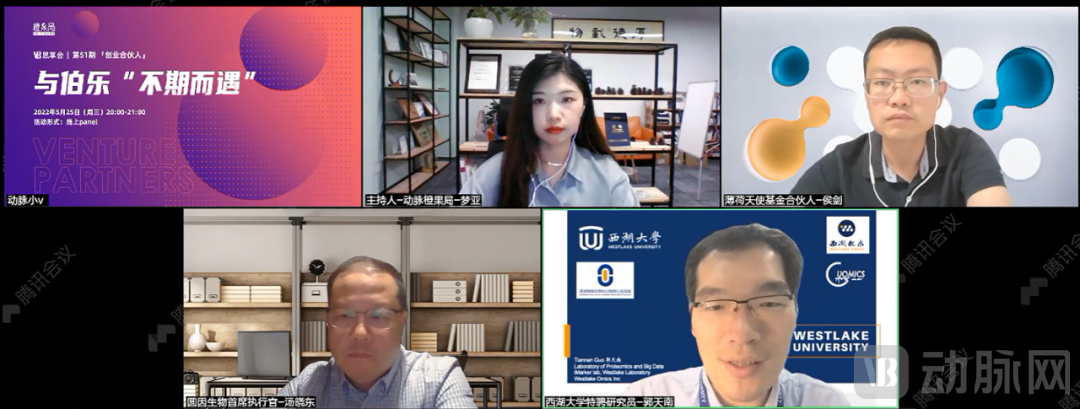
Top row (upper), from left to right:VCBeat reporter Zhou Mengya, Mint Angel Fund partner Hou Jian
Second row (bottom), from left to right:Yuanin Bio CEO Tang Xiaodong, Westlake University Distinguished Researcher Guo Tiannan
Innovative Spirit and Idealism: The Strengths and Weaknesses of Scientists
VBInsight: What Are the Advantages and Challenges for Scientists Becoming Entrepreneurs?
Dr. Tiannan Guo:I believe the advantages and challenges of scientists starting businesses can be understood from two main aspects: the first is innovative thinking, and the second is idealism. These two aspects are both the strengths and weaknesses of scientists in entrepreneurship.
First is innovative thinking,Innovation is one of the necessary conditions for scientific research. For scientists, only innovative scientific research is meaningful, so they always hope to explore new technologies and fields. However, in the business world, although innovation is also needed, it does not constitute the entirety of commerce.
The journey from scientific achievements to products, and ultimately to customer purchases, is a complex process that requires not only technical efforts but also commercial support. Especially in the life sciences field, scientists' innovative thinking may lead to the development of unique products. However, without product development and market expansion, scientific achievements may struggle to become commercialized goods.
Next is idealism.Scientists constitute a distinct group. Many have long lived and worked within the “ivory tower,” harboring idealistic mindsets. Compared with business professionals who have honed their skills in the competitive commercial arena, scientists may hold different perspectives on the world. They are prone to formulating grand visions and possess the potential to build disruptive innovative companies, but they also face the risk of being overly idealistic and out of touch with practical realities.
VCBeat Orange Bureau: What Are the Differences in Mindsets Between Scientists and Entrepreneurial Partners?
Dr. Tang Xiaodong:Scientists’ thinking focuses on innovation, and they are primarily engaged in creative work.Meanwhile, entrepreneurial partners place greater emphasis on the practicality of translating innovative technologies.
For scientists, it is essential to pursue innovation in research. They are generally unwilling to replicate work that has already been done by others.
For entrepreneurial partners,It is necessary to find the optimal balance between innovativeness and druggability. BecauseThe more innovative the field, the higher the risk of drug development.
Specifically, if a technology is to enter the translation phase, then entrepreneurial partners will need to considerThe following three questions:
First, determine the therapeutic areas to pursue based on patient needs or market demand. Second, leverage clinical data—particularly Phase II clinical trial data—to understand the challenges within the selected disease area and assess whether our technology can address these issues. Third, evaluate whether the company has sufficient resources to translate scientists’ innovative achievements into practical applications.
VCBeat Orange Fruit Bureau: What Empowerment Can the Addition of Entrepreneurial Partners Bring to Enterprises Founded by Scientists?
Dr. Hou Jian:Scientists’ motivation for entrepreneurship often stems from the exploration of the unknown in basic research, which is important, but bi-Biopharmaceutical companies operate with a clinical-need-based, product-oriented commercial approach, rather than pursuing extreme innovation.
ThereforeThe entrepreneurial co-founder is a role complementary to that of the scientist., they assist scientists in executing commercial deployments and strategic analyses, and support scientist-founders in establishing companies from diverse perspectives, including securing clinical resources, raising financing, and planning corporate development milestones.
In short, entrepreneurial partners should help the company define product-oriented milestone goals based on market and clinical needs, and devise strategies to achieve these goals.
“Complementarity + Compatibility + Professionalism” Are the Common Characteristics of Founding Partners
VCBeat Orange Bureau: What Qualities Make an Entrepreneurial Partner Irresistible to Scientists?
Dr. Tian-Nan Guo:Currently in China, there are more people engaged in business than in science, and the number of individuals who have achieved outstanding business results across various industries exceeds that of distinguished scientists. After scientists achieve results with potential for commercialization, I personally believe it is necessary to seek entrepreneurial partners who possess the following 12-character traits:Tech-savvy, business-savvy, courageous, and decisive.
Tech-Savvyis a prerequisite for effective communication with scientists. If entrepreneurial partners do not understand the basic principles of technology, it is difficult for them to communicate effectively with scientists;
andBusiness-SavvyThese are the fundamental qualities of an entrepreneurial partner. Without sufficient business experience and a unique vision, merely following what others have already done makes it difficult to engage in deep collaboration with opinionated scientists.
Courageous and BoldThese are indispensable qualities for entrepreneurial co-founders. Collaborating with scientists to commercialize innovative achievements entails assuming higher risks. Many seasoned entrepreneurial co-founders already enjoy lucrative salaries at top-tier companies; only those with courage and boldness dare to step out of their comfort zones.
VBInsight Orange Bureau: What Problems Should Startup Partners Help Scientists Solve? What Capabilities Should They Possess?
Dr. Xiaodong Tang:Co-founding partners can help scientists analyze market demand, address clinical challenges, and integrate resources, while also maintaining normal company management and operations to guide the team from inception to establishment.
I believe that a promising startup must possessThe following four factors:
First, the technology must be innovative.This is a prerequisite for entrepreneurship, as follower technologies are easily swept away by the tide. Founding partners need to identify and recruit scientists with innovative technologies to join their ventures;
Second, strong policy and government support. To break the ice, policy comes first. Understanding policies and establishing good relationships with the government can make the entrepreneurial journey smoother;
Third, establish a high-caliber team,This includes the management team and the scientific team;
Fourth, sufficient funding serves as a strong backing. Sufficient funding is required to support costly R&D efforts, particularly clinical studies.
VCBeat: What Do Investors Look for in a Startup Co-Founder?
Dr. Hou Jian:Co-founders vary widely from one individual to another, and the circumstances surrounding co-founders differ across projects. Often, it depends on whom you happen to meet at that particular point in time.The person who can drive the project forward is the most suitable.
The accessibility of a partner also represents trust to some extent. In the early stages of entrepreneurship, scientists often seek partners from their immediate circle whom they know well.
Of course, this partner should also be compatible with the scientist in temperament and personality, share common values, and endorse the scientist’s dreams to form a shared vision. A high degree of alignment in values and vision enables individuals to look beyond many material considerations, thereby creating the opportunity to reach consensus when disagreements arise.
Such a partner could be an experienced entrepreneur, or a PhD student or postdoctoral fellow from the professor’s research group. In some cases, these doctoral students are deeply involved in the development of the technology being commercialized. They can translate scientific research projects into viable business plans during the early stages of technology transfer, thereby helping scientists take their first steps out of the laboratory.
Collaboration: Attitude and Division of Labor Come First
Initial attraction stems from the power of magnetic fields, while long-term collaboration requires greater effort in mutual adaptation.
VBInsight Orange Bureau: How Do Scientists Collaborate with Co-Founders?
Dr. Jian Hou:The combination of scientists and entrepreneurial partners represents both collaboration and division of labor,To discuss collaboration, we can start by outlining the division of labor.
Everyone shouldHave a clear understanding of the boundaries of their respective capabilities, after clearly defining the division of labor based on respective areas of expertise, full delegation can be implemented; however, key matters should still be discussed collectively. It is also essential to establish in advance the decision-making mechanisms to be employed in the event of disagreements. Generally, the principle of aligning authority, responsibility, and benefits should be upheld, with each party held accountable for their own decisions.
However, all of this rests on one premise: scientists and entrepreneurial partners must engage as equals in dialogue, with both parties continuously adjusting their approaches to maintain a balanced collaboration.
Dr. Tiannan Guo:For scientists, it is routine to approach what we see and hear with a spirit of “skepticism,” explore the underlying principles behind phenomena, and venture into uncharted academic territories. However, this type of academic mindset is not always the most suitable approach in entrepreneurship, and may even worsen situations at times.
In corporate management, I believe there is a greater need forTrust in the professional capabilities of outstanding entrepreneurial partners.
In real-world corporate management, one must not only attend to the mundane intricacies of daily operations but also prioritize customers above all else, advancing step by step with careful strategic planning for the company’s future development. For many scientists, these responsibilities are far more complex than scientific research.
Therefore, if scientists wish to build successful companies, they must respect, and even hold in awe, the professional management expertise of their entrepreneurial partners.
VCBeat Orange Bureau: How Can Startup Co-Founders Collaborate with Scientists?
Dr. Xiaodong Tang:The relationship between scientists and entrepreneurial partners can be likened to an intimate marital bond.
Before formalizing the partnership, entrepreneurial co-founders need to systematically evaluate the innovativeness and practicality of the technology, as well as assess whether the scientist’s personality is conducive to collaboration.
After formally establishing the relationship, it is essential to cultivate mutual synergy. First, scientists must place absolute trust in their entrepreneurial partners, confidently entrusting them with the management of the product pipeline. Second, roles and responsibilities should be clearly defined, with each party fully aware of their own strengths and providing unwavering support within the other’s area of expertise.
Search: Two Approaches—Discovery and Cultivation
VBInsight: In actual entrepreneurial practice, many scientists choose their team members or students to serve as co-founders. What is your view on this?
Dr. Tiannan Guo:For example"In the early stages, our company was run by our own team members. As the company reached a certain scale, we needed to transition to professional entrepreneurial partners."
Technology transfer is a long expedition. Scientists may possess outstanding technologies and achievements, but they might not encounter professional entrepreneurial co-founders in the short term. In such cases, team members, students, or friends can temporarily assume this role.
Not every individual who undergoes scientific research training is suited for high-intensity, highly creative frontier scientific research. Pursuing a career in research is akin to thousands of people crossing a single-log bridge—a fiercely competitive endeavor. If researchers are interested in business, they can adopt a scientific approach to learning business knowledge and accumulating practical experience. Combined with their specialized expertise, this enables them to become the interdisciplinary talents sought by society, realize their self-worth, and carve out a new career path.
VBInsight: What additional skills do students need to develop when taking on the role of founding partners in the early stages?
Dr. Tang Xiaodong:For students, becoming a professional entrepreneurial partner is a lengthy process. Specifically in the field of biopharmaceuticals, three key competencies need to be developed:
First isPractical Experience, which means working in this industry for a long time to understand the entire pharmaceutical manufacturing process; secondly,Business Background, including advancements in knowledge and role responsibilities; thirdly,Entrepreneurial Experience, If you have entrepreneurial ideas, dare to start a business. Plan carefully before taking action, and be sure to spend some time experiencing it firsthand.
VCBeat Orange Bureau: The union of scientists and entrepreneurial co-founders is a rare find; what should scientist-entrepreneurs do?
Dr. Hou Jian:The starting point for scientists' entrepreneurial ventures lies in an idea and a result, so in this processThe most important thing is to make up your mind,The determination to embark on an entrepreneurial journey largely dictates how far a project and company can go. As for the people encountered along the way, one should remain grateful—thankful that they chose to join the team and walk side by side.
Who exactly this person is may determine how fast the project and the company can move. In the early stages of development, if this person is a student, the pace may be quite slow, but this does not necessarily mean their growth potential is weak. However, if there are significant conflicts between the scientist and the entrepreneurial co-founder, even the addition of an experienced entrepreneur may not accelerate progress.