

Zhenxing Technology Files IPO Prospectus for Its Proprietary Smart Prosthetic with Bionic Algorithms and Millisecond-Level Feedback
According to data from the Second National Sample Survey on Disability conducted in 2006, the total number of people with disabilities in China was 82.96 million. Among them, 24.12 million had physical disabilities, including 2.26 million amputees, accounting for 8% of the population with physical disabilities. Of these 2.26 million amputees, 70%, or approximately 1.58 million, were lower-limb amputees.
Nowadays, the number of lower-limb amputees caused by various diseases, traffic accidents, occupational injuries, natural disasters, and other factors continues to rise. However, rehabilitative medical devices such as prosthetics, which are used to address functional impairments of the limbs, remain in an early stage of development due to their relatively late start in research and development. Consequently, there are still shortcomings in their level of intelligence, product functionality, scope of application, and degree of automation. The domestic smart prosthetics market is predominantly dominated by imported manufacturers, and factors such as high equipment costs and complex maintenance procedures impose a severe financial burden on patients.
Three years ago, a research team from the Huzhou International Innovation Institute of Robotics at Harbin Institute of Technology jointly established the “Huzhou City Class-A Academician Workstation” with Dr. Li Jian’an, an academician of the U.S. National Academy of Medicine.Conduct bionic motion data analysis and research.
The research team has integrated multiple technologies—including microelectronics, bionic control, new materials, and AI—into its products, achieving breakthroughs in bionic gait control algorithms, miniature intelligent hydraulic damping systems, full-carbon-fiber anthropomorphic leg shells, and prosthetic joint integration., jointly developed intelligent prosthetics capable of achieving bionic gait control.
Following the successful product development, the core team and the research institute officially established Zhenxing Technology, focusing on the development of domestically produced intelligent prosthetics and sports assistive devices.
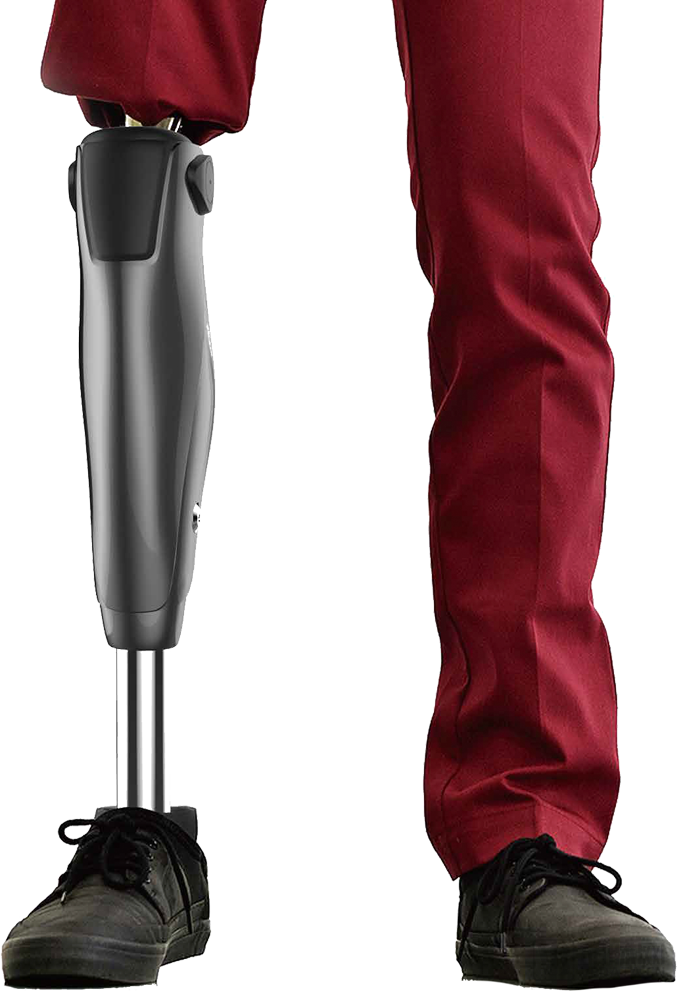
Currently, the company has successfully developed the Zhenxing·Jiguang series of intelligent prosthetic joints. Relevant research data indicate that the product supports a load capacity of ≤136 kg, with a joint weight of ≤1350 g ±25 g, a knee flexion angle of ≤125º, and a maximum walking speed of approximately 70 m/min. Technologies such as bionic gait control algorithms, micro-intelligent hydraulic damping systems, and full-carbon-fiber anthropomorphic leg shells help individuals with unilateral transfemoral amputation (long residual limb, knee disarticulation, or hip disarticulation) and bilateral transfemoral amputation (long residual limb, knee disarticulation, or hip disarticulation) return to normal life, while meeting their needs for personalization and natural gait.
“Currently, there is a growing demand among individuals with disabilities to improve their quality of life and reintegrate into normal daily activities, with expectations for prosthetic products that are more intelligent, convenient, comfortable, aesthetically pleasing, fashionable, and personalized. However, the domestic smart prosthetics market in China has long been dominated by imported products. These imports are not only expensive but also difficult to maintain and repair, imposing a significant burden on patients. Meanwhile, the development of China’s domestically produced prosthetics industry remains inadequate, with persistent issues such as lagging technological capabilities, insufficient market supply, and a scarcity of R&D talent. There is an urgent need for intelligent solutions across the entire market.”Li Zhe, General Manager of Zhenxing Technology, stated.
It is understood that the majority of products currently available on the market are traditional mechanical prostheses. Traditional mechanical prostheses require users to manually control the prosthetic limbs, resulting in considerable fatigue during ambulation and an increased risk of falls. Intelligent prostheses, however, do not present these issues; they can autonomously recognize terrain conditions and operate via automatic control without the need for manual intervention. When a tripping hazard is detected, the device can automatically lock the joints to provide support to the user, thereby mitigating the risk of falling.
Zhenxing Technology integrates motion control algorithms with ultra-precision manufacturing technology to continuously provide users with safe, high-quality, and intelligent products.Significantly reduces walking strain for individuals with disabilities, enhances user experience, and helps users return to normal daily life.
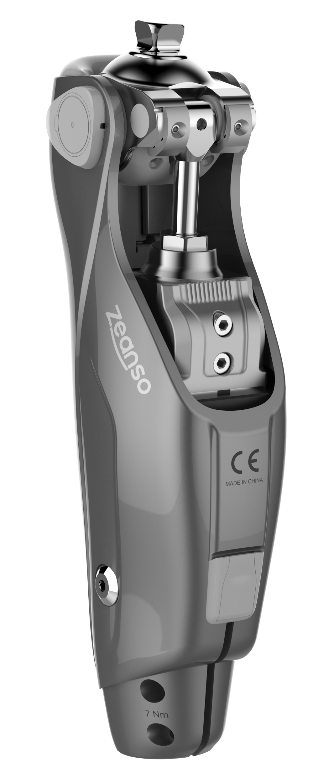
Zhenxing Technology designs its products by addressing multiple dimensions, including gait analysis, motion scenarios, user convenience and safety, product portability, fit, and overall user experience.
To address users' walking gait, Zhenxing Technology employs six sensors to capture real-time thigh posture data. Leveraging advanced biomimetic gait control algorithms, the system coordinates prosthetic limb movements to simulate natural human walking patterns while continuously sensing the user's motion intent. Whether walking slowly or briskly, the prosthetic limb synchronizes seamlessly with the body, ensuring a natural gait.
Meanwhile, Zhenxing Technology has enhanced the product’s ability to recognize diverse activity scenarios, taking into account the differentiated walking needs of users across various terrains such as flat ground, beaches, grassy areas, uneven surfaces, slopes, and stairs. This enables the prosthetic limb to real-time identify the user’s movement intentions and make corresponding adjustments, automatically adapting its gait pattern.
It is reported that the Zhenxing prosthetic limb features a built-in processor capable of performing thousands of calculations per second, continuously monitoring the user’s posture. It can execute anti-stumble processing within 20 milliseconds, preventing secondary injuries such as falls and tripping during use. Its pioneering micro intelligent hydraulic resistance system provides shock absorption and passive assistance, enabling more flexible gait for the user.
Regarding personalized user needs, Zhenxing Technology has developed its own WeChat mini-program, enabling direct control of the prosthetic limb via the mini-program. Users can even set modes such as cycling through their mobile phones, offering a richer experience and greater convenience for travel. Additionally, prosthetists will use the Zhenxing Prosthetic Configuration System software to tailor prosthetic configuration plans for each user, ensuring an enhanced user experience.
Moreover, Zhenxing Technology has upgraded its products with a focus on user experience, enhancing aesthetics, weight, and convenience. Unlike traditional mechanical prosthetics that are bulky in appearance, Zhenxing’s design mimics the human leg shape and features a metallic-texture paint finish, resulting in a more aesthetically pleasing product. The use of an all-carbon-fiber shell keeps the total product weight under 1.3 kilograms. Zhenxing’s prosthetic limb employs ultra-low-power circuit design and software control, enabling approximately 72 hours of operation after just four hours of charging.
Li Zhe told VCBeat that the most important aspects of smart prosthetics are safety, convenience, and natural gait.Only in this way can users truly enjoy a life experience comparable to that of able-bodied individuals, thereby realizing the true value of intelligent prosthetic products. This is precisely why Zhenxing Technology is committed to continuous in-depth research and development at the technological level.
To ensure product safety, Zhenxing Technology, based on international standards, conducted 3 million load cycle tests, gravity tests, and medical electronic device tests on its products in collaboration with the National Rehabilitation Center. Furthermore, it jointly established a Class-A Academician Workstation in Huzhou City with Academician Li Jian’an, a member of the American College of Medicine, to carry out analysis and research on bionic movement data.
Moreover, Zhenxing Company has established strong collaborative relationships with multiple organizations, including the National Research Center for Rehabilitation Technical Aids, the Zhejiang Provincial Research Center for Rehabilitation Technical Aids, the Heilongjiang Provincial Disabled Persons’ Federation, and the Hefei Municipal Disabled Persons’ Federation. With the support and assistance of these entities, the company has organized wearable device trial events for users in Shanghai, Hangzhou, Qingdao, Harbin, and other cities, earning widespread recognition and positive feedback from participants.
Currently, Zhenxing Technology is expanding its sales and installation channels in North China, East China, the Chengdu-Chongqing region, South China, and other areas. The company plans to build brand awareness and iterate its product offerings over the next one to two years.Delve deeply, thoroughly, and steadily into the development of intelligent joint assistive devices, truly creating a product that addresses the pain points of individuals with disabilities while remaining affordable.After expanding its domestic channels, Zhenxing Technology also plans to follow the “Belt and Road” initiative to further expand into overseas markets.
In the future, after penetrating the smart prosthetics market, Zhenxing Technology will expand into assistive products for individuals in a sub-health state, thereby broadening its product pipeline and target demographic. The company aims to develop high-tech solutions that facilitate mobility and enhance people’s quality of life.
To address the continuously growing demand for rehabilitation services and the lagging development of rehabilitation assistive devices, the state issued the “Several Opinions on Accelerating the Development of the Rehabilitation Assistive Device Industry” as early as 2016. These opinions proposed enhancing independent innovation capabilities and promoting industrial optimization and upgrading. In recent years, the Ministry of Civil Affairs has successively advanced national comprehensive pilot programs for the rehabilitation assistive device industry and pilot initiatives for innovative community-based leasing services of rehabilitation assistive devices.
In 2019, the State Council abolished the qualification accreditation for prosthetic and orthotic device manufacturers, further lowering market entry barriers and providing greater room for development for China’s domestic prosthetics industry. Last year, the National Health Commission issued the “Opinions on Accelerating the Development of Rehabilitation Medical Services,” aiming to strengthen the construction of the rehabilitation medical service system and promote high-quality development of rehabilitation medical services. The document explicitly called for advancing the development of rehabilitation assistive devices and promoting the integration and seamless connection between rehabilitation medical services and the provision of rehabilitation assistive devices.
Against the backdrop of “new infrastructure for rehabilitation,” rehabilitation medical equipment is poised for significant volume growth. Expanded product coverage, domestic substitution, and advancements in emerging technologies in recent years—including mechanical engineering, bionics, materials science, sensing technology, microelectronics, intelligent control technology, and artificial intelligence—have become endogenous drivers of industry growth. These developments have provided new impetus for the advancement of rehabilitation assistive devices, such as intelligent knee prostheses, steering the development of prosthetic and rehabilitation assistive equipment toward automation, intelligence, personalization, and enhanced performance.
Driven by sustained national policy support and the development of the rehabilitation assistive device industry, the market size and growth potential of China’s domestically produced intelligent rehabilitation assistive devices will continue to expand.
Addressing the current state of rehabilitation industry development in China, Li Zhe stated: “Although China’s rehabilitation industry currently lags behind, both policy support and industrial development trends are showing positive momentum. In the future, Zhenxing Technology will establish a closed-loop ecosystem integrating R&D, user testing and feedback, and prosthetic knowledge training. By continuously addressing the core needs of users with disabilities and enhancing their experience, the company aims to develop intelligent rehabilitation assistive devices that are both user-friendly and truly affordable, thereby helping to close the gap between China’s rehabilitation sector and its overseas counterparts.”
Currently, many domestic manufacturers have taken the first step in the research and development of intelligent rehabilitation assistive devices. Although the journey from 0 to 1 may still require time, the explorations made by Zhenxing Technology in the field of intelligent rehabilitation assistive devices are undoubtedly significant for the development of the rehabilitation assistive device industry.