

From Lab to Market: The Evolving Mindset of a Scientist-Entrepreneur – An Interview with Professor Tan Jun of Chongqing University of Education
Few scientist-entrepreneurs can take a straight path to Rome.
In reality, they must continuously navigate a winding path—turning, advancing, turning again, and moving forward—to reach their desired destination. In the realm of scientific research, they need to constantly devise new approaches to overcome successive research challenges. When engaging in the translation of technological achievements into practical applications, they must further engage in continuous trial and error, overcoming their “innate disadvantages” in the commercial sector, and identifying an entrepreneurial path suited to their strengths.
May 2022,VCBeat Orange BureauwithProfessor Tan Jun, Director of the Chongqing Key Laboratory of Medicinal Resources in the Three Gorges Reservoir Area at Chongqing University of EducationAn interview was conducted. During the conversation, Professor Tan shared his journey of evolving mindsets, from scientific research to the commercialization of research outcomes. VCBeat has compiled and edited this interview transcript to offer readers insights into the growth of this scientist-turned-entrepreneur.
From Follower to Leader in Scientific Research
The path to developing drugs for NASH (non-alcoholic steatohepatitis) is fraught with challenges, a well-recognized difficulty in the medical community.
Many major pharmaceutical companies have suffered setbacks in the field of nonalcoholic steatohepatitis (NASH). In May 2020, GENFIT announced the failure of the Phase III clinical trial of GFT-505 (elafibranor) and halted its development for NASH; around the same time, Gilead Sciences announced the failure of the Phase III clinical trial of GS-4997 (selonsertib). In August 2020, Albireo Pharma also announced the failure of the Phase II clinical trial of elobixibat, an ileal bile acid transporter inhibitor.
Nevertheless, a cohort of researchers continues to press forward, aspiring to conquer NASH—the last bastion in the field of liver disease. Professor Tan Jun is among them.
This February, Professor Tan Jun published in a top-tier international academic journalNature Communications(Nature Communications) published significant research findings in the field of non-alcoholic fatty liver disease.“The E3 ubiquitin-protein ligase Trim31 alleviates non-alcoholic fatty liver disease by targeting Rhbdf2 in mouse hepatocytes”。
Moreover, its research papers in the field of non-alcoholic fatty liver disease have been successively published inHepatology、Redox Biologyand other top-tier international journals.
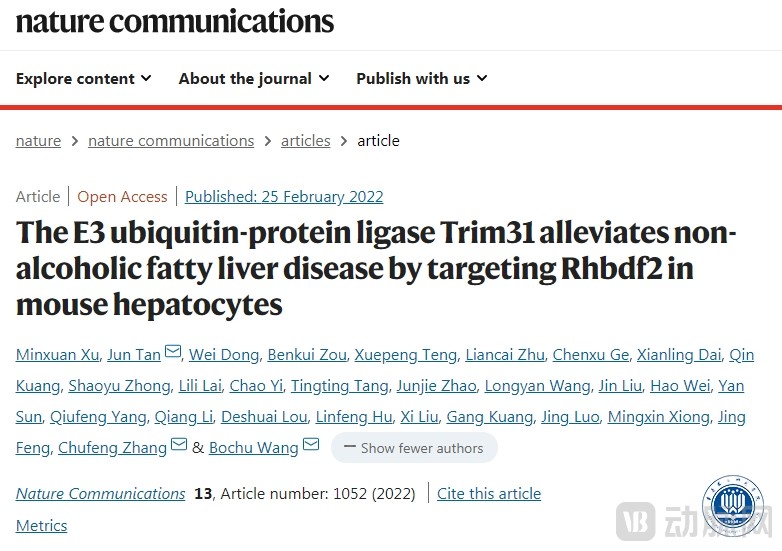
Paper Screenshot
In Professor Tan Jun's research,It has been determined that a protein named iRhom2 (inactive rhomboid protein 2, Rhbdf2) on hepatocytes may play a key role in the pathogenesis of non-alcoholic steatohepatitis (NASH). Furthermore, the study further discovered that Trim31 can target and catalyze K48-linked ubiquitination of the iRhom2 protein, promoting its proteasomal degradation. This process reduces the abnormal activation of downstream inflammatory signaling and lipid metabolism signaling pathways mediated by iRhom2, thereby significantly lowering levels of inflammatory factors in the liver, hepatocyte injury, early collagen fiber production, and disturbances in glucose metabolism. Based on these findings, a therapeutic strategy for NASH using proteolysis-targeting chimeras (PROTACs) to induce ubiquitin-mediated degradation of iRhom2 is proposed.
This latest discovery was hard-won.
First, in the context of China’s research environment, conservative followership has become the dominant trend. When discussing the landscape of NASH drug development in China, Professor Tan Jun stated: “Domestic research primarily follows international developments,"Currently, research in the field of NASH is focused on traditional drug targets, particularly those related to lipid synthesis and insulin resistance."
In fact, many new target discoveries originate from abroad. Due to insufficient R&D funding and low investment in China, the overall environment struggles to stimulate researchers' enthusiasm for innovation. Consequently, many R&D professionals simply follow foreign leads. Furthermore, the pathological mechanisms of NASH are overly complex, academic understanding remains inadequate, and existing targets lack sufficient specificity.
To address this issue, Professor Tan Jun and his team broke away from conventional approaches. They explored alternative strategies to degrade the iRhom2 protein. Through metabolomics and bioinformatics analyses, they discovered that Trim31 interacts with iRhom2 in vivo. After extensive experimental validation involving thousands of tests, the team demonstrated that this interaction leads to the degradation of iRhom2, offering a promising therapeutic avenue for alleviating NASH-associated pathology.
It is understood that Trim31 represents a novel therapeutic target for NASH. This signifies that Professor Tan Jun and his team have not only ensured the scientific rigor and innovativeness of their research but also distinguished themselves from the numerous domestic followers, emerging as leaders in the field of NASH drug development.
Secondly, the discovery of iRhom2 protease inhibitors during the research process was not smooth sailing. Professor Tan Jun informed us that his team had previously observed very low inflammation levels after knocking out the iRhom2 gene, indicating that inhibiting iRhom2 protein activity could significantly reduce inflammation. However, the challenge lay in the fact that the iRhom2 target was considered undruggable, making it difficult to identify effective inhibitors. Even when certain inhibitors were discovered, their efficacy was mostly unsatisfactory.
Finally, identifying therapeutic targets remains challenging. Despite years of research both domestically and internationally, there are few truly effective targets for non-alcoholic steatohepatitis (NASH). Currently, in Professor Tan Jun’s latest research, several drug molecules are in the synthesis stage and are poised to undergo further preclinical studies.
Professor Tan lamented, “In this process, we knew that what we had discovered was effective, but we were frustrated by our inability to identify a suitable drug, which was deeply disappointing and distressing.”
In fact, such disappointment and distress also plague most scientists. But when faced with research dilemmas, he adopted the most straightforward approach to break through.
Only through extensive experimentation can new discoveries be made. It took more than five years of research, cost millions of yuan, and involved the use of tens of thousands of laboratory animals to arrive at a satisfactory answer.
“The road ahead is long and distant; I will search high and low.” Professor Tan Jun has followed this same path, tracing the footprints of truth through failure and seeking the glimmer of hope within the darkness of disappointment.
From Direction to Management: Two Paradigm Shifts in Thinking
The publication of the article in Nature Communications is merely the beginning.
As is well known, the NASH drug market remains a blue ocean, with many investment firms eagerly awaiting opportunities and some even entering the field early. Consequently, as soon as Professor Tan Jun’s findings were published, investment firms approached him.
Currently, Professor Tan Jun and his team have reached a commercialization cooperation intention with Quark Medicine (China) Co., Ltd., a professional investment company in the field of biomedicine. In future plans, both parties intend to promote the research and development of biopharmaceuticals with NASH new target small molecule drugs as the main pipeline.
However, this was not Professor Tan Jun’s first attempt at translating scientific research achievements into practical applications; rather, it was a new endeavor undertaken after careful summary and reflection. Since 2018, Professor Tan has embarked on an entrepreneurial journey, striving to translate technological innovations and research outcomes into market applications. “My path to commercializing research results has involved many detours,” he recalled. In fact, his approach to technology transfer underwent two significant shifts during his past experiences.
The first time was in choosing a direction.
Initially, the focus of transformation was not on drug research but on general health products and food.In his initial view, the challenge of innovative drug translation lies in R&D: not only is research excessively time-consuming, but early-stage effects are also minimal, making it less straightforward and effective than general health products and foods.
However, it has become evident that the general health and wellness product and food markets suffer from two major weaknesses, resulting in a narrow path to commercial conversion. First, valuations are too low to generate substantial profits, making most investment institutions reluctant to invest. Second, market technologies are highly susceptible to imitation, while general health products rely heavily on marketing. After a period of trial and experience, companies often find themselves left with unsold inventory rather than having converted their offerings into productive assets.
After suffering setbacks in the general health products and food sectors, Professor Tan Jun discovered the promising potential of translating pharmaceutical research into commercial applications. Although the R&D process is exceedingly lengthy, capital infusion creates two high barriers to entry for startups compared to the former industries: First, high valuations, as both investment institutions and the scientists themselves can clearly foresee the returns on their research; second, stringent technical requirements, which deter many imitators from making rash moves.
Second, product management.
When it comes to specific product development, Professor Tan has made even greater contributions. For instance, he has developed health products for relieving itching in children’s skin based on traditional Chinese medicinal herbs, as well as green and safe hypochlorous acid disinfectants.These are all good products, and there is market demand for them, but the nuances of product management remain elusive.
One product that Professor Tan Jun takes pride in and is even willing to showcase to reporters is hypochlorous acid disinfectant. Professor Tan informed us that the technology behind this hypochlorous acid product is highly advanced, attracting the attention of Chongqing Daily in 2020, which published a special feature on it. In terms of the product itself, its stability is unparalleled; while the shelf life of similar products on the market is typically one year, his product remains stable for up to two years.
Regrettably, Professor Tan’s hypochlorous acid product has not expanded beyond Chongqing. “We lack the energy to manage corporate operations, and our product marketing cannot compete with others,” Professor Tan said to us with a look of helplessness.
This is a common pitfall for most scientist-entrepreneurs: lacking the bandwidth to learn business operations, they focus on pushing their technological research to the forefront, while finding themselves ill-equipped to handle sales despite their willingness.
Drawing on prior experience in commercializing research outcomes, Professor Tan Jun has demonstrated greater maturity in translating scientific achievements in the NASH field into practical applications. By contributing his technology as equity and delegating investment and corporate operations to specialized professionals, he has alleviated many concerns for the R&D team.
Scientists and Enterprises Take the Helm Separately
In Professor Tan Jun’s view, researchers should focus more on R&D, leaving product operations and corporate management to investment institutions. Only when scientists and enterprises are well paired, each fulfilling their respective roles, can they better embark on the path of commercialization.
Entrepreneurship for scientists is, in effect, a process of “winnowing the wheat from the chaff.” Only those who can overcome obstacles and adapt their course at critical junctures will ultimately prevail on this thorny path.
"Persist in R&D"This is the first hurdle. For hard-tech innovation, the capital market is highly receptive, provided that the technology and products remain advanced and there is substantial market potential and room for growth. Therefore, a one- to two-year delay in reaching the break-even point due to increased R&D investment is not necessarily a disadvantage, after all, entrepreneurship is a future-oriented endeavor.
“Resource Linkage”It serves as a bridge for the commercialization of scientific achievements. For scientists, in addition to focusing on their core competency—namely, product research and development—they must also leverage external resources by establishing precise connections with investment institutions.
When selecting investment institutions, scientists must not focus solely on financial returns or the prestige of the firm; instead, they should make targeted choices based on their company’s current stage and needs. For instance, in the early stages, it may be advisable to partner with investors who are more familiar with the venture, whereas in the mid-to-late stages, engaging industry-focused institutional investors could be more beneficial.
Just as scientific research requires teamwork, so does entrepreneurship; it necessarily involves division of labor and collaboration, with each member leveraging their respective strengths.
At this juncture, scientists cannot afford to work in isolation or handle every task personally. Instead, they should embrace a philosophy of absolute trust, delegating specialized tasks to those with greater expertise, recognizing the importance of teamwork, and placing full confidence in their teams.