

Shanghai WeDoctor Internet Hospital Launches Pancreatic and Liver Cancer Specialist Cloud Clinic with Leading Shanghai Experts
Recently, the large-scale free clinic campaign “1,000 Shanghai Physicians Offering Free Consultations, Safeguarding ‘Hu’ Health Online,” organized by Shanghai WeDoctor Internet Hospital (hereinafter referred to as “Shanghai WeDoctor Internet Hospital”), has been further expanded with the addition of a special session focused on “Pancreatic, Hepatobiliary” diseases. Led by Professor Wang Hongyang, Academician of the Chinese Academy of Engineering and Chief Physician in the Department of Oncology (Department of Oncology Teaching and Research) at the Third Affiliated Hospital of Naval Medical University, and Professor Yu Xianjun, Vice President of Fudan University Shanghai Cancer Center, Director of the Shanghai Pancreatic Tumor Institute, and Chief Physician, numerous experts specializing in liver cancer and pancreatic cancer from major hospitals across Shanghai gathered on the “cloud” platform of the Internet Hospital to provide free “face-to-face” online consultations for patients.
To meet patients’ healthcare needs during the pandemic, since early May, Shanghai WeDoctor Internet Hospital has collaborated with major hospitals—including Shanghai First Maternity and Infant Health Hospital, the Third Affiliated Hospital of Naval Medical University, and Fudan University Shanghai Cancer Center—as well as expert teams from numerous institutions such as the International Peace Maternity and Child Health Hospital of the China Welfare Institute, Shanghai General Hospital affiliated to Shanghai Jiao Tong University School of Medicine, the Obstetrics and Gynecology Hospital of Fudan University, and Renji Hospital affiliated to Shanghai Jiao Tong University School of Medicine. These efforts have led to the continuous launch of specialized free-clinic initiatives in obstetrics and gynecology, dermatology, urology, and pancreatic-hepatobiliary surgery.
Currently, specialized free clinic events are underway. Patients can access the “WeDoctor” app, select the “Shanghai” region, and enter the “Shanghai Outpatient Hall” to participate in the relevant free clinic activities. Alternatively, patients may follow the “WeDoctor Shanghai” official WeChat account, navigate to the “Medical Care and Insurance” section in the menu bar, locate the “Shanghai Medical Free Clinic” page, and initiate online consultations with participating experts. In addition, the event features live-streamed free clinics combining health education with consultation, where many renowned specialists will appear on camera. Viewers can reserve their spots by following the “WeDoctor Shanghai” WeChat Channels account.
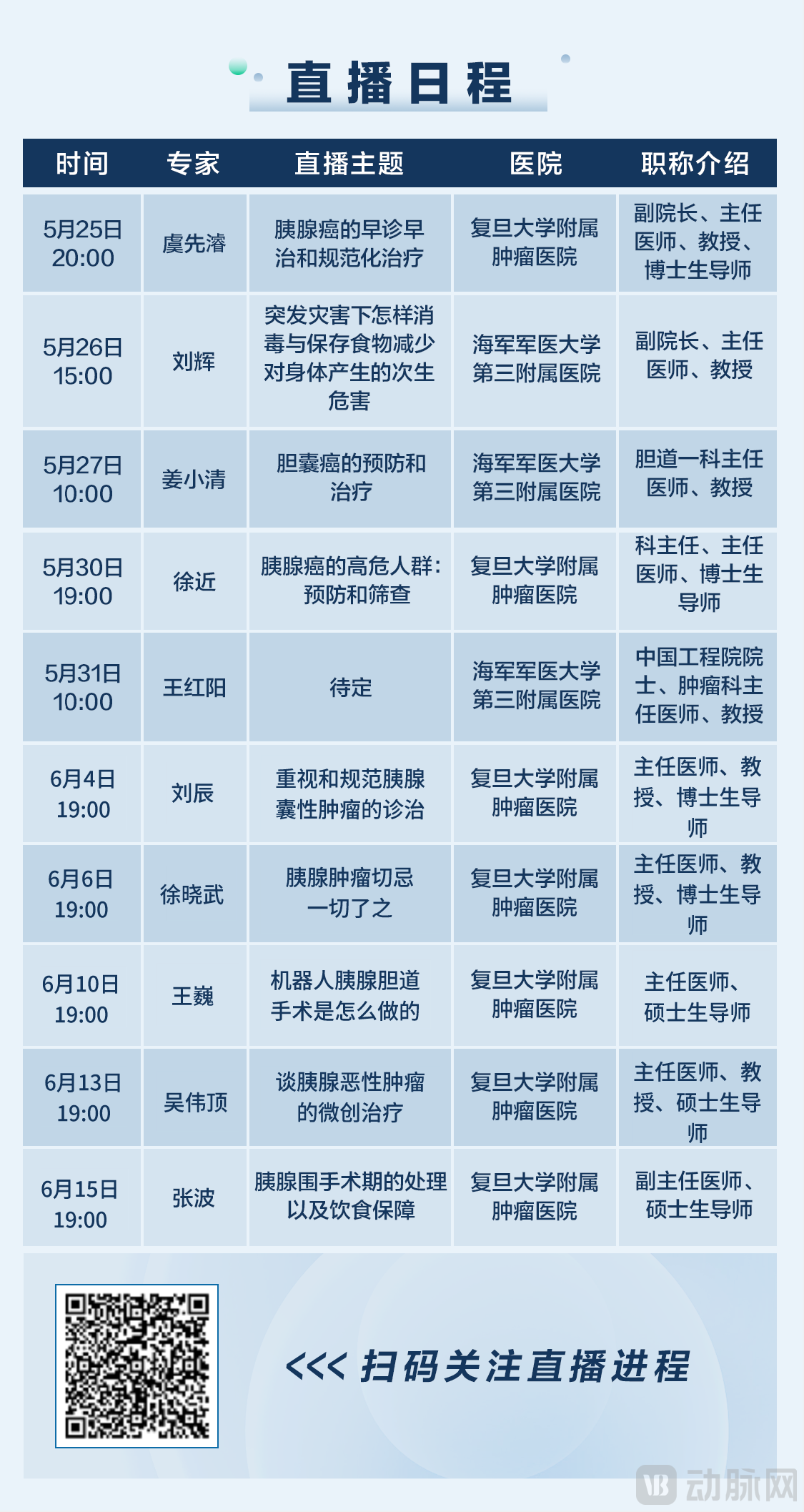
Partial Live Broadcast Schedule for the Pancreas, Hepatobiliary Specialized Free Clinic Event (Subject to Actual Conditions)
“What are the high-risk factors for pancreatic cancer? What targeted screenings should high-risk individuals undergo? How can standardized initial treatment and rational comprehensive therapy be properly implemented?” On the evening of May 25, Professor Yu Xianjun, Vice President of Fudan University Shanghai Cancer Center, Director of the Shanghai Pancreatic Tumor Institute, and Chief Physician, conducted a live online consultation via the Shanghai WeDoctor Internet Hospital platform to address patients’ questions and provide detailed scientific education on common issues related to pancreatic cancer. The session attracted over 10,000 viewers who actively participated in the interaction.
According to data on the prevalence of malignant tumors in China released by the National Cancer Center, pancreatic cancer ranks as the 10th most common and the 6th deadliest malignant tumor in the country, with a five-year survival rate of less than 10%. “Pancreatic cancer lacks specific symptoms in its early stages and is often mistaken for ‘gastric disease,’ leading to it being overlooked. Furthermore, due to a lack of proper understanding, many patients seek medical help indiscriminately when their condition worsens, and non-standardized treatments often cause them to miss the optimal window for intervention,” stated Yu Xianjun. He emphasized that early diagnosis, early treatment, and standardized care are key to improving survival rates, and highlighted the critical importance of providing scientific prevention and control education to the general public to help patients establish correct treatment concepts.
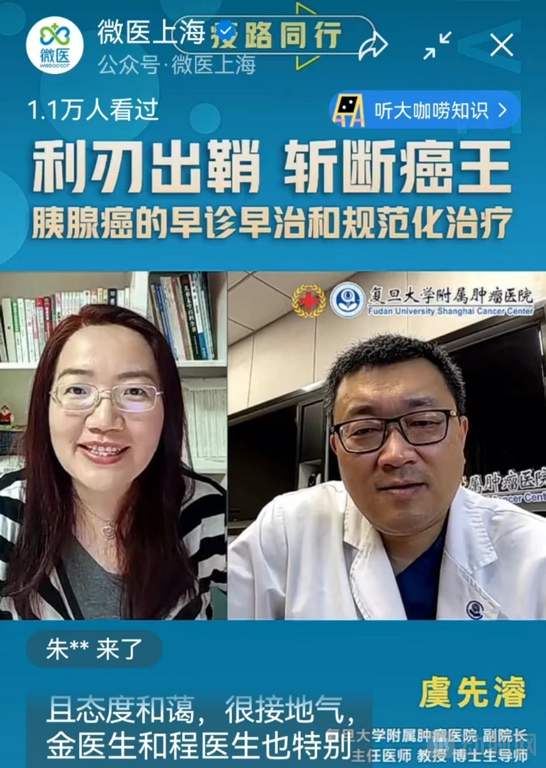
Prof. Yu Xianjun Conducts Live Free Clinic, Providing Detailed Insights into the Scientific Prevention and Treatment of Pancreatic Cancer
Data from the WeDoctor platform shows that over 120,000 users have recently consulted on issues related to pancreatic cancer. In particular, middle-aged and young adults, who are accustomed to obtaining information online, are increasingly relying on professional third-party internet hospital platforms to search for specialists with precise expertise for consultations. Notably, the convenience of the internet in breaking down physical spatial barriers is particularly evident in healthcare access. With the development of platform-based internet hospitals like WeDoctor, the imbalance in high-quality medical resources across different regions may be significantly addressed, enabling patients with complex and critical conditions in remote areas to consult top-tier experts in Beijing, Shanghai, and Guangzhou and access more advanced treatment options.
As China’s largest digital healthcare service platform, WeDoctor originated in Shanghai and has, over the years, accumulated abundant high-quality medical resources both in Shanghai and across the country. According to reports, the Shanghai WeDoctor Internet Hospital currently hosts more than 20,000 Shanghai-based specialists, with over 70% holding the title of Associate Chief Physician or higher, and more than 68% affiliated with Grade A tertiary hospitals. It has established connections with 156 hospitals in Shanghai, covering over 90% of the city’s tertiary hospitals.
Leveraging large-scale big data analytics, WeDoctor has established a medical tagging library comprising nine major categories and over 840,000 tags, enabling precise matching of patient and physician needs through its relationship engine and knowledge graph. To date, more than 9 million real-name authenticated users across China have accessed high-quality medical resources in Shanghai via the WeDoctor platform, with Shanghai-based experts on the platform having delivered a cumulative total of 68 million consultations to users nationwide.
Professor Zhang Qunhua, Honorary Chairman of the Pancreatic Cancer Professional Committee of the China Anti-Cancer Association, Vice Chairman and Secretary-General of the Internet Healthcare Branch of the China Medical Promotion Association, and Honorary Dean of Shanghai WeDoctor Internet Hospital, introduced that Shanghai WeDoctor Internet Hospital rapidly implemented services such as cross-hospital follow-up consultations, prescription renewals with medication dispensing, and medical insurance payments during the pandemic, significantly improving patients’ accessibility to online follow-up care and their sense of gain in seeking medical treatment. Professor Zhang emphasized that liver cancer and pancreatic cancer are known as the “kings of cancers.” By launching online free clinics with renowned experts specializing in pancreatic, hepatic, and biliary diseases, and by establishing precise and standardized treatment protocols for complex cases of liver and pancreatic cancer, the hospital aims to better meet patient needs during the pandemic and join forces in the collective fight against COVID-19.
Currently, the epidemic prevention and control situation in Shanghai continues to stabilize, and the large backlog of non-urgent medical needs is gradually being released. Moving forward, WeDoctor Internet Hospital in Shanghai will further leverage its advantages in allocating high-quality medical resources, precisely matching patient needs, and providing full-process closed-loop online services. It will offer residents in Shanghai and users across China precise access to medical care and whole-course disease management services through major hospitals, departments, and specialists in Shanghai.