

Spine Implant Market Faces Price Compression; Next Growth Frontier Emerges in Intelligent Surgical Navigation Systems
Due to the complex anatomy of the spinal column and its proximity to critical blood vessels and nerves, minimally invasive spine surgery demands exceptional precision in preoperative planning, localization, and intraoperative execution. Even minor intraoperative errors can result in complications such as lower back pain, weakness, or even paralysis, thereby prolonging the patient’s recovery course.
Historically, spinal surgeries have largely relied on surgeons’ experience and preoperative and intraoperative imaging to enhance procedural precision. However, preoperative three-dimensional (3D) images often fail to accurately predict changes in patient positioning during surgery, making it difficult for virtual 3D reconstructions to reflect the true spatial relationships among the spine, muscles, neural tissues, and blood vessels.
Intraoperatively, there are pain points such as insufficient accuracy of 3D images due to latency, which prevents surgeons from directly visualizing the intraspinal canal. Surgeons can only perform the surgery through multiple intraoperative CT scans, using handheld bone-cutting tools and relying on their tactile feedback and experience for blind manipulation. The mismatch between the surgical field and preoperative imaging data caused by intraoperative soft tissue deformation or displacement further increases the risk of surgery, especially when complex three-dimensional maneuvers are required and the surgeon must enter the deep spinal region without direct visualization.Traditional fluoroscopy and manual operations can no longer meet the demands for minimally invasive and precise orthopedic surgery.
Nowadays, with the deepening of population aging, the volume of orthopedic surgeries has reached an inflection point for growth. According to a report by China Business Industry Research Institute, the number of orthopedic surgeries is expected to increase to 4.7 million cases in 2021, with a compound annual growth rate (CAGR) of 10.9%. In the face of vast market demand,The development of a surgical navigation system that enables physicians to perform precise surgical interventions by observing the spatial relationship between surgical instruments and lesions in three-dimensional models has become increasingly urgent.
From an industry perspective, international giants such as Stryker, Medtronic, Smith & Nephew, and Zimmer Biomet have initiated mergers and acquisitions to continuously strengthen their digital orthopedic system capabilities, while intensifying product promotion in the Chinese market to secure a competitive advantage. Meanwhile, leading domestic orthopedic companies, including Tinavi Medical Technologies, MicroPort Scientific Corporation, and Weigao Group, are successively undertaking technological upgrades and forging industrial chain collaborations, with a strategic focus on the digitalization of orthopedic surgery.
The policy has injected a shot in the arm into industry development.
The recent release of the "National Centralized Volume-Based Procurement Plan for Spinal Medical Consumables (Draft for Comment)" signals that the national centralized procurement of orthopedic spinal implants is entering its final countdown. The market share of spinal medical consumables may shrink, thereby unlocking potential in other related markets. Precise, digital, and intelligent orthopedic surgical navigation systems are poised to become a new profit growth driver for the orthopedics sector and represent a major industry trend.
As the development of orthopedic surgical navigation systems enters a phase of standardization and marketization, truly superior products will emerge to the forefront and continue to lead the field.
As the industry’s growth window opens and the market landscape becomes increasingly clear, what kind of surgical navigation system can truly stand out in this competitive field?
Addressing the pain points of surgical procedures, surgical navigation systems aim to assist physicians in performing intelligent preoperative planning based on patients’ 3D bone models, achieving precise intraoperative localization and stable instrument handling. This enhances surgical precision and safety while reducing the likelihood of postoperative complications. Furthermore, by replicating expert experience, these systems shorten the learning curve for surgeons, lower procedural difficulty, effectively improve access to high-quality surgical care, and help address the uneven distribution of medical resources in China.
Therefore, a surgical navigation system that can stand out in the competitive landscape must be capable of enabling operationalSafety and reliability, clarity and precision of imaging, and the capability for full-procedure and full-process visualization.
Chongqing Boskang Technology Co., Ltd. (hereinafter referred to as “Boskang”) is a high-tech enterprise that VCBeat recently learned about, which specializes in providing intelligent, precise, and minimally invasive surgical solutions.It is reported that the optical-magnetic integrated multimodal imaging surgical navigation system developed by Boshikang is the first such system in China to offer real-time dynamic tracking for navigation while enabling full-endoscopic spine surgery.Currently, the system has officially obtained the NMPA Class III Medical Device Registration Certificate (National Medical Device Registration No. 20223010680).
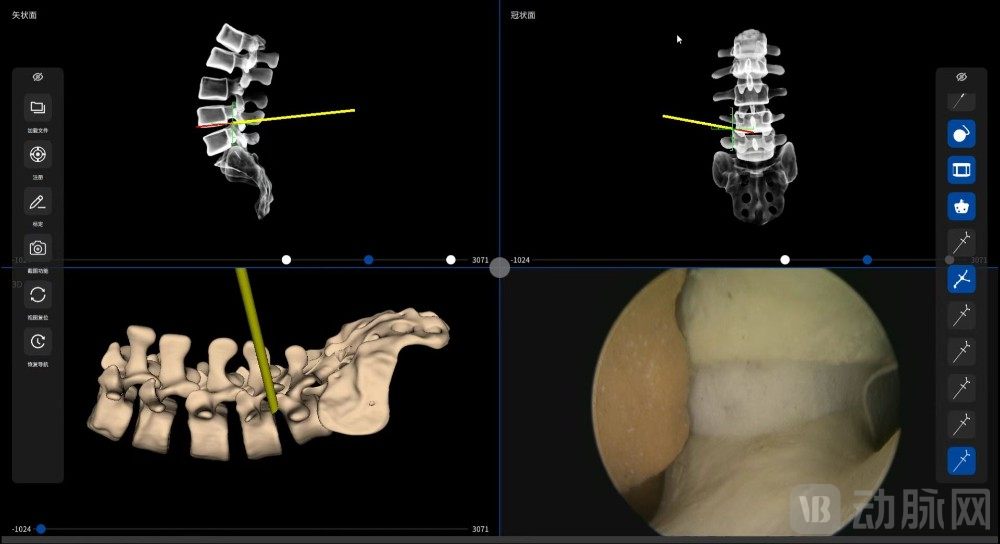
Schematic Diagram of Endoscopic Navigation
Furthermore, Boshikang has comprehensively established a presence in surgical instruments, tools, and high-end medical equipment for orthopedics, neurosurgery, cardiothoracic surgery, and otorhinolaryngology, laying the foundation for future integrated operating room solutions.
“Surgical procedures often cause deformation or displacement of soft tissues, making it difficult to fully realize preoperative planning. Since human soft tissues are typical viscoelastic materials, finite element simulation is hardly applicable in clinical practice; intraoperative CT or MRI is difficult to promote clinically due to high hardware costs and space limitations in operating rooms. Multimodal image navigation technology is a key surgical navigation technology for achieving clinical translation. Due to its advantages such as high sensitivity, safety, and ease of use, it can be widely used in surgeries such as minimally invasive spine surgery, scoliosis correction, and tumor resection, meeting clinical needs to the greatest extent.”Xia Guifeng, founder of Bosikang, told VCBeat.
In fact, compared with traditional X-ray image navigation technology, multimodal image navigation technology not only has high sensitivity and is not easy to quench, but also can achieve multi-channel and multi-target simultaneous positioning and tracking. The use of multimodal image navigation technology can clearly display the lesion and soft tissue contours, while providing structural information on multiple targets, making the localization of soft tissue edges clearer, and having excellent prospects in the surgical navigation market.
Boskang applies this technology to its navigation imaging solutions, integrating navigation and intraoperative imaging systems. By determining the three-dimensional spatial location around the lesion via imaging, displaying soft tissue structures adjacent to the surgical field, and simultaneously calibrating the spatial relationship between the lesion and the surgical site, it enables physicians to more clearly observe complex anatomical structures, achieve precise localization, and thereby design optimal surgical approaches.
It is reported that the BoshiKang optical-magnetic integrated surgical navigation system achieves three-dimensional dynamic real-time image tracking by fusing intraoperative X-ray images with preoperative CT and MRI scans, thereby enabling physicians to more precisely localize lesions for surgical intervention.
This system can be understood by breaking it down into two components: optical navigation technology and electromagnetic navigation technology.Among these, optical navigation technology enables the computer to determine the spatial position of surgical instruments by reflecting infrared signals emitted by an infrared positioning system. The infrared positioning system achieves wide-area tracking by emitting infrared signals, detecting their reflection from navigation tools, and transmitting this information to the computer system.
Electromagnetic navigation technology enables minimally invasive surgery by allowing the computer to determine the spatial position of surgical instruments through changes in electromagnetic signals induced by cutting magnetic field lines. The electromagnetic positioning system emits electromagnetic signals to detect and track navigation tools, transmitting this data to the computer system to achieve highly precise surgical localization. Physicians no longer need to worry about errors caused by intraoperative soft tissue deformation or displacement, allowing for greater flexibility in patient positioning.
By integrating optical navigation technology with electromagnetic navigation technology, Boscom has independently developed a spinal surgery navigation solution—the Optical-Magnetic Integrated Surgical Navigation System.
Integrated Optical-Magnetic Surgical Navigation SystemThe integrated optical-magnetic surgical navigation system retains the precision and stability of traditional optical navigation systems while incorporating high-precision magnetic navigation capabilities. It successfully overcomes, for the first time, the technical challenge of simultaneous co-registration and tracking within a single unit combining optical and electromagnetic navigation systems. This breakthrough resolves the persistent issue of image drift in clinical practice—characterized by unfocused images and misalignment with actual anatomical positions—and enables seamless switching between optical and electromagnetic navigation modes, thereby leveraging the complementary advantages of both technologies. Reportedly, this system achieves a surgical accuracy of 0.1 mm.
Nowadays, surgical procedures are gradually shifting towards intelligence, minimally invasive techniques, and precision, with numerous innovative solutions emerging. However, relying solely on a single solution is insufficient for companies to gain a competitive edge. Enterprises need to assist hospitals in addressing issues such as the lack of interoperability between devices during the digitalization process and products that do not align well with clinical workflows, requiring frequent switching.
A comprehensive, visualized, end-to-end solution designed to ensure the safe and efficient completion of surgical procedures is on the horizon.
In response, Xia Guifeng shared his insights. Xia Guifeng stated:“While products are undoubtedly important, devices represent only the front-end component. More crucial is the realization of visualization across all surgical procedures and throughout the entire workflow, thereby providing surgeons with an intelligent operational environment that enables them to perform surgeries safely and efficiently. This encompasses a comprehensive suite of solutions, including the optimal tool types, tool sizes, and real-time positional data of instruments within the patient’s body during surgery, as well as considerations such as scenario adaptability and compatibility. Looking ahead, we will continue to deploy our full product portfolio to build a closed-loop ecosystem that includes surgical robots.”
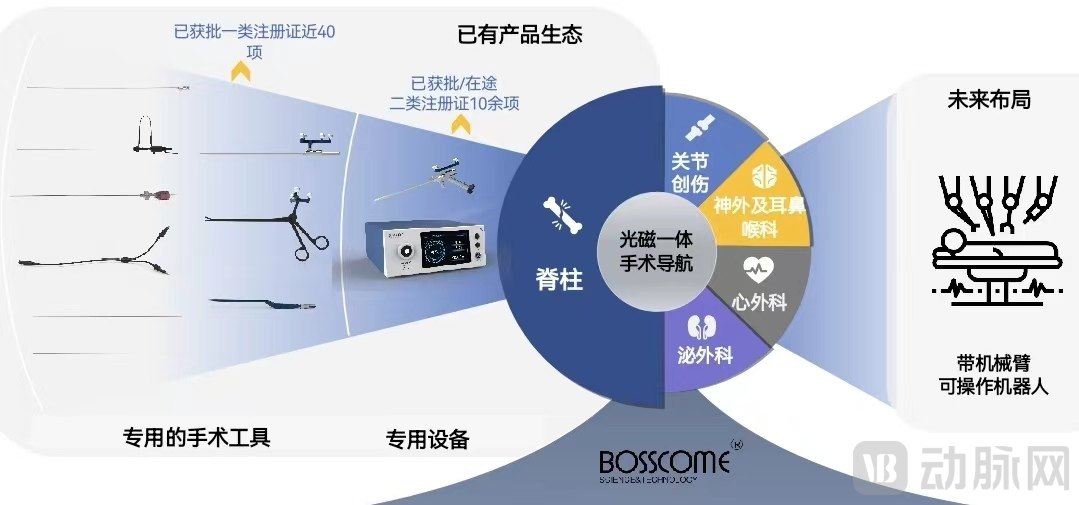
Boscom Comprehensive Solution
It is understood that, in addition to its integrated optical-magnetic surgical navigation system, Bosscorn has also completed the research, development, and production of specialized surgical instruments for thoracolumbar spine navigation, specialized surgical instruments for cervical spine navigation, minimally invasive spinal surgery instruments, a retraction system for minimally invasive cervical and lumbar spine surgery, a microscopic conical working channel system, and a transforaminal targeted shaping system. Due to the company’s stringent requirements for product craftsmanship, this series of products is independently designed by Bosscorn and then manufactured in Germany, truly realizing “Chinese ingenuity, German craftsmanship.”
In the future, Boshikang will also integrate imaging equipment, ceiling-mounted service columns, surgical lights, and video systems as required by users, provide operating room spatial layouts based on user needs, and complete the construction of digitally navigated operating rooms, thereby making the entire operating room visualized.It is reported that Boshikang has financing plans in the near future.
In summary, the development of minimally invasive spine surgery technology has become an irresistible trend.With the implementation of policies such as the “National Centralized Volume-Based Procurement Plan for Spinal Medical Consumables (Draft for Comment),” the orthopedic digitalization industry is poised for rapid growth driven by dual forces. However, only enterprises that truly address clinical pain points, resolve challenges faced by physicians, and provide end-to-end solutions will be able to maintain their leadership in this sector.