Q1 2022 Resident Health Consumption Index Released: Providing Ongoing Insights for Healthy Consumer Trends
On May 25, Health News, Huatai Securities, and the Institute of Health Communication at Fudan University jointly hosted an online launch event for “Industrial Opportunities Behind Big Data on Health Consumption and the Q1 2022 Resident Health Consumption Index Report.” Multiple guests from healthcare companies, research institutions, and securities firms discussed topics such as health consumption trends, the index, and industry interactions, sharing their insights.
During this event, the Report on the Resident Health Consumption Index for the First Quarter of 2022, based on big data research, was officially released. The Resident Health Consumption Index was jointly developed and compiled by Health Insight (Ba Dian Jian Wen) and the Institute of Health Communication at Fudan University, with support from Huatai Securities. It aims to leverage consumer big data to measure the impact of consumption habits on health outcomes across different regions, providing valuable references for the development of the broader health industry. The compilation of this index also benefited from consumer data support provided by the JD.com Consumer and Industry Development Research Institute.
Compared with the 2021 Resident Health Consumption Index first released in March of this year, the overall level of the Resident Health Consumption Index across various regions increased in the first quarter of 2022. The report’s analysis suggests that, in addition to the influence of the Lunar New Year, phased progress made in China’s COVID-19 prevention and control efforts during the first quarter contributed to a steady rise in residents’ income and the continued release of consumer demand. Furthermore, during the pandemic, consumers have paid greater attention to their health status, leading to significant increases in both search volume and purchase volume for health-related products.
In terms of rankings, the Shanghai Resident Health Consumption Index continued to rank first among the 31 provinces (autonomous regions and municipalities), consistent with its position in 2021. The provinces and municipalities ranking second through tenth were Beijing, Shandong, Henan, Zhejiang, Qinghai, Tianjin, Gansu, Chongqing, and Jiangsu, respectively. Notably, Henan, Qinghai, Gansu, and Chongqing entered the top ten of the Resident Health Consumption Index for the first time in the first quarter of this year. Henan Province recorded the most significant rise in its Resident Health Consumption Index ranking, climbing from 22nd place last year to 4th place.
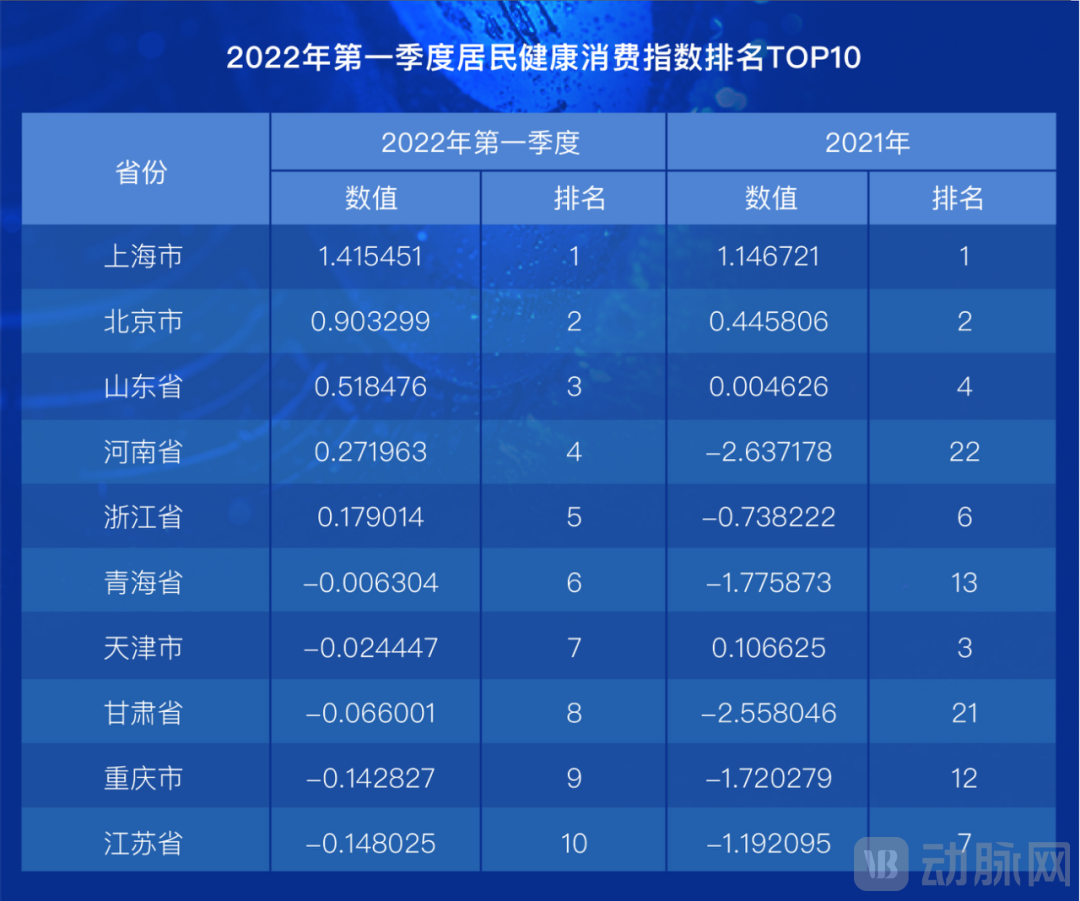
Regarding the fluctuations in regional rankings, the report’s analysis suggests that the first quarter includes the Spring Festival holiday, during which some residents from central and western regions working in the more developed eastern areas returned to their hometowns for the celebrations. This led to temporary changes in the original consumption structures and the distribution of health consumption indices across regions. Meanwhile, since 2022, China has experienced scattered outbreaks of COVID-19 in certain localities. Due to the impact of the pandemic, the recovery of consumer markets has varied across different regions, resulting in shifts in the ranking distribution of residents’ health consumption indices in specific areas.
Dr. Chen Qin, Chief Economist at Maice Technology and a participant in the index compilation, stated that the Resident Health Consumption Index represents a valuable initiative in leveraging health data. Compared with traditional offline sampling surveys, the big data–based Health Consumption Index features shorter cycles and more comprehensive data, enabling a more accurate reflection of the public’s health behaviors. It holds inherent advantages, particularly in predicting population health status. It is believed that as the calculation framework is further optimized, this index will become a critical basis for decision-making by relevant national authorities and market participants in the broader health sector.
Liu Hui, Dean of the JD Consumer and Industry Development Research Institute, which provides data support for the index compilation, believes that the framework of the Resident Health Consumption Index is meticulously designed. By deeply integrating stable household consumption of daily necessities with health trends, the index has significantly enhanced the reliability, authenticity, and usability of its data. These data not only reveal the health status of different regions and population groups but also assess their health awareness, demonstrating strong forward-looking and predictive capabilities.
When discussing the correlation between the Resident Health Consumption Index and industrial development, Dr. Dai Wen, Chief Pharmaceutical Industry Analyst at Huatai Securities Research Institute, stated that the index not only provides an accurate reflection of the current situation but also highlights opportunities for future development. Taking the current wave of the pandemic this year as an example, both the index and actual market trends indicate that consumer focus is shifting from basic material necessities to more advanced health-related demands. Areas such as home medical devices and health supplements are therefore worthy of close attention in the second half of the year.
Xu Chen, Co-founder and Co-CEO of Gulian Medical Group, stated that the rehabilitation medical services sector in which he operates has been on a strong upward trajectory in recent years, and the positive trend of the index has filled him with confidence in the future of the broader health industry.
Under the current measurement framework, the Resident Health Consumption Index encompasses more than 200 products that reflect residents’ dietary intake, physical activity, and smoking and alcohol consumption behaviors. Wang Dongyuan, President of the EMBA Healthcare Industry Association at Renmin University of China, believes that the Resident Health Consumption Index has established a highly scientific foundational model. She further suggests that incorporating categories related to healthcare service consumption—such as elderly care, nursing, and rehabilitation—would play a core driving role in government efforts to promote the development of the broader health sector.