

YSB Inc. Files for Hong Kong IPO as a Leading Driver of Digital Transformation in China's Off-Hospital Pharmaceutical Sector

YSB Inc.
Off-Hospital Pharmaceutical Industry Digital Comprehensive Service Platform
On May 24, 2022, the previously tranquil landscape of the internet-enabled pharmaceutical industry witnessed a long-awaited major event: YSB Inc., a comprehensive digital service platform for the out-of-hospital pharmaceutical industry, filed its prospectus with the Hong Kong Stock Exchange seven years after its establishment, drawing significant attention from the industry. As a company dedicated to providing a comprehensive digital service platform for China’s out-of-hospital pharmaceutical sector, YSB Inc. offers high-quality e-commerce procurement services for pharmaceutical supply chains to retail terminals, while also providing pharmaceutical brands with one-stop, omni-channel digital marketing and supply chain solutions.
Currently, China's pharmaceutical e-commerce sector can be primarily categorized into three models: B2B, B2C, and O2O. B2C transactions are the most active, while B2B transactions have the largest scale. YSB Inc. is a prominent player in the B2B model. According to data from Frost & Sullivan, the market for digital pharmaceutical distribution services is highly concentrated, with the top five participants accounting for over 63.5% of the market share. Among them, YSB Inc. ranks first in the industry with an 18.5% market share. How has YSB Inc. achieved this?
The pharmaceutical industry chain in China primarily comprises three segments: pharmaceutical manufacturing, pharmaceutical distribution, and pharmaceutical retail. The pharmaceutical distribution segment refers to the process whereby drug distributors procure medications from upstream pharmaceutical manufacturers and subsequently sell them to downstream retail endpoints, such as hospitals and pharmacies. Based on the type of retail endpoint, this segment is further divided into two major markets: the in-hospital market and the out-of-hospital market.
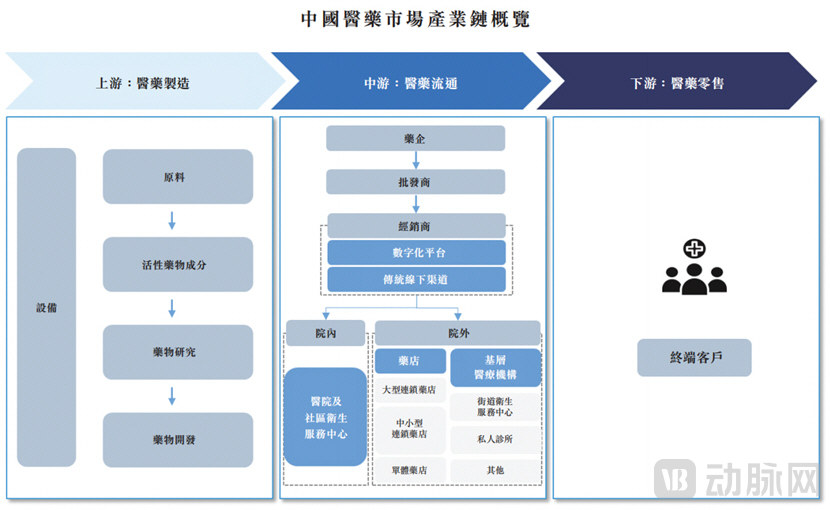
China’s Pharmaceutical Market Industry Chain, Source: Prospectus
In the out-of-hospital market, particularly in primary healthcare and rural areas, the fragmented landscape has led to a proliferation of intermediaries at various levels with differing service capabilities, subjecting all market participants to pressures of low efficiency and high costs. These industry pain points are particularly well-suited for deep empowerment through internet technologies. By facilitating connectivity and matchmaking, driving the transition from offline to online, and penetrating every link from production and distribution to retail, overall efficiency can be significantly enhanced.
Although China has established a tiered diagnosis and treatment system, aiming to manage major and critical illnesses within the province, common diseases at the city or county level, and minor ailments such as headaches and fevers at the township and village levels. However, according to research by EO Intelligence in the "2020 China Primary Healthcare Research Report": only 10% of medication expenditures occur in village clinics, 20–30% in township health centers and pharmacies, and 50–60% of spending takes place in county-level hospitals and pharmacies.
In real-world practice, drug shortages at the primary care level have long persisted. Beyond commonly used medications such as analgesics, antipyretics, and anti-inflammatory agents, there are significant supply challenges for chronic disease medications—including those for respiratory and cardiovascular conditions—as well as for certain specialized drugs. Even after receiving a prescription from their physician, patients are unable to purchase these medications locally and must continue to make regular visits to hospitals.
Pharmacy operators frequently encounter scenarios where customers bring medication packaging or specific drug names to the store in search of particular medicines. However, the standard stock-keeping units (SKUs) available at primary-care pharmacies often fail to meet this segment of demand. As such requests are low-frequency, determining how to address them has become a persistent pain point in the daily operations of pharmacies.
By identifying pain points, forming judgments, and addressing problems with unique perspectives and solutions, the founder of YSB Inc., who possesses extensive experience in vertical internet operations within the industry, has steadily built the company’s capacity and value to resolve industry-wide challenges.
Since its inception, YSB Inc. has leveraged digital tools to build a platform that connects pharmaceutical wholesalers with grassroots pharmacies and clinics, aggregating the substantial long-tail demand from these frontline terminals to construct an ecosystem. When patients visit a pharmacy for medication that is out of stock, staff can immediately search the platform, provide a quote to the patient, and arrange for home delivery within 2–4 days.
According to the prospectus, by the end of 2021, YSB Inc. had attracted approximately 305,000 grassroots pharmacies and 130,000 grassroots medical institutions. Among these, the average number of monthly active buyers reached 256,000, accounting for 87% of the total buyer base. The average monthly order volume per paying buyer increased from 8.3 orders in 2019 to 21.7 orders in 2021, representing a compound annual growth rate (CAGR) of 62%.
According to Frost & Sullivan, YSB Inc.’s total GMV reached RMB 27.5 billion in 2021, with a compound annual growth rate (CAGR) of 42.9% since 2019, ranking first among China’s out-of-hospital digital pharmaceutical industry service platforms on both metrics.
How does YSB Inc. operate?
YSB Inc.’s current business primarily consists of platform operations and innovative ventures. The platform operations are further divided into third-party and self-operated businesses.
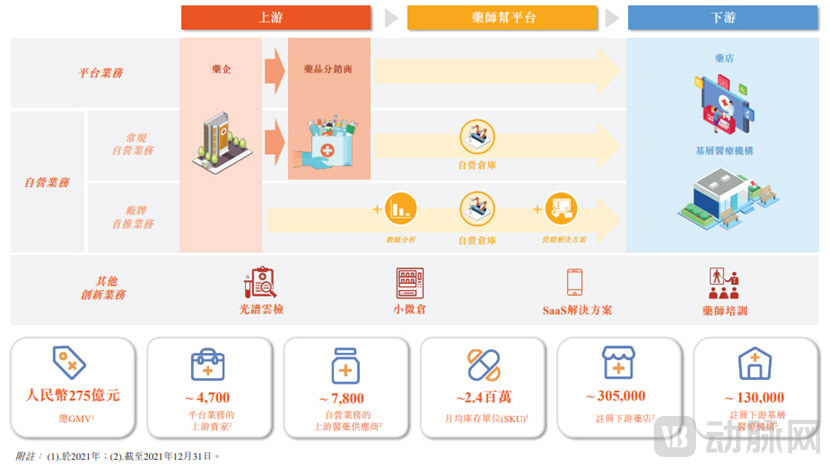
YSB Inc. Platform Structure, Source: Prospectus
PlatformThis was YSB Inc.’s initial entry into the pharmaceutical distribution sector. It is a mobile internet-based business platform designed to address the mismatch between supply and demand in the pharmaceutical distribution industry. YSB Inc. charges commissions proportional to the transaction value between buyers and sellers. By the end of 2021, the platform’s monthly SKU count had reached 2.4 million, with 4,700 sellers and 434,000 buyers, while the GMV of third-party merchants on the platform amounted to RMB 17 billion.
The emergence of the YSB Inc. platform enables pharmacies and clinics facing stockouts to quickly connect with wholesalers who have inventory, thereby addressing a persistent pain point in their daily operations. For wholesalers, the online trading platform helps them expand their reach to more pharmacies, extend their service radius, and generate more business. The aggregated purchasing power of numerous buyers and scaled-up demand grants them greater bargaining power with suppliers, which not only boosts profit margins but also benefits buyers.
As its user base grew, YSB Inc. recognized that relying solely on an online platform constrained supply chain fulfillment stability due to limitations in suppliers’ service capabilities. Consequently, in 2019, the company began establishing self-operated warehouses to further enhance platform efficiency and fulfillment quality. YSB Inc. developed a fulfillment system that centrally digitizes the management of procurement, warehousing, distribution, and working capital. By the end of 2021, YSB Inc. had established 19 smart warehouses, with orders processed and dispatched within an average of 3.39 hours. The gross merchandise value (GMV) of its self-operated business reached RMB 10.5 billion in 2021, representing a compound annual growth rate (CAGR) of 81.1% since 2019.
After completing its infrastructure development, in 2020 YSB Inc. launched services for pharmaceutical companiesLabel's Premier LaunchLeveraging structured platform data, the business provides evidence-based support for pharmaceutical companies’ product strategies, marketing strategies, and production decisions. It offers digital marketing services with direct terminal connectivity and supply chain solutions, helping pharmaceutical companies shorten distribution channels and increase the success rate of product promotion.
The brand’s flagship initiative effectively addresses two major challenges. On one hand, it partially mitigates pharmaceutical companies’ limited reach in the out-of-hospital market. On the other hand, leveraging extensive grassroots terminal sales data and advanced professional analytics capabilities, it enables reverse product customization for pharmaceutical manufacturers. This is particularly valuable in the face of sudden market shifts, allowing manufacturers at the production end to respond rapidly and promptly meet emerging patient medication needs.
The Difficulties Faced by Grassroots Pharmacies Are Not Intuitively Understood by Many. Taking Shuicheng District in Liupanshui, Guizhou Province as an example, the district administers 11 towns and features complex terrain with winding roads. Grassroots pharmacies here also face competition from hospitals and township health centers, leading them to avoid maintaining high inventory levels; consequently, their procurement frequency and spending are both very low. Even local pharmaceutical distributors deliver only twice a week.
For pharmaceutical companies and suppliers, establishing a distribution system in such areas is even more impractical. However, after aggregating the demands of a large number of grassroots pharmacies, YSB Inc. has achieved digital management across procurement, warehousing, and delivery through its self-developed intelligent supply chain management. By employing various methods, including group buying, to ensure supply-demand balance, YSB Inc. not only meets the low-price, high-frequency procurement needs of grassroots pharmacies but also guarantees suppliers’ profits through consolidated total demand.
At this point, YSB Inc. has established the shortest path between “pharmaceutical manufacturers and end-terminals,” enabling quality medicines to reach pharmacies in a single step. This approach not only meets users’ procurement demands for “greater variety, faster delivery, better quality, and cost savings,” but also addresses the needs of small and medium-sized pharmacies and primary healthcare institutions for accessing high-quality medicines with ease. This has been the driving force behind YSB Inc.’s rapid growth.
Over the past three years, the number of buyers on YSB Inc. was 258,000, 332,000, and 434,000, respectively, representing a compound annual growth rate (CAGR) of 29.7%. Among these, approximately 305,000 were grassroots pharmacies, accounting for about 50% of the total; there were 130,000 grassroots medical institutions, representing roughly 13% of the total, indicating substantial room for further market penetration.
In addition to continuing to deepen its platform operations, YSB Inc. has leveraged user feedback from the platform and combined it with its technical capabilities to expand into new business scenarios, such as Spectral Cloud Testing, micro-warehousing, SaaS solutions, and pharmacist training.
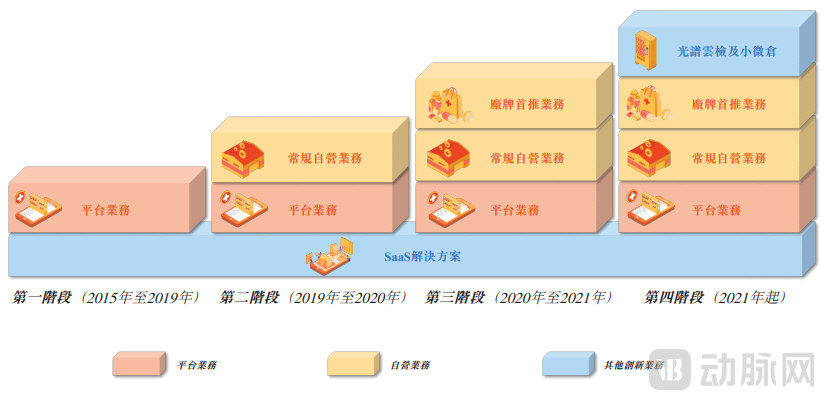
YSB Inc.’s Business Development Stages | Source: Prospectus
Spectral Cloud TestingThis is a typical example. Insufficient equipment, which fails to meet patients’ testing needs, has long been a challenge for primary healthcare institutions. YSB Inc. equips selected primary healthcare institutions with testing devices (including portable ones), establishes testing points, and collaborates with third-party providers to deliver testing services. Through this approach, it helps build diagnostic and testing capabilities at the primary care level, while expanding service coverage and improving service quality.
Micro-WarehouseThis is a new business launched by YSB Inc. in 2021. Essentially, it is an intelligent medicine cabinet designed with pharmacy needs in mind to help pharmacies better serve end customers. It provides 24/7 uninterrupted service without requiring the presence of pharmacists or staff. The Micro-Warehouse significantly enhances the experience for pharmacies and their end customers, particularly those with urgent needs.
To better connect upstream and downstream partners, YSB Inc. has also established a set ofSaaS SolutionsFor instance, YSB Inc.’s web-based platform and Cloud Commerce Connect, designed for sellers, constitute a sales management system distinguished by its data analytics capabilities. It provides feedback to sellers based on approximately 40 parameters updated on an hourly or daily basis. Furthermore, it integrates with sellers’ ERP systems, thereby simplifying their sales operations on the YSB Inc. platform.
In addition, there arePharmacist TrainingSince its launch in 2015, YSB Inc. has provided online training courses to a cumulative total of 187,000 pharmacists. A 2020 survey by the National Medical Products Administration (NMPA) revealed that the uneven geographical distribution of licensed pharmacists in China is, to some extent, a microcosm of the staffing shortages in grassroots healthcare. In light of this situation, enhancing the professional knowledge and skills of existing grassroots healthcare personnel represents a viable approach. By engaging in continuing education to improve their prescribing capabilities, grassroots healthcare providers can better meet the public’s healthcare needs.
Although these businesses do not currently make significant direct contributions to revenue, their greatest benefit lies in enhancing user stickiness. For platform-based businesses, user dependency constitutes the strongest moat.
According to the prospectus, YSB Inc. reported revenues of RMB 3.25 billion, RMB 6.065 billion, and RMB 10.09 billion in 2019, 2020, and 2021, respectively, representing a compound annual growth rate (CAGR) of 76.2%.
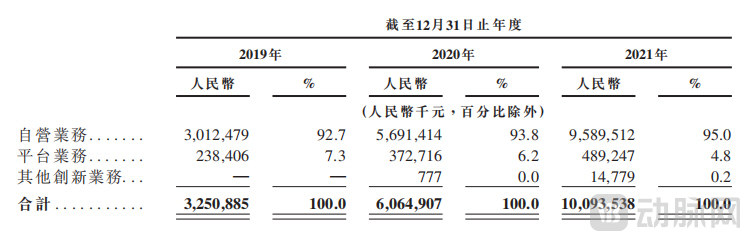
YSB Inc.’s Revenue Over the Past Three Years (Source: Prospectus)
Over the past three years, YSB Inc.’s gross profit amounted to RMB 229 million, RMB 609 million, and RMB 914 million, respectively, demonstrating steady overall growth. This improvement in gross profit was also driven by enhanced operational efficiency in recent years, with operating expenses as a percentage of revenue declining from 22.4% in 2019 to 13.2% in 2021, including a drop in sales and marketing expenses as a percentage of revenue from 18.6% in 2019 to 10.5% in 2021.
According to Frost & Sullivan, in terms of gross merchandise volume (GMV) in 2021, YSB Inc. is the largest digital integrated service platform in China’s out-of-hospital pharmaceutical industry. YSB Inc.’s total GMV reached RMB 27.5 billion in 2021, representing a compound annual growth rate (CAGR) of 42.9% since 2019. Both figures ranked first among digital pharmaceutical industry service platforms in China’s out-of-hospital market.
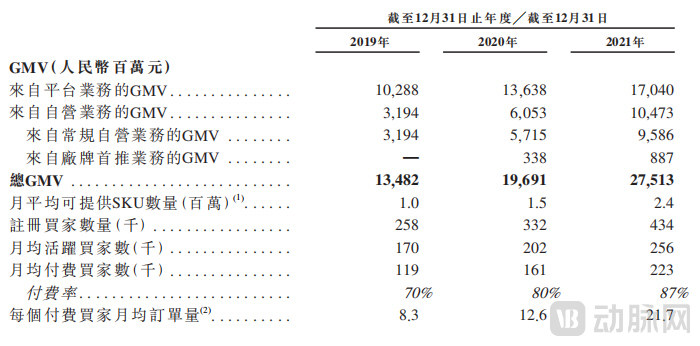
YSB Inc.’s GMV Data for the Past Three Years | Source: Prospectus
According to the same source, as of December 31, 2021, YSB Inc. had established the largest digital pharmaceutical transaction and service network, comprising approximately 305,000 downstream pharmacies and around 130,000 primary healthcare institutions. Furthermore, in 2021, it recorded 256,000 monthly active buyers, ranking highest among digital pharmaceutical industry service platforms operating outside hospitals in China.
For the retail segment of the out-of-hospital market, the primary endpoints are pharmacies and primary healthcare institutions. In the pharmacy sector, as of the end of 2020, there were approximately 560,000 pharmacies nationwide, with large chain pharmacies accounting for about 21.0%, while small and medium-sized chain pharmacies and independent pharmacies made up approximately 79.0%. In the primary healthcare sector, as of the end of 2020, there were around 970,000 primary healthcare institutions across China, mostly distributed in third- and fourth-tier cities and remote areas.
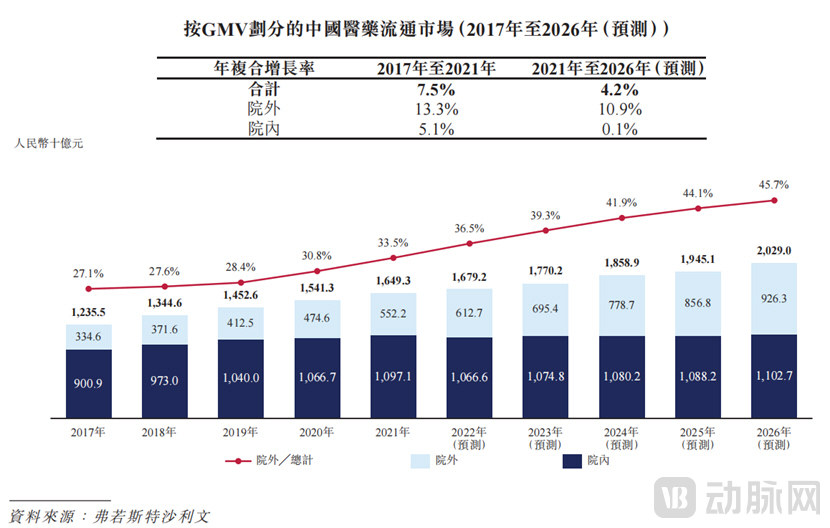
Growth Trend of China’s Pharmaceutical Distribution Market (Source: Prospectus)
According to Frost & Sullivan’s estimates, China’s pharmaceutical distribution market experienced rapid growth over the past five years, increasing from RMB 1.2 trillion in 2017 to RMB 1.6 trillion in 2021, with a compound annual growth rate (CAGR) of 7.5%. Over the next five years, the pharmaceutical distribution market is expected to maintain relatively stable growth, with a CAGR of 4.2%, rising from RMB 1.6 trillion in 2021 to RMB 2.0 trillion in 2026.
Thus, although the out-of-hospital market is fragmented and scattered, its cumulative scale holds significant promise. Meanwhile, these primary care institutions also require support to enhance their capabilities, thereby enabling them to better serve patients.
Beyond China’s first- and second-tier cities, there is a vast network of grassroots pharmacies and healthcare institutions. These scattered grassroots pharmacies and healthcare facilities are each small in scale, and the challenges they face in their development have previously received limited attention. Although individually small, collectively they constitute a core force driving the future new retail era.
With limited individual strength and a lack of digital capabilities, these entities require assistance to consolidate their resources and connect with more upstream enterprises. The emergence of YSB Inc. has met the demands of industrial development. Starting by using data to link isolated information silos across the upstream and downstream sectors, YSB Inc. has digitally empowered the entire industry chain, streamlined pathways between upstream and downstream partners, and enhanced the capacity of primary healthcare institutions to serve patients. This journey is a microcosm of the development trajectory of the industrial internet. In terms of outcomes, YSB Inc. has satisfied the needs of users and pharmacies, making high-quality medicines universally accessible and affordable. Although this is a “grueling” business, YSB Inc. finds genuine fulfillment in it.