

"Intelligent Healthcare, Creating a Winning Future" Symposium: Yidu Tech Drives Innovation and Builds a New Intelligent Healthcare Ecosystem
Centered on technological innovation and the creation of a new ecosystem for medical intelligence, the online seminar titled “Medical Intelligence: Innovating for a Winning Future,” hosted by Yidu Tech (Stock Code: 2158.HK) and co-organized by CICC, was successfully held on May 25, 2022. Ms. Yang Jing, Executive Director, President, and Chief Financial Officer of Yidu Tech, attended the event alongside the company’s senior management team, sharing the latest progress and development direction of YiduCore, the company’s medical intelligence infrastructure. Frost & Sullivan, an internationally authoritative consulting firm, released the White Paper on the Medical Intelligence Industry (hereinafter referred to as the “White Paper”). The conference also invited numerous industry experts to engage in roundtable discussions on critical issues facing the sector. The seminar attracted significant attention and active participation from professionals across the medical, technology, and financial sectors.
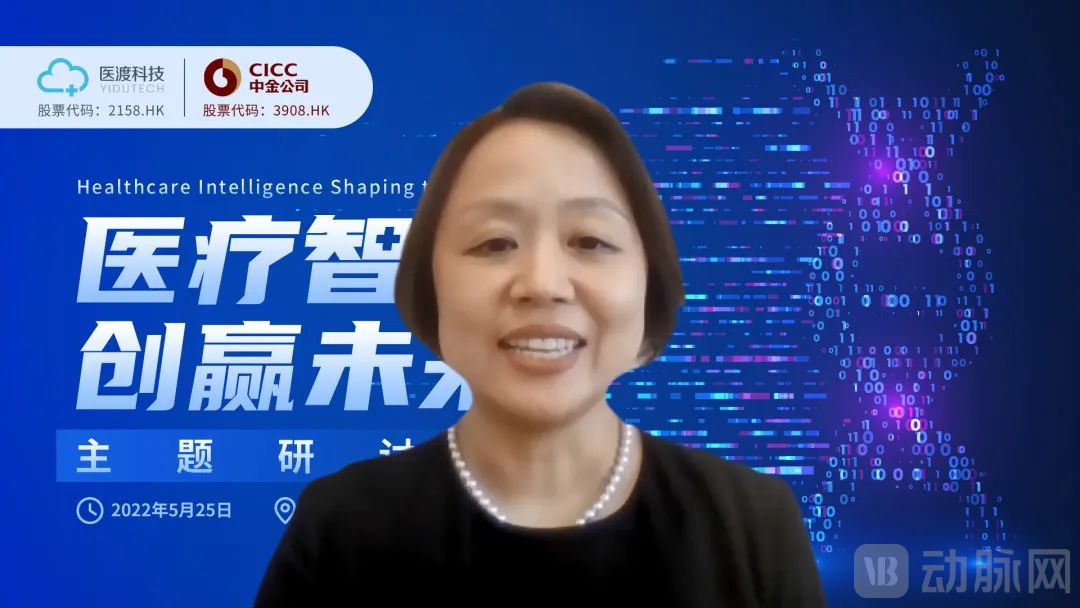
In her opening remarks, Ms. Yang Jing, Executive Director, President, and Chief Financial Officer of Yidu Tech, stated that “Green Healthcare” is the company’s long-term vision. The engines driving our progress are independent innovation in technological R&D, insights into disease areas, and the development of a multidisciplinary talent team, while our emphasis on and investment in “safety” safeguard the expansion of our ecosystem. The essence of medical intelligence lies in leveraging innovative technologies such as artificial intelligence and big data to enhance the quality and efficiency of medical evidence generation, thereby achieving greater safety, convenience, and accessibility. This encompasses multi-dimensional healthcare industry scenarios, including accelerating new drug development, assisting clinicians in diagnosis and treatment, empowering precise public health decision-making, and enabling proactive health management.
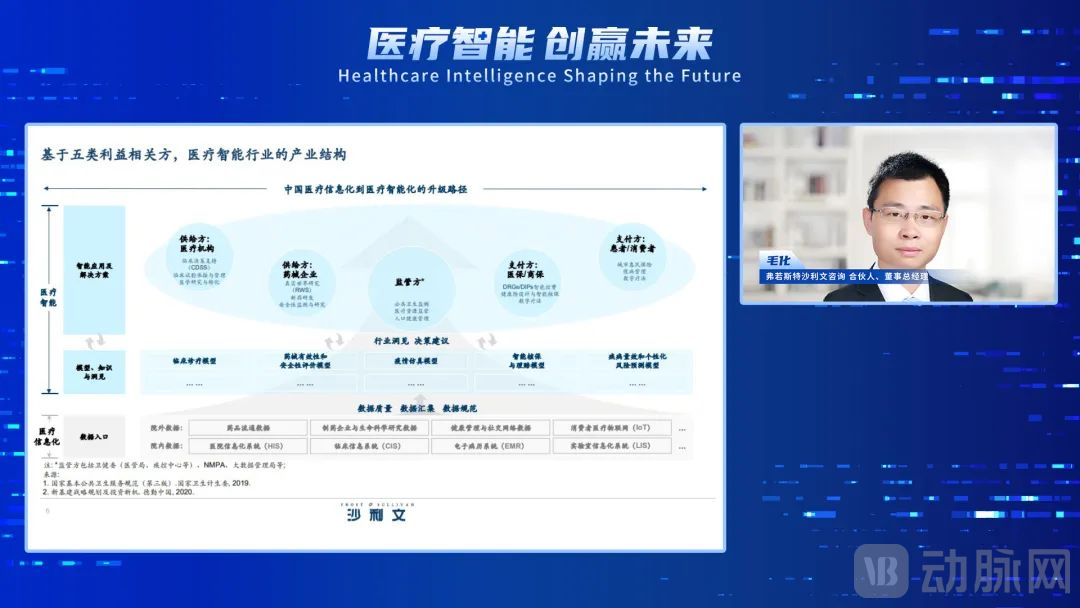
During the White Paper release session, Mr. Mao Hua, Partner and Managing Director of Frost & Sullivan Greater China, elaborated on the definition of the medical intelligence industry and its five essential core elements, providing an in-depth analysis of the industry’s current status and future prospects.and affirmed Yidu Tech’s position as a “pioneer” in the healthcare intelligence industryHe explained that medical intelligence is value-oriented, and medical AI itself is not equivalent to medical intelligence. Medical intelligence uses machine-analyzable and computable medical data as an entry point, leveraging technologies such as artificial intelligence to provide cost-reduction and efficiency-enhancement solutions for stakeholders in the healthcare industry. Through continuous iteration of models across various application scenarios, it facilitates industrial upgrading across all segments of the value chain in areas such as the digital economy and intelligent decision-making. Its five key elements—big data technology, cloud computing, AI technical capabilities, medical knowledge and scenario-based experience, and high-frequency iterative collaboration between scenarios and algorithms—generate intelligent decisions, thereby empowering stakeholders in the healthcare industry. The market size of China’s medical intelligence industry is projected to exceed RMB 1.1 trillion by 2030.Currently, Yidu Tech holds the number one market share in the medical intelligence market, the sub-segment of healthcare institutions and regulatory bodies, and the emerging medical intelligence enterprise sector. It has achieved comprehensive coverage across regulators, suppliers, and payers, thereby driving the industrial transformation, upgrading, and high-quality development of the healthcare sector.
As the conference progressed, several renowned industry experts invited to the roundtable discussion shared their insights and outlooks on intelligence in pharmaceutical R&D scenarios, focusing on the key topic of “Development of the Innovative Therapy Industry and Remote Intelligent Clinical Trials.”
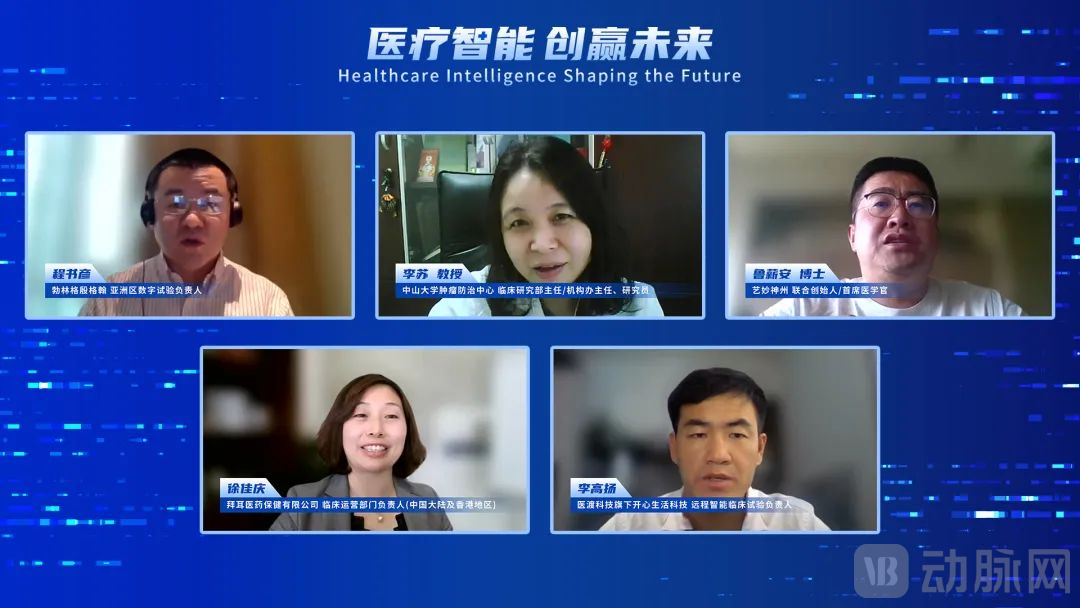
Clinical trials for innovative therapies have been increasing year by year, bringing forth new demands. Dr. Lu Xin’an, Co-founder and Chief Medical Officer of ImmuOnco, believes that closer collaboration between clinical research institutions and trial sponsors is essential, with their needs becoming increasingly intertwined. Consequently, the establishment of hospital-side management systems has become urgently necessary. New frameworks and operational models are critical in clinical operations, requiring substantial practical experience to accumulate and refine.
Ms. Xu Jiaqing, Head of Clinical Operations for Bayer Healthcare (Mainland China and Hong Kong), strongly concurs with this view. She emphasizes that the implementation of innovative therapies still requires careful consideration of the “three pillars” of clinical operational efficiency: speed, quality, and cost. Among these, patient recruitment remains a critical bottleneck—a time-consuming and labor-intensive process. Recruitment strategies must evolve with the times, such as promoting interdisciplinary integration tailored to the characteristics of specific indications and adopting patient-centric recruitment pathways. These shifts also place new demands on the configuration of the industry ecosystem. As practice yields true insight, the deployment of innovative technologies requires continuous practical application, iteration, and refinement in the field to meet the requirements and philosophies of modern clinical trials.
From a holistic perspective, Mr. Cheng Shuyan, Head of Digital Trials at Boehringer Ingelheim Asia, believes that implementing remote clinical trials is a systematic engineering endeavor from the standpoint of pharmaceutical companies’ digital transformation management. It involves not only cross-functional change management within pharmaceutical companies but also collaborative coordination with hospitals and vendors, thereby truly delivering patient-centric healthcare to patients. At this stage, our focus is to initiate pilot applications as soon as possible based on industry expert consensus, accelerate widespread adoption, and ultimately benefit patients.
In further elaborating on the concept, Mr. Li Gaoyang, Head of Remote Intelligent Clinical Trials at Happy Life Technology, a subsidiary of Yidu Tech, introduced that remote diagnostic clinical trials constitute a broad concept. This approach adheres to a patient-centric philosophy through fixed visit patterns, moving beyond the centralized models typical of traditional research. By leveraging digitalization and innovative technologies to conduct clinical trials, it is possible to diversify the participation of medical resources and healthcare professionals. This achieves expanded convenience in both space and time, enhances the generalizability of trials, significantly reduces the burden on patients, and improves their experience in participating in clinical trials. Building on its foundation of multi-scenario applications within the healthcare ecosystem, Yidu Tech employs horizontal integration to enhance the quality and efficiency of clinical trials across various stages, from design to operations.
In his outlook, Professor Li Su, Researcher, Director of the Clinical Research Department and Director of the Institutional Office at Sun Yat-sen University Cancer Center, outlined four expectations: He anticipates that more innovative therapies and novel clinical drugs will enter clinical trials to improve patients’ quality of life; he hopes for greater participation from companies like Yidu Tech, leveraging their expertise and capabilities—notably, the patient recruitment and screening system developed through their collaboration has delivered excellent user experience and outcomes; he looks forward to the establishment of patient-centered educational platforms that advocate, both broadly and in depth, for eligible patients to enroll in clinical trials; and he expects that hospital-wide digital transformation will foster interdepartmental coordination to drive the digitization of clinical research across multiple dimensions.
Following the roundtable discussion, Dr. Yan Jun, Chief Technology Officer and Chief AI Scientist at Yidu Tech, shared new breakthroughs achieved by Yidu Tech’s healthcare intelligence infrastructure, YiduCore, in terms of technology, products, and outcomes, based on recent national industrial policies.
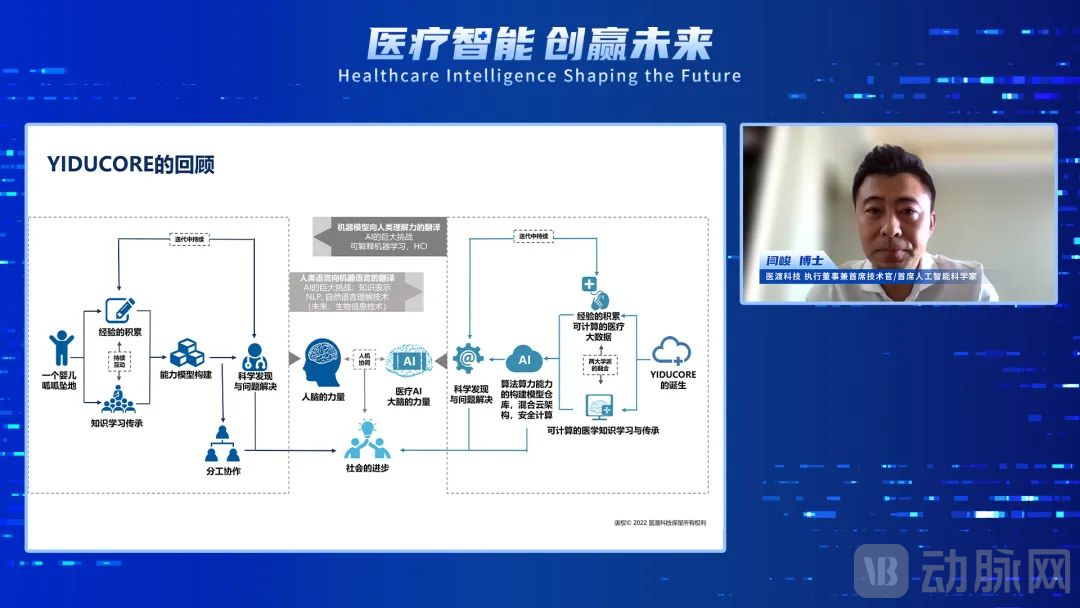
Dr. Yan Jun introduced that YiduCore, the intelligent medical infrastructure, also serves as the Group’s “medical smart brain.” It aims to address three major industry challenges: “the transformation of non-computable data into computable data,” “secure and efficient large-scale high-quality computing,” and “interpretable computational results and applications.” The Group has persisted in independent research and development, achieving significant breakthroughs in technology, products, and outcomes. To date, the Group has accumulated more than 580 authorized patents and received the China Patent Excellence Award, the highest honor in the field of intellectual property. Meanwhile, the Group is the first medical technology enterprise to obtain two certifications for independent original innovation. In terms of outputs, the Group not only assisted in epidemic prevention and control efforts in 18 cities but also facilitated the publication of multiple research findings in renowned journals and undertook several national-level projects in collaboration with prestigious hospitals and academic institutions.
As Ms. Yang Jing stated in her opening remarks, “We are grateful to join hands with our partners in the ecosystem to grow and develop together in China, a market with a large population and sustained high-quality economic growth, thereby contributing to the high-quality development of the healthcare industry.” Looking ahead, Yidu Tech will remain true to its original aspiration, leverage advanced science and technology to enhance production efficiency on the supply side, and make unremitting efforts to fulfill its mission of “making value-based precision medicine accessible to everyone.”
This thematic seminar was moderated by Ms. Feng Xiaoying, Co-Chief Financial Officer of Yidu Tech.