

Xihe Health Leverages 'Health Brain' Powered by Medical Knowledge and AI to Transform Disease Management and Digital Therapeutics
In recent years, digital health management has been accelerating its development.
According to VCBeat’s “2021 Global Digital Chronic Disease Management Value Trend Report,” the primary market for digital chronic disease management saw a total of 60 financing events in 2021, with total funding amounting to nearly $3.54 billion, marking the highest annual financing total for the industry in the past seven years.
According to statistics from VBInsight, the industry think tank of VCBeat, there are now over 300 companies worldwide with a record of financing and a core business in digital chronic disease management.
Amid rapid market expansion, the industry also faces challenges such as limited product functionality and service offerings, the need for further refinement of industry standards, and data silos.
“China’s health management industry has a relatively weak foundation and currently faces numerous challenges, such as incomplete regulatory frameworks and uneven development of professional education. Furthermore, as one component of health management, physical examinations have not been effectively integrated with other aspects of the process, resulting in a limited range of products and services within the sector,” said Ni Xiaodong, Chairman of Hangzhou Xihe Health Technology Co., Ltd. (hereinafter referred to as “Xihe Health”). He noted, however, that the robust growth of the health management industry is an irreversible trend, and companies operating in this field must identify development paths that suit their own capabilities while aligning with the times.
What kind of company is Xihe Health? VCBeat has learned thatXihe Health is a medical health technology enterprise, incubated internally and operated independently by Hangzhou Xihe Data Technology Group, that specializes in disease health management and digital therapeutics. The company is currently building an online disease health management platform and an in-hospital disease management platform to provide patients with integrated, full-cycle disease course management that connects in-hospital and out-of-hospital care as well as online and offline services. Furthermore, Xihe Health actively seeks collaborations with hospitals to accumulate patient disease management data and explores innovative applications of digital therapeutics for diseases in accordance with evidence-based medicine.
The partners of Xihe Health share a common trait—they are all graduates of Zhejiang University.
Chairman Ni Xiaodong earned his bachelor’s degree in Architectural Engineering from Zhejiang University and later obtained an EMBA from Cheung Kong Graduate School of Business.
Chief Medical AI Expert Tong Jijun completed his undergraduate, master’s, and doctoral studies in Biomedical Engineering at the College of Biomedical Engineering and Instrument Science, Zhejiang University, where he earned the corresponding degrees.
Deputy General Manager Ying Zhongguang and Technical Director Xu Chao earned their bachelor’s and master’s degrees, respectively, from the Department of Computer Science at Zhejiang University.
In addition to their educational backgrounds from renowned domestic universities, the partners at Xihe Health also boast extensive professional experience.
Taking Tong Jijun and Ni Xiaodong as examples, the former has served as a lecturer and later as a professor at the School of Information Science and Technology, Zhejiang Sci-Tech University, since obtaining his master’s degree. From 2014 to 2015, he was a visiting scholar at the School of Computer Science and Electrical Engineering, University of Oklahoma, in the United States.
After completing his undergraduate studies, Ni Xiaodong successively served as Section Chief at a public institution in Hangzhou, Chairman of Zhejiang Huayao Construction Investment Co., Ltd., Chairman of Hangzhou Run’an Investment Co., Ltd., and Chairman of Zhejiang Dongrentang Group Co., Ltd.
As a public institution employee, executive at a real estate company, hospital administrator, and chairman of a chain pharmacy, as well as an angel investor, Ni Xiaodong’s diverse professional background has provided him with a comprehensive understanding of the big health industry and accumulated extensive experience in corporate management.
At the same time, Ni Xiaodong also recognized the development opportunities in the health management industry. “With the continuous improvement of people’s living standards and awareness of health management, the demand for continuous post-discharge disease management services among hospital patients will inevitably increase. However, existing medical resources in hospitals are insufficient to meet this demand, creating significant business opportunities.”
Therefore,In 2008, Hangzhou Xihe Information Technology Co., Ltd. was established, marking the predecessor of Xihe Group, the parent company of Xihe Health.
Xihe Group leverages medical knowledge bases and artificial intelligence as its core technologies, providing clients such as large and medium-sized hospitals, Health Commissions, and insurance companies with a portfolio of products including intelligent health management platforms, regional health management platforms, digital specialty-specific full-course disease management platforms, hospital intelligent follow-up platforms, and digital commercial insurance platforms. The company has served over 1,000 institutions, more than 800 of which are hospitals, with its client base covering all 31 provinces across China.
Leveraging its parent company’s years of industry accumulation, Xihe Health possesses “innate advantages” in building two disease and health management networks—one within hospitals and one outside—laying a collaborative foundation for future product market promotion and the innovative application of evidence-based digital therapeutics.
The full implementation of all functionalities of the Xihe and Jiankang disease management platforms relies on the support of medical knowledge and artificial intelligence technology.
Xihe Health stands on two pillars: a medical knowledge base and artificial intelligence technology. These are integrated into the Xihe Health Brain, serving as the technological foundation for most of Xihe Health’s business operations.
Specifically,The Xihe Health Brain incorporates a medical knowledge graph, disease assessment models, disease management pathways, and an intelligent Q&A database, enabling functionalities such as health record creation, health assessment, monitoring and early warning, intelligent follow-up, specialized disease management, and health intervention.
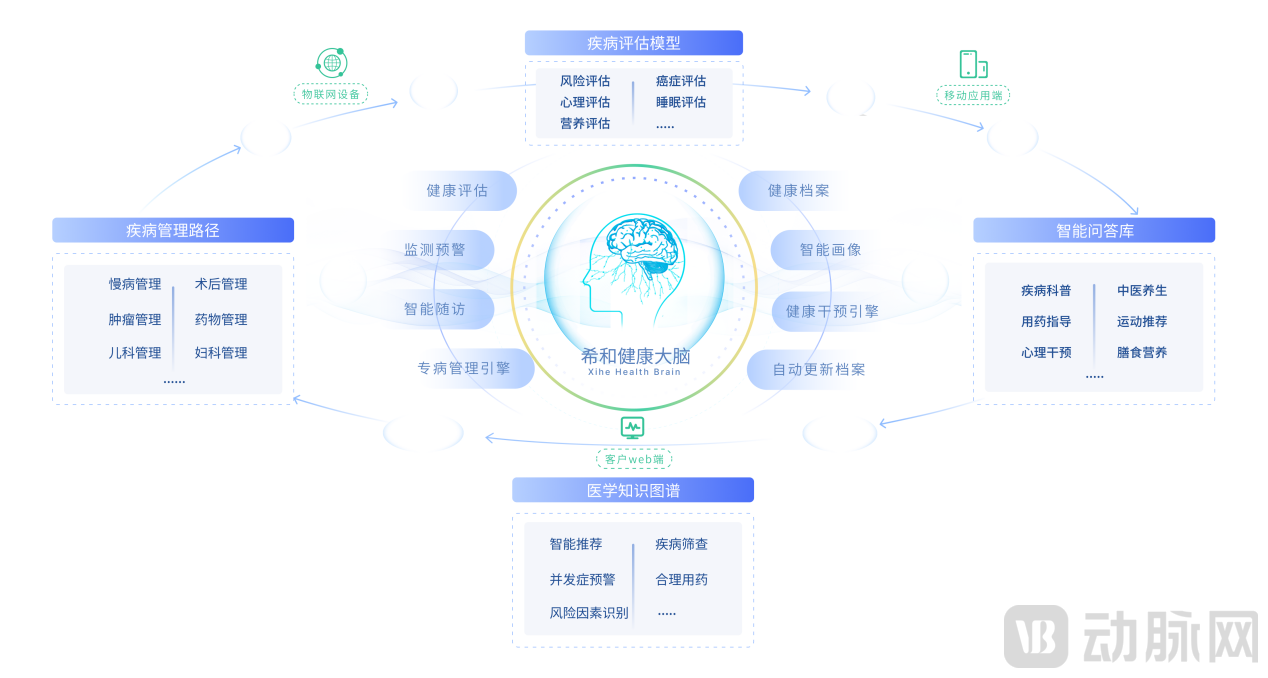
First, let us examine the medical knowledge graph. The team responsible for constructing the medical knowledge graph for Xihe Health Brain comprises more than ten members with medical backgrounds. Through years of accumulation, the graph covers diseases across multiple specialties, including cardiology, respiratory medicine, endocrinology, oncology, obstetrics and gynecology, and pediatrics.
The primary sources of medical knowledge include international and national standardized medical terminologies, authoritative medical textbooks, the latest domestic and international clinical pathway guidelines, clinical practice documents, and medical encyclopedias. For certain diseases, sources also include de-identified clinical data from partner hospitals.
After acquiring initial medical knowledge, Xihe Health performs structured processing, such as attribute classification. It then extracts, normalizes, and annotates the resulting structured or semi-structured data. Finally, through data fusion techniques—including entity tokenization, annotation, semantic association, and entity linkage—it constructs a medical knowledge graph.
Furthermore, Xihe Health conducts multiple rounds of manual verification on the knowledge graph data to comprehensively identify annotation conflicts and questionable results. Issues such as inconsistent entity terms, incorrect attributes, erroneous semantic and relational ordering, and inconsistencies are reported to the expert team for further review and corresponding corrections.
After laying a solid foundation for the medical knowledge graph,Building on this foundation, Xihe has developed over 200 assessment models covering more than 200 common diseases, primarily including cardiovascular diseases, metabolic disorders, and cancers.
According to Ni Xiaodong,Currently, many publicly available disease assessment models in the market primarily employ simple single-factor weighting methods or multivariate analysis. In contrast, Xihe’s disease assessment model utilizes a comprehensive all-factor analysis approach, incorporating disease-related risk factors as assessment parameters to holistically predict the probability of users developing multiple chronic diseases over the next 5–10 years.
Furthermore, Xihe’s disease assessment model incorporates regional, ethnic, dietary, and cultural differences by introducing region-specific correction parameters. “This is our proprietary risk assessment model.”
Building on medical knowledge graphs and disease assessment models, and adhering to the principles of rigorous medicine, Xihe has developed personalized disease management plans. This personalization extends not only across different medical specialties but also to varying stages of progression within the same disease entity.
As of now,Xihe’s disease management program covers most hospital departments, including cardiology, pulmonology, gastroenterology, endocrinology, oncology, obstetrics and gynecology, and pediatrics. For patients with the same condition, Xihe further develops personalized health management plans based on differentiating factors such as treatment modalities, patient demographics, and etiologies.
For example, management protocols for coronary heart disease can be categorized into pharmacological therapy, post-percutaneous coronary intervention (PCI), and post-coronary artery bypass grafting (CABG); similarly, diabetes management protocols are stratified by early-stage diabetes, type 1 or type 2 diabetes, and gestational diabetes.
Furthermore, Xihe’s comprehensive disease management programs encompass not only health education, dietary guidance, and follow-up visit tracking, but also medically intensive services such as risk assessment for diseases and complications, medication management, psychological intervention, Traditional Chinese Medicine (TCM) constitution regulation, and rehabilitation guidance.
The intelligent medical question-and-answer database is one of the application forms of medical knowledge graphs. The system first recognizes patients' natural language questions and converts them into structured queries, then uses algorithms to infer relevant answers from the knowledge base.
In addition to disease-related Q&A, Xihe has expanded its intelligent knowledge base to include modules on psychology, nutrition, and exercise, enabling applications across multiple scenarios such as medical science popularization, intelligent triage, health risk预警, and wellness care.
The Xihe Health Brain, integrating a medical knowledge graph, disease assessment models, disease management pathways, and an intelligent Q&A repository,It can replace at least 60% of tasks that require manual operation, such as automated data collection, intelligent disease assessment, intelligent solution matching, and personalized health education, thereby effectively improving the efficiency and quality of health management.
“The Xihe Healthy Brain’s built-in core competencies—comprising over 200 disease risk assessment models, more than 500 disease health management pathways, a medical knowledge graph, and an intelligent Q&A database—have been developed through Xihe’s 14 years of industry accumulation.”Ni Xiaodong stated, “We are one of the few companies in the industry that pursue a dual-track strategy, advancing both clinical expertise and health informatics. This will remain our core competitive advantage in the market going forward.”
When discussing the development plan for Xihe Health, Ni Xiaodong stated,Xihe Health’s short-term objective is to collaborate with hospitals on post-discharge disease management for patients, while its long-term strategy is to accumulate patient disease management data through such hospital partnerships, thereby facilitating future exploration of innovative applications in evidence-based digital therapeutics.
The essence of digital therapeutics is the digitization of services, which involves transforming physicians' clinical experience into software. Through data accumulation and continuous iterative optimization, all service components that can be digitized are ultimately converted into digital therapeutics.
Although digital therapeutics cannot fully replace manual medical services, such as surgery, their growth potential remains vast given the large base of China’s healthcare market, along with the accumulation of data, the maturation and optimization of technology, and increasing market acceptance.
As a result, numerous companies have entered this field (according to VCBeat’s “White Paper on Digital Therapeutics in China 2.0,” there were 73 digital therapeutics companies in China as of September 2022), and Xihe Health is one of them.
VCBeat has learned thatXihe Health will conduct research on digital therapeutics for pediatric growth and development, precocious puberty in children, pediatric language development, gestational diabetes mellitus, sleep apnea syndrome, and menopausal syndrome. The planned collaborating institutions for the digital therapeutics programs targeting pediatric growth and development, precocious puberty in children, pediatric language development, and gestational diabetes mellitus are Zhejiang Chinese Medical University and Jiaxing Maternity and Child Health Care Hospital. The planned collaborating institution for the digital therapeutics program for sleep apnea syndrome is the Fourth Affiliated Hospital of Zhejiang University School of Medicine. The planned collaborating institution for the digital therapeutics program for menopausal syndrome is the Women’s Hospital of Zhejiang University School of Medicine.
In the digital therapeutics arena, Xihe Health’s performance remains to be validated over time.