

Where Do Pear, Akili, and Other Digital Therapeutics Pioneers Stand Today?
In 2012, Click Therapeutics, a U.S. company, filed an application with the United States Patent and Trademark Office (USPTO) for the trademark “Digital Therapeutics,” marking the first use of the term.
Over the past decade, hundreds of companies have flocked into this rapidly emerging healthcare sector. The global digital therapeutics market is expanding quickly, with its size projected to grow from $4.22 billion in 2021 to $18.06 billion by 2028.
Governments in the United States, Germany, France, the United Kingdom, South Korea, Japan, and other countries have successively relaxed relevant restrictions. In China, policy support has also begun to gain momentum; Hainan Province took the lead by incorporating digital therapeutics into its provincial planning, encouraging and regulating the application of related products, which has significantly promoted the development of the digital therapeutics industry.
In the past year, a number of digital therapeutics companies have gone public overseas. Amid a cooling macroeconomic environment, U.S.-based digital therapeutics company Biofourmis successfully secured $300 million in Series D financing this April, bringing its current valuation to $1.3 billion.
In this rapidly evolving market landscape, how far have pioneers in the digital therapeutics space, such as Pear and Akili, progressed? And where are they headed next?
According to the latest survey by MMIT, a U.S. healthcare market access services firm, a major reason for payers’ lagging adoption of prescription digital therapeutics (PDTs) is the lack of “clinical value” demonstrated by these products. Over the past decade, most digital therapeutics companies have focused primarily on product development. However, at the current stage, clinical trials are necessary and critically important for digital therapeutics, whether from the perspectives of definition, promotion, or commercialization.
From a definitional perspective, digital therapeutics (DTx) products are evidence-based medical software designed for specific diseases. A true DTx product must be validated through clinical trials. From a promotional standpoint, clinical trial data undoubtedly serve as the most compelling evidence to demonstrate the safety and efficacy of digital therapeutics.
According to data from China Renaissance Capital, as of October 2021, there were 417 clinical trials related to digital therapeutics worldwide. Among these, the number of digital therapeutic clinical trials increased from 16 in 2016 to 98 in 2020, representing a more than fivefold growth; for the partial year of 2021, the count had already reached 134, surpassing the 2020 total by 36 trials and marking an increase of more than eightfold compared to 2016.
Taking Akili Interactive as an example, its prescription digital therapeutic for ADHD, EndeavorRx, has been approved by the FDA. However, prior to approval, Akili spent five years demonstrating the efficacy of its product and published data from five distinct clinical studies, including a prospective, randomized controlled trial published in The Lancet Digital Health.
Pear Therapeutics has also been at the forefront of advancing the clinical validation of digital therapeutics, with three FDA-cleared prescription digital therapeutics (PDTs) approved for the treatment of substance use disorder, opioid use disorder, and chronic insomnia. In late 2021, Pear’s fourth PDT product, indicated for the treatment of alcohol use disorder, received FDA Breakthrough Device Designation.
Amid a cooling trend in digital health financing this year, Biofourmis has secured $300 million in funding and obtained sales approvals in six U.S. states. The proceeds from this round will continue to support clinical trials, the development of digital biomarkers, and the expansion of its digital therapeutics product pipeline.
Chengdu Shangyi Information Technology (hereinafter referred to as “Shukang” after its product), the digital therapeutics company in China with the most recent financing round, obtained the NMPA Class II medical device certification for its “Exercise Testing and Exercise Prescription Video Software” in November 2020. According to public information, Shukang has conducted more than 30 clinical studies on digital therapeutics related to exercise therapy and nutritional therapy with over 30 Grade A tertiary hospitals, including the Chinese PLA General Hospital and West China Hospital of Sichuan University, covering more than 5,000 patients.
Among these, the clinical research findings from the project “Impact of Exercise Under Remote Monitoring on the Rehabilitation of Patients Discharged After COVID-19” have been published in THORAX, a journal with an impact factor as high as 10.139.
As an innovative medical intervention, digital therapeutics (DTx) have exerted a significant positive impact on healthcare services. However, due to the unique characteristics and inherent caution of the medical industry, DTx previously faced considerable challenges, including difficulties in detection and evaluation, as well as lack of insurance coverage. This situation is now rapidly improving.
In its exchanges with multiple digital therapeutics companies, VCBeat found that medical device review and approval authorities in many Chinese provinces are increasingly familiar with the concept of digital therapeutics and have engaged numerous experts in the field of innovative medical devices to participate in classification determinations. Provinces such as Hainan, Shandong, and Zhejiang have successively sent positive signals regarding the development of the digital therapeutics industry.
Internationally, the U.S. government stated in its newly released National Drug Control Policy Strategic Report that it will promote digital therapeutics as a potential tool to help treat substance abuse, and encourage agencies to seek congressional authorization for reimbursement. It may consider reimbursing emergency management costs to companies providing patient services through digital therapeutics within healthcare plans.
At the end of 2021, the Centers for Medicare & Medicaid Services (CMS) added a new Level II Healthcare Common Procedure Coding System (HCPCS) code for “FDA-cleared prescription digital therapeutics,” making it easier for payers to cover these digital therapeutic products.
New legislation could also pave the way for reimbursement of digital therapeutics. In March this year, U.S. senators introduced Bill HR7051, the “Access to Prescription Digital Therapeutics Act,” which requires health care plans to cover FDA-approved digital therapeutic products.
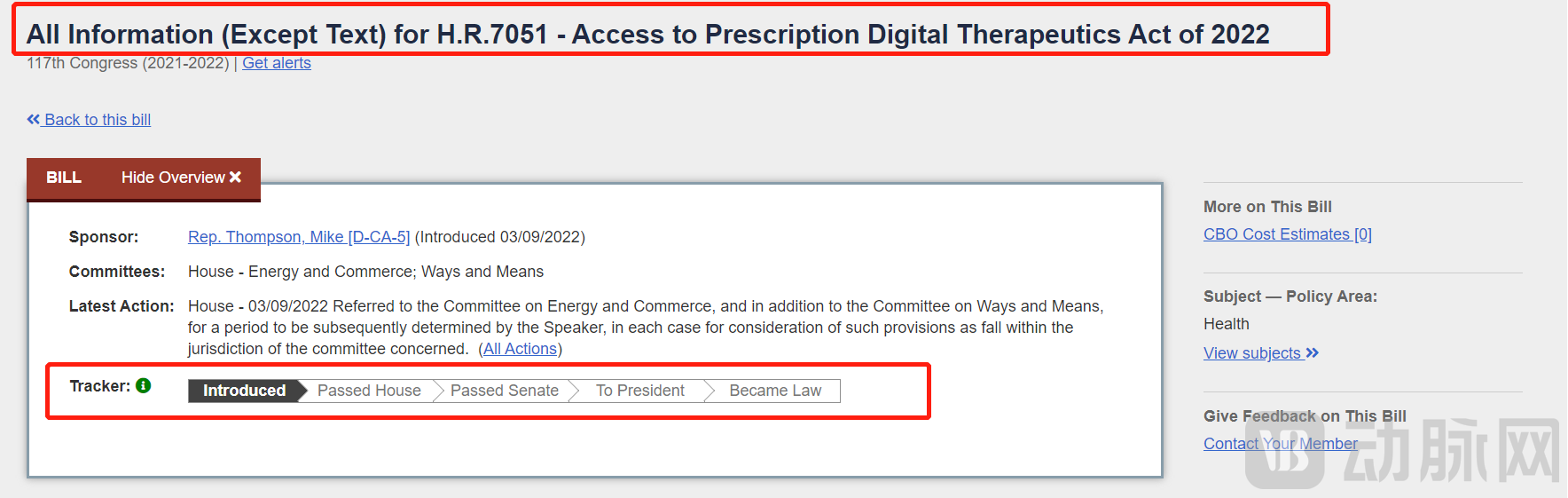 Image source: Official website of the U.S. Congress
Andy Molnar, CEO of the Digital Therapeutics Alliance (DTA), stated that these signals indicate the government’s interest in and recognition of digital therapeutics products, which will help significantly increase payer acceptance of Prescription Digital Therapeutics (PDT). However, much work remains to achieve insurance coverage. The next step is to establish a dedicated insurance category for digital therapeutics to formally recognize them and provide patients with access to these products.
The outbreak of the COVID-19 pandemic propelled telemedicine into the mainstream and attracted substantial capital inflows into the digital health sector. According to Rock Health data, digital health funding reached a record $29.1 billion in 2021. However, as the pandemic entered its next phase, funding in the first quarter of 2022 declined to $6 billion, marking the lowest quarterly total since 2020. The public market valuation of digital health stocks also plummeted by 38% between July 2021 and March 2022.
Industry insiders state that the recent stock losses and investment decline signal a return to rationality and are part of a normal market cycle. Although current market data may appear somewhat unfavorable, the fundamental value proposition of digital therapeutics remains intact, holding significant potential for the future of healthcare. In this context, VCBeat seeks to analyze the readiness of digital therapeutics pioneers, providing reference insights for companies in the sector.
Pear Therapeutics
In December 2021, Pear officially went public on the Nasdaq via a SPAC merger (stock ticker: PEAR). According to its annual report, Pear’s sales revenue from prescription digital therapeutics (PDT) products increased 24-fold in 2021, primarily driven by higher volume sales of reSET and reSET-O, the two products that first received FDA approval.
Pear also highlighted its goal to increase revenue by 30-fold by 2023, strongly underpinned by its three FDA-approved photodynamic therapy (PDT) products and 14 PDT candidates in development, spanning therapeutic areas including psychiatry, neurology, and oncology.
In April this year, the U.S. FDA granted the “STeP” designation to the candidate product Pear-010. Launched by the FDA last year, the “STeP” program is specifically tailored for innovative medical products that can significantly improve the safety of current diagnostic and therapeutic methods but do not meet the criteria for Breakthrough Device Designation. The program aims to accelerate the development, evaluation, and review of such products beyond existing market access standards, thereby enabling physicians and patients to benefit from them at an earlier stage.
Pear-010 is a digital therapeutic product based on VR technology for the treatment of acute and chronic pain, and it is also Pear’s first product in the field of neurology. BTIG analysts stated that the “STeP” designation represents a “critical victory” for Pear, marking a significant step in the company’s expansion from psychiatry into the neurology market.
Prior to 2021, Pear’s revenue was primarily derived from collaborative research, development, and commercialization agreements. Over the past year, Pear has engaged in intensive commercial partnerships with major clients such as Northwell Health and Kaiser Permanente to promote its Prescription Digital Therapeutics (PDT). The company has also accelerated its outreach to organizations including Pharmacy Benefit Managers (PBMs) and Medicare and Medicaid agencies, successfully securing Medicaid contracts in Massachusetts and Oklahoma in succession, thereby rapidly expanding product coverage.
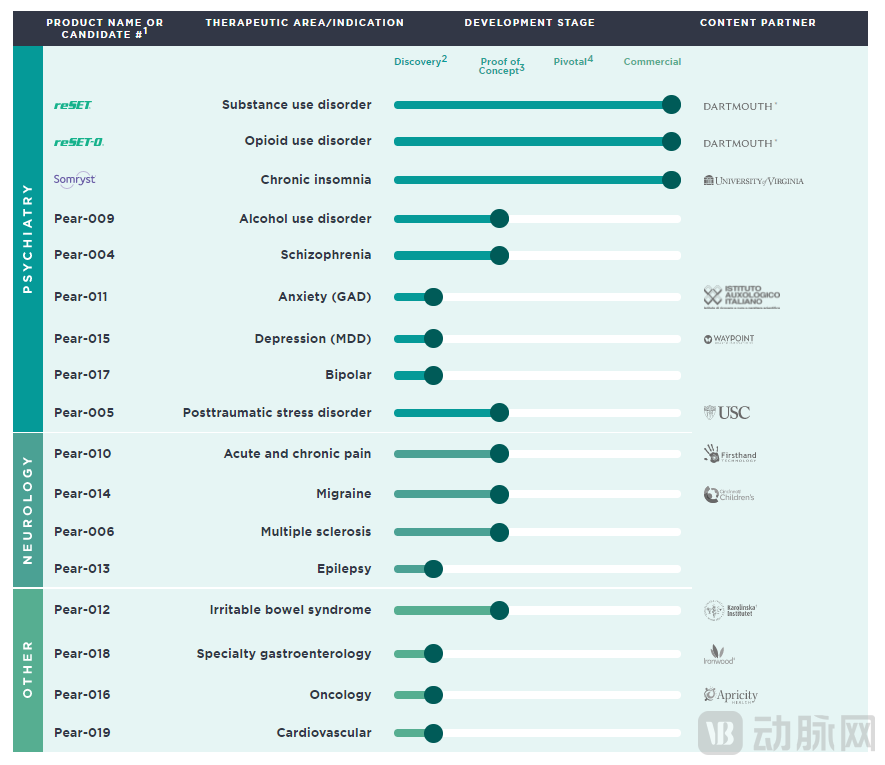 Pear Product Pipeline
Akili Interactive
On January 26, 2022, Akili announced that it would go public on the Nasdaq via a SPAC merger in mid-2022. Akili’s EndeavorRX is a digital therapeutic product based on video games, designed for patients aged 8–12 with ADHD, and is among the first batch of digital therapeutics to receive FDA approval.
From a commercialization perspective, Akili believes that with precise marketing, EndeavorRX holds strong appeal for its target population. According to data provided by Akili in its SEC filings, between April 2021 and December 2021, the prescription conversion rate for Akili’s products on a cash-pay basis was 52%, with an average revenue per user (ARPU) of $247; the prescription conversion rate for insurance-reimbursed prescriptions reached as high as 88%, with an average ARPU of $387.
Akili plans to target the 8–12 age group with EndeavorRX in the second half of 2022, followed by expansion to the 3–7 age group. Upon achieving this coverage, Akili projects potential annual revenues exceeding $500 million. Additionally, Akili is extending its core technology to address new disease indications.
Akili founder Martucci stated that, following the success of Akili’s first FDA-cleared product, the company is expanding its core technology to treat other acute and chronic conditions, such as autism, multiple sclerosis, depression, and COVID-related “brain fog.”
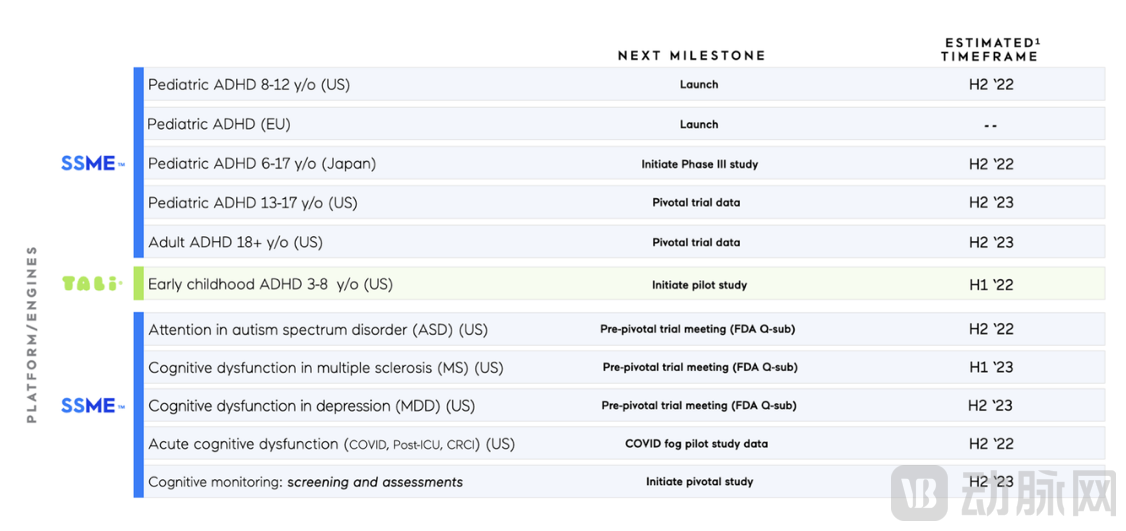 Akili Product Pipeline
Shukang
In August 2021, Shukang announced the completion of its Series C financing round, raising nearly RMB 100 million. Centered on remote intelligent assessment of cardiopulmonary, musculoskeletal, and nutritional status, Shukang combines wearable devices with scientifically formulated prepackaged medical foods. Prescribed by physicians, this solution enables patients to easily adhere to treatment plans at home, significantly reducing the implementation costs of personalized exercise and nutritional interventions—down to one-tenth of those associated with traditional outpatient care—and thereby lowering incidence, hospitalization, and readmission rates.
In terms of commercialization, the Shukang APP has seen smoother progress in overseas markets, having established a partnership with Blue Cross, one of the major health insurance companies in the United States. Furthermore, the Shukang APP has been included in the covered treatment reimbursement lists of major U.S. healthcare institutions such as Baylor Medicine and HCA. This signifies that the Shukang APP has gained recognition from mainstream medical institutions and insurance providers in the United States.
He Chunshui, co-founder of RECOVERY PLUS, revealed in an interview that approximately 30,000 to 50,000 heart failure patients in the United States are expected to use RECOVERY PLUS’s products for post-discharge rehabilitation, generating projected revenues in the tens of millions of U.S. dollars. In China, VCBeat has learned that RECOVERY PLUS is currently expanding its direct-to-consumer (2C) offerings. As the company refines its profitability model, its first-mover advantage may enable it to rapidly outpace competitors.
Furthermore, Shukang is gradually expanding its core technological capabilities into areas such as cognitive training and nutritional therapy, undertaking targeted product development and clinical trials.
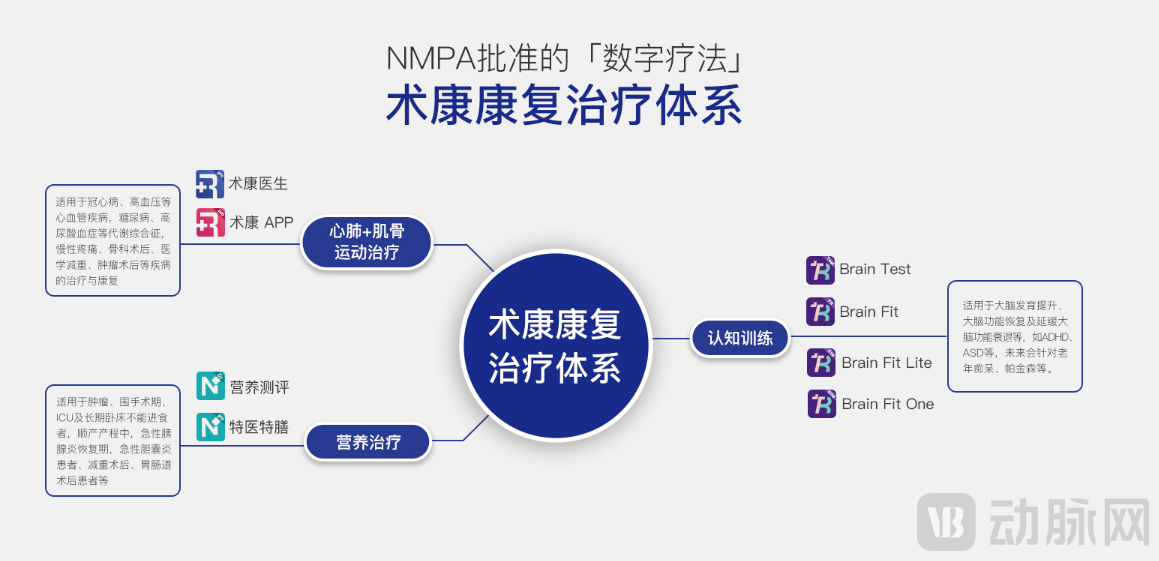
Shukang Product Pipeline
As digital therapeutics (DTx) have evolved, industry insiders have gained a clear understanding of the concept. However, for a broader range of stakeholders, the medical value of DTx remains the primary focus of attention. Particularly given that the healthcare supply side currently lacks a deep understanding of when, where, and how to leverage DTx to deliver optimal patient care, it is crucial to complement clinical trial data required for regulatory approval with retrospective analyses conducted through rigorous academic research. Demonstrating long-term real-world evidence via authoritative channels such as academic journals and conferences is therefore essential.
In its “White Paper on Digital and AI Health,” China Renaissance Capital pointed out that “hospitals have limited incentive to develop departments such as psychiatry and psychology, pediatrics, and rehabilitation due to low medication usage, fewer diagnostic tests, and high complexity in diagnosis and treatment.” Yet demand among these patient populations is robust, creating substantial growth opportunities for digital therapeutics (DTx). Consequently, current DTx companies with first-mover advantages are active in these therapeutic areas, with Shukang achieving comprehensive coverage across all of them.
Furthermore, although the healthcare industry has cooled somewhat recently, policy signals regarding digital therapeutics remain positive both domestically and internationally. On May 10, digital therapeutics were included in the National Development and Reform Commission’s “14th Five-Year Plan for Bioeconomy Development.” Looking five years ahead, we may see medical institutions not only widely adopting digital therapeutics but also prioritizing them over pharmacological or surgical interventions.
Believe that the starlight of digital therapeutics, accumulated over time and poised for breakthrough, will always pierce through the darkness and gloom.
Related Links:
https://www.congress.gov/bill/117th-congress/house-bill/7051/all-info
https://www.cms.gov/files/document/2021-hcpcs-application-summary-biannual-2-2021-non-drug-and-non-biological-items-and-services.pdf