

Meyoan Rex Secures FDA and CE Certifications for Self-Balancing Exoskeleton Rehabilitation Robot Ahead of China Market Entry

Rex Robotic
Medical Robot Developer
In 2020, Mei'an Pharmaceutical acquired Rex Bionics, a top-tier global exoskeleton robotics company, and restructured it into Wuxi Mei'an Rex Medical Robotics Co., Ltd. (hereinafter referred to as "Mei'an Rex").
According to available information, Mei An Lei Ke Si is a medical robotics company specializing in the field of rehabilitation, dedicated to helping patients complete rehabilitative therapy, restore physiological functions, resume daily activities, and improve their quality of life.
Miao Fengdong, CEO of Mei’an Lex, stated: “We primarily develop hard-tech solutions in the rehabilitation sector, particularly in neurological rehabilitation, such as rehabilitation robots, laser-based rehabilitation products, and AI-powered rehabilitation tools. We aim to address the fundamental pain points in rehabilitative therapy through the R&D of core, high-barrier technologies.”
Currently, Mei’an Lex has launched a self-balancing exoskeleton robot. This product has obtained CE certification from the European Union and FDA clearance from the United States, and has already served patients with neurological disorders overseas. Meanwhile, Mei’an Lex is expanding its product portfolio to include other lines, such as those assisting limb rehabilitation.Bedside Rehabilitation Robot, to assist patients with walkingWalking Rehabilitation Robot, repair of soft tissue injuries in patients' limbsLaser Rehabilitation Therapy Robotetc. Mei'an Lex is expected to develop prototypes of these three products within the year and begin clinical registration in 2023.
As an exoskeleton rehabilitation robot company that has already achieved overseas sales, what are Rex Bionics’ views on the neurorehabilitation market? How will it enter the Chinese market? What is its product portfolio strategy?
Neurorehabilitation is primarily associated with neurological conditions such as stroke, traumatic brain injury, and spinal cord injury.
Taking stroke as an example, the China Stroke Report 2019 (English Edition) shows that the disability rate of stroke in China is as high as 75%, meaning that 75% of stroke patients in China have varying degrees of disability.
In developed Western countries with mature rehabilitation systems, the disability rate from stroke is only 30%. Data comparisons reveal that well-established rehabilitation frameworks and comprehensive therapeutic interventions hold immense value in improving the quality of life for stroke survivors.。
Currently, there are approximately 15 million stroke survivors living with the condition in China, yet very few undergo rehabilitation therapy. This has resulted in a relatively low quality of life for stroke patients in China, with about 17% of them being bedridden for extended periods. Furthermore, these patients require dedicated caregiving, imposing a substantial financial burden on both their families and society.
Why Is the Penetration Rate of Rehabilitation Therapy for Stroke Patients in China So Low?
Miao Fengdong stated, “Three major factors limit stroke patients from undergoing rehabilitation therapy.”
First, China faces a severe shortage of rehabilitation therapists. Taking stroke as an example, there is a demand for 400,000 rehabilitation therapists to care for relevant patients, yet the country currently has only 20,000 such professionals. Furthermore, since each patient typically requires the collaborative support of multiple rehabilitation therapists, this shortage is even more pronounced.
Second, there is a severe shortage of rehabilitation institutions and equipment. In the United States, there are approximately 30,000 rehabilitation facilities, whereas China has only about 3,000. Furthermore, compared with foreign countries, rehabilitation therapy in China relies primarily on manual labor by therapists, lacking robust and reliable rehabilitation platforms and equipment.
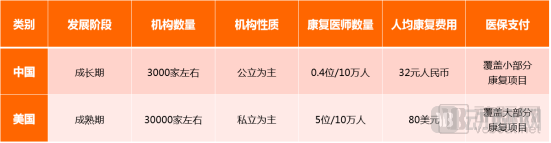
Image source: “2019 Research Report on the Development Potential of the Rehabilitation Industry”
Third, insufficient rehabilitation skills. Currently, the average educational level of rehabilitation therapists in China is relatively low, and their professional competencies vary considerably, leading to inconsistencies in the effectiveness of rehabilitation treatment.
In light of the three major pain points mentioned above, the penetration rate of rehabilitation therapy in China remains generally low. However, rehabilitation therapy enables 90% of stroke patients to regain walking ability and activities of daily living (ADL), and allows 30% of patients to return to light-duty work; whereas without rehabilitation therapy, only 6% regain walking ability and ADL, and merely 5% return to light-duty work.
It is evident that rehabilitation therapy holds immense value for patients; therefore, there is an urgent market demand for safe and effective rehabilitation solutions.
In response to urgent clinical needs, exoskeleton rehabilitation robots have emerged. Taking Mei'an Rex's independently developed exoskeleton rehabilitation robot as an example, this device can support patients through rehabilitation training without requiring physical exertion from therapists; only one rehabilitation specialist is needed to control the training process. It enables multi-modal, multi-level rehabilitation training during the acute phase.
Like Meian Leikesi, many other startup teams around the world have also identified opportunities in the exoskeleton rehabilitation robot market.
According to reports, the exoskeleton rehabilitation robot developed by Mei'an Leikesi received CE and FDA approval for market launch in 2016, making the company one of the first globally to commercialize exoskeleton rehabilitation robots.
However, exoskeleton rehabilitation robots from multiple companies worldwide have already received regulatory approval. Compared to other products on the market, what are the differentiated advantages of the Rex Bionic robot?
Miao Fengdong stated, “Unlike other products on the market, the Rex Robot is a self-balancing, multifunctional exoskeleton robot. Leveraging mechanical systems and intelligent algorithms, this robot can independently support patients’ rehabilitative movements without the need for external devices such as suspension systems, frames, or crutches. The exoskeleton robot also incorporates bionic engineering design, with movement patterns that better align with ergonomic trajectories, providing an enhanced experience for both patients and rehabilitation therapists.”
Meanwhile, the exoskeleton rehabilitation robot designed by Mei'an Leikes utilizes its self-developed motor, which features a compact size, high torque, and an efficiency rating exceeding 95%.
In addition, Mei’an Leikes enhances exoskeleton rehabilitation robots with functionalities such as multi-action control, multi-directional control, and precise motion control through technologies including algorithmic sensing and control systems. Specifically, the algorithmic sensing technology achieves intelligent and precise control via fuzzy PID algorithms, and utilizes dozens of sensors to holistically monitor the status of both the device and the patient, thereby enabling complex computations and motion control.
Based on this, Mei An Lei Ke’s exoskeleton rehabilitation robot can support patients in performing dozens of movement and posture training exercises to achieve better therapeutic outcomes.
In clinical studies, an early-stage stroke patient with grade 0 muscle strength in the right upper and lower limbs underwent Rex exoskeleton robot training twice daily. After 26 days, the patient achieved ambulation with assistance, which was 2–3 months earlier than expected. A spinal cord injury patient classified as ASIA Impairment Scale C underwent rehabilitation training with the Rex exoskeleton robot for one month. Clinicians evaluated that the patient demonstrated significantly improved trunk control, amelioration of orthostatic hypotension, marked improvement in neurogenic bowel dysfunction, and better engagement in independent activities of daily living.
By scaling up the use of Rex robots, China is well-positioned to reduce disability rates from conditions such as stroke. But how will Mei’an Rex promote its exoskeleton rehabilitation robots?
Meian Rex believes that the rehabilitation industry is currently at a critical juncture and is entering a period of policy-driven dividends. For instance, in 2021, the National Health Commission and seven other departments jointly issued the “Notice on Opinions to Accelerate the Development of Rehabilitation Medical Services,” which emphasized the need to further strengthen the rehabilitation medical service system and accelerate the high-quality development of rehabilitation medical services.
Miu Fengdong stated, “On one hand, Mei’an Lex will seize development opportunities by promoting the robot through both sales and leasing, while leveraging the sales channels and commercialization team of its parent company, Mei’an Pharmaceutical, to market the device. On the other hand, Mei’an Lex will promote the robot by highlighting its clinical efficacy and benefits to various stakeholders.”
For rehabilitation institutions, opting for a leasing model allows them to expand revenue streams with minimal upfront costs while providing patients with a more efficient approach to rehabilitative therapy. Alternatively, choosing a procurement model enables cost recovery within approximately one year, with all subsequent income constituting institutional profit.
For physicians and patients, rehabilitation therapists are relieved of physical exertion and can focus solely on designing rehabilitation training protocols, significantly improving efficiency; patients, in turn, receive more precise rehabilitation therapy, enhancing clinical outcomes.
From a societal perspective, rehabilitation therapy for stroke patients can significantly reduce disability rates and lower caregiving costs. Therefore, exoskeleton rehabilitation robots are highly cost-effective from a health economics standpoint and should be widely promoted to reduce societal costs.
Leveraging these advantages, we hope that Mei An Leikesi’s exoskeleton rehabilitation robot will receive regulatory approval for market launch in China at the earliest possible date and be widely adopted by patients across the country.
Finally, Miao Fengdong stated, “Meian Rex plans to launch a new round of financing worth RMB 80 million. The funds raised will be primarily used for the product registration of Rex robots, scaled-up production, and the research and development of other innovative products.”