

Profiles of Founders Behind 40 Unprofitable Listed Biotech Firms in China: Insights from 69 Resumes

Immunotech Biopharm
Developer of Cellular Immunotherapy Products

CARsgen Therapeutics
Developer of CAR-T Cell Immunotherapy Drugs

Jacobio
Innovative Drug Developer
In recent years, China’s biopharmaceutical industry has ushered in new development opportunities. Policies to support and regulate the sector have been successively introduced, a growing number of startups have emerged, and capital markets have shown strong favor toward the biopharmaceutical industry.
Talent is the cornerstone of industrial innovation and development. Given the high technical barriers, substantial capital requirements, and lengthy R&D cycles inherent in pharmaceutical research and development, high-caliber professionals who command multiple resources—including technology, capital, and management expertise—are increasingly valued.
So, what are the educational, research, and professional backgrounds of the founding teams of currently active biopharmaceutical companies? What kind of founders are more likely to lead biopharmaceutical companies to break through intense competition and successfully go public?
Driven by this question, we initiated a related analytical study. This paper selected 40 biotechnology companies that had been listed on the Hong Kong Stock Exchange (HKEX) and the STAR Market but were not yet profitable as of May 20, 2022 (28 on HKEX and 12 on the STAR Market). Based on their prospectuses and public information, we obtained data on the educational and professional backgrounds of the core founding teams of these enterprises and further summarized and analyzed the common characteristics of their founders.
Over 80% Hold Doctoral Degrees as the Wave of Returnees Sweeps In
Attracted by the favorable domestic biopharmaceutical environment, a large number of highly educated professionals with overseas study backgrounds, research experience at top domestic and international universities and institutes, or work experience in multinational pharmaceutical companies have embarked on entrepreneurial journeys. They have become the main force driving the development of innovative drugs in China, injecting new momentum into the future growth of the country’s biopharmaceutical industry.
Universities serve as the primary hubs for talent cultivation, aggregation, and innovation. Venture capital firms investing in biotechnology companies appear to favor startups led by founders with prestigious academic backgrounds, advanced degrees, and relevant professional expertise. For an early-stage biotechnology company, does the founder’s educational background have a direct impact on the company’s development?
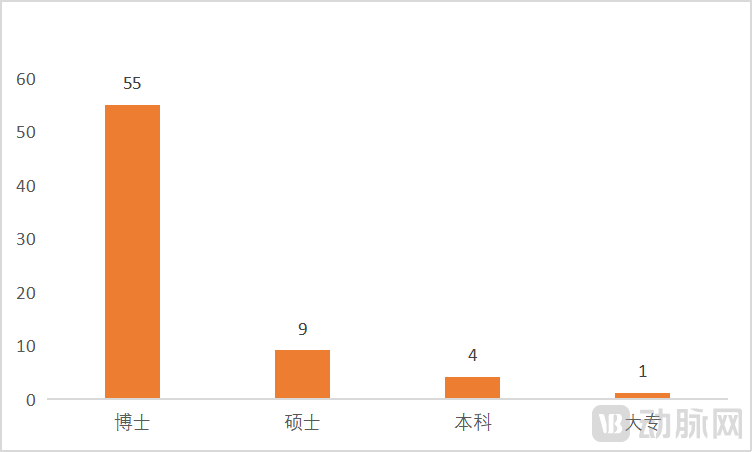
Founder's Educational Background (Note: Based on the highest degree obtained)
According to statistics, among 40 biotechnology companies, more than half of the founders hold doctoral degrees, while only 14 founders have a master’s degree or lower, accounting for just 20.3% of the total 69 founders. This trend reflects the high technical complexity and elevated entry barriers of the biopharmaceutical industry, which imposes exceptionally high requirements on candidates’ academic backgrounds and scientific research capabilities.
The proportion of highly educated professionals launching startups in the biopharmaceutical industry is gradually increasing. In the face of intense industry competition, founders who aspire to establish a firm foothold or even stand out as leaders must naturally strengthen their acquisition of relevant skills and knowledge.
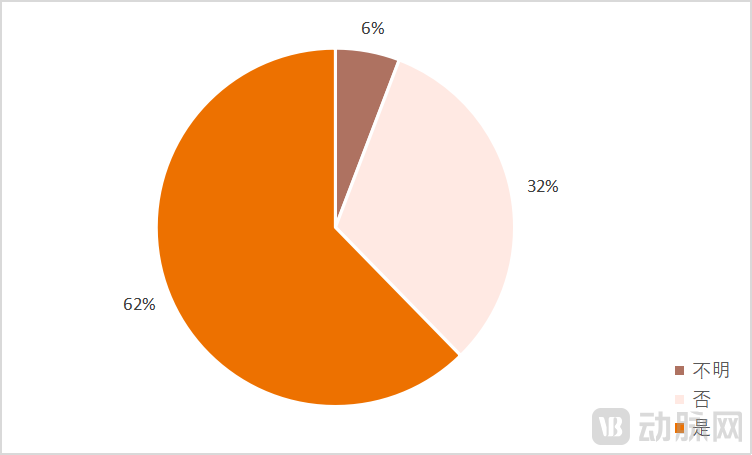
Chart: Founders with Overseas Study Backgrounds
Furthermore, among the 69 founders included in our statistics, approximately 62% have overseas study backgrounds, reflecting the growing wave of returnees.
Excluding the six founders with unspecified professional backgrounds, the founders’ specialties fall primarily into two categories. The first category comprises biomedical and related fields, accounting for approximately 83.5%. The second category is business administration; among the 69 founders, six hold or concurrently possess a Master of Business Administration (MBA or EMBA) degree.
Disruptive innovations across many different fields often originate from outsiders entering the industry; however, this pattern clearly does not apply to the biopharmaceutical sector. Unlike business model innovation, the development of the biopharmaceutical industry, driven by technological innovation, is difficult to bolster by incremental empowerment from external players. The core developmental dynamic of this industry remains endogenous growth.
90% of founders have an industry background
Based on our compiled corporate data, approximately 90% of founders have prior work experience at renowned pharmaceutical companies both in China and abroad. This background significantly contributes to enriching their academic credentials and industrial expertise, mastering drug development regulations, and accumulating operational experience in pharmaceutical enterprise management.
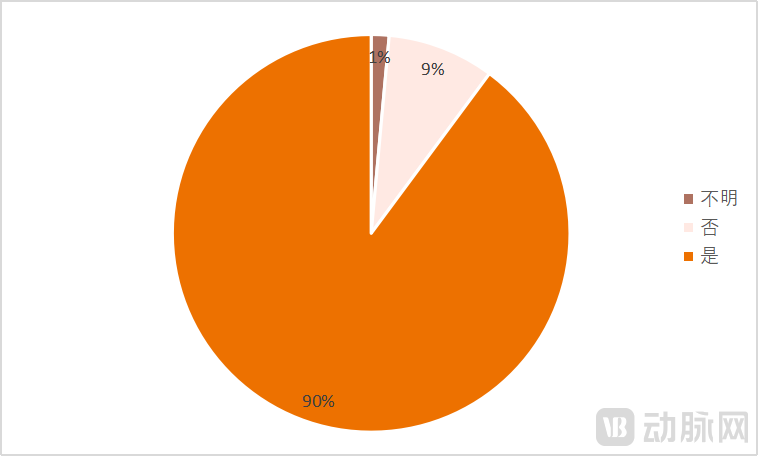
Statistical Chart of Founders with Pharmaceutical Industry Work Experience
According to our corporate statistical data, more than half of the founders have work experience at top 20 global pharmaceutical companies, including Roche, Novartis, Johnson & Johnson, Bristol-Myers Squibb, Sanofi, Pfizer, GlaxoSmithKline, AstraZeneca, Amgen, Eli Lilly, Bayer, and Merck. Among them, the number of founders with work experience at Sanofi and Pfizer is the highest, with five each.
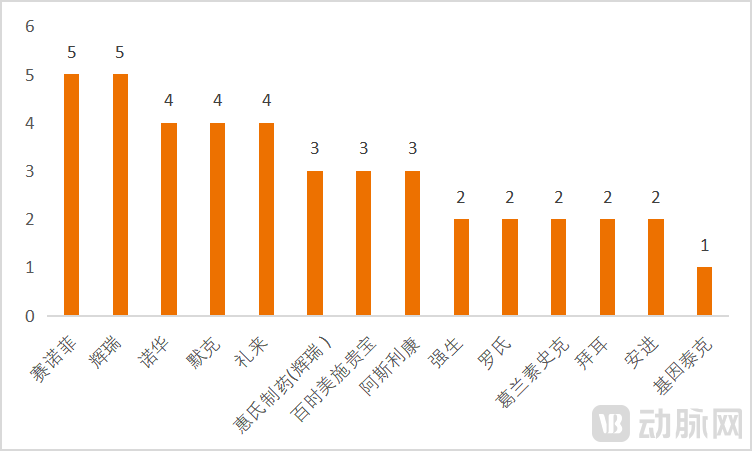
The Founder's Work Experience at Top 20 Global Pharmaceutical Companies
Pre-entrepreneurial accumulation is crucial, as it determines whether founders can successfully build their own ventures in the future. The last position held by a founder before launching their startup often represents the pinnacle of their pre-entrepreneurial career and, to some extent, reflects the level of expertise and experience they have accumulated. According to our statistical data, 12 founders held executive roles at top-20 global pharmaceutical companies as their last job before starting their own businesses.
This reflects the first wave of returnees to China’s pharmaceutical industry.
This wave did not originate entirely from entrepreneurship. Among the founders of this cohort of listed companies, the most common career path involved first accumulating R&D experience abroad, then returning to China to serve as senior executives at multinational pharmaceutical companies’ domestic branches or at local pharmaceutical firms. These individuals possess two key core competencies: drug R&D capabilities and an understanding of the domestic market. Drug R&D expertise serves as the capital for their entrepreneurial ventures, while insight into the domestic market is crucial for identifying the right timing for launching their startups.
Thus, in the process of China’s pharmaceutical industry transforming toward innovation, they have accurately grasped the pulse of the times.
In recent years, with the reform and implementation of China’s policy frameworks, the domestic market has become increasingly open and dynamic, driving the Chinese pharmaceutical sector toward innovation. Coupled with the introduction of a series of talent attraction policies, a growing number of high-level professionals with similar backgrounds are accelerating their return to China. They are eager to bring back the knowledge, technical expertise, and drug R&D experience accumulated in multinational corporations, thereby supporting the development of China’s biopharmaceutical industry.
The barriers to entry in the biopharmaceutical industry are exceptionally high, requiring years of accumulated expertise at every stage. Talents who have deeply cultivated their careers in the pharmaceutical industry for many years and have successful track records in drug development are returning to China to launch startups. On one hand, they are introducing the most advanced biopharmaceutical R&D models to the domestic market; on the other hand, they are accelerating the cultivation of local talent.
Experience to date suggests that entrepreneurs with industry backgrounds are more likely to lead their startups to greater success.
Approximately 30% of founders have serial entrepreneurship experience
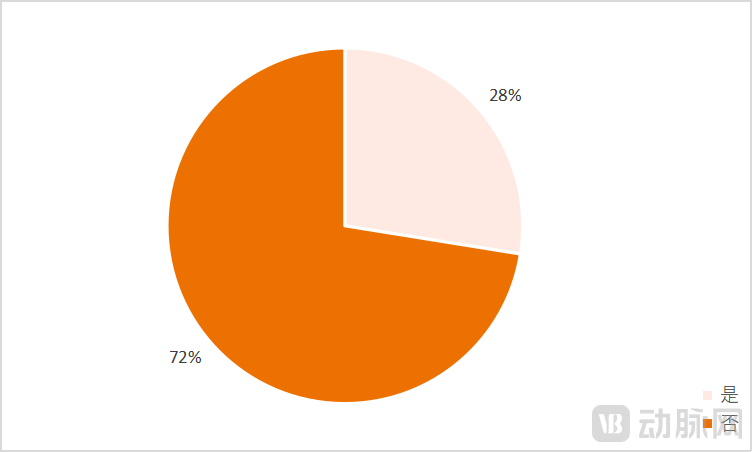
Statistical Chart of Whether Founders Are Serial Entrepreneurs
Entrepreneurship is rarely a smooth journey; it often entails numerous challenges from both within and outside the enterprise. In the biopharmaceutical sector, characterized by high technical complexity, substantial capital investment, and lengthy R&D cycles, these difficulties can be even more pronounced.
Due to their past entrepreneurial experiences, whether successful or not, “serial entrepreneurs” are often regarded as seasoned veterans who have accumulated extensive industry and startup expertise. Consequently, they are perceived to have a higher likelihood of success and are more favored by capital investors.
Among the 69 founders included in our statistics, 19 had prior serial entrepreneurship experience before establishing their current companies, accounting for approximately 28%.
For example, Dr. Wang Yinxiang returned to China after completing his postdoctoral fellowship at the Koleske Laboratory at Yale University in the United States in 2003 and founded Beta Pharma (listed on the Shenzhen Stock Exchange in 2016), where he led the company’s R&D functions. He later co-founded Jacobio with colleagues from Beta Pharma in 2015 and has served as Chief Executive Officer of Jacobio Pharmaceuticals Group Co., Ltd. since August 2019, overseeing the group’s overall strategic planning, business direction, and operational management.
Successful Cases of Scientist-Led Startups
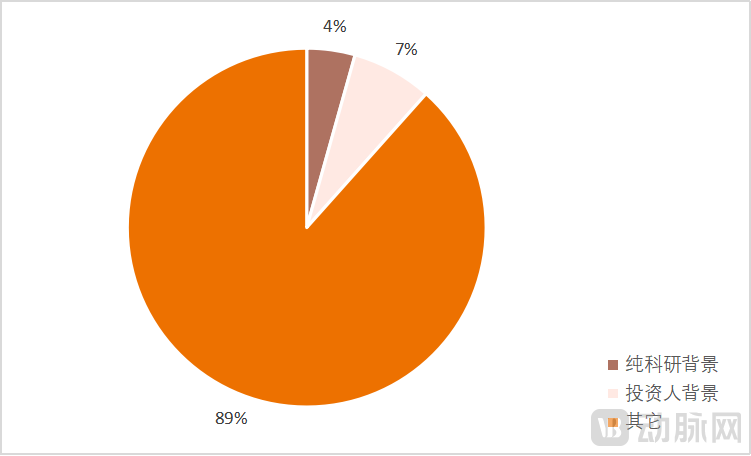
Statistics on Scientist-Led Startups
In addition to the mainstream talent pool of founders with advanced degrees and experience at large pharmaceutical companies, scientist- or investor-founded enterprises have also emerged among those that went public in the past two years.
According to our statistics, approximately 4% of founders held only the title of scientist before formally launching their startups.
Typical examples include Dr. Yang Dajun of Ascentage Pharma and Professor Wang Yu of Immunotech Biopharm. Additionally, although Dr. Li Zonghai of CARsgen Therapeutics was excluded from our statistics due to his brief tenure in the pharmaceutical industry, the vast majority of his prior experience was spent teaching at universities, making him a quintessential example of a scientist-turned-entrepreneur.
Although scientists mostly toil away in laboratories for long periods, constantly conducting experiments and publishing papers, they often do not wish to leave their research findings confined to written form. Instead, they aspire to translate these scientific achievements into products that truly benefit humanity. I believe this is the original intention behind most scientists’ entrepreneurial ventures.
Every Era Has Its Own Entrepreneurs
Focusing on the present, with the development of the times, the landscape of entrepreneurship is undergoing new changes.
As domestic R&D themes shift from fast-follow to first-in-class, the first story told by entrepreneurs in the new era is no longer about bringing globally leading products and R&D concepts back to China, but rather about developing truly world-leading pharmaceutical products in China.
Under such circumstances, the demand for technical prowess has overwhelmingly surpassed the importance of R&D experience and market insights. The focus of investment across the entire biopharmaceutical sector has shifted significantly upstream, making outstanding scientists highly sought-after assets in the primary market.
On the other hand, the previous wave of fast-follow innovation has contributed a large cohort of outstanding professional managers to the biopharmaceutical industry. Their managerial expertise complements the technical prowess of scientists, bringing the entrepreneurial narrative full circle once again.
Every era has its own theme; success always belongs to those who align with the trends of the times.