

Sequoia, Matrix Continuously Invest; Hillhouse, ByteDance Enter the Race — This Life Science Sub-sector Is Set to Explode

Kaitai Capital
Venture Capital Management Agency

Oriza Holdings
Early-stage Equity Investment Management Institution
MPCi
Venture Capital Institutions in High-Tech Startup Fields
Have you ever seen the sky at 4 a.m.? Scientists would say, “We have seen the sky at 1, 2, 3, 4, 5, and 6 a.m.”
“Getting up at two or three in the morning to turn off instruments,” “setting up a camp bed in the lab and staying there for three or four days when dealing with complex experiments,” “performing extensive repetitive tasks in experiments, where a single error requires starting over from scratch”… For scientists, these hair-raising, upside-down routines have become part of their daily operations.
It is hard to imagine that, in an era of rapid advancement in digitalization and automation technologies, many scientific teams in China are still producing the country’s most advanced scientific research using traditional methods.
“A workman must first sharpen his tools if he is to do his work well.” Well-suited laboratory research tools can help scientists improve research efficiency and shorten the cycle for producing scientific outcomes. Driven by market demand and various external factors, local innovators who have spotted opportunities are emerging, beginning to address the diverse needs of scientists in laboratory settings. Meanwhile, investors, who are most sensitive to market trends, have also flocked to this sector.
According to VCBeat, investment institutions have been actively investing in smart laboratories over the past two years.
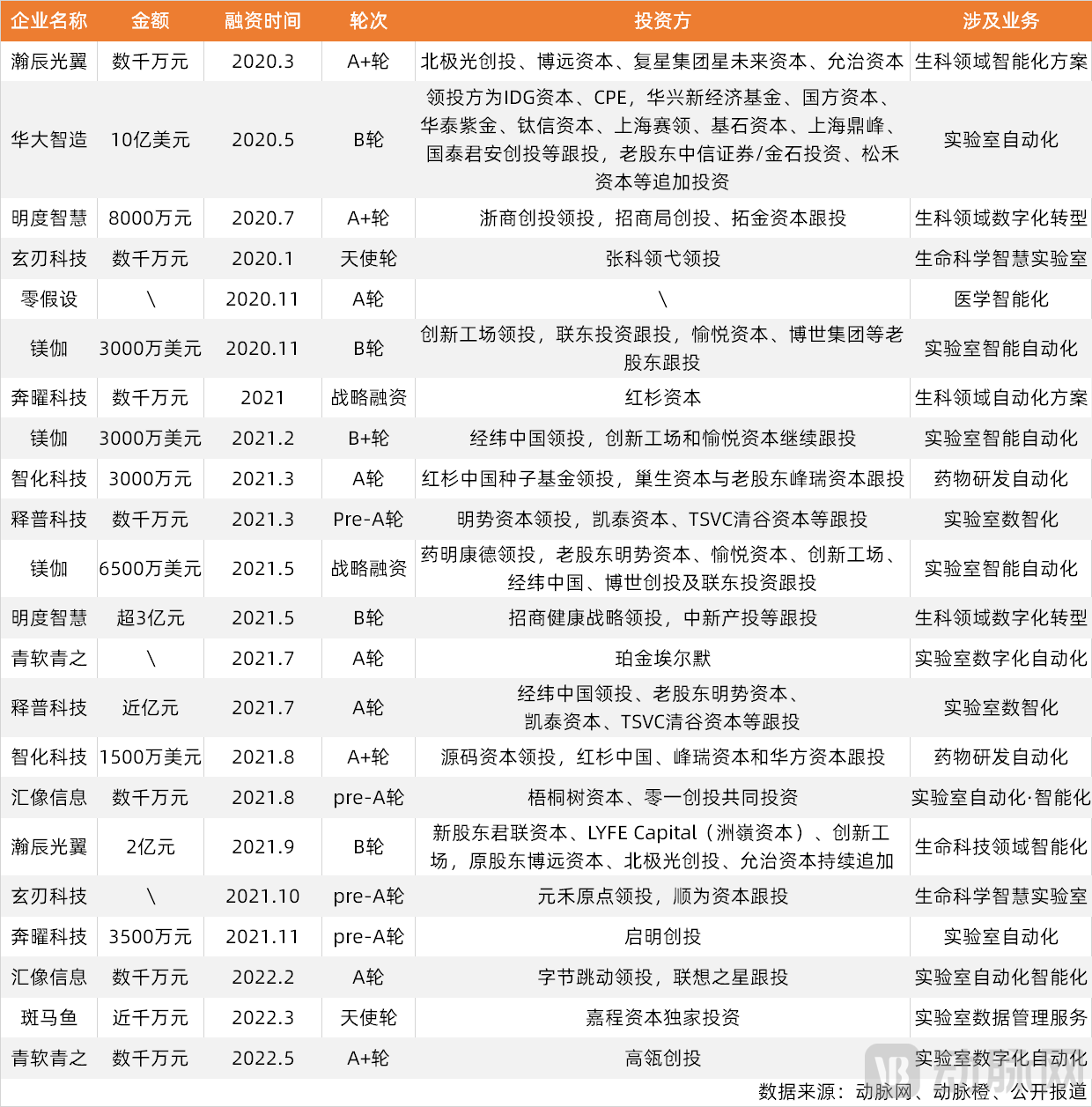
Compared with internet healthcare, artificial intelligence, and other sectors that have raked in tens of billions of yuan annually in a frenzy, investment in smart laboratories has been more rational, yet also more long-term oriented. According to incomplete statistics from VCBeat, there were fewer than 10 public financing events for smart laboratories between their emergence in 2016 and 2019; this number increased to six per year in 2020, and activity became notably more concentrated starting in 2021.
Among the 22 financing events in the smart laboratory sector from 2020 to the present, investors have collectively injected over RMB 2.5 billion. In terms of financing rounds, approximately 63% of these events occurred at Series A or earlier stages. This is primarily because many companies are still in their early development phases, with their business models yet to be fully established. Additionally, the relatively nascent state of China’s smart laboratory market has led some investors to adopt a cautious, exploratory approach.
Notably, 2021 marked a period of heightened activity for smart laboratories, with 13 financing deals closed and total funding amounting to nearly RMB 1.4 billion. Prominent venture capital firms such as Northern Light Venture Capital, Sinovation Ventures, Sequoia China, and Matrix Partners China were actively involved. In early 2022, Hillhouse Investment and ByteDance completed their investments, catching the wave of growth in the smart laboratory sector.
Through statistical analysis of the data, andEnshe Family Office, Jiacheng Capital, Kaitai Capital, Oriza Holdings (ranked in alphabetical order by pinyin of the first character)Based on interviews with investment firms that have a foothold in the smart laboratory sector, we have identified certain realities and trends for discussion.
Agilent, Thermo Fisher Scientific, Roche, and Abbott, among other pharmaceutical and medical device giants, began their laboratory smartification reforms in the early 2000s. Leveraging their accumulated resources and a favorable economic environment, they have now established relatively comprehensive smart laboratory frameworks.
“Although the digitalization and automation of laboratories in China started relatively late, they have developed rapidly. In the early stages, scientific research capabilities were expanded primarily through aggressive procurement of instruments and recruitment of teams. With the continuous emergence of innovative pharmaceutical companies and testing and inspection institutions, along with the gradual improvement of laboratory infrastructure, domestic laboratories have begun to undergo iterative upgrades toward digitalization and intelligence. They are gradually evolving from extensive, unchecked growth to refined, meticulous operations, and transitioning from labor-intensive to knowledge-intensive models,” analyzed Kaitai Capital.
We can explore why smart laboratories have attracted the attention of the capital market in recent years from two perspectives: internal catalysis and external promotion.
Internally, as the scale of experiments expands, numerous obstacles within the laboratory have become increasingly apparent., such as compliance risks in laboratory management, unclear job stability and career development paths for laboratory personnel, non-standardized data management and processing, and issues like uncontrollable processes and low efficiency caused by extensive repetitive manual labor.
Dr. Hu Xiaofang, a partner at Oriza Holdings Healthcare and former professor at the Med-X Research Institute of Shanghai Jiao Tong University, has deep insights into the challenges faced in laboratory settings. She recalls that graduate students must devote considerable time to acquiring and mastering basic experimental skills during their research. Moreover, variations in manual dexterity among students lead to inconsistent experimental efficiency. Additionally, biological experiments involve lengthy protocols, often requiring students to spend more than ten hours a day in the lab. Much of this time is spent waiting for experimental procedures to complete, rather than engaging in hands-on work, resulting in significant inefficiencies and labor intensity.
“From the perspective of the essence of scientific training, research should place greater emphasis on cultivating students’ critical thinking and problem-solving abilities. However, current master’s and doctoral students are often occupied with repetitive experiments, leaving them little time for in-depth reflection. If an intelligent system could automatically perform most basic experimental procedures and generate results based on inputted experimental designs, the efficiency of scientific discovery would be significantly enhanced. Students would then have more time to engage in thoughtful analysis, thereby identifying and addressing further issues through experimentation. I believe similar scenarios exist in fields such as pharmaceutical R&D,” said Dr. Hu Xiaofang.
External Causes, we believe there are the following aspects:
First, shrinking profit margins have spurred demand for automation and digitalization in the healthcare industry.Zhao Jingya, a biotech investor at Jiacheng Capital, analyzed that according to Deloitte’s estimates, the average cost of bringing a new drug to market rose from $1.188 billion in 2010 to $1.981 billion in 2019, while the internal rate of return (IRR) on pharmaceutical R&D declined from 10.1% to 1.8% in 2019. Enhancing R&D efficiency is a critical issue; smart laboratories can, to some extent, improve such efficiency, and intense competition among numerous biopharmaceutical companies has made cost reduction and efficiency improvement an inevitable trend.
Second, digitalization and automation technologies have been successfully validated in other fields.The healthcare industry, which is directly linked to people’s lives and health, tends to be conservative in its exploration of new technologies. Emerging technologies are typically adopted in the medical field only after they have been successfully implemented in industrial, military, and consumer sectors. “Digital technologies—represented by the Internet of Things (IoT), big data, cloud computing, and artificial intelligence—have laid the groundwork for the emergence of smart laboratories. Automation technology addresses how data is generated, while digitalization handles the collection, quantitative description, recording, and analysis of data,” said Li Chenxi, Partner at Enshe Family Office.
Third, supply-side reform drives the industry’s shift from scale to efficiency.While the state proposes a moderate expansion of aggregate demand, it is placing significant emphasis on strengthening supply-side structural reform. The emergence of this new reform objective has also ushered the manufacturing sector into a period of major reshuffling. Industries across the board are beginning to recognize shifts in “supply and demand” dynamics. Entrepreneurs must drive technological innovation to achieve a breakthrough from quantity to quality, while the industry as a whole is transitioning from a focus on scale to one on efficiency.
In addition, there areDownstream volume-based procurement has led to price declines; the normalization of the pandemic has increased demand for nucleic acid testing and in vitro diagnostics; overseas smart laboratory companies such as Benchling have completed large-scale financing rounds, driving up their valuations.driving force.
Smart laboratories represent a major trend in the rapid global development of the biotechnology industry, requiring a long-term growth trajectory. “In China, large-scale entrepreneurship in the biotechnology sector started later than overseas; therefore, the digitalization and intelligent transformation of the industry require greater impetus from industrial forces, including more startups and investors.” According to estimates by Jiacheng Capital, China’s pharmaceutical output value reached RMB 4 trillion in 2020, with R&D expenditures accounting for approximately 20%. If expenditures on data management, laboratory standardization, and intelligent R&D constitute 10% of total R&D spending, the market size for smart laboratories could reach hundreds of billions of yuan.
For investors, what characteristics do promising targets in the smart laboratory sector typically possess?
A Core Team with an Interdisciplinary Background.In any field, talent is the key driving force behind its development. This value is even more pronounced in innovative sectors such as smart laboratories. The laboratory setting is a highly interdisciplinary domain, where the demand for talent extends beyond professional expertise in life sciences, biotechnology, and medicine to include skills in data science, artificial intelligence (AI), and software and hardware engineering.
This requires research talent who truly understand scientists’ workflows and are familiar with laboratory settings. “Such products must originate from the laboratory.” Tools designed for scientists should be developed based on experimental workflows themselves, identifying the challenges researchers encounter during experiments, rather than forcing scientists to “cut their feet to fit the shoes.”
In 2021, Oriza Holdings led a tens-of-millions-of-yuan Pre-A financing round for Xuanren Technology. One of the key reasons for this investment was the professional background of Xuanren’s founding team. He Xueying, founder of Xuanren Technology, previously served as Head of the Robotics R&D Center at ABB Group, a global leader in robotics technology, and brings over ten years of experience in managing international teams and products. Li Gang, former President of ABB Robotics China, serves as the company’s Chief Scientific Advisor. Other core team members also possess many years of experience in service robot product development and backgrounds in biomedicine, enabling them to effectively identify and translate customer needs into solutions.
The founding team’s industry experience enables a thorough understanding of laboratory scenarios. According to Zhao Jingya of Jiacheng Capital, Jia Shuxin, founder of Zebrafish—a portfolio company of Jiacheng Capital—conducted quantitative research in molecular biology experiments and worked in systems biology during his master’s and doctoral studies, accumulating extensive experience in data processing and modeling. Since returning to China, he has been engaged in informatization initiatives within the biopharmaceutical sector, gaining substantial expertise in database modeling and developing a unique understanding of laboratory workflows.
In terms of products, a company’s technical and commercial capabilities are also indispensable.Li Chenxi, a partner at Enshe Family Office, believes that the life sciences sector is vast and demands a high degree of customization. To serve each client effectively, companies must gain an in-depth understanding of their scientific research scenarios and needs, anticipate their concerns, and identify and resolve their pain points. Only in this way can they earn client recognition and secure repeat business.
Different life science laboratory scenarios entail varying operational requirements. The most challenging aspect lies in planning and designing modular equipment that can accommodate customers’ non-standard needs. For instance, different sample types—such as powders, liquids, gels, and solids—require distinct gripping mechanisms, thereby necessitating tailored product solutions.
“InIn terms of products, integrated hardware-software solutions are more popular.“Kaitai Capital stated, ‘Digitalization leans toward software, while automation leans toward hardware; however, we prefer an integrated solution to bridge gaps in data and processes, thereby achieving more synergistic and cohesive collaboration.’”
Only the integration of ELN, LIMS, and laboratory automation constitutes a comprehensive intelligent laboratory super-service. However, due to significant differences in data application and technological backgrounds among these three components, current startups typically enter the market from a single perspective and then engage in ecosystem collaborations to build a robust intelligent laboratory super-service.
In 2021, Kaitai Capital participated in Shipu Technology’s Pre-A+ and Series A financing rounds. Xu Jinzhong, Partner at Kaitai Capital, once shared his expectations for Shipu Technology: “Against the backdrop of the intelligent economy, Shipu leverages technologies such as 5G, the Internet of Things (IoT), and artificial intelligence (AI) to reshape the highly closed-off field of life science laboratories.”
Maintain sufficient focus, delve deeply and thoroughly into a specific domain, and establish competitive barriers.According to Dr. Hu Xiaofang, Partner at Oriza Holdings Healthcare, a high-quality enterprise must maintain focus within a specific niche, thoroughly understand market demands, and continuously enhance its capabilities to improve alignment with those needs. Such companies should also have well-developed long-term plans for product definition and iteration, technological accumulation, commercialization capabilities, and corporate strategy.
“This field is undergoing rapid development. With the advancement of life sciences in China, an increasing number of laboratory platforms and capital investors are turning their attention to smart laboratories, committing funds and resources, thereby creating substantial market growth potential. However, the life sciences sector is highly complex,”“Many issues concerning the technology, products, and talent of smart laboratories remain unresolved, indicating that the sector is still in a relatively early stage.”An investor who has been following smart laboratories for five years said as much.
For instance, in terms of hardware, laboratory workflows are complex and not all steps can be automated at the current stage; moreover, technical control precision is insufficient, and machines require time for calibration and integration. Software and management systems also need customization. How should the industry develop, and in which direction? These questions still require step-by-step exploration by industry participants through practical implementation.
“As an industry matures, cost reduction and efficiency enhancement become inevitable. The shift from relying on labor-intensive approaches to genuinely improving R&D efficiency is a clear trend. Moreover, given the shortage of talent in the biotechnology sector, saving researchers’ time is essential,” said Zhao Jingya, a life sciences investor at Jiacheng Capital. She noted that the development of the smart laboratory sector would be influenced by the broader biotechnology industry.Building scenarios and nurturing users require a prolonged period of gradual penetration to establish a mature business model; otherwise, it is easy to cause resource idleness and misallocation. When the business model is not yet mature, it will be more susceptible to industry cyclical fluctuations.
“The demand for laboratory tools among audiences such as pharmaceutical companies, research institutes, corporate laboratories, government laboratories, and third-party laboratories has yet to be fully explored and addressed. Although there is competition in the market, it is not crowded.” Li Chenxi, Partner at Enshe Family Office, shared two pieces of advice with innovators:First, in the early stages of development, focus on addressing rigid demands, maintain sufficient specialization, develop single-point advantages, adopt an approach of small steps and rapid iteration, and prioritize efficiency. Second, establish and improve mechanisms for talent development and cultivation to ensure a robust talent reserve.
Dr. Hu Xiaofang, Partner at Oriza Holdings Healthcare, noted that entrepreneurs should possess three key capabilities: a profound understanding of the market; comprehensive strategic planning coupled with strong execution capabilities; and the ability to develop advanced, stable underlying technologies.
The most valuable and meaningful aspect of laboratory research lies in critical thinking—specifically, reflection on experimental protocols, results, and post-experiment optimization strategies. In recent years, driven by objective factors such as the pandemic and soaring valuations of comparable overseas companies, domestic demand for laboratory services has been identified and tapped.
Amidst any prevailing trend, “staying true to oneself” may seem like a cliché, but in today’s era of rapidly shifting opportunities, it might well be a subtle yet ironclad rule. Those who continue to work with an eye solely toward “big opportunities and big windfalls” are likely to get hurt. In contrast, those who persist in making steady, incremental progress—“moving forward one pawn at a time”—may ultimately fare better.
Special Thanks
Partner, Enshe Family Office | Li Chenxi
Jiacheng Capital Biotech Investor | Zhao Jingya
Kaitai Capital
Oriza Holdings Healthcare Partner | Hu Xiaofang
as well as numerous unnamed industry veterans
(Ranked in alphabetical order by Pinyin of the first character)
Further Reading:
200,000 Scientists Power a Healthcare Unicorn Valued at $6 Billion