

JD Health Enters Real-World Research with Launch of RWD Platform to Empower Scientific Innovation

JD Health
Internet Medical and Health Service Platform Provider
Real-World Study (RWS) Gains Momentum with New Entrant! In May 2022, JD Health announced its formal entry into the RWS sector and launched the operation of its Real-World Data (RWD) platform.
Leveraging its accumulated capabilities in the healthcare sector in recent years, JD Health’s Real-World Data (RWD) Platform delivers Real-World Study (RWS) solutions via a Software-as-a-Service (SaaS) model to researchers at medical institutions, academic societies, physicians, and enterprises. Through this platform, researchers can collect multi-source data from both in-hospital and out-of-hospital settings, perform in-depth processing and analysis, and generate clinical evidence on the utilization patterns or potential benefits of medical products, thereby facilitating medical research and exploring new models of patient management.
Previously, various industry players, including CROs, big data firms, and artificial intelligence companies, have been serving the field of Real-World Studies (RWS). Leveraging their respective strengths, these entities have delivered unique value in key stages such as RWS study design, data mining and cleaning, and data analysis, with extensive exploration conducted particularly in the area of in-hospital data mining.
While JD Health is deploying real-world studies (RWS) through its self-developed products, other major internet healthcare platforms are also engaging in RWS-related collaborations or building relevant capabilities. Among enterprises that had previously entered the RWS space, such as LinkDoc Technology and Zenith Medical, internet healthcare services have been established to facilitate doctor-patient communication and patient management. There is an increasingly high degree of alignment between internet healthcare and RWS.
Why Is Internet Healthcare Capable of Venturing into RWS? What Specific Value Can JD Health Deliver to RWS? VCBeat Conducted an Exclusive Interview with Jin Fangyi, General Manager of the Hospital Cooperation Department at JD Health, and Cheng Long, Deputy General Manager, to Analyze the Service Functions of JD Health’s RWD Platform and Interpret the New Role in the RWS Industry.
As the data foundation for conducting real-world studies (RWS), real-world data (RWD) refers to various types of data collected in routine practice related to patients’ health status, diagnosis and treatment, and healthcare, with a wide range of sources.
According to the National Medical Products Administration’s 2021 “Guiding Principles for Real-World Data to Generate Real-World Evidence (Trial)”, real-world data (RWD) primarily originates from ten major sources, including hospital information systems, medical insurance payment data, and registry study data, with each type of data possessing its specific research value.
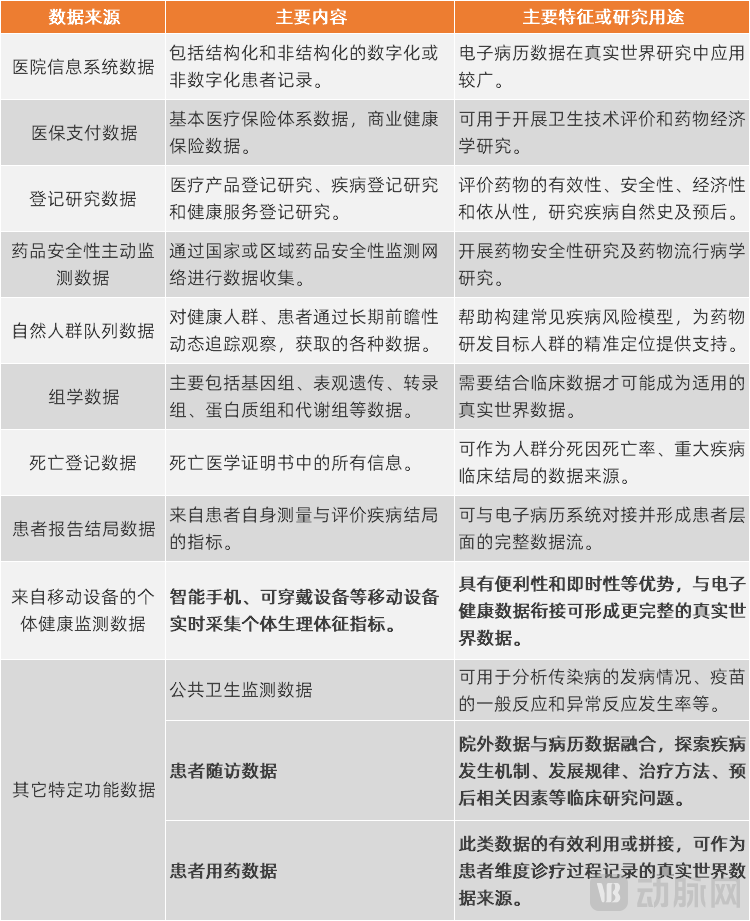
Major Sources of Real-World Data (**bolded items represent data that can be accumulated through internet healthcare**)
Source: "Guiding Principles for Real-World Data to Generate Real-World Evidence (Trial)"
Among the ten major data categories, hospital information system (HIS) data has been accumulated on a large scale during the process of medical informatization. With its rich variety, this data encompasses patient demographics, clinical characteristics, diagnoses, treatments, laboratory tests, safety profiles, and clinical outcomes. Consequently, it is widely used in real-world studies (RWS) and serves as the most fundamental data source for such research. Many artificial intelligence and big data companies are already exploring the value extraction from these datasets, providing solutions to address challenges such as data dispersion, multi-source heterogeneity, and missing data, while offering intelligent tools to facilitate their efficient application in RWS.
RWS should be built on a foundation of authentic, reliable, and comprehensive data. Although in-hospital data constitute the core of RWD, they do not capture the full course of disease progression. Out-of-hospital information, such as survival status, medication usage, and adverse events, requires observation and data completion through follow-up management and other methods.
Therefore, out-of-hospital data generated from smart hardware, follow-up visits, and medication use are also included among the ten major data sources in the Guiding Principles for Real-World Data to Generate Real-World Evidence (Trial), which emphasizes the value of these data to the completeness of RWD.
However, both the accumulation and the mining and application of out-of-hospital data still fall far short of those of in-hospital data.
Institutions such as the Institute of Clinical Basic Medicine for Traditional Chinese Medicine, China Academy of Chinese Medical Sciences, analyzed hotspots in domestic Real-World Studies (RWS). They found that over the ten years leading up to September 2021, data sources for RWS primarily included Hospital Information Systems (HIS), Electronic Medical Records (EMR), case registration platforms, medical insurance databases, and national population databases. Research hotspots were concentrated on areas such as HIS data mining and analysis.
“Researchers are deeply troubled by the lack of out-of-hospital data.” Jin Fangyi mentioned that this is also one of the reasons why JD Health decided to develop its RWD platform.
It is understood that the newly launched RWD platform is built upon JD Health’s business layout, covering the entire medical process from prevention, screening, diagnosis, and treatment to rehabilitation.
“For example, patient self-reported data collected by the JD Health questionnaire and scale middleware, health monitoring data generated by smart wearable devices, clinical diagnosis and treatment data accumulated by internet hospitals, medication and follow-up data gathered by JD Pharmacy and the Patient Care Center, comprehensive multi-dimensional medical and health data recorded by JD Family Doctor starting from users’ health status, and various laboratory and diagnostic test data linked through consumer healthcare,” introduced Cheng Long.
The aforementioned diverse data sources not only underscore the value of internet healthcare for Real-World Studies (RWS) but also highlight the unique advantages of JD Health’s Real-World Data (RWD) platform. For instance, the JD Health Internet Hospital platform handles over 190,000 daily online consultations, generating a substantial volume of clinical data. Leveraging its strength in pharmaceutical supply chains, JD Health has further enhanced professional user services by launching Patient Care Centers through JD Pharmacy to provide patient management and follow-up services. By the end of 2021, 12 such centers had been established, covering more than 24 disease types. In addition to continuously expanding service resources and diversifying service models, JD Family Doctor is extending its reach into broader scenarios: smart devices equipped with JD Family Doctor services have been deployed on select high-speed rail trains, offering travelers health and medical guidance.
Overall, the out-of-hospital data accumulated by JD Health is not only diverse in type but also substantial in volume. These data are encrypted and stored through JD Health’s data security management system, and can be used for real-world studies (RWS) only after patient information has been de-identified.
Internet healthcare connects multiple stakeholders, including healthcare providers, patients, pharmaceutical companies, and insurers. With industry development, it is continuously accumulating out-of-hospital data. For internet healthcare platforms with diverse service offerings and high service volumes, they are better positioned to provide varied data sources for Real-World Studies (RWS).
The richness of out-of-hospital data is crucial for Real-World Studies (RWS), and data quality cannot be overlooked. Follow-up management is a key method for collecting out-of-hospital data, and factors such as follow-up completion rate, completeness, and accuracy of data collection will all impact data quality.
Due to the lack of face-to-face medical intervention outside the hospital, there is significant uncertainty in data collection.
First, patient engagement in follow-up remains uncertain. Follow-up visits consume patients’ time and energy; if they do not provide benefits beyond disease treatment and rehabilitation, patient motivation will be compromised, potentially resulting in failure to complete data collection at the designated timepoints as required.
Second, even if patients are willing to comply with follow-up, they may miss appointments or fail to provide feedback due to the frequent or complex nature of the required actions, leading to data gaps caused by excessive time commitment, inability to persist, or forgetfulness.
Issues such as patient loss to follow-up and incomplete data have led to deficiencies in data quality, undermining the utility of data in research and significantly diminishing the value of real-world studies (RWS).
“Patient attrition and loss to follow-up, which make it difficult to contribute the quantity and quality of data expected in the study design, are also common problems faced by researchers.” Cheng Long mentioned that RWS solutions need to focus on solving this problem.
At the level of internet medical services, JD Health has established mature diagnostic and treatment tools that assist physicians in managing and following up with patients across multiple dimensions. By integrating various online tools such as health value assessments and incentives for follow-up questionnaire completion, JD Health enhances patient adherence.
Drawing on this approach, JD Health’s RWD platform has established a series of incentive mechanisms: patients receive corresponding rewards upon completing scale assessments and symptom reports at designated milestones during the study. Meanwhile, the platform leverages smart devices to automatically collect data wherever possible, replacing manual patient input to minimize missed or omitted entries.
“These operational models have already been implemented in practice and have yielded positive results.” Cheng Long cited the example of JD Health’s involvement in operating a psychological intervention platform for post-COVID-19 patients in Hubei Province. To address the issue of suboptimal patient data collection, various operational strategies were adopted. “The study required patients to engage in daily outdoor exercise, necessitating the collection of daily step counts and activity levels. We used smart devices to automatically capture this data in real time, replacing manual entry by patients. The devices are connected to the internet hospital, requiring no action from the patients. For those reluctant to undergo physician follow-ups or interviews, we established a comprehensive benefits system: completing key milestone activities or phased tasks could earn them practical small gifts, or even benefits within the JD ecosystem.” Cheng Long stated that the platform has been operating efficiently since its establishment in 2020.
Currently, most internet healthcare platforms have launched service packages for chronic disease management and single-disease management. In addition to providing guidance when patients need it, these platforms can also deliver regular and quantified interventions, which aligns closely with the data collection patterns of Real-World Study (RWS) follow-ups. User operations are a strength of internet healthcare platforms; during patient management, they can fully leverage technical tools and operational capabilities to enhance patient engagement and meet the requirements of RWS follow-up.
RWS typically covers a broad population, involves large sample sizes, features long follow-up periods, and spans extended project cycles, leading to prohibitively high implementation costs. RWD is fragmented, creating information silos of varying degrees both within and outside healthcare institutions, which constitutes another urgent challenge for RWS to address.
JD Health’s RWD Platform primarily reduces costs for researchers by opening up its data resources and technical capabilities. Since its inception, the platform has prioritized the development of disease-specific field sets and disease-specific databases. It builds disease-specific field sets based on universal field sets to meet diverse research needs and supports customized disease-specific models.
Currently, the platform has planned approximately 100 specialized disease databases across 12 disciplines, including cardiology, gastroenterology, otolaryngology, obstetrics and gynecology, and psychiatry and psychology, which will be made available to researchers in multiple fields in the future.
Meanwhile, the JD Health RWD platform features intelligent online follow-up capabilities. By integrating with the online follow-up functions of the JD Health Internet Hospital and leveraging various technological means, it provides tool support for research follow-up projects, including intelligent patient identification and stratification, convenient online doctor-patient consultations, and intelligent telephone follow-ups.
Leveraging these tools, the JD Health Real-World Data (RWD) Platform integrates in-hospital and out-of-hospital data, combining electronic medical records, research follow-up records, and home device data generated during patients’ interactions with JD Health’s medical and healthcare services to form comprehensive RWD. This provides physicians with holistic decision support for both research and clinical practice, enhances the efficiency of clinical data management, and reduces the costs associated with conducting research.
It is worth noting that for unstructured data collected both within and outside the hospital, the RWD platform can leverage the JD Health Knowledge Graph to perform semantic recognition, clustering, and classification through natural language processing techniques, thereby achieving data structuring and standardization.
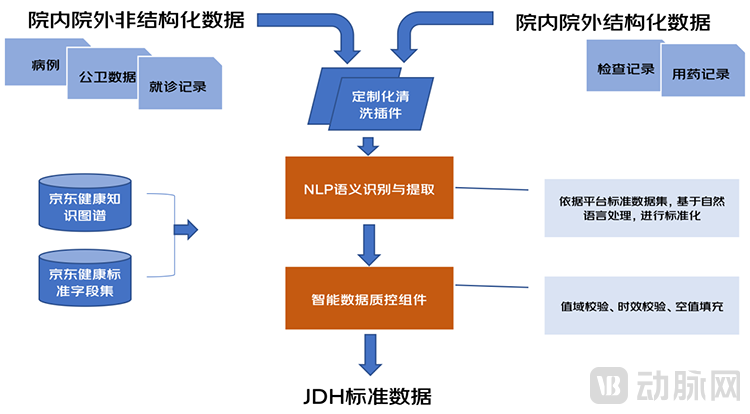
JD Health RWD Platform: Data Processing Workflow for Multi-Source Data
Researchers from Henan University of Chinese Medicine have investigated the challenges associated with follow-up in Real-World Studies (RWS) and proposed that the establishment of an open big data cloud platform for follow-up represents the future trend of informatization. By effectively organizing and managing follow-up activities, the efficiency of RWS follow-up can be significantly improved, thereby reducing costs related to manpower, material resources, time, and funding.
Internet healthcare inherently possesses the characteristics of transcending geographical barriers, enhancing efficiency, and reducing costs. Platform-based companies further exhibit openness. RWD platforms, leveraging these features, align well with the aforementioned trends.
In enriching RWS data sources, enhancing patient engagement, and helping researchers reduce costs and improve efficiency, internet healthcare is becoming an important industrial player in the RWS field.
In its *2021 Real-World Study Report*, VCBeat’s VBInsight analyzed that companies involved in real-world study (RWS) services mainly fall into five categories: clinical CROs, artificial intelligence firms, big data enterprises, physician platforms, and genetic testing companies.
When entering the RWS field, these industry players have each leveraged their core strengths, whether in study protocol design experience, data governance and analytics capabilities, efficient execution teams, or specific data assets and application scenarios. These advantages manifest at different stages of the research process.
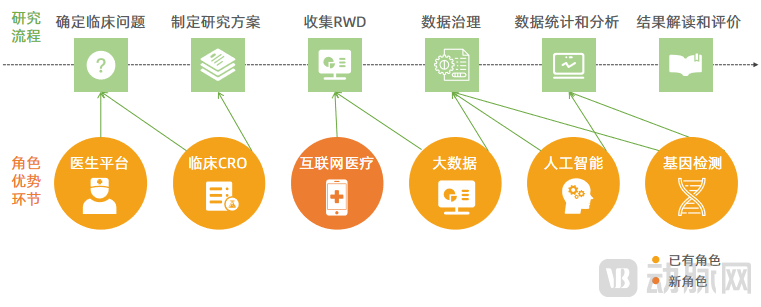
Key Industry Players in RWS Services and Their Core Strengths, Chart by VCBeat Eggshell Research Institute
Based on the preceding analysis of the value proposition of JD Health’s Real-World Data (RWD) platform, internet healthcare platforms have emerged as new industry players in the field of Real-World Studies (RWS). They primarily contribute to RWD collection, data governance, and statistical analysis, with their competitive advantage lying in the collection and mining of out-of-hospital data.
Currently, real-world studies (RWS) in China are still in their nascent stage, with limitations in research methodologies and scope. What new changes will the integration of internet healthcare as an industry player bring to the field of RWS?
Jin Fangyi believes that the threshold for conducting research has been lowered. “Previously, real-world studies (RWS) often required large enterprises and leading experts to devote substantial resources for implementation. RWS services based on internet healthcare platforms can reduce research costs, enabling more researchers interested in conducting RWS to participate, thereby yielding a greater number of high-quality scientific outcomes.”
Secondly, research directions have seen new expansions. Leveraging the advantages of internet healthcare in accumulating out-of-hospital data, real-world data (RWD) has expanded from the diagnosis and treatment stages to cover the entire process of prevention, screening, diagnosis, treatment, and rehabilitation, extending from within hospitals to both pre-hospital and post-hospital settings, thereby achieving greater completeness. Studies on out-of-hospital data can observe the benefits of various management and self-management strategies for patients after discharge; while integrated studies combining in-hospital and out-of-hospital data can better explore clinical issues such as disease mechanisms, progression patterns, treatment methods, and prognostic factors.
Furthermore, VCBeat has learned that RWS research hotspots in China have previously focused on the application of HIS data mining, often employing retrospective studies. However, the practical value of internet healthcare in the follow-up process has enabled RWS to increasingly adopt prospective studies and acquire higher-quality research data.
Overall, the integration of internet healthcare will broaden the research methodologies, content, and participant pools of Real-World Studies (RWS), thereby expanding their value proposition. Admittedly, significant challenges remain across the entire lifecycle of Real-World Data (RWD)—from collection, governance, and management to analysis. Nevertheless, we are confident that internet healthcare will synergize with other industry stakeholders, leveraging respective strengths to advance the overall development of RWS.