Digital Transformation as the Key to Breakthrough in the Next Half of China's Domestic Medical Device Industry
On May 31, the National Medical Products Administration held a report meeting to mark the first anniversary of the implementation of the Regulations on the Supervision and Administration of Medical Devices, with “innovative development and high-quality development of the industry” being frequently mentioned during the event.
In recent years, driven by both national policies and downstream demand, the overall market size of medical devices has continued to expand, with the industry gradually presenting two major new opportunities: global market expansion and “domestic substitution.”
Over the next decade, import substitution will be the dominant theme. In this process, companies with strong R&D and sales capabilities, high value-added products, differentiated product portfolios, and robust terminal service capabilities will hold a competitive advantage. With continuous breakthroughs in China’s medical device industry, increased government investment in the health sector, the emergence of new technologies such as 5G, AI, and 3D printing, the cross-industry entry of well-known internet and technology companies, and the drive from “Internet + Healthcare” and precision medicine, the medical device industry is ushering in a new competitive landscape that drives technological innovation and promotes industry transformation and development.
Meanwhile, although China’s medical device industry has achieved significant progress in import substitution and transitioning toward high-value-added products, the sector has entered a phase of intense consolidation. Companies are facing more rigorous market selection: medical device firms with substantial technological reserves and strong innovation capabilities are poised to further expand their market share, while those with weak innovation capacity and excess production capacity face the risk of elimination.The domestic medical device industry has entered the second half of its development, characterized by refined operations and enhanced quality.
However, medical device companies are mostly labor-intensive enterprises with relatively simple and extensive production management models. They rely heavily on personnel managing raw material procurement, production, and logistics, resulting in low efficiency and significant waste due to waiting. Although most manufacturers have established quality management systems, lax oversight in areas such as production processes and product warehousing leads to loopholes in production management. This undermines the effective assurance of product safety and efficacy, as well as robust quality traceability. Under such circumstances, how can refined and high-quality management be achieved?
Faced with rising costs, lack of product competitiveness, the monopoly of foreign enterprises on high-end medical devices, and the continuous emergence of cross-industry competitors, domestic medical device manufacturers must change their business models and mindset to break through. They need to apply new technologies and enterprise management concepts, reshape their business and operational models, strengthen the construction of their own hardware and software facilities, continuously innovate, optimize resource allocation, reconstruct the industrial and value chains, and maintain vitality and competitiveness in market competition.
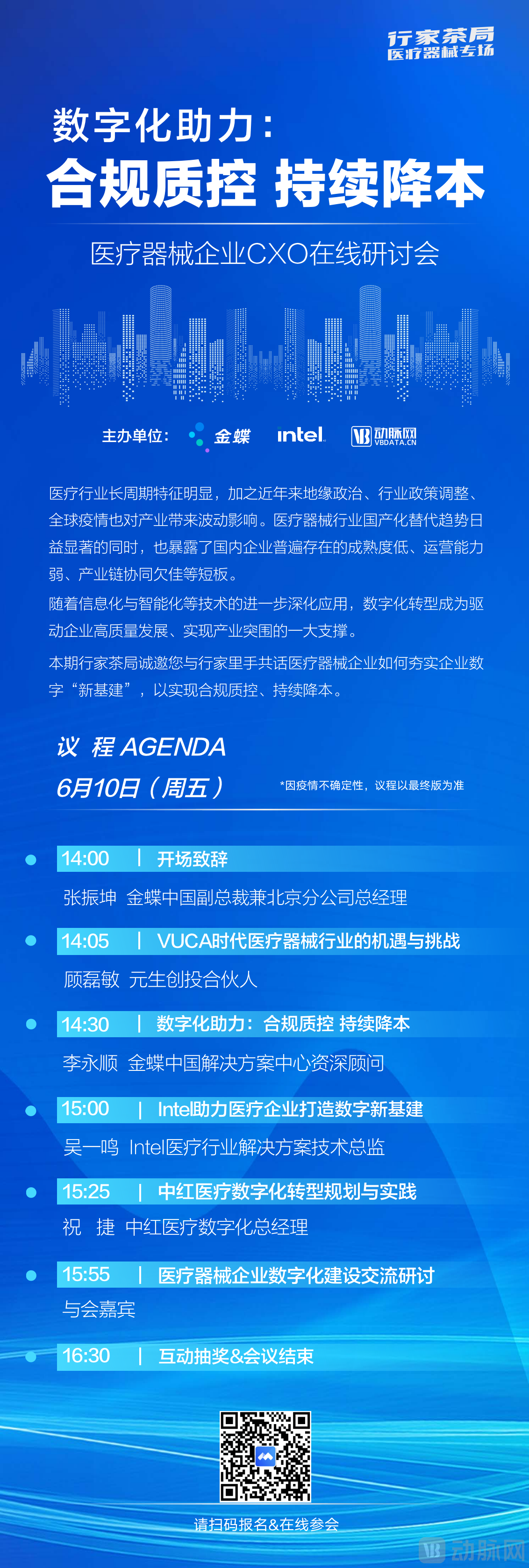
On June 10, Kingdee, Intel, and VCBeat will jointly host“Digital Empowerment: Compliance Quality Control and Continuous Cost Reduction” Online Webinar for CXOs of Medical Device Companies,We will engage in discussions with capital partners, digital service providers, and industry stakeholders to explore how medical device enterprises can advance their digital transformation across multiple dimensions—including intelligent production control, quality and risk management with traceability, and financial and cost control—ultimately driving business innovation and supporting rapid, profitable growth.
As a leading provider of digital management solutions in the Asia-Pacific region, Kingdee has observed that most industry-leading medical device companies place particular emphasis on the following aspects during their digital transformation:
1. Enhancing Rapid Response Capabilities: As the foundation of the health industry, medical devices play a critical supporting role in public health emergencies. Enterprises must establish rapid response mechanisms to flexibly address sudden surges in demand, capacity shortages, and other challenges arising from various unexpected events.
2. Enhancing Supply Chain Efficiency and Stability: Uncertainty in the supply chain can undermine the overall operational efficiency of medical device companies, drive up operating costs, and pose risks to business operations. There is an urgent need for medical device enterprises to achieve information interoperability and data sharing across all segments of the supply chain, enabling seamless integration and efficient collaboration among upstream, midstream, and downstream players. This will enhance the performance of the industrial chain, reduce total supply chain costs, maintain supply chain stability, and build long-term resilience against risks.
3. Refined Production and Operations Management: With the continuous development of the health industry and the successive introduction of incentive policies, eliminating non-value-added activities in the production process, enhancing production operational efficiency and quality, and increasing product added value are important means to build the core competitiveness of medical device manufacturers. Medical device companies need to achieve visualized and transparent control and audit of production operations through refined operational management.
4. Enhance Quality Traceability Capabilities: As medical devices are closely linked to life safety, manufacturers must establish rigorous production processes and quality control capabilities, implement a comprehensive product quality traceability system, ensure safety, and comply with industry quality management standards.
Currently, China’s medical device industry is in a transitional phase, moving from the low-to-mid end to the mid-to-high end of the value chain. The technical barriers of domestically produced products are not yet sufficient to serve as a decisive competitive advantage, whereas mature operational and commercial capabilities remain the enduring cornerstone of success in the business world. Digitalization may merely be a means to an end; compliance, quality control, and continuous cost reduction are the key strategies for breaking through in the next stage of industry development.