Tech + Talent = Success? What Else Do Scientist-Entrepreneurs Really Need?
In the current era, scientists and venture capitalists may both need an outlet.
This is because scientists need a channel to connect with venture capital (VC) firms as they move toward commercialization, while VCs, in extending their investment reach into research universities and institutes, require an effective mechanism to identify early-stage projects with genuine market potential.
Such demands are highly specific and urgent in the current healthcare sector. According to statistics from VCBeat’s Chengguo Bureau, a total of ... occurred in China’s healthcare field from January to May 2022.97 casesEarly-stage (Seed, Angel, Pre-Series A) Financing Events: Total Financing AmountOver RMB 6 billion. It is worth noting that over 90% of these early-stage projects originated from research institutions and universities.
Such fervor is unparalleled, yet entirely justified.On the one hand, from the perspective of the innovation-driven production side, in recent years, research institutes have vigorously encouraged a segment of scientists to embark on entrepreneurial ventures and have created a favorable environment for such endeavors, which has, to some extent, prompted a number of scientists to step out of their laboratories.
On the other hand, from the perspective of innovation incubation, investment institutions are “frantically” flocking to the early-stage healthcare market. According to statistics from VCBeat’s Orange Fruit Bureau, among the 97 early-stage financing and investment deals completed from January to May 2022, a total ofOver 150 Investment InstitutionsInvestment participation, mainly includingSequoia, Matrix Partners, Legend Capital, Bohe Angel, Innovation Works, Vensource Capitaland other well-known investment institutions.
Among them, Sequoia Capital demonstrated the most proactive stance, completing nine early-stage financing rounds in the healthcare sector during the first five months, fully showcasing its keen market insight and strong execution capabilities in the early-stage market.
Nevertheless, in the current early-stage healthcare market,"Channel"It remains a core topic. On one hand, scientists, having long operated within the closed ecosystem of research institutions and universities, struggle to access precise and high-quality market resources. Consequently, the commercialization process is often slow, and projects may ultimately fail to be translated into marketable products due to missed optimal timing. Such regrets are not uncommon.
On the other hand, for investors, when it comes to "scientists starting businesses,"Transitioning from “reluctant to invest” to “scrambling to invest”. This is because, in the current healthcare sector, the timeline for companies to go public has been significantly compressed compared to the past, which has also accelerated the overall pace of the primary market. High-quality startups can even complete two to three rounds of financing within a single year. Such “high efficiency” was previously unimaginable.
However, while this “fast-paced” approach enables investment institutions to quickly secure returns, it is also subtly imposing new demands on them, namelyAs the IPO process is drastically compressed, investment boundaries become increasingly blurred. Investment institutions that previously focused solely on mid-to-late stages find it difficult to identify suitable entry points at the “middle” stage; consequently, they must shift their focus to the earliest-stage projects, nurturing them from “zero.”
However, how to cultivate from "zero" is a major challenge facing current investment institutions, and within this,The primary challenge is how to reach scientists.
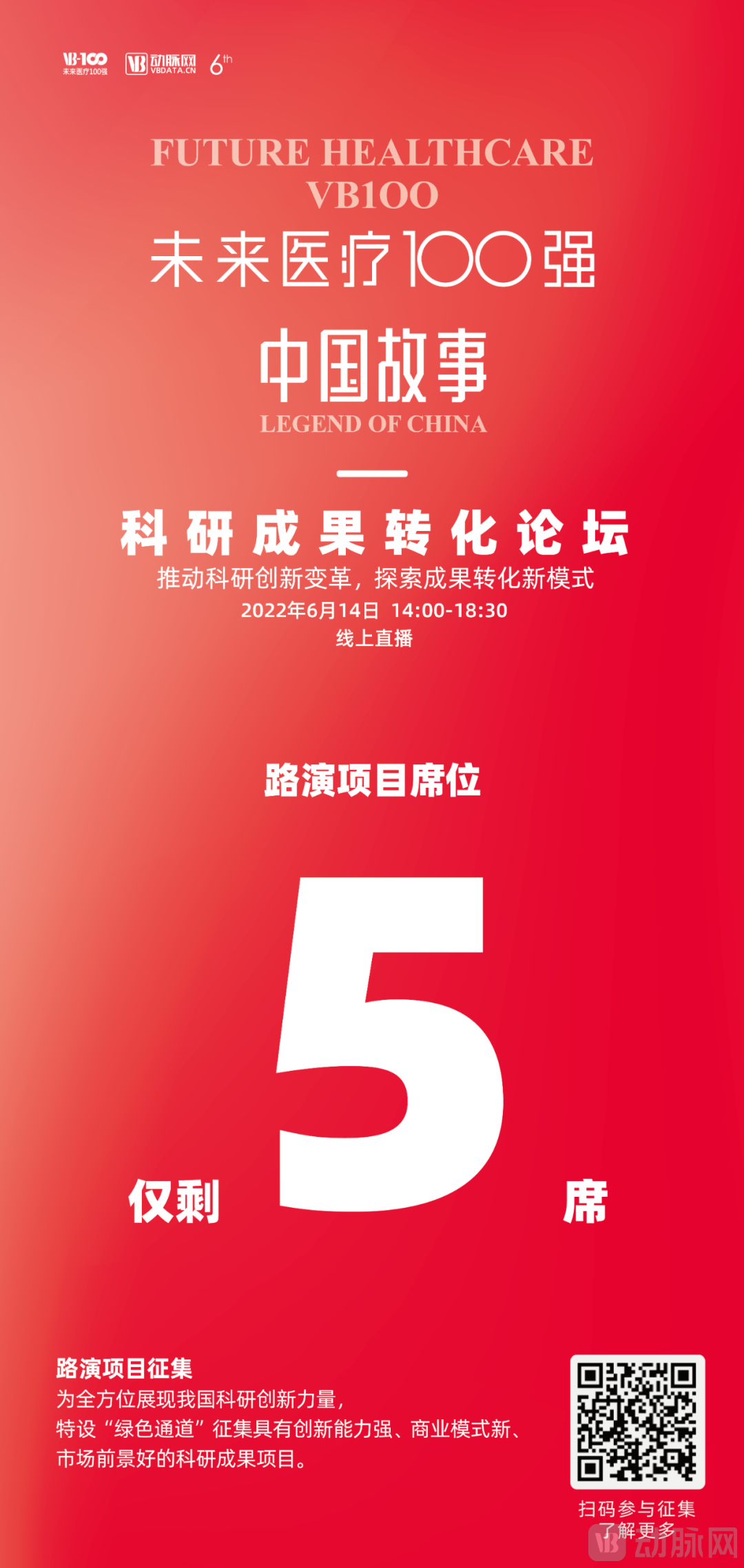
Therefore, at the 6th Future Healthcare Top 100 Conference“Forum on the Translation of Scientific and Technological Achievements”The event invited multiple industry experts to address the core challenges currently facing medical innovation and translation from the perspective of driving industrial transformation, offering insights from diverse standpoints and roles. Additionally, a project pitch session was specially established. Based on key criteria such as technological innovation capability, market potential, and founding teams, ten cutting-edge innovative projects were selected from research institutions and universities across China. Through “presentations + Q&A,” the session aims to build a bridge between the scientific research community and the industry, while also providing precise incubation services for early-stage startups.
Conference Agenda and Speakers

Call for Roadshow Projects
● Submission Period: From today until June 8
● Project Area: Primarily soliciting projects in the healthcare and wellness sector, with a focus on digital health, biopharmaceuticals, and innovative medical devices.
● Project Phase: Seed round, angel round, Pre-A round, and Series A startups
● Registration Requirements: 1. Legally established and compliant in operations; 2. Founders have a scientific research background; 3. The project demonstrates innovation in business model, product, technology, etc.; 4. Business plan (BP) documents must be uploaded
● Roadshow Schedule: Project Presentation 10 Minutes + Q&A 5 Minutes
● Registration Poster: