

Jiabao KangLe Files IPO Prospectus: A Pioneer in Child Growth Management with 90%+ Repurchase Rate via Private Domain and S2B2C Model
Qin Peng believes that with the emergence of various business models, classifying enterprises by industry is a thing of the past; it is now trendy to classify them by customer segments.
In 2017, Qin Peng founded Jiabao Kangle, which has been focused on the pediatric market in recent years. It started as a pediatric clinic, later evolving into child growth management services. Initially operating on a B2C model, it has now transitioned to an S2B2C model. Qin Peng has been on this path for five years, or even longer, dating back to before the establishment of Jiabao Kangle.
Expanding into Offline Healthcare: Entering the Chain Pediatric Outpatient Clinic Sector
Born, raised, educated, and employed in Singapore, Qin Peng returned to China in 2015 at the invitation of a former university classmate to co-found “Mingyi Zhudao,” an internet healthcare platform. This marked his first formal foray into the medical sector, and by the following year, Mingyi Zhudao had achieved a valuation of RMB 1.5 billion.

Qin Peng, Founder of Jiabao Kangle
“During my involvement in internet-based healthcare, I realized that healthcare is an industry requiring offline support; relying solely on an online platform would make future development very difficult.” In 2016, Qin Peng began exploring offline healthcare services. This coincided with the State Council’s release of policies to promote privately run medical institutions, sparking a wave of clinic openings across society.
Since the plan is to operate offline, which sector should be chosen? Qin Peng believes that healthcare is merely a broad framework, under which different medical specialties follow distinct business logics, with significant nuances involved.
Qin Peng first ruled out treatments for acute conditions, major diseases, and rare diseases, as these fields have high entry barriers, require cutting-edge technology, and are generally concentrated in Grade A tertiary hospitals. What remained were consumer healthcare services, such as dentistry, medical aesthetics, and pediatric health.
Among these, children's health is a particularly unique sector. There is a disconnect between the purchaser and the user: parents pay the bill, while children are the end users. Therefore, to succeed in the pediatric market, companies must not only understand children’s needs but also accurately gauge parental preferences. In 2017, as the post-90s generation began becoming parents, this cohort showed a tendency toward refined parenting. Their expectations for their children’s healthy growth went beyond merely “avoiding illness and injections”; they increasingly hoped their children would thrive physically and develop greater cognitive abilities.
Parents and children constitute another group with naturally extensive social networks; they spontaneously recommend products that work well, thereby influencing other parents. Once users develop trust in a brand, such trust is not easily transferred to competitors and can readily drive consumption in other scenarios. This operational approach was later termed “private-domain operations” in evolving business models, although it was referred to as “brand barriers” at the time.
In 2017, Jiabao Kangle launched its pediatric clinics in Kunming, Qingdao, Guiyang, and other cities. In 2019, the company secured two rounds of financing and opened six clinics across China. If this trend continues, it should not be difficult for Jiabao Kangle to successfully validate its offline business model.
Standardization of Pediatric Health Checkups: Leveraging Post-Pandemic Momentum to Transition to the S2B2C Model
However, in 2020, the “black swan” event of the pandemic struck. According to data from DXY’s *Report on the Development of Primary Care Clinics in China in the Post-Pandemic Era*, 93% of clinics suspended operations due to pandemic-related lockdowns in 2020, and 80% of pediatric clinics experienced a decline in outpatient visits after resuming operations.
As the saying goes, “A tree dies if moved, but a person thrives with change; adversity breeds innovation.” In the post-pandemic era, Qin Peng decided to transition his offline services to an online service and e-commerce model through private-domain operations. From a business model perspective, this upgrade represents a shift from B2C to S2B2C; from a product type perspective, it marks an evolution from offline medical services to digital products—specifically, a medical-grade child growth management system.
“It’s not accurate to say that the pandemic changed Jiabao Kangle’s business direction; we merely accelerated initiatives we had long intended to pursue but had not yet implemented. Without the pandemic, this upgrade might have occurred two or three years down the line.” In retrospect, it becomes evident that the shifts in both our services and business model were traceable and followed a logical trajectory.
Before the pandemic, Jiabao Kangle Clinic operated primarily in a physician-driven manner, with doctors determining which examinations children and their parents would undergo upon visiting. Qin Peng, however, believed that medical services should be commercialized, a process requiring standardization and productization along the way.
How Can Medical Services Be Standardized? Qin Peng drew inspiration from physical examination centers: “Adult check-up centers have already adopted standardized packages. Could child healthcare be integrated with pediatric examinations?” After experimenting, Jiabao Kangle discovered that the two not only could be combined but also worked exceptionally well together. New-generation parents’ expectations for pediatric check-ups are no longer limited to routine items such as height, weight, and visual acuity; they also want to understand their children’s cognitive and behavioral development.
Even in the era of offline outpatient clinics, Jiabao Kangle launched services such as child growth assessment and cognitive-behavioral development assessment. Initially, Jiabao Kangle offered only physical examinations and assessments; for subsequent child capability enhancement and corrective interventions, parents had to seek services from other institutions. This gave rise to a new parental demand: “Can Jiabao Kangle provide one-stop solutions?” In response to market needs, Jiabao Kangle evolved from merely identifying issues to both identifying and resolving them. It segmented pediatric healthcare into distinct modules, including height management, capability enhancement, and health management, providing tailored health management recommendations for different concerns.
Post-pandemic, the offline outpatient service model was upgraded and consolidated into a medical-grade child growth management system. This system is specifically categorized into ability enhancement, height management, attention training (for dyslexia), gait management, and gut microbiota management, marking the realization of productization.
Reaching this point, Qin Peng realized that traditional pediatric clinics could no longer define Jiabao Kangle, which now boasted a comprehensive suite of digital products. “Since this system has become highly standardized, can we expand beyond our own clinics?” Qin Peng had a new idea.
Assessment System + Operations System + Testing Equipment: Low-Cost New Business Operations for B-End Clients
The target user base for child growth management is much broader than that of traditional pediatric outpatient clinics, with potential for integration wherever children are present.
Qin Peng’s first thought was childcare institutions. Firstly, the target customer base for childcare and child growth management overlaps significantly. Secondly, in 2021, the National Development and Reform Commission (NDRC), together with 22 other departments, issued a policy document supporting the development of affordable childcare services, indicating that childcare institutions will experience rapid growth in the coming years. He initially launched pilot programs at two childcare institutions in Shenzhen, where the institutions provided the premises and client base, while Jiabao Kangle supplied its child growth management system, with both parties jointly serving the users.
After a period of time, both parties achieved win-win cooperation, and Qin Peng realized that the S2B2C model would be the new direction for development.
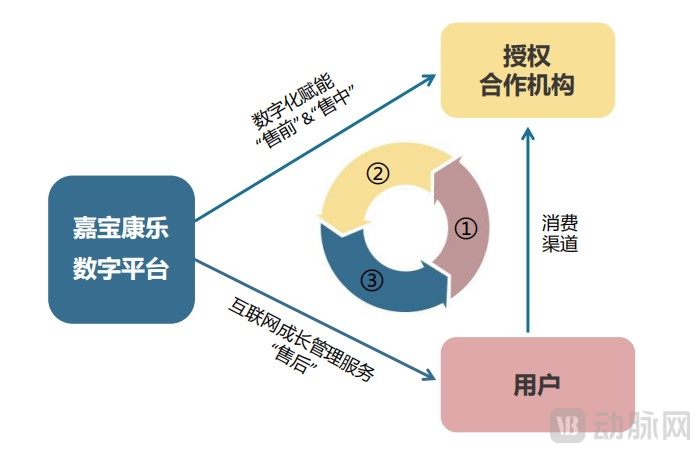
Jiabao Kangle and its authorized partner institutions jointly serve users
The S2B2C model differs from the traditional “franchise store” model. It refers to a collaborative approach where the S (supply chain) platform and B-side partners jointly serve end users. If each partner institution were staffed with professional physicians, the operational costs for the B-side would rise significantly. Therefore, a critical step in implementing the S2B2C model is the “de-physicianization” of medical services.
“De-doctorization” does not literally mean eliminating physician services; rather, it signifies that while high-quality physicians are not scalable, well-developed health IT tools are.
Jiabao Kangle’s computer team has developed a child growth and development assessment system and an operations system, which are provided to B-side users on demand alongside Jiabao Kangle’s testing equipment, enabling easy adoption and use by B-side users.
The operational system comprises the Jiabao Cloud SaaS platform, which serves as the primary hub for operations. It integrates all other Jiabao Kangle systems and is primarily used for medical and store operation management. Additional components include a CRM customer management system, an online consultation platform, consumer-facing mini-programs, and a recently developed project operation and marketing management system. All these systems are connected to Jiabao Cloud, enabling seamless interoperability between each pair of systems.
The Child Growth and Development Assessment System is key to achieving “de-medicalization,” incorporating 39 assessment scales based on domestic and international standards. In the traditional pediatric health examination process, a series of measurements are taken from children, requiring physicians to interpret the resulting data; this step is now replaced by digital tools.
Private-domain operations achieve high user stickiness, with a repurchase rate exceeding 90%.
In Jiabao Kangle’s S2B2C model, B-side users include medical institutions, chain pharmacies, childcare centers, kindergartens, maternal and infant care providers, and educational or training institutions.
Jiabao Kangle provides institutions with a child growth and development assessment system, operational support systems, and user traffic. Each institutional brand remains independent and continues to operate its original business, simply adding this new service to its existing offerings.
So why do B-side users choose Jiabao Kangle?
Qin Peng used food and beverages to describe the different business lines of an institution: “The services provided by Jiabao Kangle are akin to alcoholic beverages in a restaurant—characterized by high repurchase rates and high gross profit margins.”
Take childcare and maternal-infant care institutions as an example. These facilities are typically located in shopping malls, where high rents and operational costs lead to correspondingly high tuition fees, deterring many parents. Their advantage lies in strong user stickiness.
The growth and development assessment system provided by Jiabao Kangle is derived from professional medical services, serving both as a customer acquisition channel and a revenue-generating offering. For instance, services such as bone age assessment, gait analysis, and developmental evaluations can function as lead-generation tools. The resulting traffic influx originates from both private-domain and public-domain sources. Private-domain channels include the reputation previously accumulated by Jiabao Kangle and its WeChat communities, while public-domain sources encompass various avenues, such as public online platforms and insurance policyholders.
These initiatives can direct users not only to the institution’s core services but also to Jiabao Kangle’s revenue-generating offerings—for example, guiding customers from bone age assessment to height management, or from gait analysis to gait management. In addition to offline services, this strategy encompasses online private-domain e-commerce.
According to Qin Peng, Jiabao Kangle has an exclusive private-domain traffic pool of approximately 50,000 users, with high user stickiness. When including the private-domain traffic from B-side institutional partners, the overall traffic pool becomes even larger. Excluding objective customer-related factors (such as purchasing power, excessive distance, and lifestyle changes), Jiabao Kangle’s C-side repurchase rate exceeds 90%.
From pediatric clinics to child growth management, Jiabao Kangle has never strayed from the pediatric sector. Qin Peng stated that in the current era, the industry in which a company operates merely enhances its professional attributes; more importantly, a company must clearly define its target customer base. Jiabao Kangle has positioned itself as a provider of growth management services for children aged 0–16, specifically targeting the market segment of children within this age range. Therefore, wherever there are children and a need for healthcare and medical services, that is where Jiabao Kangle intends to establish its presence.