

MiR's AMR Solutions Bridge the Last-Mile Logistics Gap in China’s Tier-3 Hospitals
Hospitals handle a vast array of materials daily, including consumables, medical devices, pharmaceuticals for various departments, X-ray films, documents and records, laboratory specimens, soiled linens and clothing, catering services, as well as medical and municipal solid waste. These items require internal transportation and circulation by hospital logistics personnel using hand carts, baskets, elevators, and other means.
Due to the non-standardized nature of materials (weight, volume, priority, precautions, etc.), uncertain origins and destinations within logistics operations, as well as the low accuracy and efficiency of traditional manual logistics systems in hospitals, significant human and material resources have been invested in hospital internal logistics infrastructure. According to publicly available data, Chinese hospitals allocate approximately 46% of their budgets to logistics-related expenses, with 19% specifically spent on labor costs. The average annual expenditure per hospital is around RMB 3 million.
Nowadays, with the continuous deepening of healthcare system reforms such as the separation of prescribing and dispensing, and the rapid development of cutting-edge technologies like artificial intelligence, autonomous driving, big data, and the Internet of Things (IoT), the demand for optimizing internal hospital structures and reducing operational costs has been steadily rising. As a result, medical logistics delivery robots are emerging onto the scene. Public bidding data shows that hospitals began procuring medical logistics delivery robots in 2019; merely three years later, the procurement volume had already approached that of medium-sized box-type logistics systems.
Since entering the Chinese market in 2018, Mobile Industrial Robots (hereinafter referred to as “MiR”) has been dedicated to providing autonomous mobile robot solutions for global industries such as automotive, electronics, third-party logistics, and healthcare, with the aim of comprehensively enhancing internal logistics efficiency and productivity within organizations.
Currently, MiR and its ecosystem partner, Aisun Smart Medical Technology Development Co., Ltd., have deployed one and four Autonomous Mobile Robots (AMRs), respectively, at Tongji Hospital affiliated with Tongji University in Shanghai (hereinafter referred to as “Tongji Hospital”) and the Zhijiang Campus of the First Affiliated Hospital of Zhejiang University School of Medicine (hereinafter referred to as “Zhijiang Campus”). These AMRs are utilized in the hospital’s inpatient wards, operating rooms, clinical laboratories, and pharmacies to facilitate the transport of medical supplies, including medications, laboratory specimens, general materials, and sterile surgical consumables, thereby replacing the previous manual push-cart transportation model.
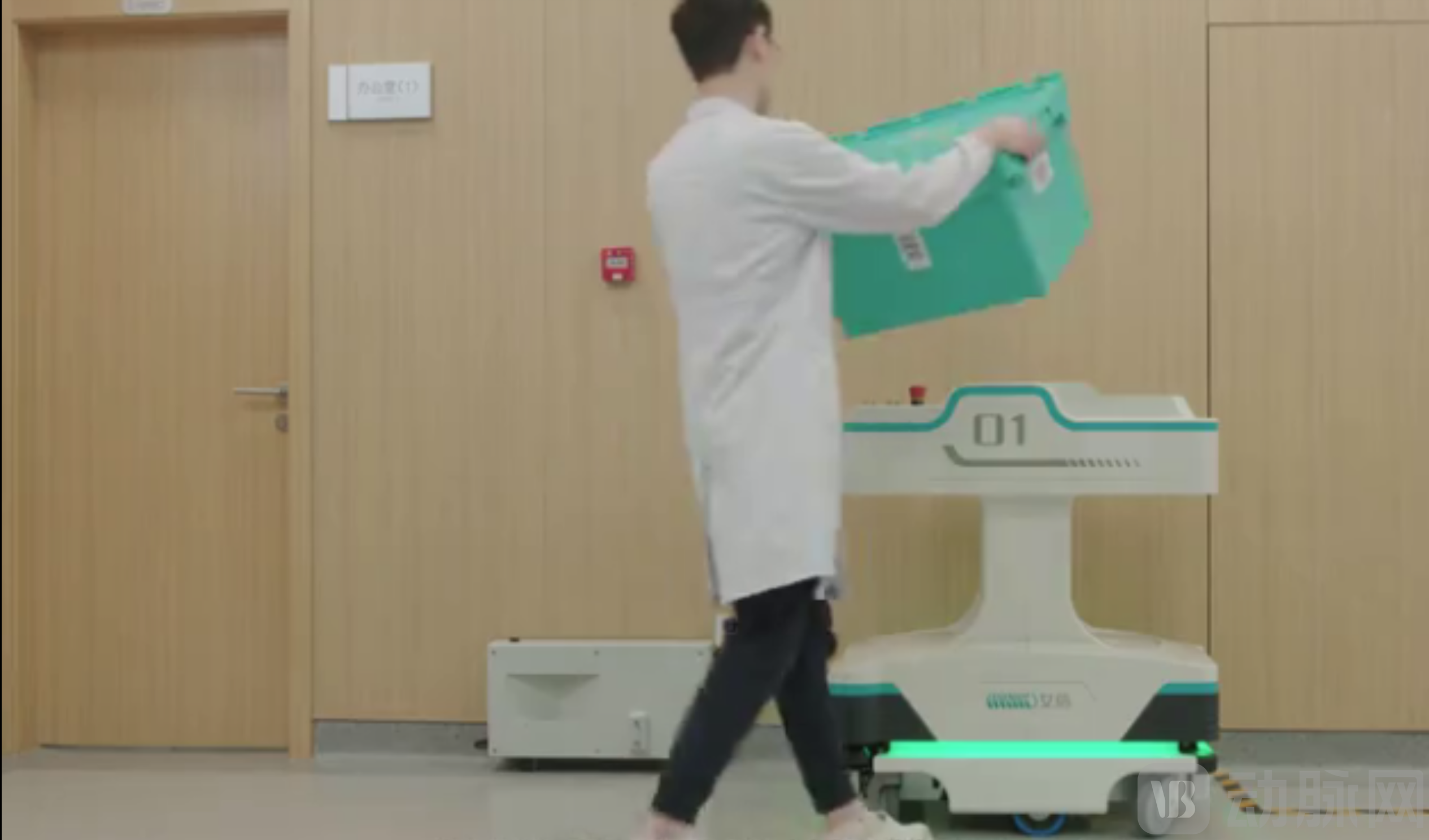
MiR AMR at Zhijiang Campus
According to Zhang Yu, Sales Director of MiR China,Hospital automated logistics has been in development for a long time, but the use of AMR technology to complete certain transportation tasks is still in the exploratory stage. The deployment of MiR’s medical delivery robots within the hospital differs from previous approaches; by leveraging AMR technology, it bridges the “last mile” of intra-hospital logistics, enabling true automation of logistical operations within the facility.
In the past, hospitals in developed countries typically employed Automated Guided Vehicle (AGV) technology to enhance the efficiency of internal logistics and transportation.
Although Automated Guided Vehicle (AGV) robotic transport systems are priced lower than Autonomous Mobile Robots (AMRs), they typically require guidance from magnetic or laser navigation devices to operate along pre-programmed paths or dock at designated locations for material handling and transportation tasks. Due to their high dependence on external infrastructure such as QR codes and optical-magnetic guidance, AGV systems exhibit limited safety, practicality, sterility, and flexibility in densely populated hospital environments in China. Consequently, they are predominantly utilized in industrial manufacturing, logistics, and overseas healthcare settings.
The advent of Autonomous Mobile Robot (AMR) technology has expanded the application boundaries of robotic transport systems, enabling medical delivery and logistics robots to be better utilized in a wider range of healthcare scenarios.AMR autonomous mobile robots are equipped with capabilities such as laser and visual navigation. They operate without tracks, autonomously navigate around pedestrians and obstacles, and perform dynamic, sequential navigation. These robots can plan routes, autonomously charge, proactively avoid personnel and objects, automatically call elevators, open and close doors, and transport materials across floors.
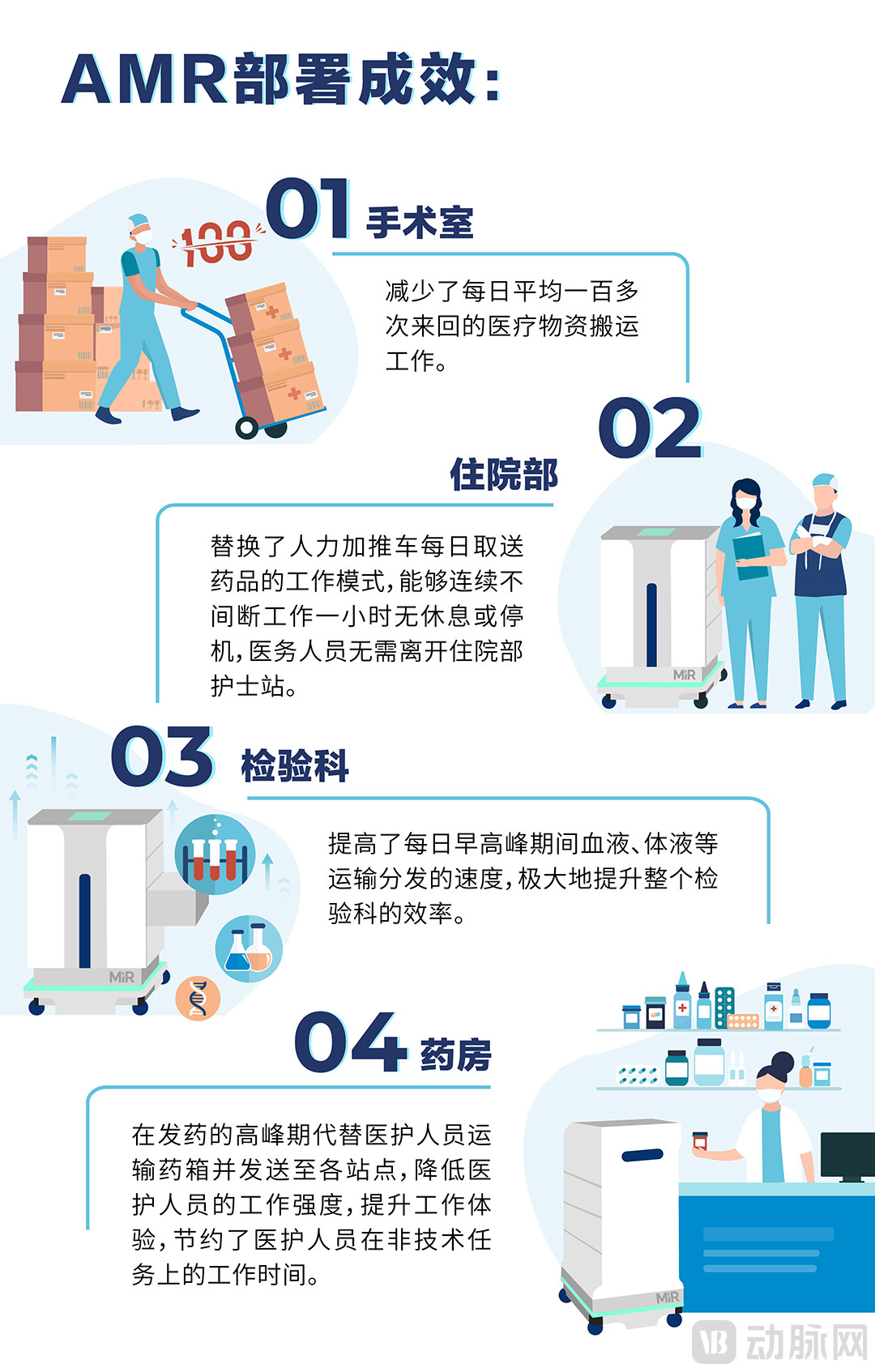
Effectiveness of AMR Deployment
As can be seen, Autonomous Mobile Robots (AMRs) with autonomous navigation capabilities offer greater flexibility and impose lower requirements on operational and maintenance costs, as well as on infrastructure and floor space. Their dynamic navigation mode is better suited for environments such as hospitals, which have stringent requirements for safety, adaptability, and antimicrobial standards. By integrating with existing pneumatic tube systems and box-type logistics systems in hospitals, AMRs can assist in transporting medical supplies—including medications, laboratory specimens, materials, and sterile surgical consumables—thereby providing a stable replacement for the traditional manual transport method using pushcarts.
The practices at Tongji Hospital and its Zhijiang Campus further demonstrate that deploying Autonomous Mobile Robots (AMRs) can enhance the operational efficiency of hospital management and back-office support departments. This enables healthcare professionals to devote more time to specialized clinical services while reducing the time spent on highly repetitive, low-skill tasks, thereby indirectly optimizing the patient care experience.
Take the practice of MiR at the Zhijiang Campus as an example.At the Zhijiang Campus, four autonomous mobile robots (AMRs) have been deployed at various points from the secondary storage warehouse to the operating rooms, and two robotic logistics transmission systems have been installed in the specimen reception room and pre-analytical processing area of the Department of Laboratory Medicine. This setup enables fully automated delivery of medical supplies from the warehouse to patient wards, operating rooms, and secondary supply stations at various locations.
According to relevant medical staff at the Zhijiang Campus,In the past, large volumes of medications required for surgical procedures were transported to operating rooms via box-type logistics systems. This approach suffered from low transportation efficiency, insufficient precision, and a risk of pharmaceutical contamination. Today, by leveraging logistics robots, consumables are sterilized and delivered precisely to operating rooms before surgery begins. The use of Autonomous Mobile Robots (AMRs) for material transport not only saves time and labor but also enhances management precision, thereby better promoting the future development of refined medical supply management within hospitals.
Deploying autonomous mobile robots (AMRs) in hospital settings, which are characterized by high personnel density and stringent requirements for the precision of material delivery, imposes significant demands on both the hardware and software capabilities of enterprise products.
It is understood that to enhance product safety and stability, MiR has equipped its Autonomous Mobile Robots (AMRs) with lasers on both the front and rear. This configuration improves obstacle detection sensitivity and provides 360-degree safety coverage. Additionally, the company has integrated a safety system for its AMRs that operates independently of the path planning system, enabling rapid response to unexpected situations during navigation and facilitating quick obstacle avoidance. Furthermore, MiR has optimized product components to handle highly complex environments, thereby ensuring product safety and stability.
Zhang Yu told VCBeat:“MiR enhances logistics efficiency and reduces healthcare institutions’ operational and maintenance costs by upgrading the software and hardware systems of its Autonomous Mobile Robots (AMRs). Furthermore, our robots feature strong openness, enabling seamless integration with diverse software and hardware systems, such as elevators and hospital business systems, to meet the needs of various scenarios and applications. This characteristic also holds significant importance for MiR’s future robot R&D and expansion into new application scenarios.”
It is reported that MiR products have been deployed at Peking University Shenzhen Hospital, Shenzhen Bao'an District Maternal and Child Health Hospital, Zhijiang Campus, and Tongji Hospital. Other healthcare enterprises that have deployed MiR AMRs include Novo Nordisk and Johnson & Johnson.
In the future, MiR will collaborate with partners to build an ecosystem, optimize robotic technologies, and expand product application capabilities and scenarios.
Medical logistics delivery robots can not only interface with hospital HIS systems to effectively facilitate the informatization, digitization, networking, integration, intelligence, and automation of hospital distribution systems, thereby delivering significant benefits in reducing costs and improving efficiency for in-hospital logistics. Moreover, they can reduce cross-infection among personnel caused by the frequent mingling of people and goods in traditional hospital logistics, as well as minimize incidents of contamination, damage, or loss of items.
The demand is evident, and policies have also demonstrated clear support for the development of medical logistics delivery robots.
The 2015 “Guiding Opinions on Actively Promoting the ‘Internet Plus’ Action” proposed a plan to “optimize in-hospital logistics through intelligent manufacturing,” ushering in the development of medical logistics delivery robots. At the end of 2021, the “14th Five-Year Plan for Intelligent Manufacturing Development” and the “14th Five-Year Plan for Robot Industry Development,” jointly issued by the Ministry of Industry and Information Technology and other departments, further propelled industry growth.
Driven by the combined effects of macro and micro policies, as well as black swan events such as the pandemic, medical logistics delivery robots in China have undoubtedly entered a golden period of development. As the “last mile” of in-hospital logistics is bridged, the large-scale deployment of Autonomous Mobile Robots (AMRs) is only a matter of time.