

University of Oxford Achieves £855 Million in Annual Commercialization Revenue Through 200+ Spinouts Over Two Decades
In 2022, the oldest university in the English-speaking world—University of OxfordMarking a new milestone, the University of Oxford rose to 2nd place in this year’s QS World University Rankings, achieving its best result since the turn of the millennium.
Unlike the other three authoritative rankings, namely “U.S. News,” “THE,” and “ARWU,” ““QS” places greater emphasis on university graduate employment rates, and thus, for the University of Oxford, the key to unlocking new achievements this year lies in the significant increase in its employment rate.
This is certainly for a reason. On the one hand, the University of OxfordOver the past 20 years, it has incubated more than 200 spin-off companies, ranking first among UK universities for spin-out enterprises.Accounting for 15.8%, it surpasses the second-ranked University of Cambridge by nearly 4 percentage points. On the other hand, the University of Oxford also emphasizes collaboration with leading enterprises; statistics show that by the end of 2021, the university had established in-depth partnerships with more than 1,000 high-tech companies in the Oxford area.
Close ties with industry not only provide Oxford University’s many students with diverse employment opportunities but also indirectly attest to the University’s core competency in incubating start-ups. Breaking down this core competency, its essence lies in Oxford’s well-established mechanisms and systematic professional expertise in translating scientific research achievements into practical applications.
So, how exactly does the University of Oxford integrate its profound academic heritage into the rapidly evolving market demands? To answer this question,VBInsightA Systematic Review of the University of Oxford's Technology Transfer System
Engage Every Link in the Innovation Ecosystem Deeply
In 1970, Stanford University pioneered the intellectual property management model of establishing a “Technology Licensing Office” within the university. Since then, universities worldwide have rushed to emulate this approach.
Soon, this trend reached the United Kingdom,The University of Oxford registered and established ISIS Innovation Ltd. in 1988., its primary mission is to assist university-based researchers in applying for patents, managing intellectual property, facilitating the execution of technology transfer agreements, and establishing new technology-based enterprises.
It is reported that,ISIS Innovation Ltd.Long-term liaison mechanisms have been established among researchers, social intermediary organizations, and enterprises to fully leverage the organizational and managerial strengths of university technology innovation companies. This approach organically integrates enterprises, social intermediary organizations, and researchers, directly translating scientific achievements into commercial value through market-oriented operational models, thereby providing sustained momentum for the generation and translation of university research outcomes.
And within this,Universities, Science and Technology Parks, GovernmentKey players deeply involved in the innovation and commercialization ecosystem have played a crucial role.
Let’s start with universities.Universities are the owners and monopolists of intellectual property rights in scientific and technological achievements, while also serving as providers that create R&D environments for researchers. The University of Oxford formulated its intellectual property policy in October 2000,The university is stipulated to hold intellectual property rights over the research achievements of all researchers and doctoral students.
Of course, universities will not treat these researchers unfairly. It is reported that the University of Oxford, while enjoying intellectual property rights, willThrough research awards, company equity allocation, and royalty commissions from intellectual property licensingProfit-sharing Model: Allocating a portion of the profits from the commercialization of scientific and technological achievements as compensation for researchers, thereby incentivizing their continued active participation in research and development.
In addition, the University of Oxford is also responsible for providing researchers with the various favorable conditions and a conducive environment necessary for conducting scientific research, thereby offering material support that enables them to engage in focused study and bold innovation.
Revisiting the Science and Technology Park. The renewal of science and technology parks serves as an “incubator,” with its core emphasis on fulfilling incubation functions. However, its advantage stems not from preferential policies, but from precise, high-quality services. These parks provide a platform that translates Oxford University’s cutting-edge research concepts and ideas into reality, serving as a critical link in transforming scientific achievements into start-up enterprises.
Specifically, science and technology parks provide startups with a full-chain transformation platform, ensuring ample room for technological development and avoiding a one-sided pursuit of corporate output value. They deliver comprehensive, high-quality supporting services to tenant enterprises through socialized mechanisms. Furthermore, to facilitate the growth of startups, a “single-bill” fee structure is implemented, streamlining cumbersome payment procedures.
Finally, the government. The UK government’s role in implementing its science and technology innovation strategy is positioned as follows:Investors, Aid Providers, and Regulators: Let the Market Determine the Interests of Various Innovation Stakeholders, safeguard and regulate the political environment and social order for technological innovation, and ensure the implementation of the technological innovation strategy.
In implementing its science and technology innovation strategy, the UK government has designed a series of government-led research and development projects through the operation of public policy mechanisms, fully leveraging the role of market mechanisms to guide the joint efforts of the government, enterprises, and researchers, thereby ensuring the effective implementation of the science and technology innovation strategy.
Clear Division of Labor: How Can “Derivative Institutions” Play a Major Role?
In January 2022, the UK’s authoritative consulting firm GovGrant released the Annual Report 2021 on UK University Spin-Outs, which conducted an in-depth survey of nearly 1,000 UK university spin-out companies. By analyzing data from the past two decades, the report identified the ten UK universities that have generated the highest number of spin-outs to date.
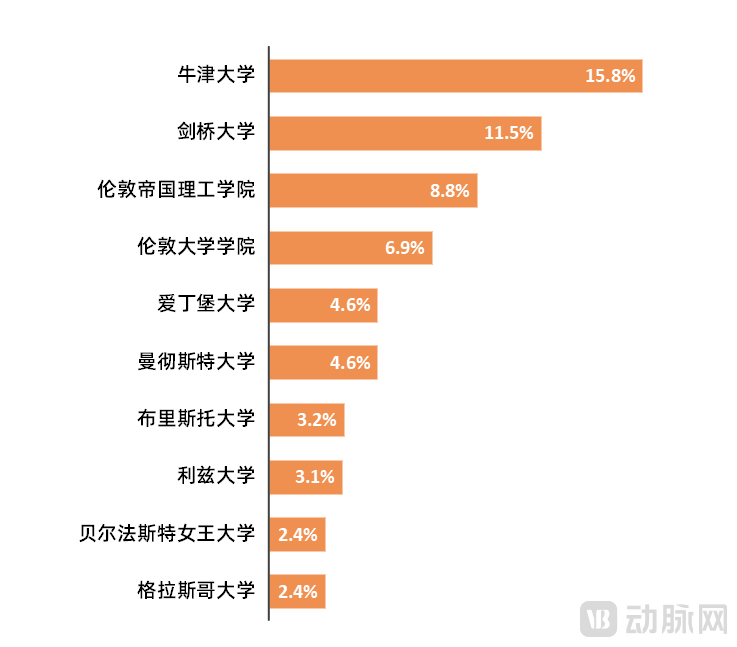
Proportion of Spin-off Companies Generated by UK Universities, 1998–2018
On this list,University of OxfordRanking first among UK universities for spin-off companies by a significant margin, it has incubated nearly 200 spin-offs over the past two decades, accounting for 15.8% of all university spin-offs in the UK.
How Exactly Did the University of Oxford Achieve This?
In fact, the integration of industry and technological innovation has long been the foundation of the University of Oxford’s sustained research achievements. Leveraging its geographic advantage in Oxford, technology companies can readily attract top-tier researchers from around the world.
It is precisely thanks to the support of these top-tier researchers that the University of Oxford can secure the necessary facilities for its research through startups, while providing these startups with access to relevant technologies, professional consulting, contract research, and industry collaboration.
As a hub for technological innovation in the UK, the Oxford region has continuously seen startups, spin-offs, and entrepreneurs join its industrial cluster as fresh blood.Through Oxford University Innovation, Oxford International Innovation Consulting, and the Oxford Science Innovations FundandOxford Innovation Associationand other derivative and related institutions, the University of Oxford has accumulated extensive practical experience and achievements in the transfer and commercialization of scientific and technological achievements.
First, we will introduce Oxford University Innovation Ltd.The company is a research and technology commercialization entity wholly owned by the University of Oxford, as well as a world-class for-profit technological innovation firm. Furthermore, it ranks as the fourth-largest PCT patent applicant in the UK, the largest in Europe, and the 16th largest globally among university-affiliated PCT patent applicants. Its primary mission is to assist researchers in commercializing their research outcomes.
As of July 2020, Oxford University Innovation managed4793A patented project by researchers at the University of Oxford, totalingAchieved 846 transactions, 529 advisory agreements, and 359 disclosures,and has spawned more than 200 startups and spin-offs. According to financial reports, in the first half of 2020, Oxford University Innovation Ltd. achievedOver £16 millionconversion revenue.
This is only one aspect; on the other hand, the more than 200 spin-off companies incubated have collectively attracted £855 million in external investment, with several already listed on the London Stock Exchange, indicating that the investment value of the University of Oxford’s innovation projects has gained broad market recognition.
Next, we introduce Oxford International Innovation Consulting Ltd.It isOxford University Innovation Ltd.A specially established functional entity, whose primary business is to provide professional consulting and services in areas such as innovative research and strategy, knowledge exchange and technology transfer management, innovation and entrepreneurship learning camps and acceleration programs, technology transfer and commercialization, as well as training and mentorship.
Among these,Professional Competency Training in Technology TransferIt is one of its signature offerings. Leveraging the University of Oxford’s proven experience and accumulated expertise in translating academic research into commercial applications, it has designed specialized training programs for professionals in the technology transfer sector, thereby unlocking greater potential for innovation-driven economic and social development.
Finally, we introduce the Oxford Innovation Society.It is aOxford University InnovationThe Association operates open innovation forums and innovation networks, bringing together researchers, inventors, spin-off companies, technology transfer experts, local enterprises, and the world’s most innovative multinational corporations. Since its establishment, the Association has been committed to strengthening ties between the University of Oxford and the business community, providing enterprises with a window to access the University’s scientific research resources and technological achievements.
Centered on the technology commercialization departments within the University of Oxford, the Association extends its reach to high-tech industrial parks of varying scales in the surrounding areas, including the large Milton Science Park, the medium-sized Magdalen Science Park, and the small Begbroke Science Park. This network has fostered a robust environment for technological innovation, gradually creating an agglomeration effect for innovation resources, particularly by establishing a complete innovation chain and a vibrant entrepreneurial ecosystem.
In fact, the various campuses serve not only as vital bases for teaching and scientific research practice at the University of Oxford, but also provide extensive physical, market, and innovation chain spaces for the further commercialization of research achievements. They are particularly conducive to fostering government-industry-academia-research collaborations, thereby effectively integrating traditional technological innovation resources with modern market mechanisms.