

Chinese Biotechs Lead Global TSLP Monoclonal Antibody Race with First-in-Class Candidates for Atopic Dermatitis and Asthma
TSLP is an epithelial cytokine that plays a critical role in the maturation of T-cell populations by activating antigen-presenting cells. Inhibition of the TSLP signaling pathway is a validated mechanism of action. Stimulated by allergens, viruses, and other factors, TSLP release sits at the apex of the inflammatory cascade, with the TSLP signaling pathway positioned upstream of other targets, such as IL-4, IL-5, IL-13, IL-7, and IgE.
In December 2021, co-developed by Amgen and AstraZenecaThe World's First TSLP Monoclonal Antibody Drug——The humanized monoclonal antibody Tezspire (tezepelumab) has been approved for marketing in the United States as an add-on maintenance treatment for children aged 12 years and older and adults with severe asthma, marking this asFirstBiologics that can sustainably and significantly reduce exacerbations in a broad population of patients with severe asthma. Following this, innovative biotechnology companies in China that early on targeted this pathway, such as Biosion and Conmed Biopharma, have also achieved certain results in this field, securing leading positions.
Recently, Upstream Bio, a Massachusetts-based biotech startup whose core pipeline candidate is a monoclonal antibody targeting the TSLP receptor, announced the completion of a $200 million Series A financing round. Investors included globally renowned firms such as OrbiMed, Maruho Co., Ltd., and Access Biotechnology. This financing event has once again drawn market attention to the TSLP therapeutic space.
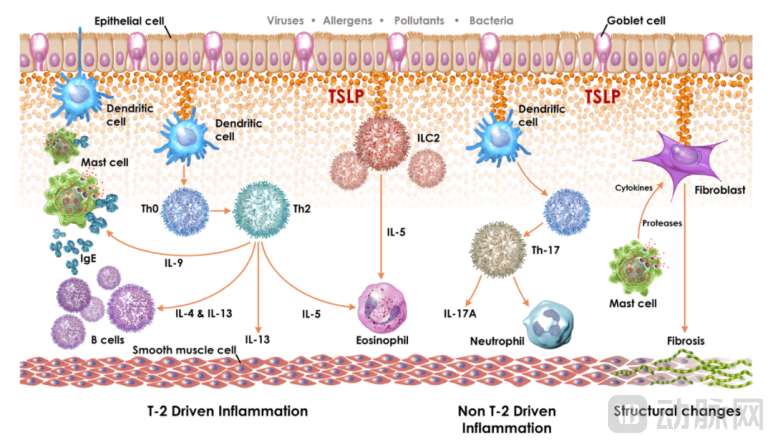
The TSLP Signaling Pathway Drives Multiple Inflammatory Cascades
(Image source: Upstream Bio official website)
According to Evaluate Pharma, a leading industry consulting and market research firm in the global pharmaceutical and healthcare sector, Tezspire was ranked among the top 10 most anticipated new drug launches globally in 2022, with sales projected to reach $2 billion by 2026. This significant market potential reflects genuine clinical treatment needs. Regarding Tezspire’s current primary indication—severe asthma—there are currently over 300 million asthma patients worldwide, including approximately 45.7 million individuals aged 20 years and older in China. However, despite the availability of high-dose standard asthma control medications, many patients with severe asthma still do not achieve adequate disease control. Furthermore, many of these patients require long-term use of chronic oral corticosteroids (OCS), leading to numerous OCS-related adverse effects. There is an urgent clinical need for safer severe asthma treatments with broader patient applicability.
In addition to severe asthma, TSLP monoclonal antibody drugs targetAtopic Dermatitis (AD), Food Allergy, Allergic Rhinitis, Netherton SyndromeA variety of allergic inflammatory diseases, including ..., are also being extensively studied. Due to their broad market application prospects and mechanisms of action,TSLP antibody drugs are considered potential challengers to the market dominance of Sanofi/Regeneron’s blockbuster biologic, Dupixent.
Dupixent (dupilumab, an anti-IL-4R monoclonal antibody) is currently the first biologic agent in the United States approved for use across dermatology, allergology, and respiratory medicine. Since receiving its initial FDA approval in March 2017, Dupixent has been launched in approximately 40 countries and regions, including the United States, China, Japan, and the European Union. In 2021, Dupixent generated sales of up to €5.249 billion (approximately $5.578 billion). This year, Sanofi has set a peak annual sales target for Dupixent as high as €13 billion (approximately $14.5 billion).
To date, the approved indications for Dupixent include asthma, atopic dermatitis (AD), chronic rhinosinusitis with nasal polyps (CRSwNP), and eosinophilic esophagitis (EoE). While its covered indications are similar to the current research focus of TSLP monoclonal antibody drugs, their mechanisms of action differ.
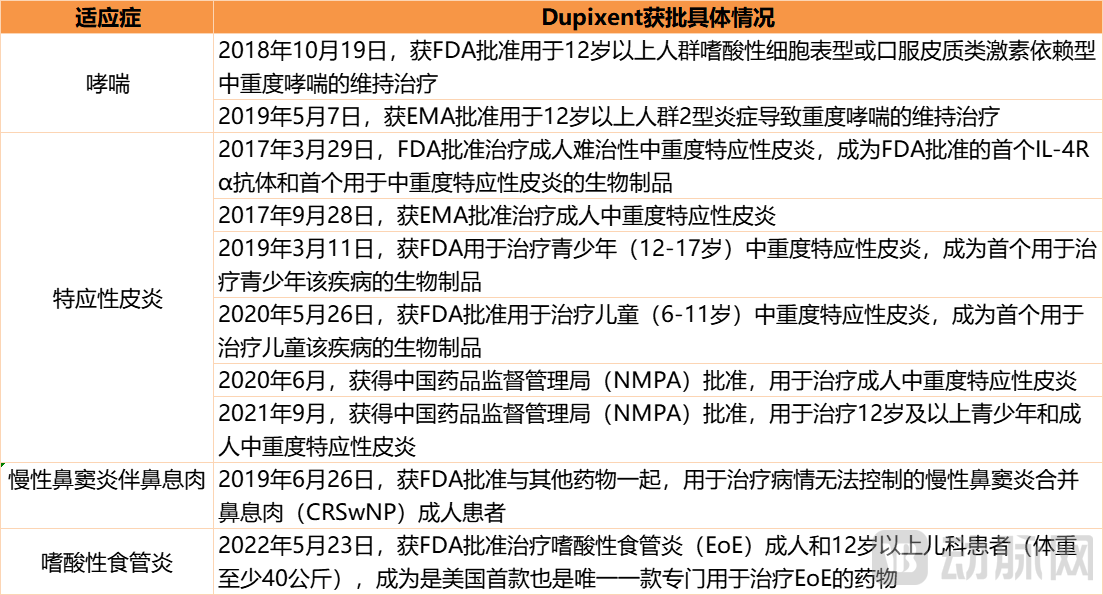
Specific Approval Status of Dupixent Across Indications (Table compiled by VCBeat based on public information)
It is worth mentioning that,In the treatment of severe asthma, Tezspire, a TSLP monoclonal antibody, is the only biologic agent without restrictions based on phenotypes (such as allergic status) or biomarkers (such as eosinophil count).Compared with Dupixent, a major advantage of Tezspire in asthma treatment is its ability to treat patients with low eosinophil levels, whereas Dupixent shows no significant therapeutic effect in such patients.
Given the broad market prospects for TSLP monoclonal antibody drugs, numerous pharmaceutical companies both in China and abroad have joined the race to develop therapeutics targeting TSLP. Chinese innovative biopharmaceutical companies such as Biosion are at the forefront of international research on TSLP-targeted therapies.
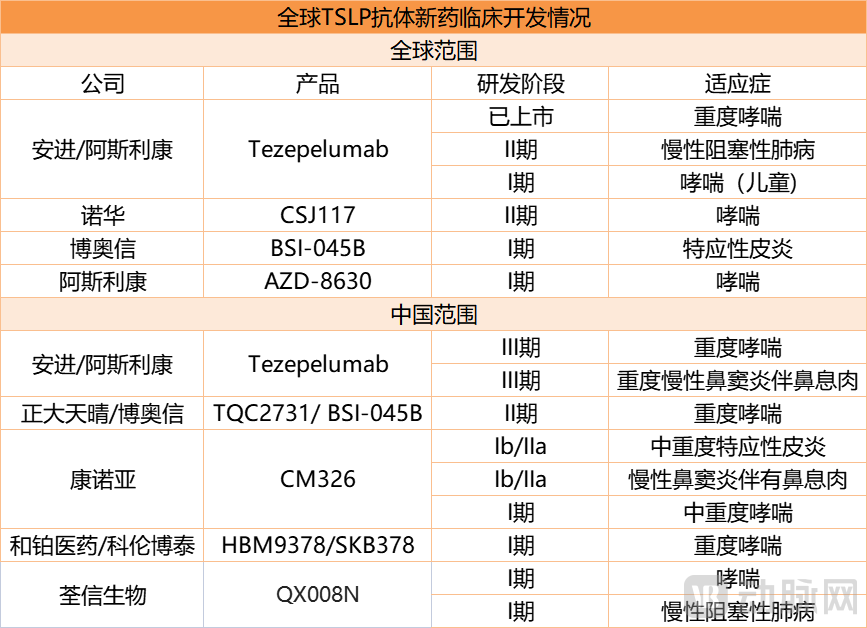
Clinical Development of Novel Global TSLP Antibody Drugs (Table compiled by VCBeat based on public information)
A key driver behind Dupixent’s significant commercial success is the sustained release of unmet demand among patients with atopic dermatitis, including adults, adolescents, and children aged 6 to 11 years.—Since Dupixent’s market launch, the age range for its use in atopic dermatitis (AD) has been continuously expanded. The indicated population for AD has grown from initially covering adults with moderate-to-severe disease to now including children and adolescents aged 6 years and older, making it the only biologic approved in the United States for patients aged 6 and above. Atopic dermatitis represents Dupixent’s largest patient market.
As a common dermatological condition characterized by chronicity, pruritus, and inflammation, atopic dermatitis significantly impairs patients' quality of life. Severe pruritus may lead to sleep disturbances, resulting in daytime fatigue. Furthermore, atopic dermatitis often coexists with other atopic disorders, such as allergic rhinitis, asthma, and food allergies.
According to Frost & Sullivan data, in 2019, there were 19.7 million and 190 million patients with atopic dermatitis (AD) in China and globally, respectively, with a prevalence rate of up to 20% among children and adolescents. It is projected that by 2030, the number of AD patients in China and globally will reach 81.7 million and 750 million, respectively, with approximately 30% being moderate-to-severe cases. Therefore,If successful in the atopic dermatitis indication, the AD therapeutics market will become another major potential market for TSLP monoclonal antibody drugs.
Previously, Amgen and AstraZeneca conducted clinical trials of a TSLP monoclonal antibody for atopic dermatitis (AD). The drug demonstrated positive efficacy and a favorable safety profile in patients with AD during Phase IIa trials. Unfortunately, it failed to meet the prespecified clinical endpoints in the subsequent Phase IIb trial. However, this does not mean that TSLP monoclonal antibodies lack potential in the treatment of AD. Differentiated products, targeted clinical trial designs, and novel dosing regimens may further expand the application of TSLP monoclonal antibodies in this field.
Biosion
VCBeat has learned that Biosion is currently conducting clinical studies on BSI-045B. This TSLP monoclonal antibody drug for atopic dermatitis represents the most advanced clinical trial of its kind globally and is currently the only ongoing clinical trial worldwide evaluating a TSLP monoclonal antibody for atopic dermatitis. According to public information, Biosion’s BSI-045B project was approved to enter the clinical trial phase in Australia in October 2021.
“Currently, due to the high burden of treating moderate-to-severe atopic dermatitis and the limited number of safe and effective therapies, there remains a significant unmet medical need in the field of atopic dermatitis,” Dr. Ye Xinliang, Chief Strategy Officer of Biosion, told VCBeat. “Biosion plans to leverage the strengths of its industry-leading global biologics development team toBSI-045B adopts a differentiated and innovative strategy in its clinical development.First, in previous Phase III clinical trials of Dupixent, fewer than 50% of patients with atopic dermatitis (AD) achieved effective symptom relief, indicating that at least 50% of patients still have a strong unmet need for novel therapies targeting TSLP. Second, we are collaborating with Dr. Jonathan Silverberg, Professor of Dermatology at the George Washington University School of Medicine and Health Sciences and a leading clinical expert in atopic dermatitis in the United States, to explore innovative TSLP-based combination regimens that may deliver greater clinical benefits to patients. Finally, based on preclinical and Phase I clinical data for BSI-045B, we anticipate that this candidate will achieve breakthroughs in the treatment of atopic dermatitis.
Preclinical data from Biosion’s BSI-045B project demonstrate that, compared with the reference antibody, BSI-045B exhibits approximately 150-fold higher in vitro biological activity and a threefold greater binding affinity.
In addition to conducting international clinical trials in Australia, the BSI-045B/TQC2731 project is also carrying out Phase II clinical trials in China for the treatment of severe asthma.——As early as 2017, Chia Tai Tianqing signed a collaborative development agreement with Biosion, obtaining the rights to develop and commercialize the BSI-045B project in Greater China.
In addition to Biosion, there are also including in ChinaConnoMed(Stock Code: 02162.HK) has also initiated clinical studies of a novel TSLP antibody for atopic dermatitis. In addition, innovative pharmaceutical companies, including Harbour BioMed/Keymed Biosciences and Quanxin Biologics, have actively pursued strategic developments in novel TSLP antibodies.
ConnoMed
CM326, an innovative monoclonal antibody targeting TSLP independently developed by Keymed Biosciences, is the first TSLP-targeting drug in China to enter clinical development. On November 3, 2021, Keymed Biosciences announced that the National Medical Products Administration had approved its investigational new drug application for CM326 for the treatment of atopic dermatitis. This marks the second indication approved for clinical trials of CM326, following asthma.
In the same month, Keymed Biosciences disclosed the Phase I clinical trial results of CM326, demonstrating favorable safety and tolerability. Currently, CM326 has sequentially obtained clinical trial approvals for indications including asthma, moderate-to-severe atopic dermatitis, and chronic rhinosinusitis with nasal polyps. On November 22, 2021, Keymed Biosciences and CSPC Pharmaceutical Group jointly announced the formal signing of an exclusive licensing agreement for the development and commercialization of CM326 in respiratory diseases such as moderate-to-severe asthma and chronic obstructive pulmonary disease (COPD).
Harbour BioMed / Kelun-Biotech
On February 21, 2022, Harbour BioMed (stock code: 02142.HK) and Kelun-Biotech (a subsidiary of Kelun Pharmaceutical) jointly announced that the National Medical Products Administration (NMPA) had approved their clinical trial application for HBM9378/SKB378, a next-generation fully human monoclonal antibody against TSLP co-developed by the two companies, for the treatment of patients with moderate-to-severe asthma. Harbour BioMed and Kelun-Biotech share global rights to HBM9378/SKB378.
Quanxin Biologics
On May 16, 2022, according to the official website of the Center for Drug Evaluation (CDE), QX008N Injection, a recombinant humanized anti-TSLP monoclonal antibody independently developed by Jiangsu Quanxin Biologics, was approved for clinical trials (Acceptance Numbers: CXSL2200126/7) for the treatment of asthma and chronic obstructive pulmonary disease (COPD). Quanxin Biologics stated that the company plans to initiate Phase I clinical trials for these two indications in the near future.
Overall, the current global pipeline of TSLP-targeting antibody drugs is predominantly focused on asthma. Development for other promising indications, such as atopic dermatitis, chronic obstructive pulmonary disease (COPD), and allergic rhinitis, remains in relatively early stages, indicating that the therapeutic potential of the TSLP target warrants further exploration.
Encouragingly, Chinese innovative pharmaceutical companies such as Biosion are at the forefront of international development in novel targets, positioning them to potentially capture the global market for TSLP in its new indication of atopic dermatitis. Conmed’s progress in TSLP target development is also noteworthy, and the parallel advancement of CM326 across multiple indications warrants close industry attention.
As enhancing global market competitiveness has become a key driver for the next stage of development in China’s pharmaceutical industry, setting sights on the broader global market and pursuing globally oriented innovation is an inevitable path for leading pharmaceutical companies of the future. Amid today’s intense domestic competition characterized by homogeneous target research and development, more local biopharmaceutical companies could follow the example of Biosion and act with greater courage in developing first-in-class drugs. After all, high risk and high reward have always gone hand in hand.