DP Technology Unveils RiDYMO.MolTx and RiDYMO.PepTx at DDC 2026: Agent-Driven Platforms Accelerating Small Molecule and Cyclic Peptide Drug Discovery

DP Technology
Simulation R&D Platform Developer
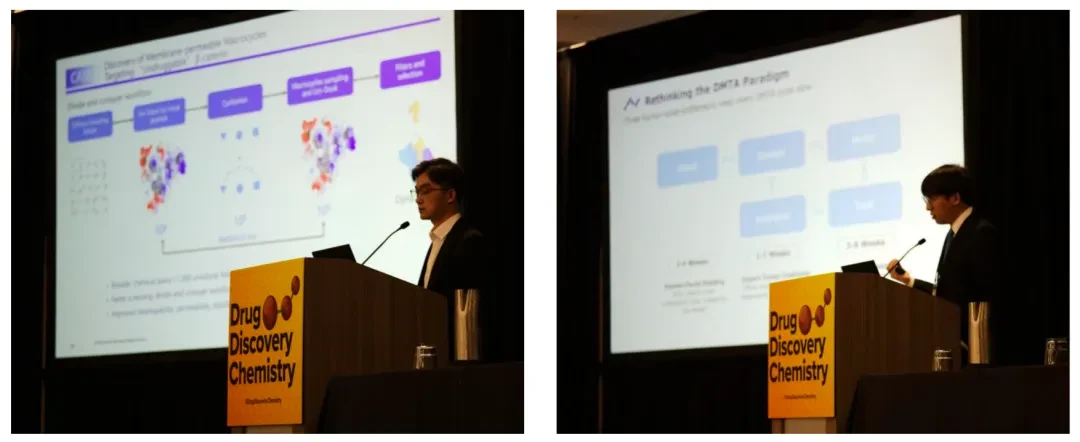
On April 15, 2026, local time, at the Drug Discovery Chemistry 2026 (DDC 2026) conference held in San Diego, USA,DP Technology Releases RiDYMO.MolTx and RiDYMO.PepTx, Two Agent-Driven Drug Discovery Platforms.Two Platforms Targeting Small Molecules and Cyclic Peptides: Automating and Optimizing the Full "Read Literature – Perform Calculations – Conduct Experiments" Process

DMTA
From "Human Speed"
Liberate
The reality is that the key aspects of DMTA are all affectedHuman Bandwidth and ExperienceThe restriction."Read" card stuck in extraction——A large amount of truly valuable SAR data lies dormant in patents, but molecular structures are often presented as images or in Markush form, activity data is scattered across charts and texts, and different patents have varying standards. Traditionally reliant on medicinal chemists to read each patent individually and manually piece the information together, the process is slow, difficult to reuse, and heavily dependent on personal experience."Calculation" stuck in series——The truly time-consuming part is not individual calculations, but the串联与综合判断 between different tools and results. This manually connected chain of judgment determines the rhythm of the entire calculation process."Stuck" in synthesis——Small molecule synthesis routes often take weeks to months, forcing R&D towards "One-shot Design"; the manual throughput of complex modalities such as cyclic peptides is as low as 20–30 per month, unable to support efficient iteration.
The solution approach is therefore clear:On the side of "reading" and "calculating," use an Agent with judgment capabilities to take over串联与分析; on the side of "doing," use reliable chemistry and automated synthesis to stabilize the "month"-long synthesis cycle down to "day-week" levels.,Let DMTA truly run as a closed-loop high-frequency process.

RiDYMO.MolTx:
Agent × Physics Simulation × AI Modeling,
Compressing the Small Molecule DMTA Closed Loop from Months to Two Weeks
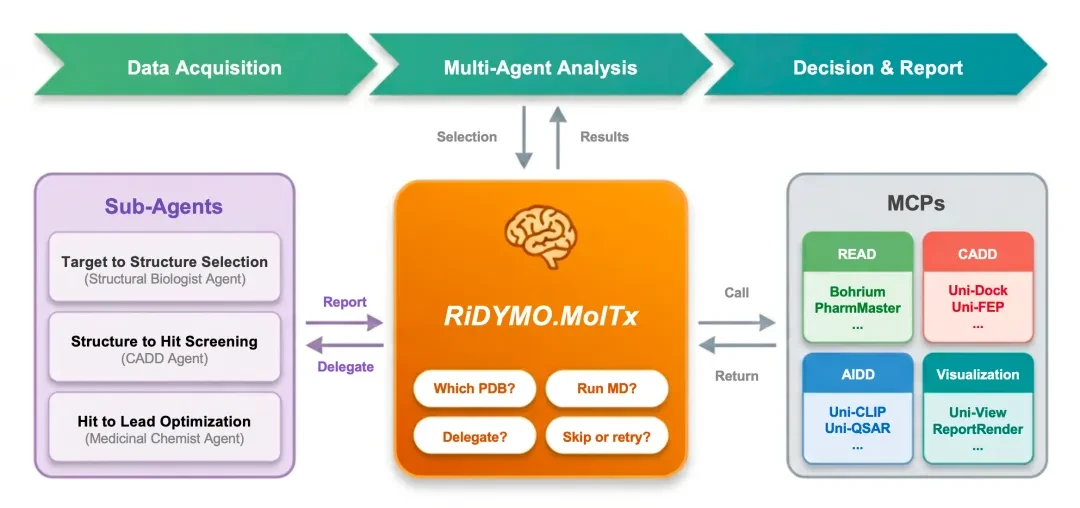
Under the intelligent scheduling of Agent, MolTx enablesPhysical SimulationWithAIModelingUnder the Agent's orchestration, a bidirectional closed loop is formed: simulations based on physical methods such as free energy calculations provide high-quality computational evaluation results; AI modeling trains and iterates using this high-quality data, then expands the search to a larger chemical space that is difficult for physical computations to directly cover. This process, in turn, feeds candidate compounds back into physical simulations for precise validation. The two approaches complement each other under the Agent’s coordination.Physical-level AccuracyWithAI Search Scope——A single project can complete over 20 million molecular docking simulations and more than 5,000 free energy calculations within two days, ultimately providing a list of recommended molecules instead of intermediate results that require further expert analysis.
On the wet-lab side, MolTx anchors the Agent's search scope within a synthesizable chemical space built on a highly reliable synthetic reaction system, ensuring that every recommendation can be experimentally validated within a "days to weeks" timeframe.
In independent benchmarking of four targets, DP Technology's Agent system achieved 100% Capture,and compared with the past molecular discovery process, the computational workload required to complete the same screeningDecrease by 25.5%,Save approximately 1,200 timesFEPCalculationIn the USP1 demo project, MolTx starts from Agent's tens of millions of synthesizable compound space,Within two weeksCompletion of 50 molecular recommendations, synthesis of 22 molecules, and final bioactivity testingObtained 14 bioactive positive molecules——In the traditional process, such a round usually takes 2-3 months. Beyond the example project, DP Technology has completed the same dry-wet closed loop on nearly 20 targets, all yielding hit compounds with novel scaffolds.

RiDYMO.PepTx:
Agent × Automated Synthesis × Direct-to-Biology,
Closing the Loop on Cyclic Peptide DMTA in Weeks Instead of Months
Adopting the same architectural design as MolTx, the core of PepTx is also a system equipped withSelf-assessment, Route Planning, and Tool Integration CapabilityThe Agent. Facing a trillion-level non-natural chemical space, the Agent starts from target structures and diverse building block libraries, connecting modules such as molecular fragment selection, peptide screening, cyclic sampling, free energy calculation, and developability filtering for multi-level evaluation. It makes decisions after each step—determining which conformations need recalculating, which branches can be pruned, and which candidates are worth pushing into synthesis—achieving complete automation of the decision-making process.
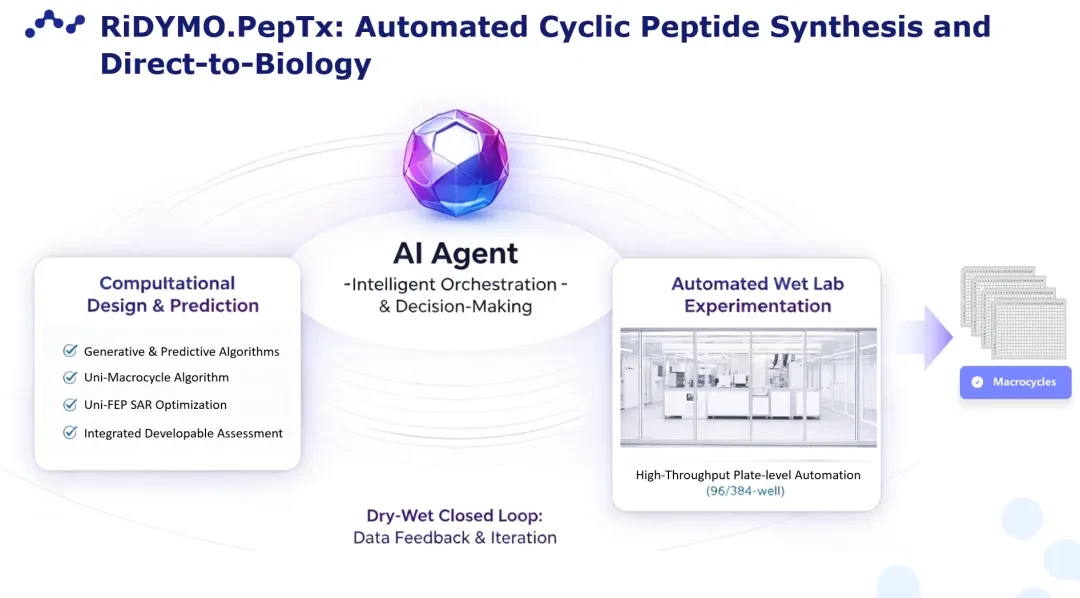
At the wet-lab end, PepTx increased the throughput of cyclic peptide synthesis from 20–30 peptides per month manually toEvery3WeekExceed10,000 Items, with a unit flux increase of approximately 500 times — enabling the candidate molecules recommended by Agent to be obtained as real molecules within a "week" timeframe. The synthesized cyclic peptides can directly enter 96/384-well plate parallel activity testing without purification (Direct-to-Biology), merging the three-step process of "synthesis-purification-testing" into one, further compressing the iteration cycle. In the non-natural cyclic peptide system targeting the anticoagulant target Thrombin, the first closed-loop of PepTx is about4 WeeksCompleted within, identified8 itemsActivityCyclic Peptides (hit rate approximately 9%), further validation yieldsKi = 1.28 μMThe leading molecules; subsequently, the Agent, based on the structural understanding of the binding mode, continues to drive the systematic iteration of molecular block replacement and free energy calculation ranking, eventually obtainingOptimized molecules with Ki up to ~30 nM, and has very goodMembrane Permeability andGastrointestinal TractStability。

One Architecture Covers Multimodality:
Agent Scheduling + Dry and Wet Dual Factories,
Let each iteration flow back into the system.
We believe,Next-Generation Drug DiscoveryThe evolution is moving from a single-point breakthrough design conducted by a few senior experts based on experience, towards the construction of a research and development system that integrates intelligent Agent scheduling, computational design, reliable chemistry, automated synthesis, and continuous learning and iteration within a real closed loop. This system aims to optimize scientists' time allocation on repetitive tool operations and data integration tasks, allowing their valuable professional judgment to be more focused on critical scientific decision-making processes.
About DP Technology