

Degron Therapeutics Secures $22 Million Series A Financing to Advance Novel Molecular Glue Degraders Targeting Undruggable Proteins
Degron Therapeutics
Small Molecule New Drug Developer
Protein degraders, considered capable of targeting “undruggable” targets, have become the new darlings of the small-molecule pharmaceutical industry. Protein degradation technologies, represented by PROTACs and molecular glues, have emerged prominently, with investment and M&A activities in this sector remaining continuous.
Recently, Artery New Medicine learned at the earliest opportunity that,Degron Therapeutics Officially Closes $22 Million Series A Financing RoundDegron Therapeutics has officially signed agreements to complete a $22 million Series A financing round. The round was led by Mifang Health Fund, with participation from Deyi Capital, BV Baidu Ventures, and Xinhang Capital. Existing seed-round investors, Kaifeng Venture Capital and YSVC, continued their support. The funds will be primarily used to advance the company’s product pipeline and further expand its molecular glue technology platform.
Degron Therapeutics focuses on the development of novel small-molecule drugs based on molecular glues, aiming to become a globally leading innovative company in protein degradation therapeutics. The company has established an R&D and management team with international perspectives and extensive industry experience. It is dedicated to de novo design, synthesis, and screening of novel compounds for the discovery and validation of targets previously considered undruggable by traditional small-molecule inhibitors. By providing source-innovative solutions and pathways for preclinical and clinical research, Degron Therapeutics seeks to meet patient needs through novel therapeutic modalities.
Strategic Alliance, Focusing on Source Innovation
The founding of Degron Therapeutics stemmed from the immediate synergy between its CEO, Dr. Lily Zou, and its Chief Scientist, Professor Cang Yong.
Although the two had known each other for many years, their in-depth exchanges did not begin until 2021, when Degron Therapeutics was still in its infancy and required a robust team to support its future development. “Professor Cang and I share highly aligned visions; we are both committed to pursuing genuine source innovation and building an enterprise that leads the world in both products and technology,” said Zou Lihui.
Zou Lihui has successively held roles in R&D, business development (BD), investment, strategy, and marketing at top-tier consulting firms, large international pharmaceutical companies, and small biotechnology startups. Driven by an exploratory spirit across diverse disciplines, she has accumulated comprehensive scientific knowledge as well as extensive experience in business and team management.
Prior to founding her startup, she served as CEO of Fosun Pharma USA, where she not only established the company’s U.S. subsidiary but also built Fosun’s innovation incubator in Boston. Her investments in early-stage innovative drug projects sparked her interest in the field of molecular glues.
In the field of small-molecule pharmaceuticals, most companies focus more on target identification than on technological innovation; however, targeted protein degradation technology is poised to disrupt this status quo. According to Zou Lihui, at a time when cell therapy and gene editing are driving a technological revolution in biomedicine, molecular glue-based protein degradation technology will inject new vitality into the innovation of small-molecule drugs, which remain a mainstream therapeutic modality.
Coincidentally, Professor Cang Yong of ShanghaiTech University boasts over two decades of R&D experience in the field of targeted protein degradation. He previously served as an Assistant Professor at the Sanford Burnham Prebys Medical Discovery Institute and as a Professor at Zhejiang University. An expert in ubiquitin-mediated protein degradation, he specializes in the screening and mechanistic studies of novel molecular glue drugs, as well as their applications in tumor-targeted therapy and immunotherapy.
With one partner boasting profound academic expertise and the other bringing extensive commercial experience, their collaboration was forged, officially launching Degron Therapeutics on its path of innovation.
Established just one year ago, Degron Therapeutics has already built a highly specialized R&D team dedicated to developing the company’s core technologies, while extensively leveraging CRO resources to handle non-core routine tasks.Under the leadership of senior scientists, the company’s three core divisions—biology, chemistry, and protein structure—are advancing in tandem, while the soon-to-be-established AI computing department will bring new momentum to the development of molecular glue drugs.
Creating Differentiated Advantages, Building Technical Barriers
Although the development of molecular glue degraders has spanned only a few years, they have already demonstrated significant therapeutic potential. Compared with small-molecule inhibitors, molecular glues circumvent drug resistance by targeting proteins for degradation. In contrast to the currently prominent PROTAC technology, molecular glues do not require binding pockets; their “double-sided tape”-like properties enable them to target a broader range of previously undruggable targets. Furthermore, their low molecular weight, favorable druggability, and accessibility akin to conventional small-molecule drugs confer advantages that facilitate wider application in the treatment of tumors, inflammatory diseases, chronic conditions, and other indications.
Despite their clear advantages, molecular glues face numerous challenges that must be overcome. First, molecular glues function by inducing or stabilizing protein–protein interactions between E3 ubiquitin ligases and target proteins, thereby recruiting and degrading the targets; however, the complex structure of the resulting ternary complexes precludes direct rational design using conventional chemical methods. Second, because molecular glues require specific chemical features to achieve selective recruitment of target proteins, the lack of compound libraries designed for this purpose hinders precise screening. Finally, characterizing the interactions between molecular glues and their target proteins demands extensive in vitro and in vivo biological validation. Moreover, the limited data available on lead optimization and pharmacological profiling of molecular glues poses significant challenges to their clinical development.
The challenges in developing molecular glue drugs have not deterred numerous pharmaceutical companies from strategic positioning. Globally, multinational pharmaceutical giants such as BMS and Novartis are making rapid clinical progress, while startups including Monte Rosa Therapeutics, C4 Therapeutics, and Neomorph are poised to enter the fray.
As the first company in China dedicated to developing molecular glues that degrade novel targets, Degron Therapeutics has established a systematic strategy based on its profound understanding of ubiquitin enzymes and molecular glue chemistry. The company differentiates itself through comprehensive efforts spanning compound library construction, screening and validation, data accumulation, and AI-driven prediction.
Proprietary Molecular Glue Library
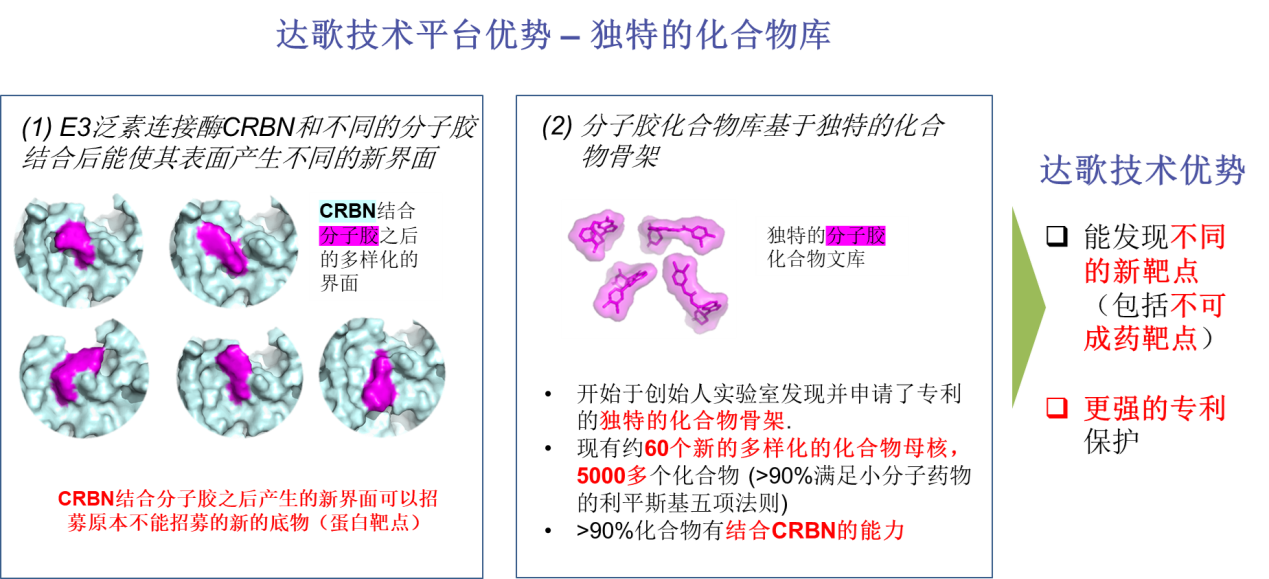
Degron Therapeutics established its proprietary compound library based on a novel chemical scaffold developed in Professor Cang Yong’s laboratory. Through continuous exploration and data accumulation, the company has expanded the size and diversity of its library, creating Degron’s unique molecular glue library, which is protected by global patents.
After more than a year of coverage, Degron Therapeutics’ molecular glue library comprises over5,000 Unique Compounds, and the number continues to grow. These compounds are already highly promising molecular glue candidates.
Currently, most pharmaceutical companies are still mining for potential molecular glues and targets based on the structures of lenalidomide and pomalidomide, leading to significant target overlap. In contrast, Degron Therapeutics has leveraged its proprietary molecular glue library to explore a broader landscape for target discovery, enabling the identification of novel targets that will differentiate it from other players in the field.
Systematic Molecular Glue Screening and Validation Mechanism
Degron Therapeutics’ capabilities in discovering molecular glue compounds have expanded the scope for target validation and screening. According to Degron Therapeutics, verifying whether therapeutic efficacy is truly achieved through molecular glue-mediated degradation requires not only assessing the binary complex formation between the molecular glue and the E3 ubiquitin ligase, but also evaluating the ternary complex involving the molecular glue, the E3 ubiquitin ligase, and the substrate. By analyzing the degradation process and the downstream pathways modulated by the substrate, the effects induced by molecular glue-mediated substrate degradation can be determined.
Historically, Celgene’s representative drug, thalidomide, caused a severe medical disaster because its toxic side effects were not observed in experimental animal studies at the time. In light of this,Degron Therapeutics has developed a suite of tools, including gene-knockout cell lines and CRBN-humanized mice, to conduct more rigorous experimental validation. In addition to accurately elucidating the mechanisms of action of molecular glues, the company evaluates their substrate selectivity and performs a series of screenings and validations at both the cellular level and in humanized mouse models to assess targeted efficacy and safety.
Bridging the data accumulation gap to enhance AI predictions
As molecular glues remain an emerging technology, the understanding of them is still incomplete, resulting in a relatively scarce accumulation of data. Degron Therapeutics is currently establishing an AI system to conduct more in-depth research. This system has already accumulated nearly 30,000 data points, with the aim of achieving greater precision in AI-based prediction and drug screening.
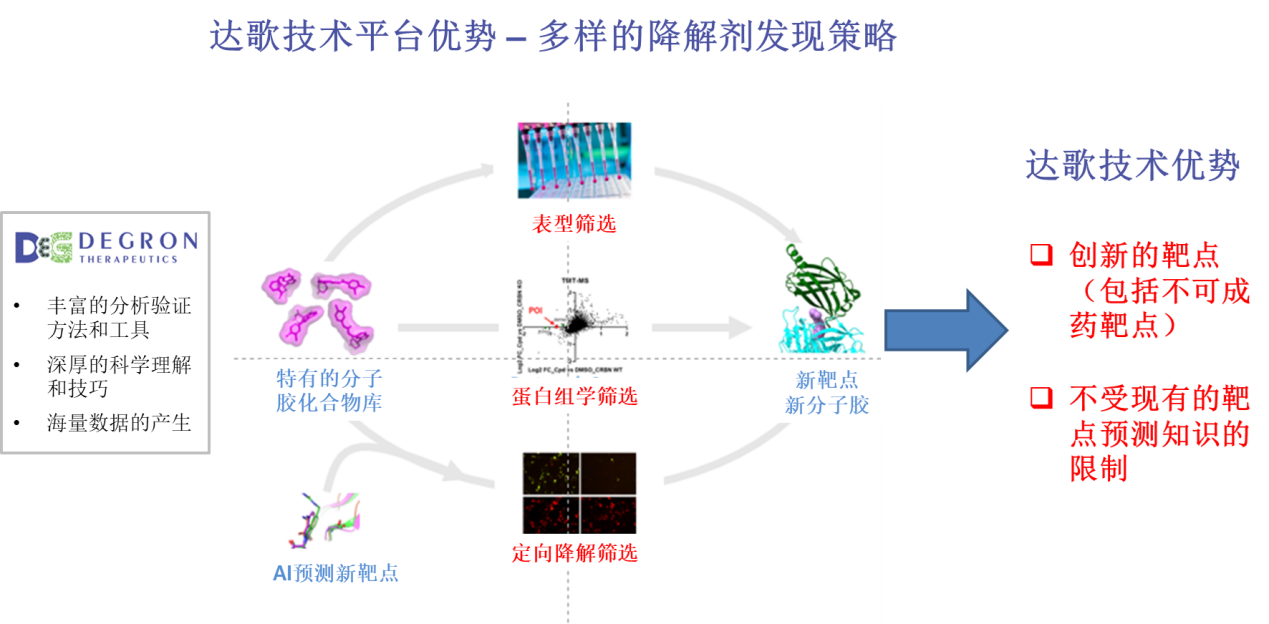
At the drug screening stage, the vast majority of pharmaceutical companies employ AI-based target prediction to screen their molecular glue compounds.Degron Therapeutics has adopted a more objective and comprehensive approach by integrating three distinct screening strategies. In addition to the target-based method commonly used by most molecular glue companies to identify compounds, Degron also employs phenotypic screening and proteomic screening to discover novel targets.
Among these, phenotypic screening is more focused on cancer targets. By observing the mechanism by which molecular glue compounds kill cancer cells, researchers can determine the specific protein targets involved, thereby facilitating further validation of both the targets and the compounds. Proteomic screening shares similar principles with phenotypic screening but extends its applicability to a broader range of indications, no longer limited to specific therapeutic areas.
Degron Therapeutics has established technological barriers that have enabled it to achieve a highly competitive and differentiated market position. Zou Lihui stated, “We aim to broaden our perspective by benchmarking against global companies, pursuing foundational innovation and achieving new breakthroughs in the field of novel drug development.”
GraspFirst in classOpportunities
Currently, Degron Therapeutics has initiated three pipeline programs in the field of oncology, targeting WEE1, Protein A, and GSPT1, all of which are in the lead optimization stage.
Among them,WEE1 is a Potential Best-in-Class Novel Drug, while related inhibitors have already entered clinical trials globally, Degron Therapeutics has designed its candidates based on the mechanism of molecular glue degraders. Due to the completely different sites of action, this approach avoids the selectivity challenges commonly associated with WEE1 kinase inhibitors and does not affect other kinase targets. Meanwhile,Degron’s degrader targets two distinct targets: WEE1 and IKZF1/3, which not only blocks WEE1-mediated regulation of cell cycle progression and prevents DNA repair in cancer cells prior to division, but also enhances T cell cytotoxic activity against cancer cells.
Protein A is a First-in-Class project in which Degron Therapeutics has placed high expectations; this drug candidate was identified through proteomics-based screening.“This protein plays a critical role in numerous cancers and immune-mediated diseases, but due to its structural characteristics, it was previously considered undruggable. Although developing a first-in-class (FIC) innovative drug entails substantial risks, requires a prolonged timeline, and demands significant effort, ‘a successful development would represent a breakthrough discovery. It would not only provide new therapeutic options for patients with cancer and immune diseases but also serve as validation that molecular glue degraders can be systematically developed to target previously undruggable proteins. Furthermore, Degron Therapeutics will gain recognition for its global leadership in the field of molecular glues,’” stated Zou Lihui.
Amid the capital winter, every round of financing for enterprises is precious. Since its establishment in 2021, Degron Therapeutics has completed two rounds of financing, gaining recognition for both its technological advancement and team cohesion.
As the lead investor in this financing round, Hu Hongdan, Executive Director of Mifang Health Fund, stated, “Degron Therapeutics is a pioneer in the molecular glue sector, possessing robust core competitive advantages. Mifang holds strong confidence in Degron’s founding philosophy—achieving genuine innovation by focusing on traditionally undruggable targets. Technologically, Degron has established significant competitive barriers through its proprietary compound library and screening systems. In terms of team, Dr. Zou Lihui and Professor Cang Yong lead a highly cohesive group characterized by clear objectives and strong conviction.”
Backed by capital, Degron Therapeutics has established a strategic roadmap for its future development. In addition to advancing its existing products, the company will continue to expand its project portfolio and enrich its product pipeline. Equally important, Degron will further scale its technology platforms, deepen its expertise in its proprietary molecular glue library, and strengthen its AI infrastructure. Building on this foundation, Degron Therapeutics will actively pursue strategic collaborations with global pharmaceutical companies, leveraging the broad applicability of its platform technologies and the novelty of its targets. By tapping into the financial and technical resources of these global partners, the company aims to expand its pipeline and indications, thereby capitalizing on its unique advantages in the field of molecular glues.
“The journey from technological advantages to product strengths, and ultimately to commercial success, is a long one for biotech companies. We have made a promising start and will continue to work steadily, step by step, until Degron Therapeutics becomes a globally leading innovator in molecular glue therapeutics,” said Zou Lihui.
Mifang Health Fund
Mifang Health Fund focuses on investments in the pharmaceutical, healthcare, and life sciences sectors, with offices in Shanghai, Beijing, and Shenzhen. The management team boasts a broad international perspective, deep industry background, extensive sector resources, and professional investment expertise. The fund emphasizes “early-stage value discovery and identification of promising therapeutic areas,” targeting investment opportunities in biopharmaceuticals, medical devices and diagnostics, digital health, and health technology. To date, it has completed investments in approximately sixty pharmaceutical and healthcare companies, including Hanyu Medical, TianGuangShi (TGS), InnoMicro, ZhenRong Pharma, LinkMed, PhenoGen Biologics, XinQing Medical, LiBang Pharma, AnRay Biotech, HeDu Biologics, SaiFu Pharma, AnSong Technology, and WeiYan Medicine.
“Decentralized Investment” combined with “Systematic Operations,” guided by the vision of “Mapping the Life Sciences Horizon” and upholding the philosophy of “Leveraging Capital Responsibly to Reward Trust,” Mifang is committed to becoming an open, platform-based professional investment institution distinguished by its strong competitiveness and far-reaching reputation.
Deyi Capital
Deyi Capital focuses on VC/PE investments, with a primary emphasis on sectors such as healthcare and next-generation information technology. Its management team hails from renowned domestic and international institutions, bringing extensive experience in investment, investment banking, and industrial operations, along with deep industry resources and rich sector expertise.
In the healthcare sector, Deyi Capital focuses on unmet clinical needs and invests in the industrialization of innovative technologies, including innovative drugs and medical devices. Its portfolio of innovative biopharmaceutical companies includes OriginForce Life Sciences, Yili Pharmaceuticals, ZhiMeng Pharma, Wellist Biologics, and AkornBio, as well as Zejing Pharmaceuticals (688266.SH), Allist Pharmaceuticals (688578.SH), and InnoCare Pharma, which are already listed or have passed listing reviews.
Baidu Ventures
Baidu Ventures is an independent venture capital firm initiated by Baidu Group, with its three USD/RMB funds totaling over $700 million. Focusing primarily on early-stage pioneer companies in emerging technologies, Baidu Ventures concentrates on key sectors including consumer commerce, healthcare and livelihood, and technology expansion. Leveraging the strong support and resource sharing of Baidu Group, Baidu Ventures has strategically positioned itself in the field of artificial intelligence. Its current investment portfolio spans new energy vehicles, life sciences, enterprise services, smart cities, semiconductors, smart industry, and IoT-enabled living.
Only through finer granularity and more exacting standards can innovative technologies emerge. Baidu Ventures hopes to identify more companies that integrate innovative technologies into every detail, and will continue to support industries across various sectors that contribute to the advancement of modern human civilization, working alongside outstanding enterprises to paint a brighter future for society.
Xinhang Capital
Xinhang Capital has been committed to building an early-stage incubator platform at the intersection of “AI + Life Sciences,” focusing on identifying and nurturing startups in the biotechnology sector to drive exploration and innovation at the frontiers of life sciences. Xinhang focuses on areas such as innovative biologics and therapies, gene editing, synthetic biology, AI-driven biological computing platforms, brain-computer interfaces, and biochips. By employing systematic and deep-incubation methodologies, it aims to achieve breakthrough innovations in biotechnology. To this end, it has established an investment network spanning China and the United States, connecting with top-tier laboratories and elite team projects from prestigious institutions including Harvard University, MIT, Stanford University, Carnegie Mellon University, Tsinghua University, Peking University, and the University of Science and Technology of China.