

China Enacts 'Internet Diagnosis and Treatment Supervision Rules (Trial)': Key Red Lines and Industry Impact
Recently, the landmark policy on internet healthcare, the “Detailed Rules for the Supervision of Internet Diagnosis and Treatment (Trial)” (hereinafter referred to as the “Rules”), was officially released and has come into effect.
Compared with the 2021 “Detailed Rules for the Supervision of Internet-Based Diagnosis and Treatment (Draft for Comments)” (hereinafter referred to as the “Draft for Comments”), the trial version has not undergone significant overall changes. It continues to prioritize quality and safety supervision throughout the entire process of internet-based diagnosis and treatment, with the overarching goal remaining the promotion of the healthy development of internet-based diagnosis and treatment.
However, the Detailed Rules provide more granular provisions on medical record documentation and retention, issuance of online prescriptions, sale of prescription drugs, and red lines for artificial intelligence applications, thereby further clarifying standards for regulatory implementation.
The “Detailed Rules” were formulated to address practical issues that have emerged in the internet healthcare industry in recent years and are closely relevant to practitioners. Specifically, what industry problems do the “Detailed Rules” aim to resolve? What red lines have been drawn? What impact will their implementation have on the industry? VCBeat interviewed multiple stakeholders to provide an interpretation.
The document underwent a public consultation process in 2021; the two versions exhibit both continuity and differences in detail.
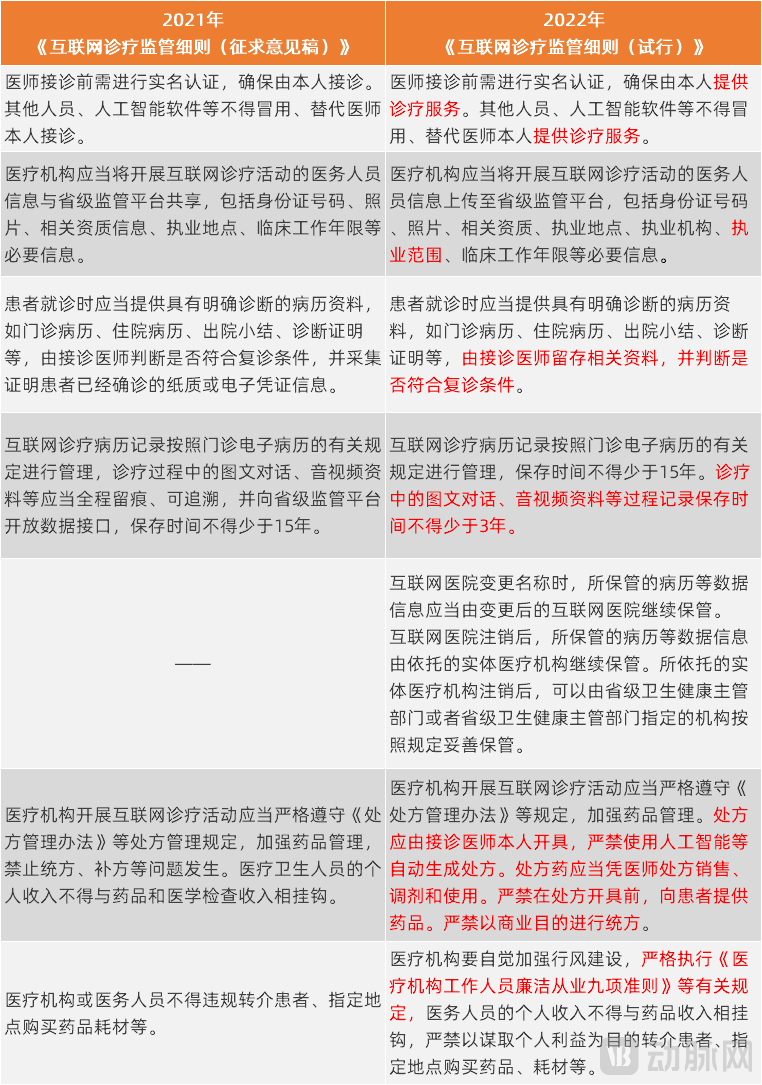
Comparison of Selected Provisions Between the “Detailed Rules for the Supervision of Internet-Based Diagnosis and Treatment (Trial)” and the “Detailed Rules for the Supervision of Internet-Based Diagnosis and Treatment (Draft for Comment)” (changes marked in red); Source: Official Website of the National Health Commission
The Detailed Rules require that physicians personally conduct patient consultations; other personnel or artificial intelligence software are prohibited from impersonating or substituting for physicians in this role. The Exposure Draft revised the term “patient consultation” to “provision of diagnostic and treatment services,” thereby covering all stages of online medical care, including post-consultation diagnosis and prescription issuance. The requirement that diagnostic and treatment services be provided directly by physicians serves as a critical safeguard for medical safety.
Electronic medical records serve as the vehicle for medical quality control. The Detailed Rules stipulate that internet diagnosis and treatment medical records shall be managed in accordance with the relevant regulations for outpatient electronic medical records, with a retention period of no less than 15 years; furthermore, process records such as text-and-image dialogues and audio-visual materials must be retained for no less than 3 years.
“The Draft for Comments” stipulates that medical institutions providing internet-based diagnosis and treatment shall establish an exit mechanism, but it does not specify how medical records should be handled under such a mechanism. In this regard, the “Detailed Rules” provide detailed supplementary provisions: after an internet hospital changes its name, the data information, including medical records, shall continue to be maintained by the renamed internet hospital; upon deregistration of an internet hospital, the physical medical institution on which it relies shall continue to maintain the records; if the relying physical medical institution is also deregistered, the provincial health administrative department or an institution designated by it shall properly maintain the records in accordance with relevant regulations.
Clarify the disposition under various conditions to make the retention of medical records more operable in accordance with requirements.
The “Detailed Rules” also provide further provisions on prescription issuance and the sale of prescription drugs, explicitly stating that “the use of artificial intelligence or other automated systems to generate prescriptions is strictly prohibited.” In fact, the existing requirement that “physicians must personally provide diagnostic and treatment services” already implies a prohibition on AI-generated prescriptions; this separate reiteration reflects a response to practical issues within the industry.
Regarding the issue of online kickbacks for pharmaceuticals, the Detailed Rules explicitly state that relevant regulations, including the Nine Principles for Integrity and Professional Conduct by Healthcare Institution Staff (hereinafter referred to as the “Nine Principles”), must be strictly enforced.
The “Nine Principles,” jointly issued in November 2021 by the National Health Commission, the National Healthcare Security Administration, and the National Administration of Traditional Chinese Medicine, represent an upgraded version of the 2013 “Nine Prohibitions on Strengthening Ethical Conduct in the Healthcare Sector” and serve as a red line for personnel working in medical institutions. The “Nine Principles” include requirements such as refusing commercial kickbacks, prohibiting patient referrals for profit, and rejecting rebates from enterprises. Their comprehensive incorporation into the “Detailed Rules” further underscores that online and offline practices should be held to consistent standards.
Not only do the two versions of the document maintain continuity; Fu Hongqiao, Secretary-General of the Yinchuan Internet + Medical Health Association, stated that the Detailed Rules overall represent an extension and refinement of the requirements set forth in the 2018 Administrative Measures for Internet Diagnosis and Treatment (Trial) and two other related documents, rather than an attempt to impose “strict regulation” on the industry.
Zhou Qiru, Director of the Internet Medical Center at Guangdong Second Provincial General Hospital, stated that since 2018, internet healthcare has developed rapidly, yet significant regional disparities persist across China. Without the pandemic, these imbalances might have become even more pronounced. Furthermore, certain misconceptions have emerged during the industry’s development. “To address these issues, the Detailed Rules establish clearer and more actionable provisions to achieve standardized, unified management nationwide.”
Medical quality and safety are the core of the Detailed Rules, which also propose an overarching principle: “implementing integrated online and offline quality control.”
Since the onset of the pandemic, the number of internet hospitals has achieved scaled growth. Although the Administrative Measures for Internet Hospitals (Trial) established basic standards for internet hospitals, differences in approval policies across provinces have led to varying models of “binding” between online and offline entities in different regions; in some areas, multiple internet hospitals may rely on a single physical medical institution, while in others, the relationship is strictly “one-to-one.”
Regardless of the operational model, integrated online-offline quality control imposes higher requirements, presenting internet healthcare enterprises with both challenges and opportunities.
A representative from Weiyi stated that, in accordance with the “Integrated Online and Offline Supervision” requirements outlined in the Detailed Rules, internet-based diagnosis and treatment services must achieve maximum “homogeneity” with those provided by physical medical institutions. The Detailed Rules further emphasize that internet hospitals must undergo verification as scheduled, establish dedicated departments to manage medical quality and safety, and be capable of directing patients to physical medical facilities for care. These requirements will significantly increase the costs associated with the establishment, operation, and maintenance of internet hospitals, while also posing a substantial test to the integrated online and offline service capabilities of internet diagnosis and treatment platforms. In the future, possessing internet healthcare infrastructure, relevant technical capabilities, and operational management experience will become essential prerequisites for compliant operations.
“Medical quality and safety, as well as life and health, admit no compromise whatsoever; this is precisely why compliance in operations is imperative for the industry. Only on this foundation can the industry pursue sustainable development and improvements in quality and efficiency.” The executive noted that this also necessitates the establishment of clear standards and rules for the industry, ensuring that all entities have guidelines to follow and regulations to abide by. This is the significance of the relevant provisions in the Detailed Rules. Looking ahead, it is believed that the gradual implementation of the Detailed Rules will encourage the industry to place greater emphasis on quality and safety. On this basis, the industry can then innovate its services and products, providing patients with higher-quality, more efficient care, thereby achieving its own rapid development.
Wang Hang, founder and CEO of Haodf.com, also noted that the Detailed Rules require electronic medical records (EMRs) for internet-based diagnosis and treatment to be consistent in format with those of the affiliated physical medical institutions. “This poses a significant challenge for practitioners, as online and offline clinical practices differ; the industry must jointly explore how to implement this requirement.”
In Wang Hang’s view, medical quality management is an issue that all practitioners must prioritize, as it forms the foundation of their professional practice. Enterprises must implement strict compliance and establish a sustainable business development model grounded in delivering valuable services to patients. Meanwhile, the Detailed Rules clarify platforms’ responsibilities toward physicians, which will inevitably drive platforms to optimize physician work systems and establish management mechanisms for training, assessment, incentives, and supervision, thereby enabling physicians to provide efficient, high-quality care to patients.
Wu Ziwei, General Manager of Weimai Internet Hospital and Platform Center, believes that as the state’s regulatory measures for internet-based diagnosis and treatment continue to improve and become more detailed, the industry will move toward greater standardization. The rapid development of internet healthcare has provided significant convenience and affordability to the public, while quality and safety must also be ensured. This requires internet healthcare to return to its core service focus, concentrating on how to provide inclusive, comprehensive, and full-cycle services to the entire population, while simultaneously meeting people’s diverse and multi-level medical and health service needs.
VCBeat has learned that practitioners are particularly concerned about the regulations on prescriptions and prescription drugs in the Detailed Rules, which are two key elements of medical quality and safety.
A JD Health representative stated that the company has been closely monitoring industry policies and regulatory frameworks and has been anticipating the release of the Detailed Rules. The requirements outlined in the document, such as the prohibition on AI-generated prescriptions and the decoupling of physicians’ income from drug sales, align with both industry standards and public expectations. “These measures will further standardize online diagnosis and treatment practices, providing protection and support for compliant enterprises. We remain committed to advancing the specialization and standardization of medical services to ensure safe, convenient, and trustworthy internet-based healthcare for our users.”
The Detailed Rules stipulate that prescriptions shall be issued by the attending physician in person, and the use of artificial intelligence or other automated systems to generate prescriptions is strictly prohibited. Prescription drugs shall be dispensed, compounded, and used only upon presentation of a valid physician’s prescription. It is strictly prohibited to provide medications to patients prior to the issuance of a prescription. The aggregation of prescription data for commercial purposes is strictly prohibited.
The aforementioned regulations directly address issues that have previously emerged in the industry, such as prescribing medications to supplement prescriptions and AI-generated prescriptions.
“Given that many platforms rely heavily on drug sales as a significant source of revenue, it is only logical to pay close attention to regulations concerning prescriptions and prescription drugs,” said Chen Qiulin, Deputy Director of the Health Development Research Center at the Chinese Academy of Social Sciences.
According to Chen Qiulin’s interpretation, the provision in the Draft for Comments that “strictly prohibits providing medications to patients before a prescription is issued” carries two implications. First, if a patient requests to purchase prescription drugs without medical records confirming a diagnosed condition, relying solely on self-reported diseases and symptoms, and the platform issues a targeted prescription to comply with the requirement of dispensing drugs only upon prescription, this clearly constitutes a violation. Such practice amounts to both “retroactive prescription issuance” and initial diagnosis. Second, if a patient requests a prescription and medication while possessing complete medical records, it is necessary to determine on a case-by-case basis whether the encounter qualifies as a follow-up visit. If it is deemed a follow-up visit, the process should proceed through the standard steps, including consultation, prescription issuance, and prescription review.
On the Clear Prohibition of AI-Powered Prescribing, Chen Qiulin noted that as an emerging technology, artificial intelligence is not yet mature in its applications; even in offline settings, it should serve only as an aid to physicians, and the same principle should apply online. “Moreover, this is not merely a technical issue but also involves ethical considerations.”
Currently, the “healthcare + pharmaceuticals” model has become an industry norm. Internet healthcare platforms have widely established self-operated pharmacies and engaged in online-to-offline (O2O) pharmacy partnerships to conduct drug sales. Meanwhile, pharmaceutical e-commerce platforms and pharmaceutical O2O platforms are addressing prescription sourcing by building their own internet hospitals or collaborating with third parties. Some large comprehensive platforms handle substantial volumes of online consultations and medication orders. As their business scales, it is crucial not to overlook genuine compliance in service processes and technology.
A representative from Huazhuo Technology stated that if platforms are driven by commercial interests, disregarding regulatory requirements and patient needs, this would not only contradict the original intent of remote consultations and online prescribing but also fail to ensure medication safety for patients. As a technology-driven enterprise, it should build internet hospitals in accordance with the latest national regulatory requirements and the strictest standards; fully leverage medical resources to assist physicians in decision-making, while refraining from directly providing consultation and prescribing services to patients.
Overall, the Detailed Rules use the term “shall” 38 times and “strictly prohibited” four times, thereby establishing industry standards and red lines. “Without standardized regulation, it is difficult for the industry to achieve sustained and healthy development,” noted Zhou Qiru. He pointed out that the Detailed Rules clarify previously ambiguous concepts, define clear market entry and exit mechanisms, and delineate more precise boundaries for internet-based medical services. The Rules not only emphasize the primary responsibilities of providers in internet healthcare but also help address issues such as non-compliant platform construction and chaotic service practices. The positive implications for industry development are evident.
Chen Qiulin acknowledged that the industry is likely to undergo some structural adjustments. First, companies previously engaging in regulatory gray areas face high compliance risks and must devote greater efforts to compliant operations; as their business scope contracts, more room will be created for enterprises focused on “serious medical care,” thereby steering internet-based diagnosis and treatment back toward what the industry terms “serious medical care.” Second, with fewer negative incidents arising from non-compliance, user acceptance of this new business model will increase, thus providing a positive boost to companies. Finally, from a commercial perspective, these changes will compel companies to reconsider how to reduce their reliance on pharmaceutical revenues and optimize their revenue structures.
Relevant officials from WeDoctor stated that the introduction of the Detailed Rules marks a new phase for the internet healthcare industry, further clarifying the goal of promoting the healthy development of online diagnosis and treatment. It emphasizes relying on physical medical institutions and leveraging information technology as support to implement standardized supervision over medical institutions, personnel, service quality, and safety. Enterprises should deeply explore the integration of healthcare and digital technologies, contributing to the healthy, standardized, and sustainable development of the entire industry.
In any case, the landscape of the internet healthcare industry has undergone significant changes compared to previous years, with the rise of public internet hospitals being particularly unstoppable. Due to pandemic prevention and control requirements, 89 public internet hospitals in Shanghai can even provide cross-hospital follow-up consultations and medication dispensing, marking a major step forward in information interconnectivity among public internet hospitals.
Following the implementation of the new regulations, public internet hospitals face minimal challenges, as they continue to adhere to requirements such as integrated online-offline management and the provision of authentic internet-based diagnosis and treatment services. For enterprises, it is essential to further clarify their positioning within the new landscape amid an overall favorable industry environment. Only by strictly adhering to the standards set forth in the Detailed Rules, or even imposing self-discipline that exceeds these regulatory benchmarks, can they establish a stronger foothold.