

Kanghujia Files IPO Prospectus: Empowering Rehabilitation and Care with Technology to Deliver an Integrated 'Healthcare, Wellness, Nursing, and Rehabilitation' Solution
Rehabilitation medicine, as a vital component of clinical practice, is recognized alongside preventive medicine, health preservation medicine, and clinical medicine as one of the “Four Major Medical Disciplines.”
In recent years, with the continuous development of the national economy and advancements in medical technology, coupled with a series of policies and regulations issued by the state for guidance, the rehabilitation medicine industry has garnered increasing attention from all sectors of society. This has attracted numerous investors, entrepreneurs, and researchers to engage in the field, jointly driving the rapid development of China’s rehabilitation medicine industry.
According to statistics from a study published in The Lancet, China has the largest rehabilitation demand globally, with the total number of individuals requiring rehabilitation services reaching 460 million in 2019. The market size of China’s rehabilitation medical services grew rapidly from RMB 10.9 billion in 2011 to RMB 58.3 billion in 2018, representing a compound annual growth rate (CAGR) of 27.1%. It is projected that by 2023, China’s rehabilitation healthcare industry will reach a scale of RMB 100 billion.
China has a vast population with rehabilitation needs, yet the supply of rehabilitation medical services remains severely inadequate.
Huang Lingling, Founder of KanghujiaIt is believed that many patients with rehabilitation needs, after receiving treatment in general hospitals during the acute phase and being discharged, can mostly only rest at home and find it difficult to complete subsequent systematic rehabilitation therapy. The reasons are, first of all,Insufficient supply of rehabilitation professionals, inadequate number of rehabilitation beds, and short in-hospital rehabilitation cycles. Secondly, in home-based rehabilitation scenarios, only small, portable devices can be utilized, compared to hospitalsSpecialized equipment is extremely scarce., thereby imposing high demands on professional and technical personnel. Finally, in the context of home-based care servicesLack of corresponding supporting policies and payment systems.
In fact, follow-up rehabilitation services in communities and households are of great importance. Huang Lingling stated that community health service centers currently have internal rehabilitation departments, but these primarily focus on traditional Chinese medicine (TCM) rehabilitation and mostly treat patients with nerve injuries. In reality, the scope of rehabilitation is extensive; beyond nerve injuries, it encompasses chronic diseases, sports injuries, post-operative rehabilitation for bone and joint replacements, and oncology rehabilitation, indicating a substantial market potential.
From this perspective, Kanghujia centers its operations around community rehabilitation sites, committed to providing service recipients with"Integrated Solutions for Health and Wellness Care". By leveraging intelligent portable devices, service recipients can continue to consolidate the effects of rehabilitation treatment at home or within the community after discharge, thereby preventing the worsening of disability.
Huang Lingling has been working in the rehabilitation healthcare industry for over a decade, during which she has carried out extensive home-based and primary-care rehabilitation services. Her years of experience at the grassroots level have made her acutely aware that the concept of “health and elderly care” currently discussed in the market still has some way to go before it can truly meet people’s needs.
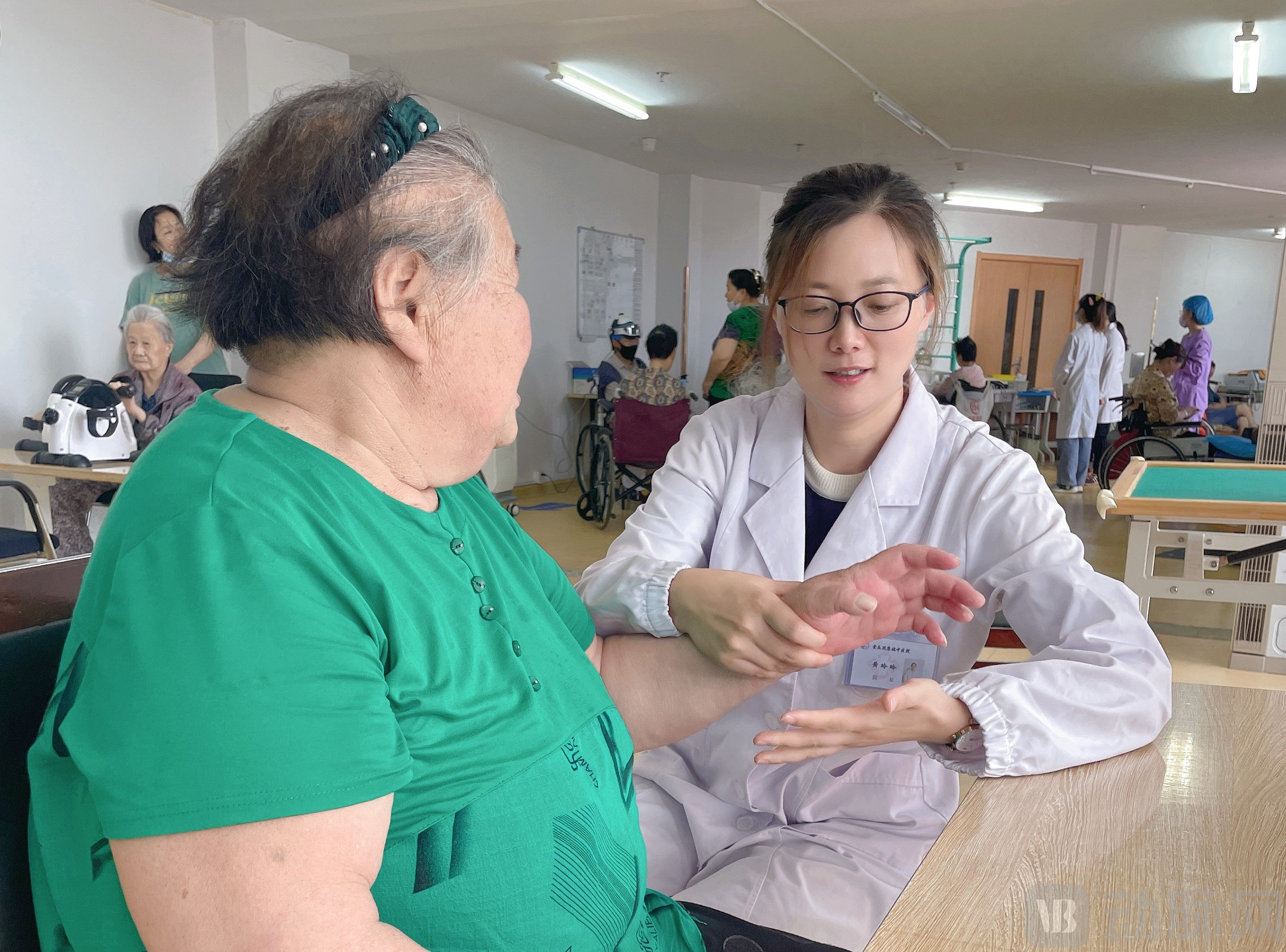
The image shows Huang Lingling, founder of Kanghujia (rightmost), providing rehabilitation guidance.
According to Huang Lingling, patients in the acute phase undergo several cycles of rehabilitation training after receiving treatment at general hospitals. However, due to medical insurance restrictions, the rehabilitation period is not very long. Coupled with the economic costs of hospitalization for rehabilitation and the pressure of family care, many people often give up on rehabilitation directly. AndThe lack of a systematic rehabilitation program may result in the failure to consolidate early-stage rehabilitation outcomes.
Furthermore, in addition to out-of-hospital rehabilitation needs, the aging population is becoming an increasingly severe issue. With a large elderly population at the grassroots level exhibiting extensive rehabilitation and nursing needs, community rehabilitation centers are the most accessible rehabilitation institutions for them.
For the elderly population, rehabilitation and nursing care are closely intertwined, with concurrent needs for both rehabilitative therapy and rehabilitative nursing.
Years of grassroots rehabilitation experience led Huang Lingling to consider whether it was possible to create a product and service model centered on rehabilitation while also addressing the daily living needs of elderly individuals at home and people with disabilities. This became the original intention behind founding Kanghujia.
“Kanghujia has achievedSystematically provide rehabilitation, nursing, and elderly care services, extending professional rehabilitation services to communities and homes.“, enabling more individuals with rehabilitation needs to access more systematic rehabilitation services,” said Huang Lingling.
By integrating online and offline channels, Kanghujia provides comprehensive “healthcare and nursing” services to those in need. Online, users canSelect rehabilitation needs on the Kanghujia Mini Program,The system will evaluate geographic location, rehabilitation therapists, and other factors.Smart Matching, providing community-based and home-visit services to users.
Offline, Kanghujia throughUpgrade Community Stores, focusing on providing professional rehabilitation services, rehabilitation guidance, and rehabilitation prescriptions; offering medical health monitoring and nursing care services; and providing rehabilitation and elderly care consulting to local communities in need.
Meanwhile, by integrating internet-based healthcare services, Kanghujia also provides the elderly and individuals with disabilities withInternet-Based Home Video Doctor, providing on-demand online health and medical consultations, integrated with professional offline rehabilitation and nursing services, to deliver comprehensive wellness and healthcare solutions for the elderly and individuals with disabilities.
Leveraging its offline service outlets, integrating an intelligent supply-and-demand scheduling system, and incorporating mobile internet-based home video doctor services, Kanghujia has created a seamless online-to-offline integrated “healthcare and nursing” comprehensive service solution.
To ensure service capability, Kanghujia has also established a professional R&D team dedicated to information technology, introducing mobile internet and Internet of Things (IoT) technologies to the rehabilitation industry to serve the elderly population. Offline, it has built a professional team of rehabilitation technicians covering rehabilitation nursing, elderly care, and medical services, providing one-on-one, systematic rehabilitation and nursing care.
“Our goal is to leverage technology and rely on information platforms to better assist those in need, providing systematic solutions for health and elderly care issues,” said Huang Lingling.
Since its inception, Kanghujia has consistentlyHealth Technology CompanyAs its own positioning,Deeply Empowering the Field of Rehabilitation and Nursing Services with Technology, utilizing intelligent and portable devices to address the lack of equipment for home-based rehabilitation.
Currently, Kanghujia has established its first offline store in Qixia District, Nanjing. Meanwhile, Ailesi, Kanghujia’s largest rehabilitation service provider, operates more than 40 community-based rehabilitation service outlets in Nanjing and may collaborate with Kanghujia to deliver services in the future.
Looking toward the future, Kanghujia aims to establish a rapidly replicable service model through its offline stations in the short term. In the long run, it seeks to collaborate with rehabilitation and nursing institutions interested in partnership, leveraging Kanghujia’s system platform to jointly create an integrated online-to-offline comprehensive healthcare and elderly care service.
After years of dedicated work in the field of rehabilitation, Huang Lingling’s greatest sentiment is that it has been a journey of hard work yet profound fulfillment.
“The populations we serve may include individuals requiring rehabilitation for decades on end, those with congenital disabilities, or patients in the early stages of rehabilitation. Since delving deeper into the rehabilitation sector, particularly in providing home-based services, I have come to realize more profoundly that a rehabilitation process lacking systematicity, comprehensiveness, and continuity is unlikely to achieve desired outcomes,” said Huang Lingling.
Currently, Kanghujia has launched its first round of financing. In the future, we hope to collaborate with more local channels to provide professional and systematic services to a broader population, empower rehabilitation nursing with technology, offer reference value to the industry, and jointly promote the advancement of the rehabilitation sector.