

EnsoData Files for IPO: AI-Powered Sleep Apnea Diagnosis Platform Serving Over 500,000 Patients with 94.9% Detection Accuracy

EnsoData
Sleep Diagnosis Analysis Software Developer
“Getting a good night’s sleep” has become the most sincere wish among young people today.
According to the World Health Organization, 27% of the global population suffers from sleep disorders. Sleep is as vital to humans as oxygen; while we are unaware of its presence during normal breathing, deprivation of it causes suffering every second.
Obstructive Sleep Apnea (OSA) is a common clinical sleep-related breathing disorder, which literally means “cessation of breathing during sleep.” The disease has a high prevalence, affecting approximately 2%–4% of the population, and carries a risk of mortality. Its main clinical symptoms include snoring, frequent awakenings, and excessive daytime sleepiness. Most OSA patients report loud snoring during sleep; however, not all snoring indicates OSA. Simple snoring is generally not alarming, whereas intermittent snoring that starts and stops is the most concerning.
How can one distinguish between simple snoring and sleep apnea?
If you experience intermittent snoring at night, wake up with headaches despite a full night’s sleep, or suffer from daytime sleepiness, it is advisable to monitor your sleep. For patients suspected of having sleep apnea, polysomnography (PSG) is recommended.
Polysomnography is the gold standard for diagnosing OSA. The American Sleep Disorders Association (ASDA) classifies sleep monitoring devices into four categories. Category I consists of PSG equipment installed in sleep laboratories, with a 100% detection rate, representing the “gold standard.” Category III comprises home sleep apnea testing (HSAT) devices, which are currently the most widely used in clinical practice. These devices have a slightly lower detection rate that varies by brand, generally exceeding 70%.
A standard PSG should record parameters such as cardiorespiratory, neurophysiological, and sleep stage data during the subject’s sleep, specifically including electroencephalography (EEG), electrooculography (EOG), electrocardiography (ECG), blood oxygen saturation, and leg movements (optional). The entire testing process is conducted by professionals in a sleep laboratory, and overnight monitoring yields a waveform chart encompassing the aforementioned data.
Interpretation of waveforms by specialized physicians is time-consuming and labor-intensive, and is constrained by factors such as facility space, bed availability, and staffing. Consequently, the frequency of standard polysomnography (PSG) procedures remains low.
Shortage of Sleep Monitoring Beds and Staff, EnsoData Develops AI Software for Automatic Triage
Manual interpretation of medical images is challenging, whereas AI holds inherent advantages in data processing and feature extraction. Waveform tracings are ubiquitous in healthcare, and the use of artificial intelligence to interpret them is becoming an inevitable trend.
EnsoData is a SaaS company that leverages AI to analyze various medical waveforms and tracings. Headquartered in Wisconsin, USA, and founded in 2015, the company currently focuses on the sleep medicine sector and has three FDA-cleared AI software products: EnsoSleep, EnsoTST, and EnsoViewer. In addition to the United States, these three software solutions are also available for sale in Canada and Colombia.
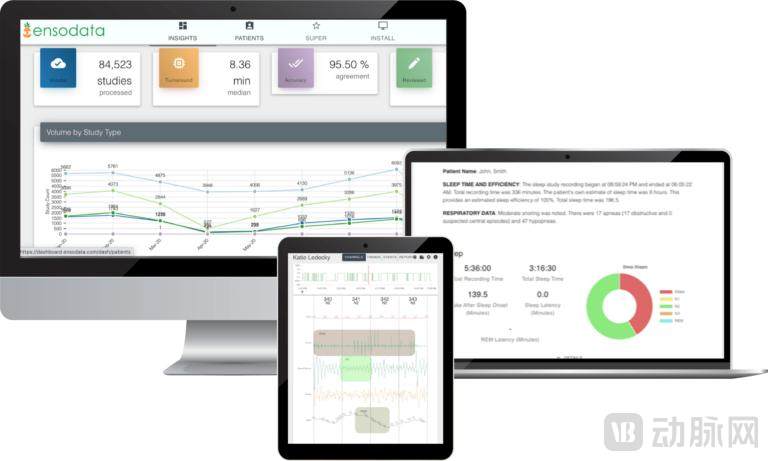
EnsoData Software Interface | Image Source: Official Website
The company’s three founders, Chris Fernandez, Sam Rusk, and Nick Glattard, met while studying at the University of Wisconsin. During their college years, they harbored the idea of founding an artificial intelligence enterprise, and after graduation, they decided to focus on the analysis of sleep monitoring data.
Mirroring the global landscape, the U.S. sleep monitoring market faces shortages in facilities, beds, and personnel. Currently, sleep centers in the United States adopt two primary solutions: First, patients without comorbidities are advised to undergo Home Sleep Apnea Testing (HSAT), with diagnostic analysis performed either automatically by the device or remotely by the sleep center upon data transmission. Second, Polysomnography (PSG) is conducted at sleep centers, which outsource the data analysis to third-party companies.
This is the result of the continuous development of the U.S. sleep monitoring industry, yet problems still persist.
For example, a key metric in sleep monitoring is the Apnea-Hypopnea Index (AHI). The AHI is defined as the average number of apneas and hypopneas per hour during sleep. A higher AHI indicates more severe obstructive sleep apnea. For instance, if a patient sleeps for 7 hours in one night and experiences 350 episodes of apnea and hypopnea, their AHI would be 50.
Most home sleep apnea testing (HSAT) devices prioritize portability by omitting EEG leads, which precludes the determination of sleep onset and awakening times. Consequently, total recording time (TRT) is used as a substitute for total sleep time (TST) in calculating the apnea-hypopnea index (AHI). Since TRT ≥ TST, this leads to an underestimation of AHI values, resulting in false-negative diagnoses of obstructive sleep apnea (OSA) and reduced detection rates.
Another approach to outsourcing data analysis is not only time-consuming but also leads to increased costs.
OSA diagnosis rate: 94.9%; maximum cost per analysis: $16.5
Therefore, EnsoData primarily needs to address two issues: first, accuracy, and second, cost.
The accuracy of AI analysis is closely tied to the database and algorithms. According to EnsoData, its database contains sleep monitoring data from over one million users, and it continues to expand as the user base grows. Its algorithms employ active machine learning, rather than relying on manually programmed rules for passive pattern matching.
In 2017, EnsoSleep, the first FDA-approved AI-powered sleep analysis software from EnsoData, was launched. The software automatically analyzes raw data obtained from PSG or HSAT monitoring to provide sleep staging and sleep apnea assessments, and is indicated for patients aged 13 years and older.
According to EnsoData’s official website, the detection rate for sleep apnea using EnsoSleep is 94.9%, and the accuracy of Apnea-Hypopnea Index (AHI) assessment is 93%. Like most AI triage software, EnsoData emphasizes both the high accuracy of its AI analysis and that its judgments are intended solely as recommendations, not as definitive diagnoses; physicians should review the results.
Unlike traditional outsourced data analysis, EnsoSleep integrates directly with the sleep center’s existing devices or data review software. EnsoSleep extracts raw data from sensors or device databases, eliminating the turnaround time associated with outsourcing. Healthcare professionals can then access diagnostic results directly through EnsoData’s software platform.
Because EnsoSleep is provided directly to sleep centers, EnsoData can customize EnsoSleep settings according to each center’s preferences—including snoring detection and leg movement parameters—offering a more personalized solution than outsourced analysis.
Regarding pricing, EnsoSleep charges on a per-case basis with monthly settlement and tiered pricing. For up to one case per month, the fee is $16.50 per PSG analysis and $8.25 per HSAT analysis. For 2–100 cases per month, the fee is $16 per PSG analysis and $8 per HSAT analysis. For 300–500 cases, the fee is $15 per PSG analysis and $7.50 per HSAT analysis. The higher the volume, the lower the price.
STS charges an additional fee of $2.5, with users covering sleep clinics and dental clinics.
In addition to diagnosis, EnsoData’s technology also encompasses the formulation of treatment plans, although this capability has not yet been launched as a commercial product. For instance, AI is used to predict CPAP pressure levels. CPAP (Continuous Positive Airway Pressure) involves delivering air through ventilator tubing to keep the upper airway open and is currently the most common method for treating sleep apnea. Pressure requirements vary from patient to patient. The most traditional and accurate approach is manual pressure titration by technicians; however, this method is time-consuming and faces challenges due to staffing shortages.
EnsoData predicts CPAP pressure using patient data such as BMI, AHI, and neck circumference, with an average accuracy of 97.8%.
To address the aforementioned issue of inaccurate total sleep time (TST) prediction in home sleep apnea testing (HSAT), EnsoData has launched EnsoTST, a software solution that calculates TST in home tests using common data from HSAT. This software can be integrated into home respiratory monitoring devices that do not originally measure total sleep time, with an additional fee of $2.50 per HSAT analysis for the added TST calculation.
According to EnsoData, the STS calculated by EnsoTST shows a 90% concordance rate with the STS derived from ECG.
EnsoViewer is a utility software launched by EnsoData to streamline physicians’ workflows. It enables the review and editing of all data obtained from sleep monitoring after raw data acquisition but before the final report is generated, while also allowing users to customize report formats.
To date, EnsoData has served over 500,000 patients and partnered with more than 500 clinics in the United States, including over 300 sleep clinics, as well as a smaller number of dental practices and individual users. Dentists are included because oral appliances are an important method for alleviating obstructive sleep apnea (OSA). Dentists often recommend home sleep monitoring for their patients but lack the expertise to interpret the resulting data, thereby necessitating EnsoData’s involvement.
EnsoData Completes $20 Million Series A FinancingRecently, EnsoData completed a $20 million Series A financing round. The round was led by Inspire Medical Systems, with participation from Zetta Venture Partners, Venture Investors, Supermoon Capital, and others. Inspire Medical Systems is a publicly traded company that treats sleep apnea using neurostimulation therapy.
On EnsoData’s official website, a prominent tagline reads, “We will leverage artificial intelligence to unlock the medical secrets hidden in waveform data, starting with sleep.” EnsoData will use this funding round to expand its team and forge commercial partnerships. In the longer term, the company may venture into fields beyond sleep medicine, such as neurology or cardiology.
China Has a Large OSA Patient Base but a Small Market; Challenges Lie in Public Awareness and Clinical Diagnosis and Treatment
According to data from the 2021 White Paper on Exercise and Sleep, over 300 million people in China currently suffer from sleep disorders. This vast population of individuals with insomnia has spurred the growth of a substantial “sleep economy.” From 2016 to 2020, the overall market size of China’s sleep economy grew from RMB 261.63 billion to RMB 377.86 billion, with furniture and hardware as well as bedding constituting the largest segments, followed by pharmaceuticals and health supplements.
Sleep apnea was previously regarded as a syndrome; however, since 2018, the “Multidisciplinary Diagnosis and Treatment Guidelines for Adult Obstructive Sleep Apnea” have defined it as a sleep-related breathing disorder. Globally, over one billion people are affected by obstructive sleep apnea (OSA), with approximately 176 million cases in China.
In developed countries such as the United States and Japan, sleep apnea has been included in the scope of chronic disease management. In China, the early diagnosis rate of obstructive sleep apnea (OSA) is less than 1%. The concept of OSA has not yet reached widespread public awareness. Low awareness, low early diagnosis rates, and low rates of standardized treatment characterize the current status of OSA diagnosis and management in China.
Currently, most institutions in China capable of conducting sleep monitoring are large tertiary Grade A hospitals in major cities. Companies entering the obstructive sleep apnea (OSA) sector primarily focus their business efforts on sleep monitoring and initial screening, with most still at the angel or seed funding stages. Pioneering companies include Orange Family Health Care, among others. Last year, Orange Family Health Care’s “Sleep Respiratory Data Transmission and Processing Software” received medical device registration certification from the National Medical Products Administration (NMPA). In the future, with advancements in wearable devices and artificial intelligence, remote home-based therapy may emerge as a new model for OSA treatment in China.