

Dr. Ling Zhang of China-Japan Friendship Hospital Leverages Patient Data from Haodf Online to Achieve Clinical Research Breakthrough on Cinacalcet in Secondary Hyperparathyroidism
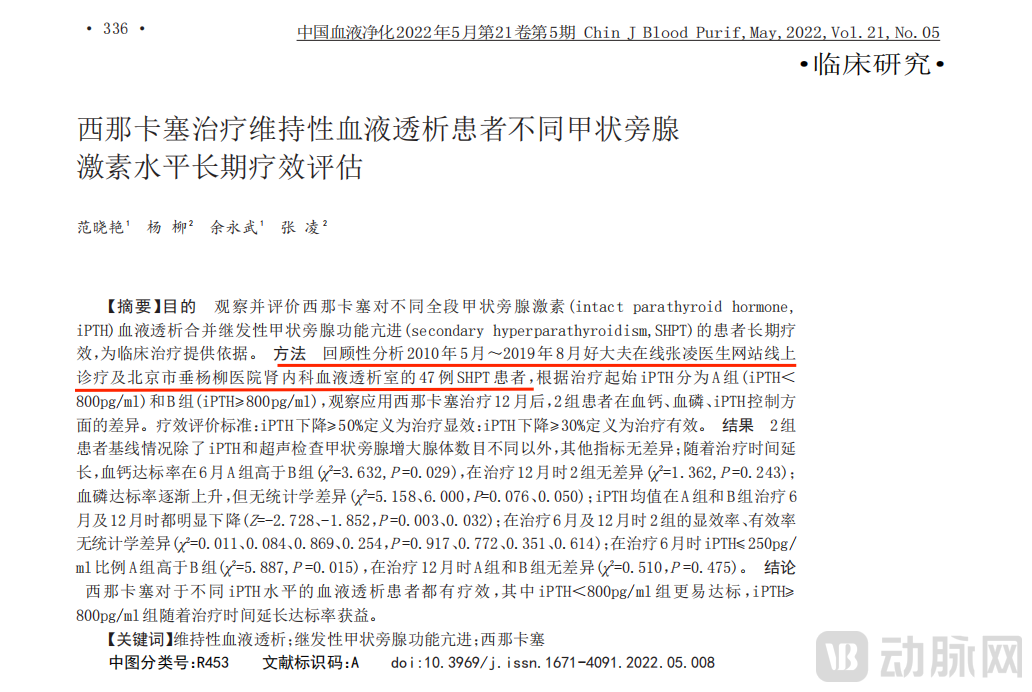
In May 2022, the journal Chinese Journal of Blood Purification, a national-level key academic journal under the supervision of the National Health Commission and sponsored by the Chinese Hospital Management Association, published an original article titled “Long-term Efficacy Evaluation of Cinacalcet in Maintenance Hemodialysis Patients with Different Parathyroid Hormone Levels,” with Dr. Zhang Ling, Chief Physician of the Department of Nephrology at China-Japan Friendship Hospital, serving as the corresponding author. This represents another significant research achievement by Dr. Zhang, who brings over 30 years of clinical experience. She has long been engaged in clinical practice, teaching, and scientific research in nephrology, kidney transplantation, and blood purification. Dr. Zhang is proficient in the application of various blood purification techniques and possesses unique expertise in managing complex complications of uremia, particularly demonstrating extensive experience in the diagnosis and treatment of renal osteodystrophy.

Director Zhang Ling
This latest research study focused on 30 patients who consulted Director Zhang Ling online via Haodf.com between May 2010 and August 2019, as well as 17 patients undergoing maintenance hemodialysis in the Hemodialysis Unit of the Nephrology Department at Beijing Chuiyangliu Hospital. “The sample for this study was drawn from across China, featuring a long follow-up period and numerous data points, which made data collection highly challenging. Haodf.com played a significant facilitating role in this research,” stated Director Zhang Ling.
China currently has over 130 million patients with chronic kidney disease, including more than one million patients with uremia who require dialysis treatment. Secondary hyperparathyroidism is a common complication in patients with end-stage renal disease and is one of the leading causes of disability and even death among these patients. Prior to 2008, there were no highly effective medications available to adequately control secondary hyperparathyroidism (hereinafter referred to as “hyperparathyroidism”) in dialysis patients. This situation persisted until the introduction of cinacalcet; however, cinacalcet was not approved for use in China until 2015. During those seven years, a small subset of patients in China traveled to Hong Kong or abroad to purchase the medication, incurring exorbitant costs. Even after its domestic launch, high prices—exacerbated by the lack of timely inclusion in national medical insurance coverage—deterred many patients from accessing the drug. From 2008 to 2019, a span of 11 years, patients who maintained continuous treatment for more than one year were exceedingly rare.
In 2019, cinacalcet was officially included in China’s National Reimbursement Drug List, leading to its widespread adoption among renal patients across the country. However, Zhang Ling noted that there was still no domestic study providing comprehensive data support and adequate clinical guidance for physicians’ prescribing practices. She resolved to fill this gap.
Zhang Ling’s success stems not only from her robust clinical research capabilities but also from a crucial factor: a dedicated cohort of patients who have maintained long-term follow-up. In China, she may be the only physician with access to data on patients with secondary hyperparathyroidism who have been continuously treated for over a year. As early as 2012, she established a presence on Haodf Online, enabling post-consultation patients from across the country to maintain long-term contact with her for medication guidance. “I establish patient cohorts to facilitate management, such as those undergoing parathyroidectomy, those using cinacalcet, and those with hypertension, chronic glomerulonephritis, or chronic renal failure. This allows me to efficiently distribute follow-up questionnaires, medical education materials, and notifications about public welfare lectures to these patient groups, thereby enabling long-term tracking of treatment outcomes.” “For new drugs like cinacalcet, there was initially no extensive experience with long-term use.” However, over the years, Zhang Ling and her patients have “crossed the river by feeling the stones,” gradually accumulating rich clinical experience and patient data.
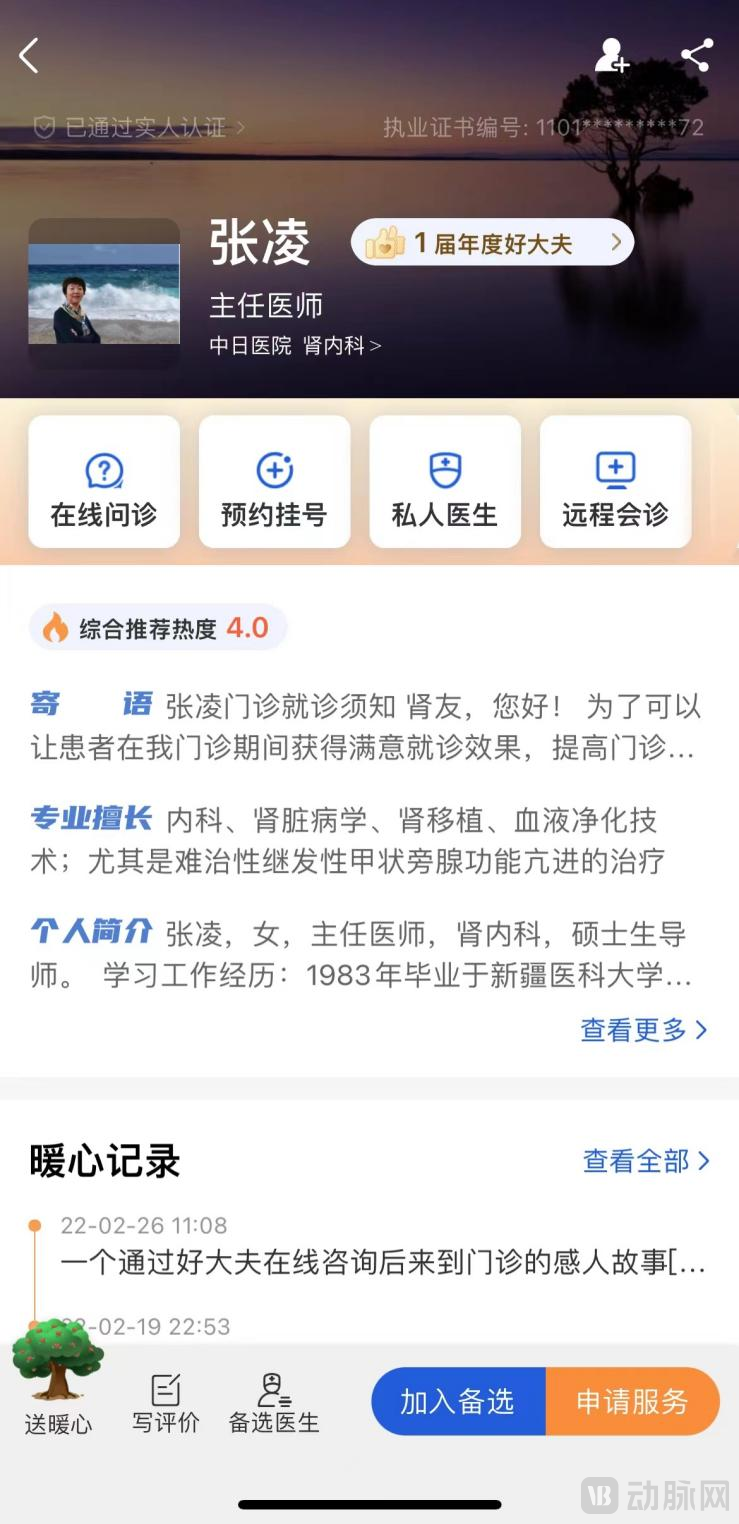
Dr. Zhang Ling’s Homepage on the Haodf Online App
“Without data, scientific research lacks a foundation, and clinical experience cannot be summarized with evidence-based medical support. Haodf Online has not only increased my visibility among patients but also helped me accumulate valuable patient data, enabling my team and me to conduct this study. I hope these research findings will help our colleagues in China use new drugs like cinacalcet more effectively and scientifically, thereby benefiting more patients with kidney disease,” said Zhang Ling. “I urge more physician colleagues to make full use of internet tools such as Haodf Online. While helping patients, we should prioritize long-term patient management and data accumulation, thereby generating more valuable clinical research outcomes.”
Over the past decade, Haodf Online has become deeply integrated into Zhang Ling’s clinical practice. She currently logs on at least twice daily to answer patient inquiries and has assisted 4,996 kidney disease patients through the platform, including 1,506 patients under follow-up care. Additionally, she engages in academic exchanges with peers on Haodf Online, having supported 128 physicians working in primary-care dialysis units.
For Zhang Ling, internet-based healthcare has long ceased to be divided into online and offline components; instead, it has become an integral part of her patient care process. The internet has not only expanded the breadth and depth of her services but, more importantly, has facilitated the accumulation of valuable clinical data. This data aids in summarizing clinical experience, ultimately helping more patients achieve better treatment outcomes.