

Bosch Tech Unveils Integrated Smart Nursing Solutions, Covering Over 80 Tertiary Hospitals in Sichuan After Six Years of Deep Market Penetration
Recently, the National Health Commission released the "National Nursing Career Development Plan (2021-2025Year)》, emphasizing the need to fully leverage information technologies such as cloud computing, big data, the Internet of Things (IoT), blockchain, and mobile internet, in conjunction with the development of smart hospitals and “Internet+“Medical and Health” requirements, focusing on strengthening the construction of nursing informationization. Utilizing information technology to innovate nursing service models, providing patients with convenient and efficient nursing services.
In recent years, the Chinese government has repeatedly emphasized from a policy perspective the need to strengthen the informatization of nursing care, and the smart nursing sector is now emerging with great momentum.
Compared to emerging enterprises that have risen with the wind, those who have been quietly cultivating in this field for six yearsSichuan Boshi Technology Information Industry Co.,Ltd.(hereinafter referred to as“Boshi Technology”) Having participated in and witnessed the development of smart nursing in China from its inception to large-scale implementation, we are better positioned to convey the industry’s overall development trends.
Boshi Technology, established in 2002, is a provider and service specialist dedicated to healthcare informatization solutions. Under its “Boyi Jingcheng” brand, the company focuses on the research, development, and sales of software and hardware products for smart nursing, smart wards, intelligent dialysis, and intelligent follow-up care. It has achieved nearly 100 successful healthcare informatization cases within Sichuan Province, with certain products ranking first in market share in the region.
Boshi Technology retains the same understated demeanor as its founder, maintaining a low profile externally while enjoying a strong reputation within Sichuan’s industry.
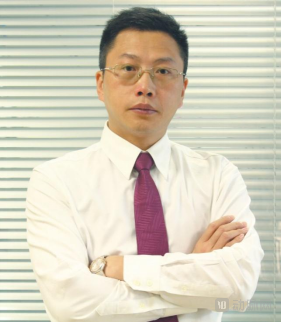
Luo Jianbo, Founder of Boshi Technology
Luo Jianbo, founder of Boshi Technology, is a serial entrepreneur.
Previously, his professional and entrepreneurial endeavors were focused on channel distribution and system integration, serving as an agent and distributor for Cisco, Huawei, H3C, and Sangfor. His company once became one of the largest distributors for these companies in Sichuan and even the entire Southwest region.
While crafting garments for others is undoubtedly noble, the entrepreneurial spark buried deep within his heart continued to pulse, faintly yet distinctly. This prompted Luo Jianbo to contemplate the second curve of his life and career. In 2011, he pursued an EMBA at Sichuan University, which significantly transformed his mindset and awareness. At the beginning of 2016, he entered the healthcare industry, focusing on healthcare informatization—a commitment he has maintained ever since.
Over two decades of experience in marketing, channel development, and successful enterprise management and operations laid a solid foundation for the launch of Boshi Technology. During his subsequent six-plus years of entrepreneurial ventures in the healthcare industry, Luo Jianbo continuously honed his expertise, pursued an MBA in Hospital Management at West China Hospital of Sichuan University, and served as a Council Member of the Sichuan Health Information Association and as an Executive Committee Member of its Nursing Informatics Professional Committee.
Deeply aware of the importance of talent, Luo Jianbo devoted considerable effort to building his management team. The team comprises top-tier sales professionals who previously served as provincial regional managers at NCH (China) and were named top sales performers for three consecutive years; R&D specialists who serve as off-campus master’s supervisors at the University of Electronic Science and Technology of China; and nursing experts who have held deputy director positions in the nursing departments of tertiary public hospitals. With each member bringing unique strengths, they have formed a formidable force in smart nursing care.
In terms of talent development, Luo Jianbo spares no effort. While arranging various business and skills training sessions for employees is standard practice, he ensures that R&D personnel remain connected to frontline operations by having them observe surgeries at partner hospitals every six to twelve months, where they engage with frontline medical professionals to gather feedback on the use of software products.ContinuouslyDelve Deep into Needs, Refine Product and Service Offerings.
And such dedication is directly reflected in the products of Bosch Technology.
Like many healthcare IT companies, Boshi Technology began by entering the market with hardware products, and its electronic whiteboards for nurse stations served as the pioneering product that enabled the company to gain a foothold in hospitals.
Traditional healthcare IT companies mostly interact with hospitals’ infrastructure and information departments, rather than clinical operations teams. Luo Jianbo is well aware that while a pure hardware-sales model is straightforward, it tends to hit a value ceiling early on. Therefore, at the outset of the company’s development, Luo Jianbo and his team defined their strategic path as follows: “Starting with electronic whiteboards at nursing stations as the entry point for product R&D, we will build a comprehensive suite of software and hardware solutions centered on nursing workflows—including nursing management, smart wards, specialty nursing, and transitional care—to support the construction of smart hospitals.”
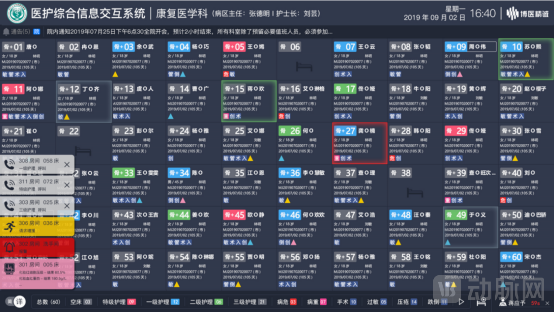
Bosch Technology Integrated Healthcare Interaction System
Bosch Technology was among the first companies in Sichuan Province to propose solutions for upgrading smart nurse stations. Several years ago, Bosch Technology’s electronic whiteboards for nurse stations were already far ahead of competitors in terms of conceptual design, product performance, and industry reputation. This leadership is clearly reflected by its number-one market share. Today, having completed its channel layout, Bosch Technology is focusing onIntegrated Smart Nursing Solution, which includesClinical Nursing Information System, Nursing Management Information System, Smart Ward Information SystemThree parts.
Clinical Nursing Information System: Dual-Driven by Nursing Terminology and Nursing Process to Promote Homogeneous, High-Quality Nursing Care Services
Leveraging the development of a specialized Nursing Clinical Decision Support System (NCDSS), Sichuan Boshi Technology Information Industry Co., Ltd. has collaborated with top-tier nursing experts in China to research and develop a Clinical Nursing Information System. Through this system, nurses conduct patient care assessments, and nursing diagnoses are automatically generated. By linking nursing goals, interventions, and health education materials within the system, nurses can rapidly formulate care plans. Upon completion of plan execution, the process automatically transitions to evaluation. This closed-loop workflow automatically generates nursing records, establishing a continuous improvement cycle based on the PDCA (Plan-Do-Check-Act) model. This approach fundamentally addresses issues such as non-standardized nursing processes and reliance on empirical experience, thereby achieving standardization, proceduralization, data-driven management, intelligence, platform integration, and smart capabilities in clinical nursing.
Nursing Management Information System: Optimized Allocation of Human Resources and Continuous Improvement of Nursing Quality
Boshi Technology, grounded in modern nursing science and leveraging next-generation information technologies, has developed a new-generation nursing management information system that is standardized, systematic, intelligent, and platform-based. This system addresses key nursing management scenarios, including human resources, nursing quality, and administrative management.
It includes modules for nursing personnel file management, medical staff scheduling management, hospital training and examination management, nursing quality inspection, hospital adverse event reporting and management, nursing-sensitive quality indicator monitoring, hospital service evaluation management, nursing affairs management, nursing dossier management, and nursing management decision support. These systems help hospitals optimize human resource allocation, invigorate nursing team management, promote continuous improvement in nursing quality, enhance nursing work efficiency, and increase the value of data assets.
Smart Ward Information System: 18 Core Functions for Refined Care
Boshi Technology adopts a patient-centric approach, centering on “high-quality nursing” and “refined care.” By leveraging next-generation information technologies such as the Internet of Things (IoT) and artificial intelligence (AI), and relying on its self-developed intelligent interactive terminal devices and smart software systems, it has built an IoT-based comprehensive smart ward service platform integrated with wired/wireless networks and 4G/5G connectivity. The platform showcases 18 core functions—including electronic bedside cards, electronic door signs, call and intercom systems, bedside interaction, ward broadcasting, health education, assistance alerts, mobile payment, infusion monitoring, patient management services, entertainment and information services, nutritional meal ordering, visitation management, remote ward rounds, vital signs monitoring and early warning, patient turning reminders, cost inquiries, and information dissemination—thereby covering the entire spectrum of medical service scenarios within hospital wards.
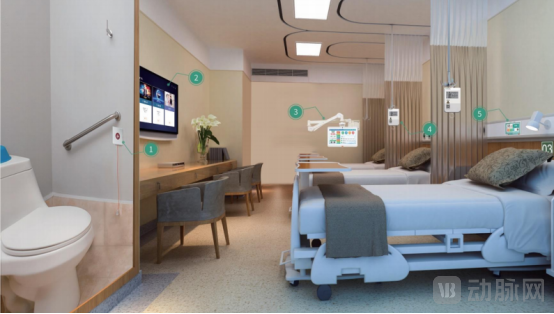
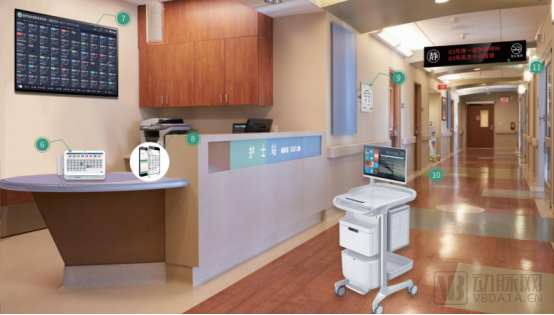
Boshi Technology Smart Ward Example
After a decade of dedicated efforts, Bosch Technology has achieved a high penetration rate in Sichuan Province, establishing partnerships with West China Fourth Hospital of Sichuan University, Wenjiang Hospital of Sichuan Provincial People's Hospital, Guangyuan Central Hospital, Guangyuan Hospital of Traditional Chinese Medicine, Panzhihua Central Hospital, Ya'an People's Hospital, Leshan People's Hospital, Luzhou Hospital of Traditional Chinese Medicine, and the Fourth People's Hospital of Zigong, among others.More than 80 large tertiary hospitalsAchieved cooperation.
In addition, Bosch Technology is also actively engaging in multi-dimensional strategic cooperation with upstream and downstream resource partners—University of Electronic Science and Technology of ChinaFacilitate collaboration among technical professionals; andMaya Information, Rockchip Electronics, BOEEngage in product resource collaboration; withSichuan Nursing Association, Sichuan Health Information Association, and the Nursing Informatics Professional Committee of the Sichuan Health Information SocietyEngage in expert resource collaboration; withWest China Fourth Hospital, Sichuan UniversityConduct benchmark pilot collaborations.
At this stage, Boshi Technology’s services are primarily focused on in-hospital scenarios. According to Luo Jianbo’s plan, Boshi Technology will fully integrate in-hospital and out-of-hospital scenarios in the future by providing an “Internet + Nursing Services” operation platform, an “Internet + Caregiver Services” operation platform, and a Smart Home Health Care operation platform. This will achieve integrated services for medical professionals, nurses, patients, and caregivers, thereby realizing full-process closed-loop operational management of integrated smart nursing.
According to Luo Jianbo, smart nursing will move towards the future in the direction ofStandardization, Process Optimization, Data-Driven Operations, Intelligent Automation, Platform Integration, and Smart Transformationdirection. In terms of strategic layout, the company has established Sichuan as its base, refining its operational strategies and consolidating experience to gradually expand into Southwest and Northwest China, with the ultimate goal of serving the entire Chinese market.
At this stage, the company has three primary objectives. First, driven by clinical needs, it aims to collaborate with leading tertiary hospitals, nursing colleges, and principal investigators (PIs) in China to refine nursing standards and clinical knowledge bases, establish best practices for integrated smart nursing solutions, and build competitive product barriers. Second, guided by R&D needs, it seeks to recruit core R&D technical and managerial talent to strengthen its talent and technological barriers. Third, it is pursuing resource partnerships and equity financing to support product development, team upgrading, marketing, and customer expansion.