DTA, Weimai, and VB Insights Jointly Release 'Digital Therapeutics Value Assessment and Integration Guide' to Advance Industry Standardization

Weimai
Digital Health Service Platform Provider
Whether in China or abroad, digital therapeutics (DTx) are undoubtedly one of the hottest topics in the healthcare sector today. This is hardly surprising—digitalization had already become an overarching trend in the healthcare industry even before the COVID-19 pandemic. At that time, digital therapeutics began to gain prominence by demonstrating their advantages in managing specific diseases within particular clinical scenarios. During the pandemic, various industries, either proactively or reactively, intensified their exploration and application of digital technologies, achieving notable results. For instance, several digital therapeutic products that received emergency authorization from the U.S. Food and Drug Administration (FDA) in the early stages of the pandemic proved their value during this period and subsequently obtained formal approval.
Of course, it must be acknowledged that digital therapeutics is an emerging field. As a product of multidisciplinary integration, it entails certain technical barriers. More importantly, industry consensus has not yet been fully reached, and there is a lack of corresponding frameworks and regulatory standards. This has led to considerable confusion and misunderstanding among many people regarding the recognition and comprehension of digital therapeutics, let alone enabling an objective and accurate assessment of their value.
The industry has been striving to refine this. On June 16, the Digital Therapeutics Alliance (DTA), Weimai, and VCBeat—recognized as some of the most significant and active driving forces in the digital therapeutics sector—jointly released the Chinese version of the Guidelines for Value Assessment and Integrated Application of Digital Therapeutics (hereinafter referred to as the “Guidelines”) at the 6th Future Healthcare 100 Summit. This initiative aims to further promote the healthy and orderly development of the digital therapeutics industry.
In the digital therapeutics industry, the most frequently asked questions are invariably: “What are digital therapeutics? Which interventions qualify as digital therapeutics, and which do not?” Furthermore, perceptions and requirements regarding digital therapeutics vary across the industry, depending on the stage of industry development, regional characteristics, and differing stakeholder perspectives.
For instance, regulators and digital therapeutics companies may not see eye to eye on regulatory requirements for digital therapeutics—the former favoring a stringent approach, while the latter leaning toward a more lenient one. Clearly, if consensus cannot be reached on these foundational frameworks, the industry’s development will inevitably face significant obstacles.
At the press conference, Chen Peng, a senior editor at VCBeat and a senior researcher at VBInsight, who has long observed the digital therapeutics industry, stated that China’s digital therapeutics sector is still in its early stages and lacks clear regulatory policies specifically tailored to digital therapeutics. Although the number and variety of approved products meeting the definition of digital therapeutics have accelerated in recent years, significant confusion surrounding them persists.
Bai Yan, Director of the Strategic Investment Department at Weimai and Co-Chair of the DTA Asia Research Center, stated that many digital therapeutics (DTx) products from Chinese enterprises are currently in the registration application phase or undergoing clinical trials, with some having already obtained medical device registration certificates. However, commercialization still requires significant development, as there is a lack of national health insurance coverage for DTx. At present, out-of-pocket payment by patients remains the primary reimbursement model for digital therapeutics in China.
Even in the United States, where digital therapeutics are on the rise, these issues constraining industry development have not been fully resolved. Megan Coder, Founder and Chief Policy Officer of the Digital Therapeutics Alliance (DTA), has also stated that even in the U.S., there is still no coding system that would allow digital therapeutics to be recognized by public payers. To make digital therapeutics accessible to patient populations, the Digital Therapeutics Alliance is working with the U.S. Congress to explore new approaches for recognizing digital therapeutics.
Meanwhile, in Germany, where fast-track approval pathways and reimbursement mechanisms for digital therapeutics (DTx) have already been established, the adoption rate of DTx remains slower than anticipated. This is primarily because clinicians were not involved in the early-stage discussions on product design, and thus, greater time is still required to foster their acceptance of DTx.
These pain points constraining industry development served as one of the catalysts for the release of the Guidelines. Megan believes that the Guidelines provide a comprehensive overview of digital therapeutics, illustrating the full spectrum of considerations involved in their development, regulation, evaluation, and practical application.

"Guidelines for the Value Assessment and Integrated Application of DTA Digital Therapeutics" Global Connection (Screenshot from Live Broadcast)
Defining terms, resolving discrepancies, and thereby guiding healthcare decision-makers in the evaluation and application of digital therapeutics to meet the needs of the industry ecosystem—this is precisely the purpose behind the release of the Guidelines. In terms of definition, the Guidelines adhere to the prior definition established by the Digital Therapeutics Alliance, regarding Digital Therapeutics (DTx) as interventions driven by high-quality software programs that deliver evidence-based preventive, management, or therapeutic interventions for diseases or symptoms; they may be used independently or in conjunction with medications, devices, and other therapies.
Digital Therapeutics overlaps with the concepts of Digital Medicine and Digital Health. These three form a hierarchical inclusion relationship, specifically: Digital Health > Digital Medicine > Digital Therapeutics. In particular, since both health apps within the definition of Digital Health and Digital Therapeutics are software-driven, distinguishing between Digital Therapeutics and health apps remains one of the most frequently encountered challenges.
The Guidelines also provide a detailed distinction to differentiate digital therapeutics from health apps, defining the following fundamental principles for digital therapeutics: prevention, management, or treatment of a specific disease or condition; delivery of medical interventions through software; integration of best practices in product design, manufacturing, and quality management; involvement of end users throughout both product development and application processes; incorporation of patient privacy and safety protections; integration of best practices for product application, management, and maintenance; publication of clinically significant experimental results in peer-reviewed journals; obtaining review, approval, and certification from regulatory authorities, along with clear statements regarding potential risks, clinical efficacy, and intended use; and the collection, analysis, and application of real-world evidence and/or product performance data, including disclosures concerning clinical evaluation and regulatory status.
Meanwhile, the Guidelines provide a comprehensive overview of digital health technologies and clarify the positioning of digital therapeutics (DTx) within the healthcare ecosystem. They also offer a concise and clear decision-making framework for evaluating DTx products, enabling healthcare decision-makers to make informed assessments. This is crucial for healthcare decision-makers (HCDMs), including payers, employers, government entities, evaluators, health system administrators, clinical research leaders, patients, and other stakeholders involved in DTx-related decision-making.
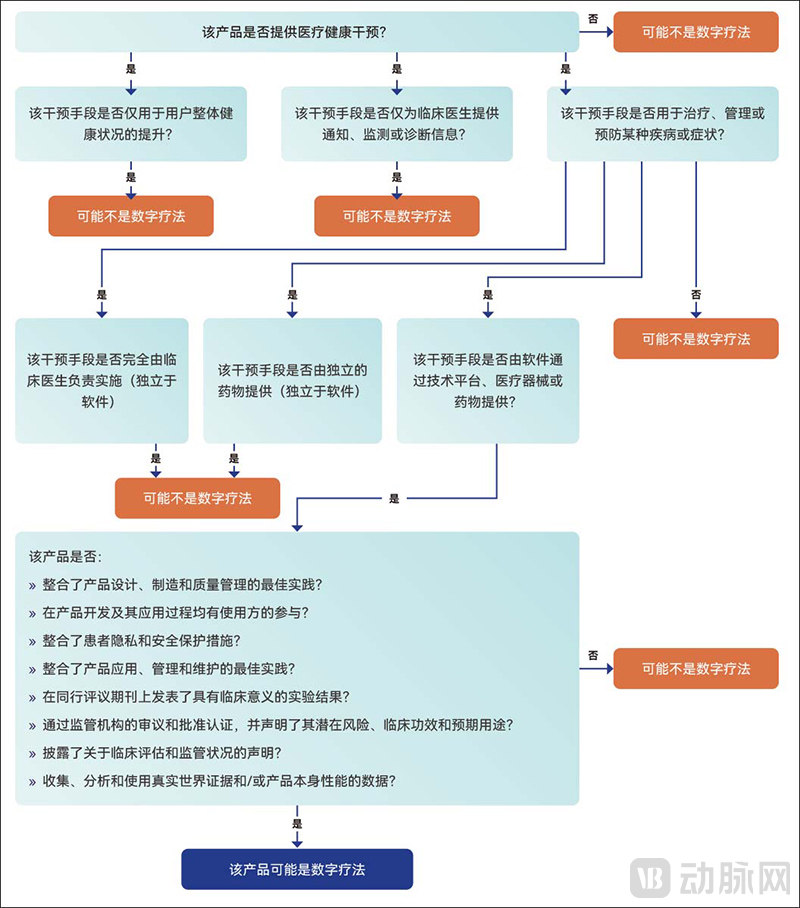
Identification Methods for Digital Therapeutics Products (Screenshot from the Guideline)
Prior to the emergence of digital therapeutics (DTx), healthcare decision-makers had already established unified evaluation frameworks for assessing other evidence-based clinical interventions, such as pharmaceuticals and medical devices. However, the nascent DTx industry lacks a standardized framework for evaluating the merits and drawbacks of digital therapeutics. Consequently, many decision-makers are compelled to rely on their own methodologies to assess DTx products, resulting in highly fragmented requirements and evaluation criteria for DTx manufacturers across local, regional, and national levels.
If this situation does not improve, it would mean that digital therapeutics manufacturers must meet varying framework requirements to drive product access in different regions. With differences among these frameworks being highly random and devoid of any discernible pattern, the task would be virtually impossible.
Therefore, a primary objective of the Guidelines is to integrate existing diverse assessment frameworks to establish unified evaluation criteria and processes for healthcare decision-makers and digital therapeutics manufacturers throughout the product assessment lifecycle. This assessment tool is designed to evaluate the basic information, clinical utility, and real-world impact of digital therapeutics products.
Meanwhile, given that digital therapeutics are in a phase of rapid development, this unified framework should also be capable of quick and dynamic adjustments. Therefore, the Guidelines will be continuously revised and updated to promptly reflect the rapid evolution of the healthcare ecosystem and meet the needs of all stakeholders. A closer look readily reveals that the officially released version of the Guidelines is Version 2.0. This represents a rapid iteration based on Version 1.0 of the Guidelines, which was developed between June and August of last year.
Megan also stated that 12 of the DTA’s 90 members are Chinese, and future iterations of the Guidelines will be tailored to better suit the Chinese context, thereby ensuring that they provide a high-quality evidence base consistent with international understanding.
“The Guidelines” summarize the commonalities of digital therapeutics, identifying the primary concerns of various healthcare decision-makers—including patients, clinicians (healthcare providers), payers, and policymakers (regulators)—when adopting digital health technologies, including digital therapeutics.
For example, patients using various digital health technologies wish to understand what products they are using, the purposes of use and how they benefit, as well as information related to product information security, personal privacy, and payment costs.
Clinicians need to clarify their expectations for the product, understand how it integrates with other therapies, assess the implications of clinical data and research, and review prescribing authorization requirements. Meanwhile, they also need to understand reimbursement and payment structures to determine whether patients can afford the product.
Information needed by payers includes the types of products eligible for reimbursement, how these products benefit individuals and populations, and the expected clinical outcomes and results. Meanwhile, policymakers, represented by regulatory authorities, need to understand the risks posed to patients by the products and determine the most appropriate regulatory approach for them.
Based on a synthesis of these stakeholder concerns, the Guidelines summarize the common factors that must be considered in the evaluation of digital therapeutics (DTx). At the product level, the Guidelines identify the key factors for DTx evaluation as including basic information, clinical value, technical pathway, information security and privacy protection, authorization and distribution, implementation engagement, evaluation types, and regulatory requirements.
Notably, the Guidelines place particular emphasis on real-world data generated by digital therapeutics (DTx) and their application in real-world settings. In contrast to traditional therapies, the most distinctive feature of DTx is its ability to generate real-world data during patients’ continuous use of the product, which is then shared with appropriate stakeholders in accordance with relevant information security and privacy protection protocols.
These real-world data hold significant value in many aspects, such as providing patients and caregivers with real-time insights into treatment progress and outcomes, generating actionable clinical data to inform clinical decision-making and optimize patient care, or analyzing trends and outcomes at the individual, subpopulation, and population levels.
By integrating additional data sources—including sensors, wearable devices and other product plug-ins, validated patient assessment tools, electronic health records, insurance reimbursement records, and patient insights—the real-world data generated by digital therapeutics are fully reliable. Accordingly, the Guidelines suggest that if individual digital therapeutics have accessible real-world data, it may be unnecessary to conduct additional formal real-world evidence studies specifically for direct patient care.
Distinct from real-world data, real-world evidence is generated through formal clinical study design processes. It primarily involves the formal analysis of real-world data and other data sources to address specific clinical questions related to digital therapeutic products or associated treatments. Generally, real-world evidence is typically derived from prospective or retrospective observational studies.
“The Guidelines” also provide clear and concise explanations regarding when standalone real-world evidence (RWE) studies are or are not required, the benefits of RWE studies, and the evaluation of RWE studies (including responsible entities, input coverage, considerations, result publication and validation, etc.).
In addition, the Guidelines also incorporate relevant reference frameworks for the health economic evaluation of digital therapeutics, providing detailed guidance on preparatory work, the conduct of formal health economic analyses, and the assessment of the health economic impact of digital therapeutics and their broader economic implications.
For example, the Guidelines clearly define the objectives of conducting specific health economic evaluations for digital therapeutics. These objectives include assessing the impact of digital therapeutic interventions on costs, revenues, and other economic factors; comparing digital therapeutics with existing alternative therapies and standards of care; gathering information related to implementation costs and considerations within healthcare systems; and understanding the significance of digital therapeutics in various patient use cases and their impact on medical costs for patients, clinicians, and payers.
Through these references, the Guidelines aim to influence healthcare decision-makers globally, fostering consistent expectations regarding the types of economic data that digital therapeutics companies must generate and submit for formal review, thereby promoting industry development.
Report Table of Contents
I. Establish a Unified Framework for the Evaluation of Digital Therapeutics
Why is this guideline necessary?
Who is the beneficiary?
II. Industry Overview: A Panoramic View of the Digital Health and Digital Therapeutics Ecosystem
III. Considerations for Digital Therapeutics Assessment
Basic Information on Digital Therapeutics Products
Clinical Value
Technical Considerations for Digital Therapeutics
Technical Considerations for Patients
Product Usability
Patient-Centered
Best Practices for Safety
Data Privacy and Governance
Licensing and Distribution of Digital Therapeutics
Clinical Team Involvement
Implementation and Engagement of Digital Therapeutics
Types of Digital Therapeutics Product Assessment
Assessment of Clinical Evidence Types
Assessment of the Quality of Clinical Evidence
Regulation
Types of Real-World Data Generated by Digital Therapeutics
Leveraging Real-World Data Generated by Digital Therapeutics
Development and Impact of Real-World Evidence
IV. Evaluation of Digital Therapeutics Products: Health Economics Assessment
Preparation of Health Economics Analysis for Digital Therapeutics
Conduct Formal Health Economics Analysis
Factors to Consider When Evaluating the Health Economic Impact of Digital Therapeutics
Factors Influencing the Economic Impact of Digital Therapeutics
Considerations for Health Technology Assessment (HTA)
V. Appendix
Questions Regarding Digital Therapeutics Benchmarking
Glossary
Examples of Digital Therapeutics Products
Scan the QR code to download the report: