2026 Landscape of China's Oligonucleotide CXO Sector: Capabilities, Platforms, and Strategic Positioning
Argo
RNAi Drug Developer
Ribo Life Science
Small Nucleic Acid Drug Developer
WuXi AppTec
New Drug R&D and Production Service Provider

ASYMCHEM
Pharmaceutical R&D and Production Outsourcing Service Provider
▲May 14-15Shanghai BiopharmaceuticalInnovators SummitScan to Register
Note:This article does not constitute any investment opinions or suggestions; please refer to official/company announcements for accuracy.This article only introduces drugs related to medical health, not a recommendation of treatment options (if involved), and does not represent the platform's position.Any article reprinted needs to be authorized.
This trend is also significant in China.By the end of 2025, Argo Biopharma reached a collaboration with Novartis with a potential total value exceeding 9 billion USD, setting a new benchmark for BD transactions in non-oncology fields.。Ribo Life Science, China Biologic Products and other companies have successively completed overseas licensing or mergers and acquisitions worth hundreds of millions of dollars. These transactions not only reflect the recognition of international pharmaceutical companies for Chinese innovation, but also highlight the significant leap of small nucleic acids from technology to commerce.
Notably, behind these high-value pipelines, a specialized small nucleic acid CXO force is quietly emerging.
Why Small Nucleic Acid Drugs Are Becoming the New Blue Ocean for CXOs
The research and development and production of small nucleic acid drugs inherently possess the attributes of "high threshold and high complexity." The core challenges mainly focus on the two key aspects of R&D and production.
R&D ProcessThe sequence design must balance targeting efficiency with off-target risks; the chemical modification strategy directly affects stability and immunogenicity, while the delivery system (such as GalNAc, LNP) is crucial in determining drugability.
Production ProcessEven higher standards. The solid-phase synthesis process demands extremely high control over impurities, yield, and scalability, and the lack of unified industry standards caused many early projects to get "stuck" in the transition from milligram to kilogram scale.
For this reason, the traditional CRO/CDMO model struggles to fully meet the demands of small nucleic acids. Service providers with integrated CRDMO capabilities can not only support early-stage target validation and molecular optimization but also streamline the entire chain from preclinical to commercial production.
WuXi AppTec, the leading CXO company in China, has supported multiple siRNA projects entering clinical stages through its TIDES platform. ASYMCHEM, on the other hand, has alleviated domestic companies' anxiety over the "supply disruption" of key delivery components by building its own GalNAc raw material production capacity. Many other CXO companies in China are also striving to leverage their technical advantages to compete in this field.
With the explosion of downstream R&D pipelines and the catalysis of BD transactions, the competition among small nucleic acid CXOs in China will enter a more intense multi-dimensional contest by 2026. The current landscape of small nucleic acid CXOs in China can be clearly divided into three categories: integrated CRDMO platforms, CROs focused on early-stage R&D, and CDMOs emphasizing process and capacity, each playing different roles in the industry chain.
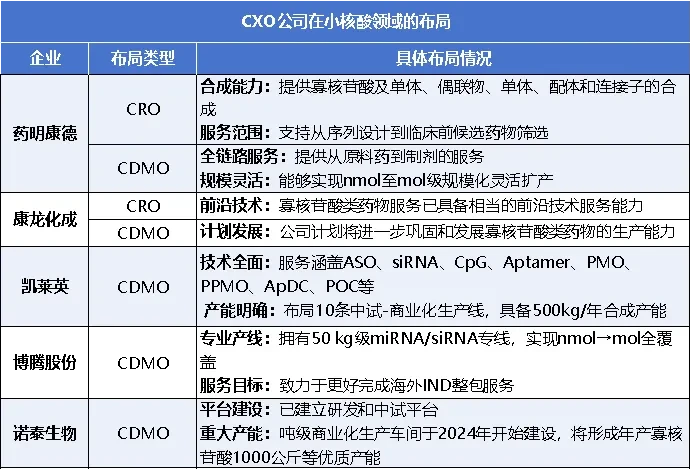
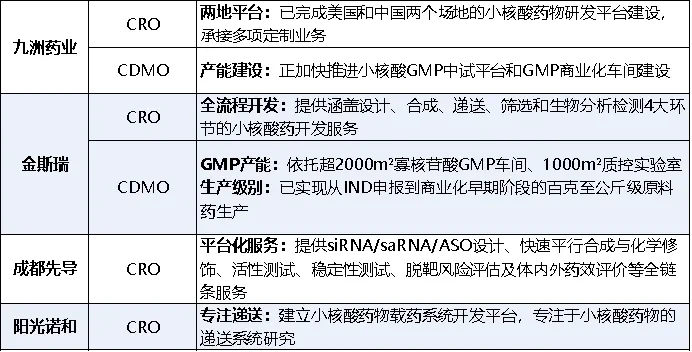
InWuXi AppTec as a representative of integrationCRDMO Platform EnterpriseRelying on its TIDES platform, it provides end-to-end services from sequence design, chemical modification, and delivery system development to GMP production, along with LNP and high-potency injectable formulation capabilities, and has supported multiple siRNA projects in entering the clinical stage.According to the companyThird Quarter Report of 2025TIDES business (covering oligonucleotides and peptides) continues to grow rapidly,Revenue for the first three quarters reachedRMB 7.84 billion, a year-on-year increase of 121.1%; orders in hand increased by 17.1% year-on-year。With the gradual release of new production capacity in 2024 and the early completion of the Taixing peptide base in September 2025, the total volume of solid-phase synthesis reactors will exceed 100,000 liters, further strengthening its integrated service capabilities for small nucleic acids and peptides.
PharmaronIt is also accelerating the layout of small nucleic acid CRDMO capabilities by integrating early discovery, process development, and GMP production resources. It has established a synthesis and analysis platform covering ASO and siRNA and configured pilot-scale oligonucleotide production lines at its US and Tianjin bases, gradually undertaking global customer projects. Additionally,GenScriptWith a GMP workshop exceeding 2,000 square meters, it can provide oligonucleotide API services ranging from hundreds of grams to kilograms;AuritaFocus on the needs of the late clinical and commercialization stages, and advance the construction of a flexible small nucleic acid CDMO production line. Although their scale is still not as large as the leading platforms, they are forming differentiated supplements in specific segments.
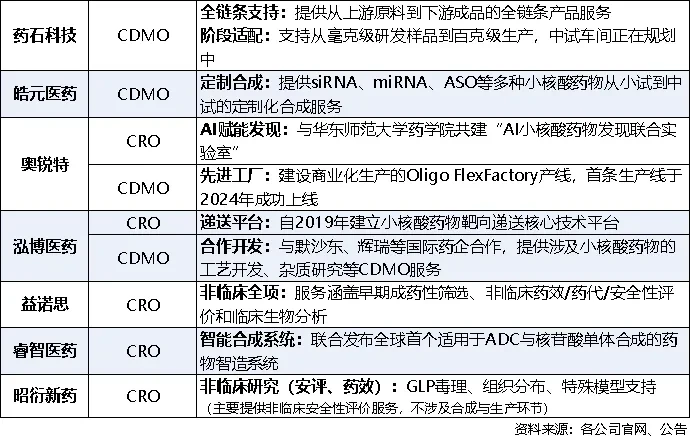
CRO EnterprisesMainly covers the preclinical research phase.HitGenWith the OBT platform, it has differentiated capabilities in siRNA/ASO target screening, sequence optimization, and off-target evaluation. In addition, Xian Dong Pharmaceutical, a holding subsidiary of the company, can provide commercial small nucleic acid API CDMO services that comply with GMP conditions. These services mainly meet the needs from clinical Phase I to III at the hectogram scale, as well as early commercial demands ranging from hectograms to kilograms. Moreover, a production line at the tens-of-kilograms scale can be established in accordance with the progress of product development.Sunshine NovoFocus on the research of delivery systems and establish a small nucleic acid drug-loading platform.JOINN LaboratoriesAlthough not involved in molecular design or synthesis, it has become a key partner in non-clinical safety evaluations (such as tissue distribution and immunotoxicity).
CDMO EnterpriseThe core competitiveness lies in process scaling and commercial supply.ASYMCHEMSignificant progress has been made in this field. Its mid-2025 report shows that the CDMO business revenue of the chemical macromolecule sector (covering oligonucleotides, peptides, toxin conjugates, and Lipid delivery systems) reached 379 million yuan, with a year-on-year increase of over 130%. During the reporting period, 88 projects were delivered, and 38 new customers were added. As of the date of the report disclosure, the amount of orders on hand increased by more than 90% year-on-year, with overseas customers accounting for more than 40%, indicating that its small nucleic acid-related service capabilities have gained international recognition. The company is simultaneously advancing the independent synthesis of key delivery components such as GalNAc and expanding solid-phase synthesis capacity to support full-cycle needs from clinical to commercialization stages.。
In addition,Porton AdvancedA dedicated 50kg-scale siRNA/miRNA production line has been established, aimed at supporting overseas IND applications.Nuotai BiotechPlanning a ton-level GMP workshop, the future annual production capacity of oligonucleotides is expected to reach 1000 kilograms. Companies such as Pharmaron and Hao Yuan Medicine have also established pilot or commercial-scale oligonucleotide synthesis capabilities. Although their scales and stages vary, they collectively form an increasingly diverse supply landscape for small nucleic acid CDMOs in China.
Currently, the small nucleic acid CXO ecosystem in China has initially taken shape, with platform companies like WuXi AppTec and ASYMCHEM that possess full-chain capabilities, as well as specialized service providers focusing on细分环节 such as delivery, safety evaluation, and AI design. The future competition in the small nucleic acid industry will not only be a comparison of production capacity scale but also a comprehensive assessment of technology and industrial synergy capabilities.
2026 will be a pivotal year for China's small nucleic acid CXOs, marking a shift from "passive acceptance" to "active definition."Whether China can occupy a place in the global small nucleic acid track depends not only on the source innovation of Biotech but also on the capability co-construction of this "behind-the-scenes force."
References: Corporate official website, financial reports, and publicly available information
Copyright Statement: This article is reproduced fromThe Era of Biologics, Media or individuals who do not wish to be reprinted can contact us, and we will delete it immediately.