

The Future of Domestic Cardiovascular Device Innovation: Insights and Outlook from Industry Leaders
A Wave of Cardiovascular Technological Innovation Is Sweeping In, with Sustained Heat in the Sector. According to data from VCBeat Orange, global investment and financing in the cardiovascular consumables sector showed an upward trend from 2015 to 2021. In 2020, the sector experienced explosive growth, with total financing increasing by 237% year-over-year. In 2021, financing saw a modest rise, with 58 deals totaling $1.943 billion. This lucrative sector has attracted overseas giants such as Medtronic, Abbott, and Edwards Lifesciences, while domestic innovative enterprises are continuously breaking through, accelerating their efforts to catch up with these industry leaders and fostering original R&D capabilities.
Where lies the future of the cardiovascular industry? What new patterns and models will emerge in each sub-sector? How can Chinese-made medical devices sustain their innovative momentum as they expand into global markets? On June 17, 2022, the Top 100 Future Healthcare Cardiovascular Innovation Development Forum was held online. The forum invited clinical experts, industry researchers, and representatives from innovative enterprises to jointly analyze current industry pain points and future trends from perspectives including forward-looking insights, innovations in clinical procedures, and technological transformations.
Below are the key highlights of the speakers' viewpoints compiled by VCBeat VB100:
From Clinical Needs to Practice: What Is the Future of Innovation in Cardiovascular Surgical Procedures?
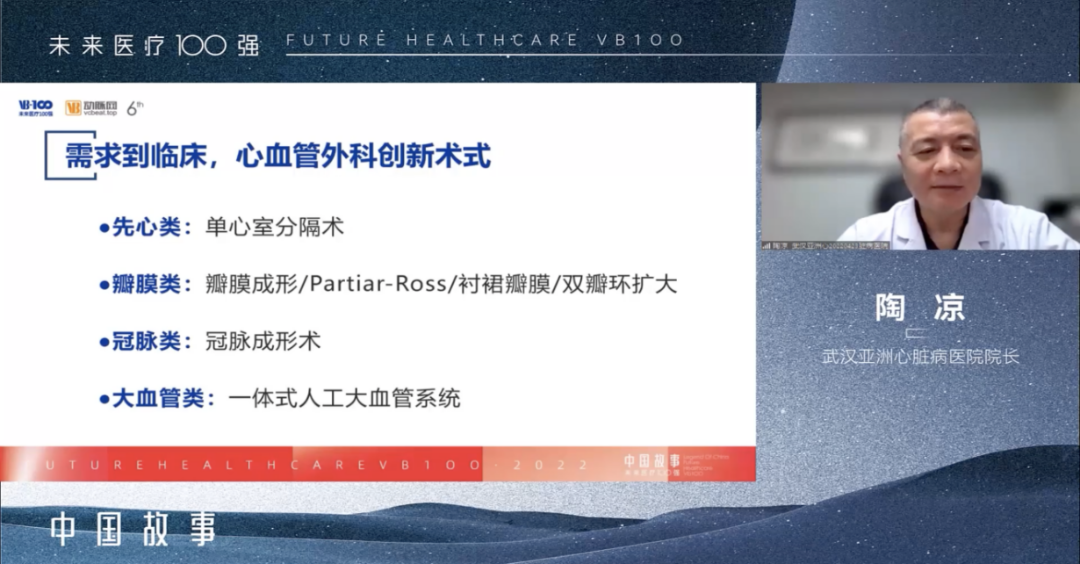
Tao Liang | President, Wuhan Asia Heart Hospital
As a representative of hospital-based experts, Mr. Tao Liang, President of Wuhan Asia Heart Hospital, stated that innovation in surgical techniques is inseparable from patient needs and advancements in modern technology. He elaborated on the practical journey from clinical needs to implementation, highlighting innovative procedures in cardiovascular surgery for congenital heart disease, valvular disorders, coronary artery disease, and major vascular conditions.
Innovation in Congenital Heart Disease Surgical Techniques: A Case Study of 3D Printing TechnologyTaking 3D printing technology as an example, preoperative simulation allows for careful study and observation, enabling feasibility assessments based on diagnostic accuracy. This approach helps reduce errors and improve surgical success rates. President Tao elaborated on four major innovations in valvular surgery through case studies. Innovation I includes pediatric aortic valve plasty, trileaflet valve replacement, and the Partial Ross technique. Innovation II involves valve skirt technology and double annulus enlargement, which provides an optimal solution for small annulus problems. Innovation III refers to minimally invasive treatment for valvular heart disease, which is gradually becoming the prevailing trend in management. Innovation IV encompasses interventional valve procedures, such as the globally pioneering transapical mitral valve clip system, a product of China’s "intelligent manufacturing."Innovations in coronary artery surgeries are represented by percutaneous coronary intervention (PCI). For large vessel surgeries, the most critical aspect is achieving effective hemostasis intraoperatively. The innovative structural design of the integrated artificial large vessel system has significantly reduced surgical difficulty and greatly increased the adoption rate of these procedures.
Finally, he stated that the driving force behind innovation in clinical surgical techniques stems from patient needs. Innovation is a mindset that breaks away from convention and leverages emerging technologies to address a range of challenges, including surgical contraindications.
How to “Win” the Breakout Battle in the New Landscape?
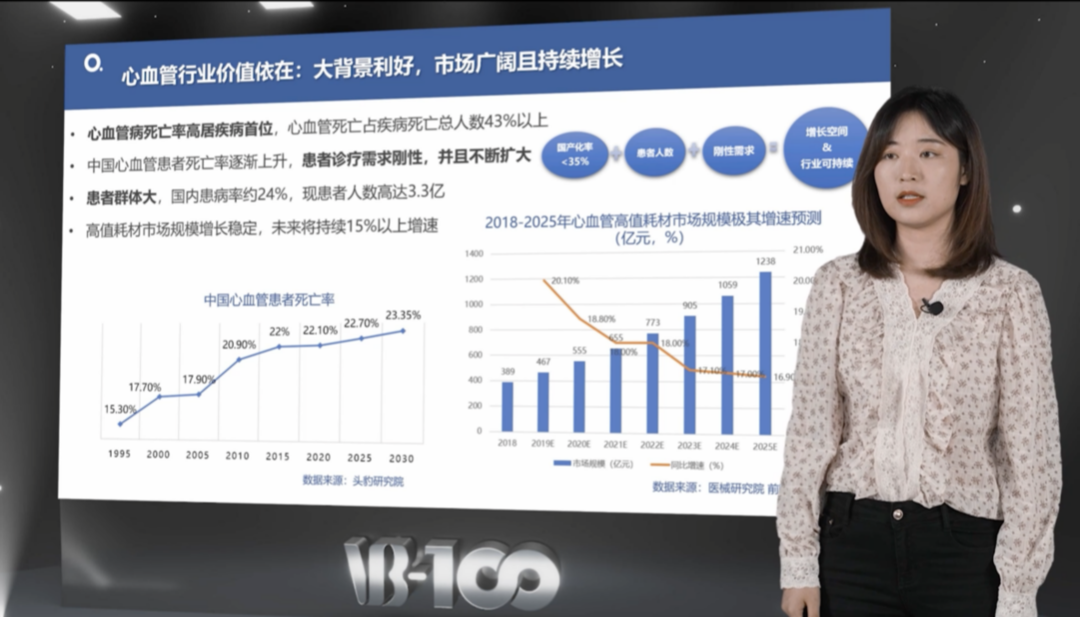
Qu Xinyu | Senior Researcher, VCBeat Institute
Ms. Qu Xinyu, a Senior Researcher at VCBeat Institute, delivered a presentation based on the "2022 Cardiovascular Research Report," analyzing the cardiovascular industry under the new landscape from three dimensions: current industry status, industry value, and future trends. Regarding the current industry status, the cardiovascular sector is gradually transitioning from a phase of explosive growth to maturity, with accelerated substitution of imported products by domestically produced alternatives, particularly in the stent and balloon industries, thereby breaking the monopoly held by imports. Discussing industry value, Ms. Qu stated that, against the broader backdrop, the overall market prospects are extensive and steadily growing, with expanding patient demand. The industry features high technical barriers and is undergoing rapid iteration; judging by the trend of continuous product optimization, it is not yet saturated, indicating that the cardiovascular industry still holds significant value. Looking ahead, two segments within the cardiovascular field deserve particular attention: first, the heart valve segment, which currently accounts for a small market share but is experiencing rapid growth, with mitral and tricuspid valves holding immense future potential, especially tricuspid valves; second, the heart failure segment, where the next decade is poised to be a "golden decade" for the development of heart failure treatments.
Finally, she discussed future industry trends, highlighting the pathways for companies under volume-based procurement (VBP)—namely, product upgrading and global expansion. Future optimizations in the valve sector will focus on several directions, including valve materials, precise deployment, and complementary access routes. In the field of heart rate management, electrophysiology intervention technologies, particularly pulsed field ablation (PFA), are showing strong growth potential and are regarded as the next disruptive ablation technology. With the increase in surgical volumes and prolonged technological accumulation, new types of assistive devices may reach a tipping point in the near future.
The Path of Chinese Innovation in Valve Interventional Therapy
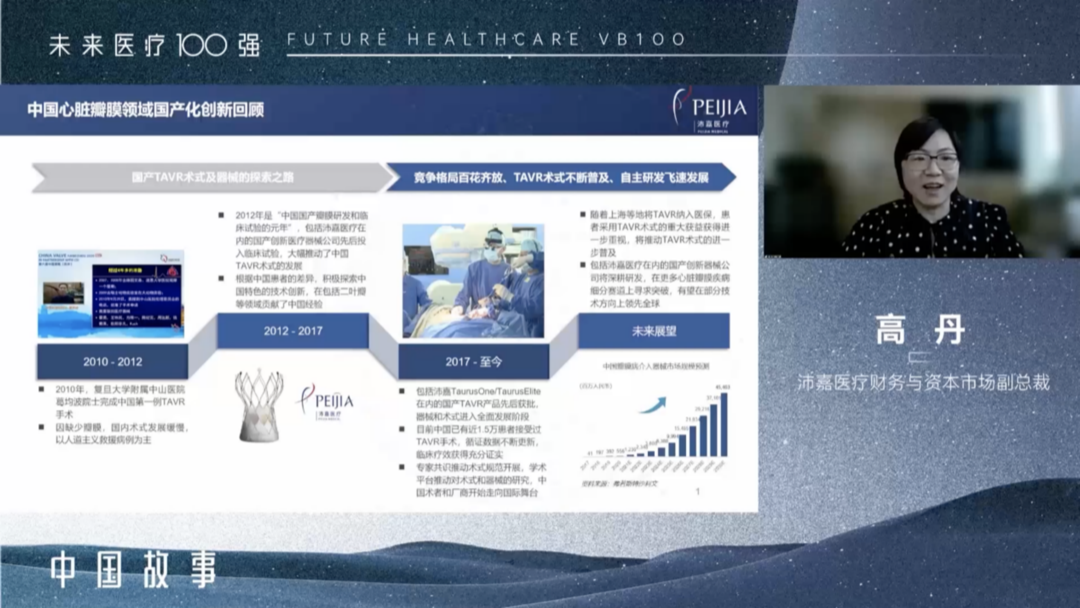
Gao Dan | Vice President of Finance and Capital Markets, Peijia Medical
Ms. Gao Dan, Vice President of Finance and Capital Markets at Peijia Medical, delivered a speech centered on Peijia Medical’s journey of innovation and practical insights in the fields of valve intervention and structural heart disease. She began by outlining the developmental exploration of domestically produced TAVR devices. TAVR represents a significant breakthrough in the treatment of valvular heart disease and stands as a prominent example of innovation in China’s high-value medical consumables sector. Looking ahead, several technological directions warrant attention: first, interventional non-implant solutions; second, more durable valve materials; third, the market for aortic regurgitation; and finally, repair and replacement therapies for the mitral and tricuspid valves.
Peijia Medical has established a comprehensive presence across the aforementioned technological domains, covering major valvular diseases and next-generation innovative technologies, with a product pipeline that boasts both depth and breadth. In the field of aortic valves, in addition to the commercially available TaurusOne® and TaurusElite®, Peijia Medical has developed Trilogy™, currently the only transfemoral regurgitation valve worldwide to receive CE certification; TaurusNXT®, a third-generation non-aldehyde cross-linked dry valve designed to enhance material durability; TaurusApex, a fourth-generation polymer valve; and TaurusWave®, an interventional non-implantable therapy system capable of treating valvular calcification either as a standalone procedure or as a preparatory step for TAVR. In the fields of mitral and tricuspid valves, Peijia Medical has also deployed multiple globally leading innovative products, including the HighLife transseptal mitral valve replacement system, the innovatively designed GeminiOne edge-to-edge repair system, and the MonarQ tricuspid valve replacement system.
From the perspective of marketing model innovation, Ms. Gao believes that the first priority is to have an excellent product that meets clinical needs and delivers significant benefits to patients, followed by selecting a market promotion strategy suitable for the product’s development stage. As an innovative medical device in its early stages, a direct sales model combined with specialized market education and clinical support is a key driver for facilitating TAVR product market entry and achieving rapid volume growth. The strong integration of product strength and marketing capability has been the driving force behind Peijia Medical’s rapid development. Finally, she stated that R&D innovation is the foundation of the company. Through a virtuous cycle of strengthening its in-house R&D capabilities and introducing cutting-edge global technologies, Peijia Medical has further narrowed the gap with world-leading technologies. Always embracing an international perspective in integrating innovative concepts, Peijia Medical is confident that its innovative products will soon take their place on the mainstream international stage.
Chinese Wisdom: Illuminating the Global Field of Structural Heart Disease
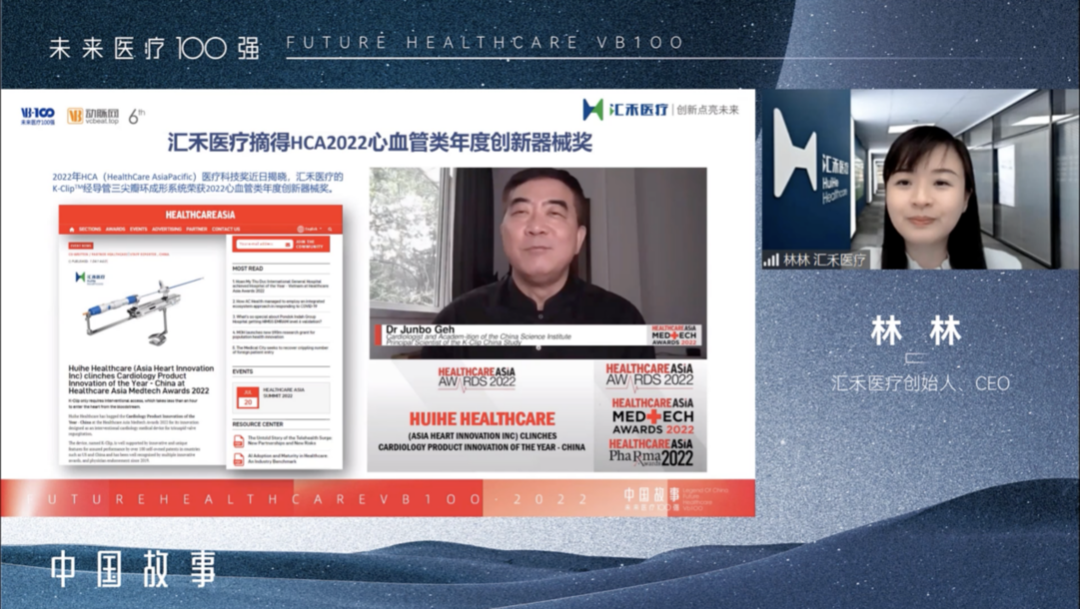
Lin Lin | Founder and CEO of Huihe Medical
Ms. Lin Lin, Founder and CEO of Huihe Medical, delivered a speech titled “Chinese Wisdom: Illuminating the Global Field of Structural Heart Disease.” She began by outlining the current status of severe tricuspid regurgitation in China. To date, there is no widely commercialized minimally invasive device available globally for treating tricuspid regurgitation. Against this backdrop, the Huihe Medical team drew inspiration from surgical techniques to replicate surgical outcomes via an interventional approach, thereby creating the K-Clip. The emergence of this innovative device marks a significant milestone in the global expansion of China’s original research and development technologies. It boasts five major advantages: no thoracotomy required, short procedure time, rapid recovery, ultrasound guidance, and ease of learning. The K-Clip has been used in over 40 procedures, and clinical studies for its global CE registration have been initiated. As the Chief Scientist for the K-Clip CE program, Professor Lin Yixian, Director of the Asian Heart Center in Hong Kong, shared insights on the first K-Clip procedure performed in Hong Kong, which proceeded smoothly with good patient recovery. Beyond Hong Kong, the K-Clip has also been featured at EuroPCR, one of the world’s premier academic conferences on cardiac intervention. Its standout presence at this event underscores the recognition of Chinese original medical devices by top international experts.
Huihe Medical’s future commercialization strategy is broadly divided into three phases. The first phase involves establishing domestic demonstration and training centers; the second focuses on penetrating deeper into the Chinese market; and the third aims to accelerate international expansion, ultimately building global influence and securing a rightful place for Chinese medical devices on the world stage.
Continuous Innovation: Building an International Brand for Cardiovascular and Cerebrovascular Implantable and Interventional Medical Devices with High-Quality Products
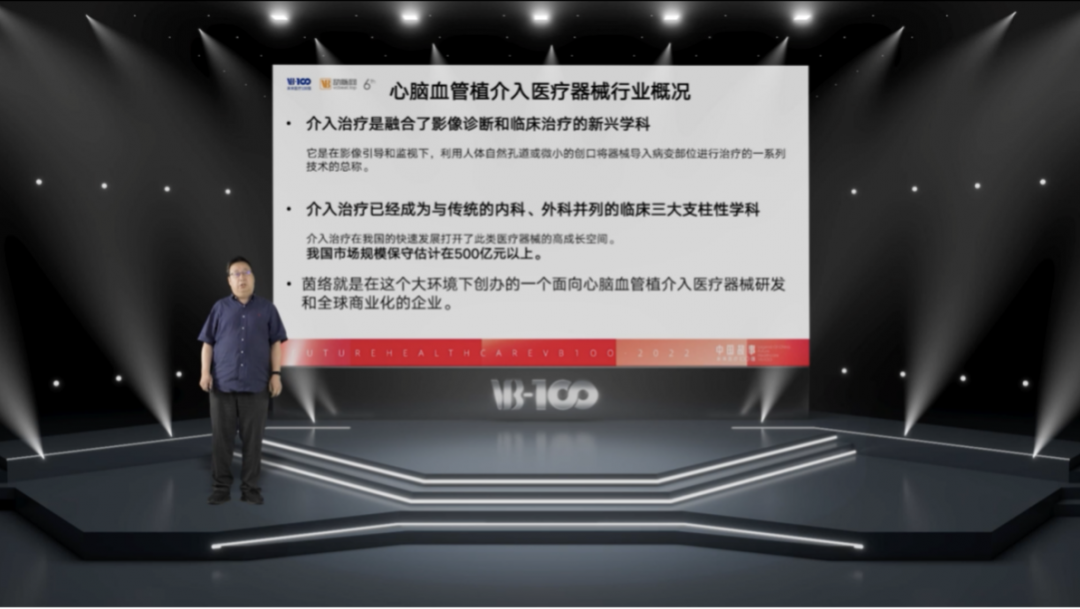
Gong Xiaoyan | YinFounder of Luoyi Medical
The founder of Inflow Medical delivered a presentation titled “Continuous Innovation: Building an International Brand for Cardiovascular Implantable and Interventional Medical Devices with High-Quality Products.” Starting from the R&D journey of Inflow Medical’s innovative medical devices in vascular surgery, he outlined the future of interventional medical devices. He pointed out that the interventional medical device sector offers substantial growth potential. Inflow Medical’s product portfolio spans diagnostic guidewires, venous braided stents, artificial hearts, and heart valves, focusing on developing cardiac products of global significance.
Over the past decade of growth, Inflow Medical has established three innovative product commercialization platforms: first, channel sharing for mutual benefit to expand brand influence; second, building a portfolio of peripheral vascular solutions centered on its innovative braided stents; and third, developing globally pioneering, high-value-added products with essential clinical demand. Mr. Gong particularly highlighted Inflow’s innovative braided stent platform, especially for lower-extremity vessels. Its products overcome mechanical safety challenges while enhancing clinical outcomes. The company has completed CE registration and entered multiple European Union countries and key Asian markets. Finally, he stated that Inflow Medical is continuously exploring new collaboration models, driving innovation through technology, achieving win-win cooperation, and working with industry peers to elevate overall industry standards and foster industrial clustering.
Coronary Macro-Diagnostics in Full Swing: How to Crack the Enigma of Micro-Diagnostics?
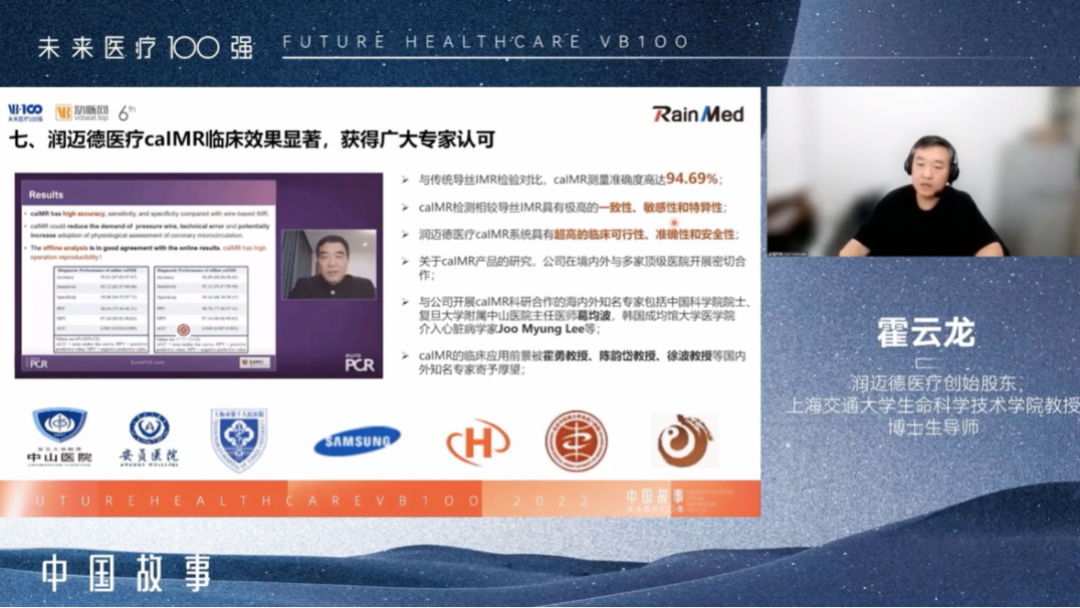
Huo Yunlong | Founding Shareholder of Rainmed Medical, Professor and Doctoral Supervisor at the School of Life Sciences and Biotechnology, Shanghai Jiao Tong University
Mr. Huo Yunlong, a founding shareholder of Rainmed Medical, Professor at the School of Life Sciences and Biotechnology of Shanghai Jiao Tong University, and doctoral supervisor, delivered a presentation titled “The Rising Tide of Macroscopic Diagnosis in Coronary Arteries: How to Solve the Puzzle of Microscopic Diagnosis?” Professor Huo systematically introduced the adverse effects of coronary artery disease on human health, pointing out that it can lead to heart failure. With China’s aging population and increasing risks associated with unhealthy diets and lifestyles, the number of cardiovascular disease cases in China is expected to continue rising in the coming years. Currently, cardiovascular disease has the highest mortality rate in China, making it the leading threat to national health; it is estimated that two out of every five deaths are caused by cardiovascular diseases. Therefore, there is an urgent clinical need to identify effective diagnostic and therapeutic approaches for cardiovascular diseases.
Based on an understanding of the clinical diagnosis and treatment needs for coronary artery disease, Rainmed Medical has developed caIMR, a globally pioneering innovation. Rainmed’s caIMR enables quantitative measurement of coronary microcirculatory blood flow without requiring pressure guidewires, vasodilators, saline injections, or additional surgical procedures. With an accuracy rate as high as 93.81%, it offers significant clinical advantages over traditional diagnostic methods such as PET and CMR. Currently, Rainmed’s caIMR has completed pre-market clinical studies and is poised to become the world first commercially available non-invasive functional diagnostic product for coronary microcirculation. Furthermore, Professor Huo pointed out that Rainmed’s caIMR, together with its already commercialized caFFR, will serve as functional diagnostic modules integrated into the FlashBot vascular interventional surgical robot, thereby enhancing the standardization of diagnosis and treatment in vascular interventions. The vascular interventional surgical robot system has been successfully developed and has smoothly entered the animal experimentation phase. By automating the entire process of vascular interventional diagnosis and treatment, the future commercialization of the FlashBot system will propel vascular interventional surgical robots into a new era.